
Past exam of the mathematics course of the University of Cambridge 2005 iii Paper 1 3 Solution Created 2026-10-03 Updated 2026-10-14
Choose a minimal nontrivial normal subgroup of itself. Every conjugate for is also a minimal normal subgroup of , since is normal in . Distinct such subgroups intersect trivially: their intersection is normal in and minimality forces either equality or trivial intersection. Moreover , so distinct ones commute.
Choose a maximal family of these conjugates whose product is direct. For any further conjugate , its intersection with is normal in and is either all of or trivial. In the latter case it commutes with all the existing factors and could be adjoined to the direct product of groups, contrary to maximality. Thus every conjugate is contained in . The product of all conjugates is consequently , which is nontrivial and normal in . Minimality of as a -normal subgroup gives .
Any normal subgroup of a factor is normal in : the other direct factors commute with it, and normalizes it. Minimality of as a -normal subgroup makes it simple. All factors are isomorphic because they are conjugate to . This proves the direct-product structure of a finite minimal normal subgroup:An abelian simple group is cyclic of prime order, so the abelian case is elementary abelian. Now let be a maximal proper subgroup of a nonabelian simple group . It is nontrivial, since has nontrivial proper cyclic subgroups. Choose a minimal normal subgroup of . Then . This normalizer cannot be , since that would make normal in . Maximality givesFor each of the two groups in this question, the allowed absence of proper nonabelian simple subgroups makes the factors of such a cyclic of prime order. Hence it suffices to examine normalizers of nontrivial elementary abelian subgroups.
In , the possible primes are two, three and five. The Sylow subgroups for the last two primes are cyclic of orders three and five. Every involution is a double transposition; for the centralizer in isthe Klein four-group fixing point five. Thus an elementary abelian -subgroup is cyclic of order two or a Klein four-group. The normalizer of a cyclic order-two subgroup equals its centralizer and has order four, so is contained in a point stabilizer of order twelve. A Klein four-group's common fixed point is intrinsic, and the full point stabilizer normalizes it; its normalizer is therefore exactly that stabilizer.
An order-three subgroup has support a triple. Its normalizer preserves the triple and the remaining pair, and is , of order six. An order-five subgroup acts regularly on all five points. Label the points by , with the subgroup acting by translations. Its normalizer in is the twenty affine maps . The translations are even, whereas multiplication by a generator of is a four-cycle and is odd. Exactly half these maps are even, so the normalizer in has order ten.
The only candidates for maximal subgroups are thus the normalizers of orders twelve, ten and six. They are all maximal: none can lie in a larger candidate, except potentially an order-six subgroup in an order-twelve . But an index-two subgroup of would contain every order-three element; there are eight such elements, plus the identity, already more than six. Hence that containment is impossible. Point stabilizers are conjugate; order-three and order-five subgroup normalizers each form one class by the Sylow theorems. Therefore the maximal subgroups of A5 form preciselyTheir numbers are five, six and ten respectively, since these proper maximal subgroups are self-normalizing in the simple group.
For , choosing independent columns gives . If is an involution, write . Field characteristic two gives , and in dimension three forces its nonzero rank to be one. Thus , with nonzero vector , nonzero linear functional and . This transvection fixes the plane and has image line . Every flag consisting of an incident line and plane occurs, giving involutions, all conjugate. Its centralizer, and hence the normalizer of its cyclic subgroup, is the flag stabilizer of order . It lies in both the line and plane stabilizers of order , so cannot be maximal.
For the elementary abelian subgroups in GL3 over F2, consider commuting transvections , . Their rank-one parts satisfyIf are independent, equality forces both sides zero; thus vanish on and are the same nonzero functional. If , they have a common image line. Consequently the two types of order-four elementary abelian subgroup areNo extra transvection can commute with all elements of : if its image were different, its functional would have to equal each of the two independent functionals occurring in . Dually, the same holds for . Thus these exhaust the elementary abelian -subgroups of rank at least two. The normalizer of is the line stabilizer and the normalizer of is the plane stabilizer, each of order . They give different conjugacy classes because their common fixed spaces have dimensions one and two. All line stabilizers are conjugate, as are all plane stabilizers.
For an order-three element, its minimal polynomial is : it has a fixed line and an invariant complementary irreducible plane. Its normalizer preserves both and is the full on that plane, of order six, since the order-three subgroup is normal in . This normalizer lies in the corresponding line and plane stabilizers, so is not maximal.
An order-seven element is irreducible. Over the finite field one has , and both cubic factors are irreducible because neither has a root in . Its minimal polynomial divides this square-free product and cannot be just , since the element is not the identity. It therefore contains a cubic factor; the three-dimensional space forces that irreducible cubic to be the whole minimal polynomial. Identify the space with and the element with multiplication by a generator of . Its centralizer consists of the seven nonzero multiplication maps. A normalizer induces an -automorphism of this field, so it sends to , or . All three possibilities occur via the field automorphisms . Therefore the normalizer of the Singer cycle has order , and all such normalizers are conjugate by the Sylow theorems.
The maximal-normalizer reduction leaves exactly the two order-twenty-four stabilizer types and the order-twenty-one type. Each is maximal because it cannot be contained in any larger remaining candidate; equal-order subgroups cannot properly contain one another and does not divide . Thus
Past exam of the mathematics course of the University of Cambridge 2005 iii Paper 1 2 Solution Created 2026-10-03 Updated 2026-10-14
First prove Simplicity of alternating groups. The -cycles generate : express an even permutation as an even number of transpositions and pair them. A pair sharing a point is a -cycle, an identical pair cancels, and a disjoint pair can be written . All -cycles are conjugate in when : a conjugator in can have its parity corrected by a transposition on two points outside the target triple, without changing its effect on that triple.
Let and choose . Some -cycle does not commute with . Indeed, commuting with every -cycle would preserve every triple setwise; intersecting all triples containing a given point forces that point to be fixed, so would make . The nonidentity group commutator is supported on at most six points. Its possible nontrivial even cycle types are a -cycle, a double transposition, a -cycle, two disjoint -cycles, or a -cycle times a transposition. Each yields a -cycle in by explicit group commutators:
For , use with a fifth point ; conjugation reverses , so the group commutator is . For , use : the group commutator is . The same calculation works for . For , use ; its conjugate is , and the product is a -cycle, reducing to the preceding case. Thus contains a -cycle, hence the whole conjugacy class of -cycles, and hence all of . ThereforeFor the exceptional automorphism, a duad is an unordered pair of six points, a syntheme is a partition into three duads, and a pentad is a set of five synthemes covering every duad once. There are fifteen synthemes. To count pentads, fix , where bars separate duads. A syntheme disjoint from it in duads is one of eight; the union of the two matchings is a six-cycle, so the stabilizer of the fixed syntheme is transitive on these eight choices. For the choice , the remaining compatible synthemes are , , and . The last shares a duad with each of the first three and cannot belong to a completion; the first three form the unique completion. Thus each of the eight choices has a unique completion through the fixed syntheme. Each completion contains four of them, so exactly two pentads contain a fixed syntheme, and there are pentads in total.
Here is the complete list, which also defines concrete labels for the induced action:Relabelling points gives a group homomorphism on these pentads. Direct substitution in the table givesThe restriction to is nontrivial, hence faithful by the simplicity just proved. Therefore the full kernel has order at most two. An order-two normal subgroup would be central, whereas has trivial centre: an element centralizing every transposition fixes every unordered pair and consequently every point. The kernel is trivial, and equal orders make an automorphism. It preserves , because that is the unique index-two subgroup of : any nontrivial group homomorphism to sends every conjugate transposition to the nonidentity element, and is therefore the sign map. Its restriction is the pentad construction of the exceptional alternating-group automorphism. It maps a -cycle to two disjoint -cycles, while conjugation in preserves cycle type. Hence this automorphism of is not induced by any element of .
For the other degrees, recover the points from -cycles. An element of order three has type . Its centralizer in has order . That centralizer contains an odd permutation: either swap two fixed points, or, when , swap two three-cycles by three transpositions. ThusFor , only is possible. For , the value is strictly largest. For equality first occurs at , and the ratio increases strictly with . For , already at one has : it holds at , and the inductive ratio is . Increasing again increases the ratio. Consequently every automorphism preserves the set of -cycles when .
Each cyclic subgroup generated by a -cycle corresponds to its three-point support. Two distinct such subgroups commute exactly when the supports are disjoint. If they meet in one point, products of their nonidentity generators have order five. If they meet in two points, those products have order two or three. These intrinsic tests recover adjacency in the Johnson graph , so the automorphism acts on its vertices.
We can reconstruct the underlying points without an additional group-theoretic bound. The maximal cliques of a Johnson graph in are the triples containing a fixed pair, and the four triples contained in a fixed four-set. To verify the classification, take adjacent triples and with . Any common adjacent triple either contains or lies in . A triple of the first kind outside that four-set is not adjacent to a triple of the second kind omitting a point of , so a clique cannot mix the two alternatives. Extending a clique therefore gives exactly one of the two listed families.
For , , their sizes distinguish the pair-containing cliques. Their intersections reconstruct the pair graph : two such cliques intersect precisely when their defining pairs meet in one point. In this graph the maximal cliques are stars of pairs through a point and triangles of three pairs within a triple. These sizes are different for , so its automorphisms permute the stars and hence the points. Every pair is the intersection of its two point stars, and every triple is determined by its three pairs. Thus the original graph action comes from some .
Undo conjugation by . The remaining group automorphism fixes each cyclic -subgroup, so it fixes or inverts each generator. For adjacent supports, inverting exactly one generator changes the order of their product between two and three; inverting both preserves that order. Hence the two inversion choices must agree. The triple-support graph is connected, since one can replace differing points one at a time, so the choice is uniform. Inverting every -cycle is impossible: take , , whose product is the -cycle . Then , whereas the group homomorphism property would give ; these are unequal because do not commute. Therefore fixes every -cycle and is the identity. Conversely, conjugation by acts faithfully on , since centralizing all -cycles fixes every triple and every point. The automorphisms of alternating groups from triple supports are exactly
Past exam of the mathematics course of the University of Cambridge 2005 iii Paper 1 1 Solution Created 2026-10-03 Updated 2026-10-14
Work with finite groups, as required for these Sylow subgroup counts. Let act by conjugation on the set of Sylow -subgroups. The stabilizer of is . Since is the normal Sylow subgroup of its own normalizer, every -subgroup of that normalizer lies in . Consequently the stabilizer is exactly , and the orbit-stabilizer theorem gives orbit size . The orbit of has size one. Every other orbit size is a power of at least , hence is divisible by . Adding orbit sizes proves the strengthened Sylow congruence from intersections:Now suppose is simple of order . If , its Sylow -subgroup is normal because its number divides three and is one modulo five. If , an involution in the regular permutation action of swaps fifteen pairs, so its sign is negative. The sign of a permutation would give a nontrivial group homomorphism with a proper nontrivial normal kernel. Both cases contradict simplicity. Thus .
The Sylow theorems make a divisor of fifteen. It is not one, since a nontrivial Sylow subgroup would then be normal. It is not three, since the conjugation action on three Sylow subgroups would give a faithful group homomorphism , impossible by order. If , take a Sylow subgroup itself: its normalizer has subgroup index five. If , not all distinct Sylow subgroups can intersect in subgroup index at least four, since that would give . Choose with . Put , of order . It has subgroup index two in both , so is normal in each. Hence contains both distinct Sylow subgroups and has order greater than . It is proper: otherwise would be a nontrivial proper normal subgroup of . Its order is therefore or . The latter would give an index-three subgroup and again an impossible faithful action on three cosets. Thus .
In either case we have the requested subgroup of order or with index-five normalizer. The action on the five cosets of that normalizer is nontrivial and faithful by simplicity. Its image lies in , since composing with sign cannot give a nontrivial map from this simple group of order greater than two to . Thus divides , forcing and equality of orders. This proves the simple groups with order a power of two times fifteen conclusion:For , choose the first column: there are nonzero choices. For each, determinant one is a nonzero linear equation in the second column and has five solutions. Therefore . A central matrix commuting with has zero lower-left entry and equal diagonal entries; commuting also with makes the upper-right entry zero. It is scalar. Determinant one then givesTo establish the projective special linear group over the field with five elements isomorphism without assuming its simplicity, compute its classes. For determinant-one matrices, the characteristic polynomial is with trace . The possibilities over exhaust the group:For trace zero the eigenvalues are , so the determinant-one centralizer is the split diagonal torus of order four. For traces , the discriminant is the nonsquare : the centralizer is the norm-one subgroup of , of order six. In both semisimple cases the determinant map on the full linear centralizer is surjective onto ; consequently each trace type is a single special-linear class. For the noncentral traces , a Jordan block has full linear centralizer with determinant . The determinant image consists of the two squares, so each general-linear class splits into two special-linear classes; the determinant-one centralizer has order . These sizes sum to .
Quotienting by identifies a matrix with its negative. The trace-zero class gives one projective class of size fifteen; the two traces give one class of size twenty; the four noncentral unipotent classes give two classes of size twelve. Their respective projective orders are , by the characteristic polynomials. A normal subgroup is a union of classes containing the identity. The nontrivial proper possible union sizes are , none of which divides . Thus the quotient is simple. Applying the order- result above givesFinally, if over an odd-characteristic field, its minimal polynomial divides the square-free polynomial , so it is diagonalizable with eigenvalues . In dimension two, determinant one requires both eigenvalues equal. Hence or . This proves the unique involution in SL2 over an odd field assertion: the only element of order two in is . If an index-two subgroup existed, it would be normal and have order sixty. By Cauchy theorem it would contain an involution, hence contain . Then would be a normal subgroup of order thirty in the simple quotient , a contradiction. Thus has no index-two subgroup.
Past exam of the mathematics course of the University of Cambridge 2004 iii Paper 9 6 Solution Created 2026-10-03 Updated 2026-10-14
We first derive the exterior area theorem for univalent functions directly from Green's theorem, then obtain the coefficient bound needed for the Koebe quarter theorem.
Suppose is univalent on and has a Laurent seriesFor , the image of , , is a regular simple closed curve. By the Jordan curve theorem the curve has one bounded and one unbounded complementary component. The image of lies in the unbounded component, since it is connected, avoids the curve by injectivity and contains points near infinity. It fills that component: any finite boundary limit of the image has preimages bounded by , and a convergent preimage subsequence must land on or else give an interior image point. Thus no boundary of the image lies inside that complementary component. The curve is positively oriented about its bounded interior, since the exterior is on the right of and a holomorphic map with nonzero derivative preserves orientation. Green's formula gives its enclosed area asFor completeness, the positive Fourier mode is and the negative modes are . On multiplying by the conjugate series and integrating, all unequal-frequency products integrate to zero by Fourier orthogonality. The equal-frequency products give and , respectively; the constant term gives zero. The Laurent series and its differentiated series converge uniformly on the circle, since , so these operations are justified. Nonnegativity of yields . Letting , or first doing so for every finite partial sum, givesNo regularity of the map on the unit circle has been assumed.
Now let be a normalized univalent function. Its only zero is at zero, so , extended there by the value one, is holomorphic and nowhere zero. On the simply connected disc it has a holomorphic square root with value one at zero. Its odd square-root transform isThis is an odd function which is holomorphic and normalized. It is also univalent: gives and hence . If , oddness gives , so , forcing . Thus is univalent on the exterior disc, with expansionApplying the area bound to its first negative coefficient proves the second coefficient bound for normalized univalent functions, .
Let be any point omitted by . It is nonzero. Postcomposition with a Möbius map gives another normalized univalent functionwhose denominator does not vanish. Applying the second coefficient bound both to and to givesEvery omitted point therefore has modulus at least , provingThis establishes the Koebe quarter theorem from the allowed area formula.
Sharpness is witnessed by the Koebe function . It has the required value and derivative at zero. The equality simplifies to , and makes it injective. Moreover,Thus is omitted, so no larger universal radius is possible. In fact shows its image is the plane slit along .
Without univalence take a real andIt is entire, with and , but it omits , a point of modulus less than , since the exponential never vanishes. It is genuinely not univalent on the disc: the distinct points lie there and both give exponential value . Even its derivative never vanishes, illustrating why local conformality alone does not give the quarter-disc inclusion.
Past exam of the mathematics course of the University of Cambridge 2004 iii Paper 9 5 Solution Created 2026-10-03 Updated 2026-10-14
An explicit disk map of a slit half disk makes the two boundary approaches visible without assuming an extension theorem for the boundary. We construct the map as a succession of bijections and then determine its limits.
First maps the upper half-disc of radius two bijectively onto slit along . Indeed, its inverse chooses the square root whose argument lies in . The removed segment on the imaginary axis becomes , so the image of is preciselyThe Möbius transformation maps the radius-four disc bijectively onto the unit disc, taking to zero and to one. This follows also by writing it as , an automorphism of the unit disk after the scaling. It takes the removed real interval to , so the image is the unit disc with this radial slit removed. Choosing defines a single-valued square root and maps that slit disc bijectively ontoAll these maps have nonzero derivatives on their respective domains, since their potentially problematic zero or branch point is on the removed slit.
Next the Joukowski map is a conformal bijection from onto the lower half-plane. For ,If , then , and rules out the second factor vanishing. To prove surjectivity, take in the lower half-plane and consider . Neither root lies on the unit circle, where is real. Their product is one, so exactly one has modulus less than one. For that root the displayed imaginary-part identity forces . Thus it lies in . Also cannot vanish there. Finally maps the lower half-plane bijectively onto the unit disc: the inequality is exactly , and its inverse is . Consequentlyis a conformal bijection of onto the disc.
At the slit point the continuous rational expression for tends to . In a sufficiently small neighborhood of , points of have nonzero real part. Since and the real-coefficient Möbius map preserves the sign of the imaginary part, right-side approach gives , while left-side approach gives . HenceThe two limits of are thereforeThey have modulus one and are distinct, since and the Möbius map is injective on the extended real line. The two-sided cluster set at an interior slit point is a geometric consequence of opening the slit into two boundary intervals.
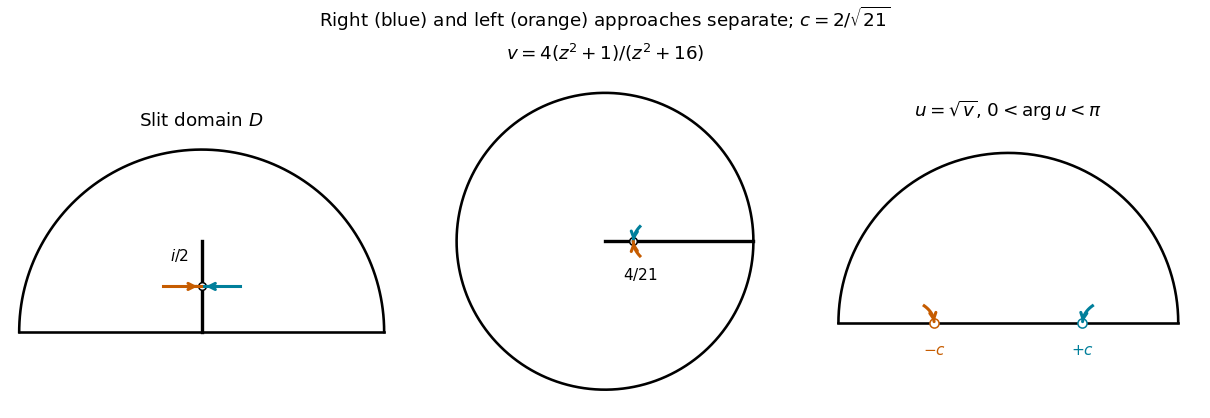
Two sides of the slit at i/2 become distinct boundary points after squaring, a disk automorphism and a square root
. Details. 
For the given map , the composition is an automorphism of the unit disk. To see its precise boundary behavior, let and compose with the inverse of . This gives a disc automorphism fixing zero. Applying Schwarz lemma to it and its inverse shows it is a rotation. ThusIts denominator never vanishes on the closed disc, and its inverse has the same property; it therefore extends to a continuous bijection of the unit circle. Put and . These are distinct points of that circle, independent of the approaching sequence.
For any sequence approaching , every infinite right-side subsequence has image tending to , and every infinite left-side subsequence has image tending to . At least one side occurs infinitely often. Conversely, any convergent image subsequence has a further subsequence confined to one side, so its limit must be the corresponding one of these two points. The cluster set is therefore exactly , or , according to which sides occur infinitely often. Both sides really occur in the domain, for example along with positive .
Past exam of the mathematics course of the University of Cambridge 2004 iii Paper 9 3 Solution Created 2026-10-03 Updated 2026-10-14
For a plane domain, the following are equivalent descriptions of a simply connected domain: every based loop contracts in the domain with its basepoint fixed; any two paths with the same endpoints are homotopic while those endpoints stay fixed; its complement in the Riemann sphere is connected; every holomorphic function has a single-valued primitive; and every nowhere-zero holomorphic function has a holomorphic logarithm. The complement must be taken in the extended plane, including infinity. An equivalent winding number formulation is that every closed curve has index zero about every point outside the domain.
Here is a direct equivalence proof for the first two topological formulations. If all paths with given endpoints are homotopic relative to those endpoints, apply this to a loop based at and the constant path at , obtaining a contraction. Conversely, let join to . The loop contracts with basepoint fixed. Concatenating this contraction with produces a homotopy from to , relative to . The middle retracing excursion contracts by shortening its traversal in both directions, giving a homotopy from that first path to . Hence and are homotopic relative to their endpoints. Planar domains are path-connected, so no extra path-component condition is needed.
The analytic descriptions follow from path independence of the holomorphic integral. Local primitives exist on discs by integrating power series; a homotopy can be subdivided into pieces lying in such discs, and local path integrals cancel along its common edges. Thus integrals over homotopic paths agree, giving a global primitive. Applied to for a nowhere-zero function, a primitive makes constant and hence supplies a holomorphic logarithm. These observations are also the tools used in the mapping proof below.
The Riemann mapping theorem states that every nonempty simply connected proper domain admits a conformal bijection onto the unit disc. Given , there is exactly one such map with and . The exclusion of the whole plane is necessary: an entire map into the disc would be constant by Liouville's theorem.
An extremal proof has the following concrete steps. First construct an injective bounded holomorphic map. Choose and a holomorphic square root of . It is injective, since equality of its values implies equality of their squares. Its image is disjoint from its negative: would imply and then , impossible. If , choose with ; the disc is omitted. Therefore is injective and bounded. Scaling it and applying an automorphism of the unit disk gives a map into the disc taking to zero; a rotation makes its derivative positive.
Let consist of all injective maps with this normalization. It is nonempty. The derivative at is bounded above by the Cauchy integral formula on a small disc compactly contained in . Choose with derivatives tending to their positive supremum . Boundedness, the Cauchy estimates and a diagonal Arzelà-Ascoli theorem argument give a subsequence converging locally uniformly to ; this is the bounded-family form of the Montel theorem. Then , , and the maximum modulus principle puts its image in the open disc. The limit is injective: if distinct had , apply Hurwitz's theorem near to , which has no zero there; the limit would vanish identically, contradicting .
Finally suppose is omitted by . It is nonzero since . Let and choose a holomorphic square root of . It is injective and takes values in the disc. Put , so , and normalize by a rotation. The new map's derivative magnitude at isThis square-root improvement of a normalized conformal map contradicts extremality. Thus is onto. Two normalized bijections differ by a disc automorphism fixing zero; Schwarz lemma applied to it and its inverse makes it a rotation, and positivity of the normalized derivatives forces that rotation to be the identity. This completes the requested proof outline.
Past exam of the mathematics course of the University of Cambridge 2004 iii Paper 9 2 Solution Created 2026-10-03 Updated 2026-10-14
Use the extended-value convention for a normal family, which is essential here: every sequence in the holomorphic family has a subsequence converging uniformly on compact subsets either to a finite holomorphic function or to infinity. Convergence to infinity means for every compact . Equivalently one uses local uniform convergence in the chordal metric. For holomorphic functions a nonconstant meromorphic limit cannot acquire a pole: near a supposed pole, the reciprocals of sufficiently large-index functions are holomorphic and nowhere zero, and converge to a holomorphic function with a zero. Hurwitz's theorem would force that reciprocal limit to vanish identically, giving the constant infinite limit instead.
Restriction proves that global normality implies normality near each point. For the converse, choose a countable cover by connected discs on which the family is normal, with smaller discs covering and having compact closure inside the corresponding . Such a cover exists from the countable rational-disc basis and local normality. Starting with any sequence, extract a subsequence converging on , then a further subsequence converging on , and so on. The diagonal sequence converges on each . On an overlap the limits agree; a finite holomorphic limit and infinity cannot both occur there. The overlap graph of this cover is connected, since otherwise its components would partition the connected domain into disjoint open subsets. Therefore all local limits are of the same type and patch to one holomorphic function or to infinity throughout . Every compact set has a finite cover by the smaller discs, so convergence on their compact closures gives uniform convergence on that compact set. This proves that normality is a local property.
For the counterexample take the unit disc and the family . Since , tends uniformly to infinity. Any sequence from this family either has a constant subsequence or has indices tending to infinity, so the family is normal. Its derivatives are . No subsequence of these derivatives can have a finite locally uniform limit, because their values at any fixed nonzero point grow without bound; nor can they tend locally uniformly to infinity, since every derivative vanishes at zero. Thus a holomorphic normal family need not have a normal derivative family.
Now impose the point bound at . For any sequence of derivatives choose corresponding functions from the original family. Normality supplies a locally uniformly convergent subsequence, and the point bound excludes the infinite limit. Let its finite holomorphic limit be . The Cauchy integral formula gives convergence of derivatives uniformly on compact subsets. Explicitly, for compact choose so its closed -neighborhood lies in a compact ; thenEvery sequence of derivatives therefore has a locally uniform subsequential limit. This pointwise anchoring of a holomorphic normal family proves the derivative family is normal under the stated bound.
Past exam of the mathematics course of the University of Cambridge 2004 iii Paper 9 1 Solution Created 2026-10-03 Updated 2026-10-14
With determinant-one normalization, the necessary and sufficient condition for sphere rotations as special-unitary Möbius transformations isEquivalently, the matrix belongs to the special unitary group . The two determinant-one representatives and induce the same Möbius transformation, and both satisfy this condition.
Use north-pole stereographic projection in the direction from the plane to the sphere:Its chord-distance identity is , where is the chordal metric. Direct subtraction, using , givesThis is first calculated away from poles and then extended continuously to the Riemann sphere. A sphere rotation preserves chord distances, so for distinct finite nonpole pointsUsing three distinct points shows all these positive ratios equal one. Hence everywhere. Comparing its coefficients givesThus is a unitary matrix. Comparing with proves the boxed relations.
Conversely, these relations give , so the induced sphere map preserves all Euclidean chord distances. Such a bijection of the unit sphere is the restriction of an orthogonal matrix: let ; preservation of distances makes these an orthonormal basis, and forces . Finally the Möbius transformation is holomorphic with positive real Jacobian at every ordinary coordinate point. Conjugating by stereographic projection preserves orientation, so this orthogonal matrix has determinant . It is therefore a genuine rotation in three dimensions, proving sufficiency rather than just spherical isometry.
For the circle assertion, a nondegenerate generalized circle has an equationFor this is an ordinary circle, and for it is a line with infinity included. On the sphere write coordinates , with and . Multiplication by gives the planeIf and , then . Thus the plane intersects the unit sphere in a proper circle. It contains the north pole exactly when , accounting for the point at infinity on a line.
Conversely, a circle on the sphere is the intersection with a plane , . Set , and . The preceding equation is recovered and has . Its inverse stereographic image is an ordinary circle or a line with infinity attached. This proves both directions of the circle-plane relation under stereographic projection.
Past exam of the mathematics course of the University of Cambridge 2004 iii Paper 80 5 Solution Created 2026-10-03 Updated 2026-10-14
We prove the required duality pairing explicitly. This also identifies the word “canonical” in the final conclusion: the isomorphism will be the intrinsic residue trace on a smooth projective curve, not a choice of basis for a one-dimensional vector space.
Begin on the projective line. With , the equation identifies its sheaf of Kähler differentials over a field with . The Laurent description in Question 3 pairs with by multiplication and extraction of the coefficient of . For the respective bases areand their pairing matrix has entriesThis is an invertible antidiagonal matrix. For both spaces vanish. The coefficient extraction is well defined on the Čech cohomology quotient: a differential regular on the first chart has no term, and one regular on the second chart is a sum of terms with , also with no such term.
To extend this calculation to every vector bundle on the projective line, we give the splitting argument. Every line bundle on is : choose a nonzero rational section to obtain a divisor, and use the divisors of to move each finite point to infinity. The denominator-clearing argument in Question 4 makes both and globally generated for large . The first assertion ensures for some integer ; the second gives an embedding , so this is impossible for . Choose the largest such integer .
A nonzero section gives . Saturating its image gives a line subbundle; if it were strictly larger, it would be for a positive integer , recording the section's zeros, contrary to maximality. Thus the quotient is a vector bundle. Induct on rank and write . Twist the sequence by . Since and , exactness forces , whence every . Local lifts of a quotient summand differ on overlaps by a Čech cocycle in . But by Question 3. Adjusting the lifts by a coboundary makes them glue, splitting the sequence. This proves the Birkhoff–Grothendieck theorem here. The direct-sum Laurent calculation consequently proves the perfect pairingAlthough a splitting proves nondegeneracy, the pairing itself uses only evaluation followed by the coefficient trace on , so does not depend on that splitting. This is residue duality on the projective line.
Now choose a rational function on with . Such a choice is available over the perfect field : a local parameter at a smooth point has nonzero differential in the rank-one sheaf of Kähler differentials over a field. Since spans the differentials of , the extension has zero relative differentials and is separable. Question 1 gives a finite generically separable morphism . It is flat: locally its finite module over a discrete valuation ring is torsion-free, hence free. For the invertible sheaf , its pushforward is therefore a vector bundle.
We next prove the differential-valued dual identification needed to transfer the pairing. At a point of the base, complete the local rings. Each branch is of the formIf is the order of , formal division writes with basis and a monic degree- equation . In particular this argument does not assume tame ramification or the special equation . For a polynomial the elementary interpolation identity isTo see it, pass to a field containing the distinct roots of . Lagrange interpolation writes the remainder as . Comparison of its leading coefficient gives the identity, and descent returns it to the original field. The top-coefficient pairing on is perfect: in the power basis its matrix has zero entries for and ones for , so its determinant is a unit. It follows that the trace-dual fractional module is exactly .
Formal division of gives with a unit. Differentiate in and evaluate at . This shows that and differ by a unit. Since , we obtainThis is the trace-dual module of a finite curve map identity. Its map sends a differential to the functional , where the trace of is . For several branches take the direct sum of these maps. Completion is faithfully flat, so their being isomorphisms proves the corresponding isomorphism of the original local modules. A local trivialization of now gives, compatibly on overlaps,
The inverse images of the two standard affine charts and their intersection are affine. As in Question 4, the Čech cochain complexes identify with . Global sections in the last display identify the other factor with . Thus the perfect pairing already calculated on the projective line givesIn particular the stated vanishing of global sections forces . The proof has established the relevant case of Serre duality, rather than invoked it as the requested argument.
To identify its intrinsic trace, use the rational principal-parts resolution on an algebraic curve. The constant sheaf of rational sections and the sheaf of their finite-support principal parts are both flasque sheaves. Consequently a class of is represented by finitely many rational principal parts , modulo the family coming from one global rational section. For a global section of , evaluation gives the pairingThe algebraic residue of a rational differential is its coefficient, independent of the local parameter. Adding a regular representative changes no residue. The local trace calculation above also givesOne can check this directly in the monogenic description: expand a differential in the basis , use the displayed interpolation formula for its trace, and extract the coefficient of . Formal division of makes that coefficient exactly the coefficient of ; for a product of branch fields the trace is the sum. Thus the identity remains valid in positive characteristic, including wild ramification. On , partial fractions show that a rational differential's residues at finite points sum to the negative of its residue at infinity. Tracing to therefore proves that the sum of residues of every global rational differential on is zero. Adding a global rational section to consequently changes the pairing by zero. This defines the same pairing as the finite-pushforward calculation, intrinsically, without a chosen map to .
Finally take . Its differential-valued dual is , and Question 4 proved . Perfectness identifies with the dual of this space. Evaluation at the distinguished constant section givesThis residue trace on a smooth projective curve uses neither a basis choice nor an auxiliary finite map. It is the canonical isomorphism.
Past exam of the mathematics course of the University of Cambridge 2004 iii Paper 80 4 Solution Created 2026-10-03 Updated 2026-10-14
The printed vanishing claim needs the restriction . On with and , Question 3 gives for every . Thus no bound on the degree of a divisor can force vanishing in degree zero. We prove finiteness in every degree and the corrected vanishing in every positive degree, uniformly over all divisors on an algebraic curve of large degree.
First take a finite morphism as in Question 3 and put . The direct image sheaf is coherent: on an affine chart its module is finitely generated over a finite algebra and hence over the chart's coordinate ring. The two affine-cover Čech cochain complexes for on and for on are identical. Therefore
We need an elementary presentation of any coherent sheaf on the projective line. Choose finitely many generators on each of its two standard affine charts. A generator on the first chart restricts to an element of the second chart's module localized at . Multiplication by a sufficiently large power of brings that element into the second chart's module. Since the transition of is , this makes the original generator extend to a global section of . A generator on the second chart similarly extends after clearing its denominator at . Use one common exponent for all the finitely many generators. The extended sections generate on both charts. Untwisting gives a surjectionwith coherent kernel . The long exact sequence in sheaf cohomology and Question 3 show that is a quotient of the finite-dimensional , since . Apply the same presentation argument to to obtain finiteness of . Then the segment proves finiteness of . Higher groups vanish by Question 3. Hence every is finite-dimensional.
Next establish a useful degree estimate without using the duality requested later. A global regular function on is constant: a nonconstant one would give a finite morphism by Question 1. Such a morphism is surjective, because its closed image contains the generic point, but a regular function misses , a contradiction. Thus . Write , the genus of a smooth projective curve. For any divisor on an algebraic curve and point , the local discrete valuation ring givesThe last term is a length-one skyscraper sheaf. Additivity of the Euler characteristic of a coherent sheaf and repeated addition or subtraction of points giveThe inequality follows because is nonnegative, and is sufficient for the following argument.
Fix . For this estimate gives at least two independent sections of , one of them the constant section. A nonconstant section is a rational function on an algebraic variety whose poles are confined to . It must have a pole there, since a globally regular function is constant. Its extension is finite, and its inverse image of is exactly . Consequently is affine.
Let be the torsion subsheaf of and let . The support of is finite; such a coherent sheaf is a finite direct sum of sheaves supported at points and has zero higher sheaf cohomology. The torsion-free sheaf is locally free: a finitely generated torsion-free module over a discrete valuation ring is free. Tensoring by any invertible sheaf is exact, so
The inclusions have point-supported quotients. Their long exact sequences in sheaf cohomology therefore give surjections on . Moreovera section regular away from has some finite pole order at . Compute this direct limit on a finite affine cover of . All its intersections with are affine by Question 2, and localization commutes with filtered direct limits. The Čech cochain complex consequently givesThe maps from to these groups are surjective. Choose a finite basis of this starting vector space. Each basis vector becomes zero at some stage in the direct limit; one common stage kills the entire basis. Thus there exists with .
Now let be any divisor on an algebraic curve with . The estimate above gives . A nonzero section identifies with an effective divisor up to linear equivalence of divisors. Hence . Adding gives a point-supported quotient of , so its first sheaf cohomology is a quotient of . We have proved uniform high-degree vanishing on a smooth projective curve:This bound concerns all high-degree divisors, not only multiples of a previously chosen divisor.
Past exam of the mathematics course of the University of Cambridge 2004 iii Paper 80 3 Solution Created 2026-10-03 Updated 2026-10-14
Choose a nonconstant element of the function field . By Question 1 it gives a finite morphism . The inverse images and are affine, because the inverse image of an affine under a finite morphism is the spectrum of a finite algebra over its coordinate ring. They cover . This proves the two-affine cover of a smooth projective curve assertion.
Their intersection is affine by Question 2. Thus the Čech cochain complex for any coherent sheaf has just two nonzero terms,It follows that
On the projective line, put on the first chart. The twisting sheaf on projective space has frames and , with on the intersection; these are frame symbols also for negative . In the frame the differential of the Čech cochain complex isA global section is therefore a Laurent polynomial in both and . Its monomials have exponents . For the sections have basis ; for there are none. The first sheaf cohomology isIts basis consists of the monomials with . These are precisely the exponents missed by the two chart spaces. Thus for every integer ,Both groups vanish at ; all higher groups vanish for every . This is also an explicit calculation of the Čech cohomology of twists on the projective line.
Past exam of the mathematics course of the University of Cambridge 2004 iii Paper 80 2 Solution Created 2026-10-03 Updated 2026-10-14
Write the affine variety as . Its coordinate ring is Noetherian, and a coherent sheaf is for a finitely generated -module . We first justify the acyclic resolution used to compute its sheaf cohomology.
If is an injective module, then is a flasque sheaf. Indeed every open in this Noetherian scheme has the form for a finitely generated ideal. Clearing denominators givesHere a homomorphism gives, on a principal open with , the fraction ; the fractions agree on overlaps. Conversely choose fractions for a section on a finite principal-open cover. A common power clears their denominators and the finitely many compatibility relations. Multiplication by a further power of kills any elements supported on , producing a well-defined map on some . Changing that power accounts for the direct limit. This is the sheafification of an injective module is flasque construction. Since is injective, each map extends to . Thus every section on every open extends to . Extending globally and restricting again also proves surjectivity for restrictions between arbitrary opens.
Choose an injective module resolution . Localization is exact, so sheafifying gives a flasque resolution of . Its global-section complex is exactly , since . This complex is exact in positive degrees, and a flasque resolution computes sheaf cohomology. ConsequentlyThe argument actually proves vanishing of quasi-coherent cohomology on an affine scheme, without finite generation of .
For the intersection assertion, varieties are taken to be separated, as usual. The diagonal morphism is a closed immersion. Its inverse image over identifies with a closed subvariety of the affine variety . A closed subvariety of an affine variety is affine: its coordinate ring is the ambient coordinate ring modulo its defining ideal. Thus is affine. Repeated application gives affine finite intersections. Without separatedness this statement need not hold.
Choose a finite affine open cover of the projective variety . For ordered indices write . The answer is the cohomology of the Čech cochain complexIn particular and, in positive degree,The chart modules , together with their restriction and gluing maps, supply the modules on overlaps by localization. The gluing maps are essential; abstract chart modules alone do not specify a sheaf.
For completeness, take a flasque resolution and its double complex of Čech cochain complexes on this cover. In the resolution direction, its cohomology is , which vanishes for by the affine result. In the cover direction, the augmented Čech cochain complex of a flasque sheaf is exact: sections can be extended from overlaps, successively adjusting a cocycle to eliminate one cover member at a time. Equivalently the augmented sheaf complex is stalkwise contracted by inserting a cover index containing the point. Thus computing the total cohomology in the two directions identifies Čech cohomology with sheaf cohomology, proving the displayed description.
Past exam of the mathematics course of the University of Cambridge 2004 iii Paper 80 1 Solution Created 2026-10-03 Updated 2026-10-14
At a point of the smooth algebraic curve , the local ring is a discrete valuation ring. Embed the projective variety in . A rational map of algebraic varieties to has homogeneous coordinates in the function field , not all zero. Let be the local valuation, choose a uniformizer , and set . The coordinates are regular at , and at least one is a unit. On a sufficiently small open subset containing , all these functions are regular and that coordinate stays nonzero. Their ratios therefore define a morphism of algebraic varieties into the corresponding affine chart of . Every homogeneous equation defining vanishes on the original dense open, hence vanishes identically on this neighborhood. The local extension consequently lands in .
Two such extensions agree wherever the original rational map of algebraic varieties is defined. Their equalizer is closed, because is a separated variety, and contains a dense open. Thus they agree throughout their overlap and glue. The rational map has a unique extension to a morphism on all of . Projectivity is needed for the target; the source need not be projective.
For the function field correspondence, let be a finitely generated field extension of transcendence degree one. Choose a transcendence basis consisting of one element . The extension is finite: finitely many algebraic generators each have finite degree. Take the integral closures of and in . The finiteness assumption allowed in the paper makes both finite modules over their original coordinate rings. Integral closure commutes with localization, so these two rings agree over and glue to the finite normalization model of a one-variable function field . This is a finite morphism, hence projective, and its function field is . Its one-dimensional normal local rings are discrete valuation rings, so it is regular. Since the algebraically closed field is perfect, regularity here implies smoothness. Thus is a smooth projective curve.
Conversely the function field of a smooth projective curve is finitely generated over and has transcendence degree one. Two such curves with isomorphic function fields have mutually inverse birational maps. The extension argument just proved makes both maps morphisms; their composites equal the identity on a dense open, and hence everywhere by separatedness. This proves uniqueness of the smooth projective model. More precisely, pullback gives a contravariant correspondence between nonconstant morphisms of smooth projective curves and -embeddings of their function fields. A field embedding defines the map on affine coordinates near the generic point, and the extension argument completes it. Constant morphisms are excluded from this correspondence because they do not induce embeddings of function fields.
Finally let be nonconstant. Its image is dense, and pullback gives a finite extension : both fields have transcendence degree one and the latter is finitely generated. Normalize in , applying the allowed finite-integral closure result on affine charts. This gives a finite morphism with a smooth projective curve and function field . The identification of function fields gives an isomorphism by the preceding paragraph. Its composite with equals at the generic point, hence equals everywhere. Every nonconstant morphism of these curves is finite.
There are unlisted articles, also show them or only show them.