
Past exam of the mathematics course of the University of Cambridge 2003 iii Paper 28 3 Solution Created 2026-10-03 Updated 2026-10-14
Use integral coefficients throughout, allowing a nontrivial orientation character. A dimension- Poincare duality group has a finite resolution by finitely generated projective group-ring modules andas abelian groups. The action on the top copy of may be by signs. This group-ring criterion is particularly suited to the Lyndon–Hochschild–Serre spectral sequence.
Apply that sequence to the extension with coefficient module :As an -module, is a direct sum of copies of indexed by the cosets in . Cohomology of commutes with this direct sum because its projective resolution is finitely generated. Hence the inner cohomology vanishes except when , where it is a direct sum of rank-one groups indexed by . The -action shifts these summands freely and transitively, with possible signs from the orientation module. Choosing a generator in one summand and transporting it by identifies the resulting left -module with its regular module . The residual right group action records the orientation twist; it need not be trivial.
Now the duality of says that the only nonzero term is and that this term is as an abelian group. No differential can enter or leave it. Therefore has exactly the duality pattern in degree . The usual extension-resolution construction also supplies a resolution by finitely generated projective modules: combine the finite kernel and quotient resolutions, lift the quotient differentials and add the necessary homotopy corrections. Its total length is at most . Alternatively, the same spectral sequence for arbitrary coefficient modules gives the dimension bound, while the extension finiteness lemma supplies finite generation of the resolution. The surviving top term makes the bound sharp. This proves the extension rule for Poincare duality groups:Requiring a trivial top orientation action would need an additional orientation condition; the untwisted conclusion is not implicit in the hypotheses.
We next need two precise auxiliary dimension results. The Strebel infinite-index subgroup theorem says that an infinite-index subgroup of an integral group has integral cohomological dimension at most . The Stallings-Swan theorem says that a group of integral cohomological dimension at most one is free, including the trivial group. Since contains an element of infinite order, has infinite index in , so . If its dimension is at most one, the required free-group conclusion follows, with finite rank because is finitely presented.
Suppose instead that . Finite presentation gives a partial free resolution with finitely generated modules through degree two. The kernel in degree one is finitely generated and, because the integral cohomological dimension is two, projective. Truncating at this kernel gives a finite resolution by finitely generated projective modules. Thus has the finiteness needed for group-ring cohomology to commute with direct sums.
Choose an infinite-order element , lift it to , and let be the preimage of . Then . Restriction of to yields copies of indexed by all powers of . For every , the quotient generator acts on by shifting this direct sum, possibly with an automorphism on each copy. Its invariants vanish, since an invariant finite-support sequence must be zero. Its coinvariants are one copy of : the shift relations identify successive copies, and any twists can be removed by transporting the identifications along the integer index.
The infinite cyclic group has integral cohomological dimension one, so only columns zero and one occur in the spectral sequence. Column zero vanishes and column one consists of these coinvariants. We obtain the cyclic-extension shift of group-ring cohomologyas abelian groups. Moreover . Here is a useful proof of that last point: if top cohomology of a finite projective resolution were zero, its last dual differential would be onto. Its target is projective, so that differential splits. Dualizing back splits the last injection of the original resolution, shortening it and contradicting integral cohomological dimension two.
It follows that , and hence . Strebel's theorem forces to have finite index in . It is therefore itself a group, by finite-index invariance of Poincare duality for torsion-free groups. The displayed shift now makes zero except for , where it is . Together with its finite projective resolution, this provesThe classification of two-dimensional Poincare duality groups identifies the latter with the fundamental group of a closed aspherical surface. This classification includes orientation-twisted surface groups; it does not include the two-sphere or real projective plane, whose fundamental groups do not have integral cohomological dimension two.
In this latter case we have also proved that is virtually infinite cyclic, since has finite index. If necessary replace the surface group by its characteristic index-two orientable subgroup and take the subgroup generated by it and . This still has finite index in and is a semidirect product of an orientable closed aspherical surface group by . The Dehn-Nielsen-Baer theorem for closed orientable surfaces realizes the outer automorphism defined by conjugation by as a surface homeomorphism . For the torus this is just realization of by linear homeomorphisms. Changing the chosen lift accounts for an inner automorphism. The mapping torusis a surface bundle over with fundamental group . Thus a finite-index subgroup of is the fundamental group of a surface fibration over the circle. Taking a further double cover of the base if required makes the monodromy orientation-preserving.
Past exam of the mathematics course of the University of Cambridge 2003 iii Paper 28 2 Solution Created 2026-10-03 Updated 2026-10-14
A nilpotent group has lower central series , terminating at the identity. A polycyclic group has a finite subnormal series with cyclic factors, which may be finite or infinite.
If a nilpotent group is generated by finitely many elements, then is generated by the finitely many weight- iterated commutators in these generators. Modulo the next term, commutator identities make these quotients abelian and permit this collection of words. Each quotient is thus a finitely generated abelian group. Refine each by a series with cyclic factors and splice the refinements through the finite lower central series. This proves that a finitely generated nilpotent group is polycyclic.
For the duality-group assertion, first prove the useful finite-index reduction. Induct on the length of a polycyclic series, taking its last proper term . By induction has a finite-index poly-infinite cyclic group. Because is finitely generated, it has only finitely many subgroups of any fixed finite index. Intersect all automorphic images of that subgroup to obtain a characteristic finite-index subgroup which is still poly-infinite cyclic. It is normal in . The quotient is finite-by-cyclic. If it is finite, already suffices; if its cyclic quotient is infinite, the subgroup generated by a lift of its generator is infinite cyclic and has finite index. Its preimage in is an extension of by , hence poly-infinite cyclic. This proves polycyclic groups are virtually poly-infinite cyclic.
Take such a finite-index subgroup of the given dimension-three Poincare duality group. It is again a dimension-three duality group. The extension rule proved in Question 3, applied successively to its infinite cyclic series, makes a duality group of dimension equal to its Hirsch length. Hence that length is three. Its last quotient giveswhere has a poly-infinite cyclic series of length two. Thus , with the last generator acting on the first by or . In the first case . In the second case is the Klein-bottle group . Its characteristic subgroup is the centralizer of its commutator subgroup . Replace by this characteristic index-two subgroup if necessary. It remains normal in , and the quotient is finite-by-infinite-cyclic. Taking the preimage of a finite-index infinite cyclic subgroup givesThis extension splits: any lift of the cyclic generator supplies a section. Therefore for some .
In additive notation on , . All its other internal commutators vanish, so induction givesConsequentlyThis is the nilpotence criterion for an abelian-by-cyclic group. If the group is abelian; otherwise it is two-step nilpotent. The criterion concerns this actual semidirect product. A finite extension of it is only known to be virtually nilpotent: for example is virtually abelian but its lower central series never terminates.
Write elements of the real Heisenberg group as . Direct matrix multiplication and inversion giveThese formulas show that is a subgroup. It is discrete. For the right quotient, multiplying by changes the coordinates toThus is well defined on the quotient. Over a small base rectangle choose real lifts of its coordinates. Every coset above that rectangle has a representative , and two such representatives differ precisely by . Henceis a smooth local trivialization. The fibres are circles, proving the locally trivial fibration over . Reducing first and then also gives a compact fundamental region, so is cocompact.
The ambient Lie group is diffeomorphic to , hence simply connected and contractible. Its quotient has fundamental group , and the first integral homology is its abelianization. Let , and . Every element is uniquely , since its third coordinate is . The commutator formula isso is central and . Every commutator lies in , and this subgroup is generated by . Thus . The homomorphism is surjective onto and has exactly this kernel; the cross term in multiplication is divisible by after dividing by . ThereforeFor the last factor is trivial. This is the Scaled Heisenberg lattice, whose fibre is central but whose total group need not split as a direct product of groups.
Past exam of the mathematics course of the University of Cambridge 2003 iii Paper 28 1 Solution Created 2026-10-03 Updated 2026-10-14
The possible ranks and the corresponding homeomorphism types areThere is no example for or . The uniqueness here is topological, not uniqueness of a Riemannian metric.
To see the restrictions, use the prime decomposition of a closed orientable three-manifold. Its fundamental group is the free product of the prime three-manifold groups. A free product of two nontrivial groups is nonabelian, so at most one summand can have nontrivial fundamental group. The remaining simply connected summands are three-spheres by the Poincaré conjecture. If the nontrivial summand is not irreducible, it is , giving rank one. If it is irreducible and has infinite fundamental group, the sphere theorem for three-manifolds makes it aspherical. Its fundamental group is then a dimension-three Poincare duality group. But is a duality group of dimension , as seen from the torus classifying space or its Koszul resolution, so .
For rank three, the flat case of the geometrization theorem says that a closed irreducible orientable three-manifold with fundamental group admits a flat metric. Write it as . By the Bieberbach theorem, contains a full-rank translation lattice . If commutes with translation by each , then for every lattice vector, forcing . Since itself is abelian, it consists entirely of translations. Its quotient is therefore the three-torus. Rank zero follows directly from the Poincaré conjecture, and rank one was already determined by the prime decomposition of a closed orientable three-manifold. Historically, before the Poincare theorem, the uniqueness conclusions were phrased allowing connected sums with homotopy three-spheres; the modern theorem removes that ambiguity.
The six flat types below mean the six closed orientable flat three-manifold types. There are infinitely many individual flat metrics and there are additional noncompact flat Riemannian manifolds. In each closed case the universal cover is Euclidean space and the deck transformation group is a torsion-free crystallographic group. The holonomy groups of closed orientable flat three-manifolds are .
The first is a flat torus , with trivial holonomy. For each cyclic case choose a planar lattice admitting the relevant rotation , and generate the deck transformation group by translations in and the screwIts th power is unit translation along the axis. A nontrivial holonomy element has nonzero axial displacement modulo integers, so has no fixed point. All transformations preserve orientation. A compact prism fundamental domain gives compactness. Equivalently, the manifold is a torus mapping torus with finite-order monodromy. In planar lattice bases one may takeThe half-turn uses any planar lattice, the quarter-turn a square lattice, and the third- and sixth-turns a hexagonal lattice. These give respectively the half-turn flat three-manifold, third-turn flat three-manifold, quarter-turn flat three-manifold, and sixth-turn flat three-manifold. Their holonomies have orders , and their first Betti numbers are all one, since the only fixed direction of holonomy is the screw axis.
The sixth type is the Hantzsche-Wendt manifold. A concrete group is generated byTheir linear parts are commuting half-turns about perpendicular axes. Moreover , and are translations by , and . Their translation subgroup is the unit cubic lattice and their linear quotient is . In each nontranslation coset, the displacement along the fixed axis is a half-integer, so the action is free. The quotient is compact and orientable. No vector is fixed by both linear parts, so its first Betti number is zero. Bieberbach classification gives precisely these six affine types; the explicit screw descriptions distinguish them without identifying arbitrary finite quotients with holonomy.
Past exam of the mathematics course of the University of Cambridge 2003 iii Paper 27 6 Solution Created 2026-10-03 Updated 2026-10-14
An index- handle in dimension is . A handle attachment glues its attaching region to a corresponding neighborhood in the boundary of the preceding manifold with boundary. Besides the embedding of the attaching sphere, one specifies a framing of an embedded sphere, namely the normal-disk directions used in this gluing. Corners are then smoothed.
In dimension four, a two-handle is and attaches along . Its attaching circle is a knot in the boundary of the zero-handle . Identify that boundary with and remove a point away from the circles to draw them in . Disjoint attaching circles give a framed link. Each integer records the twist of its normal framing relative to the zero Seifert framing; the integer is also the linking number of the circle and its framed push-off. The resulting boundary change is Dehn surgery on a framed link. This is the two-handle part of a Kirby diagram.
For , use the following explicit handle decomposition. Write each factor as two disks, , glued along their boundary circles. The four product pieces giveThe first is a four-dimensional zero-handle after rounding its corners. Its boundary is the union of the solid tori and . The two middle product pieces attach along these tori. Their attaching circles and form the standard Hopf link, with linking number one after choosing orientations.
Both framings are zero. For example, the normal disk of is the second disk factor. Its constant normal push-off has linking number zero with the original circle: the circle bounds in the four-ball, and a parallel push-off bounds a disjoint translated disk. Thus the framed self-intersection is zero; the same argument applies with the factors interchanged. These product framings are the zero Seifert framings.
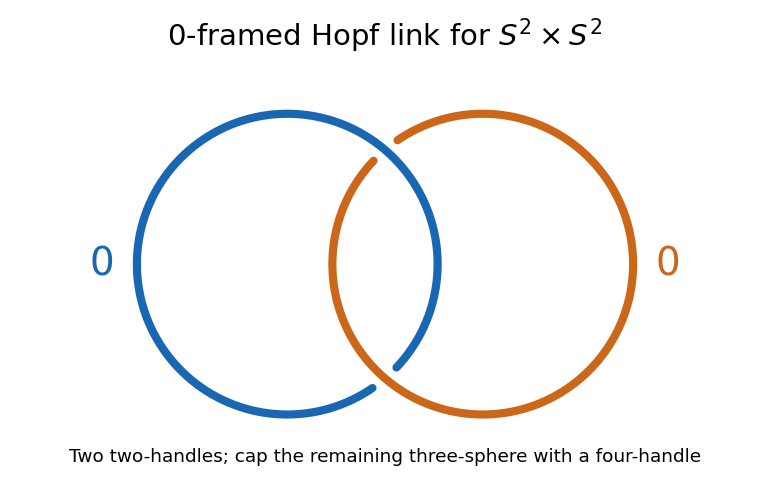
Zero-framed Hopf link for the two two-handles of S2 times S2; the upper crossing has blue over orange and the lower crossing has orange over blue
. Details. After these two two-handles, the remaining product piece is a four-ball. Its boundary is exactly the boundary of the assembled first three pieces, so it attaches as a four-handle. Equivalently, zero surgery on the Hopf link gives , which this handle caps. We have therefore constructed the actual product, provingThere are no one- or three-handles. As a check, the two factor spheres have self-intersection zero and meet once, giving the intersection form . The explicit product construction, rather than the intersection form alone, identifies the smooth four-manifold. This is the zero-framed Hopf-link handle decomposition of the sphere product.
Past exam of the mathematics course of the University of Cambridge 2003 iii Paper 27 5 Solution Created 2026-10-03 Updated 2026-10-14
Here projection means Hermitian orthogonal projection: with , as indicated by the unitary conjugation in the question. These matrices represent the complex Grassmannian as orthogonal projections, a compact manifold of complex dimension . The constants are real. Let and use the given tangent directions . Cyclicity of the matrix trace givesThe commutator is skew-Hermitian. If this derivative vanishes for every skew-Hermitian , choose to obtainso . Conversely makes every tangent derivative zero. Because the diagonal entries of are distinct, a commuting matrix is diagonal. Its idempotent entries are zero or one. Thus the critical projections are exactlywith critical points and values .
To compute the Hessian matrix, write and . A neighboring plane is the graph of a complex linear map . With , its orthogonal projection is . Writing for the diagonal blocks, we getExpanding yieldsEach complex coordinate has two real components, each with Hessian coefficient . Every coefficient is nonzero, proving that is a Morse function. Its negative directions correspond to . For there are complementary indices below , givingThis is the diagonal trace Morse function on a complex Grassmannian. Its critical values need not be distinct; ties between sums do not make its critical points degenerate.
All Morse indices are even. Choose a Morse-Smale gradient flow and form its integral Morse chain complex. The odd-degree chain groups vanish, so every differential vanishes. Equivalently the Morse handle-attachment theorem supplies only even-dimensional cells. The integral homology of complex Grassmannians is thereforewhere counts the subsets with , and . In particular there is no torsion. The nondecreasing sequence lies between zero and , so reversing it identifies these subsets with partitions of an integer fitting in a by rectangle. The Poincaré polynomial is explicitlyFor the permitted example , the subsets have indices . ThusThe general calculation above applies throughout ; it does not reduce to any of the excluded rank-one cases.
Past exam of the mathematics course of the University of Cambridge 2003 iii Paper 27 4 Solution Created 2026-10-03 Updated 2026-10-14
Work over . A closed connected orientable surface of genus has Betti numbers ; the circle has Betti numbers . The Künneth theorem therefore givesWe use the following precise consequence of the Morse handle-attachment theorem: a closed manifold with a Morse function has the homotopy type of a finite CW complex with one index- cell for each index- critical point. Its degree- rational cellular chain group has dimension , so its homology has dimension at most . Consequently , the weak Morse inequalities. Summing yieldsThis counts every critical point, regardless of whether some critical values coincide.
To attain the bound, construct a surface Morse function from the standard orientable handle decomposition: start with a disk, attach orientable bands in the usual paired pattern forming the genus- surface with one boundary component, and cap that boundary with a disk. Give the first disk a minimum, each band one saddle with local form , and the final cap a maximum. Regular collar coordinates join successive levels without additional critical points. This constructs with counts .
On the product takeIts critical points are exactly the pairs of a critical point of with . The Hessian matrix is block diagonal, with surface block and circle entry . It is nonsingular and its Morse index is the sum of the two factor indices. Thus this product of Morse functions has countsand exactly critical points. If distinct critical values are desired, choose outside the finite set producing collisions after first choosing distinct critical values for . The minimal Morse critical count on a circle times an orientable surface is therefore attained for every .
Past exam of the mathematics course of the University of Cambridge 2003 iii Paper 27 3 Solution Created 2026-10-03 Updated 2026-10-14
A Morse function is a smooth real-valued function all of whose critical points have nonsingular Hessian matrices. We use the descending convention for a gradient-like vector field : away from critical points, , and near a critical point of Morse index , in Morse lemma coordinates , the field can be chosen as .
For its flow , define the unstable manifold and the stable manifold . Their dimensions are and . The Morse-Smale transversality condition isFor a closed manifold, this lets us form the Morse-Smale complex over . Orient each unstable manifold and takeThe transverse intersection for an index difference of one is one-dimensional; quotienting by flow time gives a finite set of trajectories, and counts them with orientation signs. Compactifying the one-dimensional spaces of trajectories for an index difference of two adds broken trajectories. Their oriented boundary count is zero, giving . The descending cells are the unstable manifolds, and these counts are the incidence numbers of the corresponding cellular chain complex, so the homology of this complex is . Ambient orientability is unnecessary: orientations of the unstable cells provide the requisite coorientations and trajectory signs.
For the Klein bottle, use the quotient of by and . A model of the standard four-critical-point height function isIt is well defined under both identifications. Its critical points, their Morse indices, and critical values areThe Hessian matrix is diagonal with entries and , so each point is nondegenerate. The flat quotient metric gives descending equations , . Their saddle separatrices are the coordinate lines; the two saddle-to-saddle intersections are empty, and all remaining stable and unstable intersections are transverse. This is a Morse-Smale gradient flow. If one insists on the exact local-model version of a gradient-like vector field above, change the two coordinate speeds near the critical points to the standard quadratic-model speeds. This preserves the separatrices, signs and transversality.
Both branches of either saddle flow to the minimum with opposite endpoint signs, so . From the maximum to , the two trajectories lie on and approach from opposite directions. The identification in is a translation, so their incidence signs are opposite and cancel. The two trajectories to lie on and approach from opposite directions. The identification in reverses the transverse -coordinate, reversing one additional orientation sign. These two contributions consequently have the same sign. Choosing the orientation of gives .
One can check the coefficient directly from the cell attachment of the top cell: its boundary word is , with exponent sums zero on the base loop and two on the fiber loop . Thus the integral Morse complex of the Klein bottle isandCounting trajectories without signs, or working only modulo two, would miss the order-two class.
Past exam of the mathematics course of the University of Cambridge 2003 iii Paper 27 2 Solution Created 2026-10-03 Updated 2026-10-14
The Morse lemma states that if is a nondegenerate critical point of a smooth real function on an -dimensional smooth manifold, there are smooth coordinates , centered at , such thatHere is the Morse index, the number of negative directions of the Hessian matrix at . The equality is exact on a neighborhood, not merely a second-order expansion.
To prove it, start with any coordinates putting . Since , integral Taylor theorem givesThe matrix is smooth and symmetric, with . By Sylvester's law of inertia, a constant invertible linear coordinate change makes .
We perform completion of squares with coefficients depending smoothly on the original . The first pivot stays nonzero and keeps its sign on a sufficiently small neighborhood. Algebraically,The remaining coefficient matrix is the Schur complement. At zero it is the remaining signed diagonal matrix, so its first pivot is also nonzero nearby. Continue recursively, shrinking the neighborhood finitely many times. Every pivot is smooth and nonzero, with sign for and thereafter. Absorb into the square by its smooth positive square root. This produces a smooth triangular matrix with nonzero diagonal such thatAll coefficients here are functions of the original ; no circular coordinate substitution is involved. Define . Its derivative at zero is , which is invertible. The inverse function theorem makes a smooth coordinate system and gives the asserted exact quadratic form. The number of negative squares agrees with the Hessian matrix signature and hence with the Morse index. This is the smooth completing-square proof of the Morse lemma.
Past exam of the mathematics course of the University of Cambridge 2003 iii Paper 27 1 Solution Created 2026-10-03 Updated 2026-10-14
The cellular approximation theorem says that a continuous map between CW complexes is homotopic to a cellular map, meaning that it sends each -skeleton into the target's -skeleton. Give , for , its CW complex structure with one zero-cell and one -cell. Its -skeleton is the whole sphere, so the theorem applies and gives the requested result. For use the two zero-cells of . In particular the conclusion isThere is no local-finiteness assumption on .
For completeness, here is a direct proof of the needed case of cellular approximation, including the point-avoidance step. We use three standard facts, stated explicitly. First, a compact subset of a CW complex lies in a finite subcomplex. Second, a continuous map from a smooth manifold into Euclidean space has arbitrarily close smooth approximations, and smooth cutoffs exist around compact subsets of open sets. Third, the Sard theorem says the critical values of a smooth map have measure zero; when the domain dimension is smaller than the target dimension, its entire image has measure zero.
The first fact has a useful short proof. If a compact set met infinitely many open cells, choose one point in each of countably many distinct cells. Closure-finiteness makes every closed cell meet the chosen set, and every subset of it, in finitely many points. The weak topology of a CW complex then makes all those subsets closed. The chosen set is an infinite closed discrete subset of a compact space, a contradiction. Taking the closures of the finitely many cells met proves the claim.
Now lies in a finite subcomplex . Take a top-dimensional open cell of with , and identify its interior with the open unit ball in using its characteristic map. On the open set , write for the coordinate expression. Choose and a smooth cutoff supported in and equal to one near the compact set . By smooth approximation of maps into Euclidean space, choose a smooth with , where . Replace byThe straight-line interpolation is a homotopy supported away from the boundary of the cell and stays inside that cell. Where , we have and hence . By the Sard theorem, choose outside . Where we have , and elsewhere , so the modified map avoids everywhere.
Radial retraction of onto its boundary fixes that boundary. It therefore descends through the characteristic map, including its possibly noninjective boundary identifications, and fixes all other cells of . Composing gives a homotopy whose endpoint misses all of . Remove every cell of dimension greater than in descending order. There are finitely many such cells, so their homotopies concatenate to yield . This proves dimension reduction of sphere maps into CW skeleta. The approximation step is essential: an arbitrary continuous image of can fill a higher-dimensional region, so dimension alone would not supply an omitted point.
Past exam of the mathematics course of the University of Cambridge 2003 iii Paper 26 6 Solution Created 2026-10-03 Updated 2026-10-14
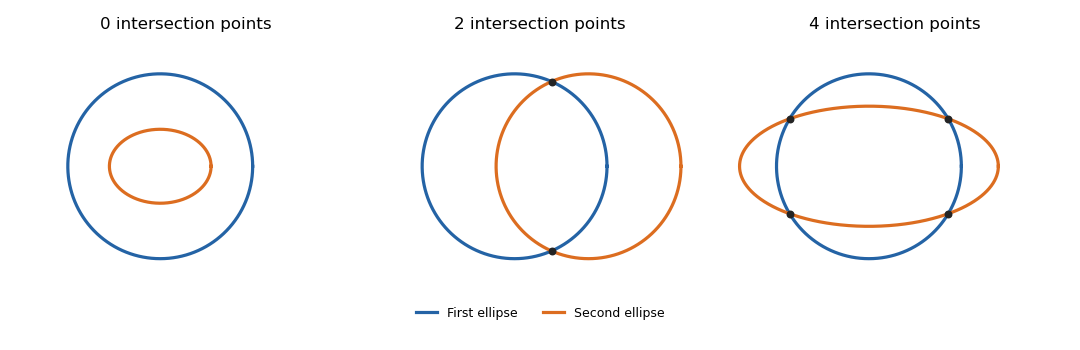
An ellipse here is a nondegenerate ellipse, hence a smooth embedded circle. Write the first ellipse aswhere is invertible. Write the second as , wherefor a positive-definite symmetric matrix . Its gradient is nonzero on the ellipse. Let . At an intersection, transversality says the tangent vector is not tangent to , soEvery intersection is thus a simple zero of , and changes sign there. The intersection set is finite: it is closed and compact, and transversality makes each of its points isolated. Start at a parameter with and traverse one full period. Returning to the same sign requires an even number of sign changes. Therefore the number of intersection points is even, including zero when the ellipses are disjoint.
For the upper bound, substituting the parametrization into the quadratic gives the trigonometric polynomialIt is not identically zero: otherwise the first ellipse would lie on the second, and its tangent would be tangent to the second everywhere, violating transversality. Put . Multiplying by turns this function into the polynomialIt is nonzero and has degree at most four, so it has at most four distinct roots. Distinct points on the first ellipse correspond to distinct parameters modulo and hence distinct points on the unit circle. ThusBoth the parity and the upper bound follow without using an algebraic intersection theorem. The four-point bound is attained by a unit circle and a concentric ellipse whose semiaxes lie on opposite sides of one.


Past exam of the mathematics course of the University of Cambridge 2003 iii Paper 26 4 Solution Created 2026-10-03 Updated 2026-10-14
Here closed oriented surfaces are connected, as in the usual single-genus convention. Let have nonzero mapping degree . Work over , so multiplication by is invertible and cannot vanish.
The Poincare duality pairing on is nondegenerate. Thus for every there is with . Naturality of the cup product and evaluation on the fundamental class giveIn particular , so is injective. The cohomology ring of a closed oriented surface has . Comparing dimensions now givesThis proves genus monotonicity under nonzero-degree surface maps by rational cohomology injectivity of a nonzero-degree map, without requiring to be a covering map or a smooth map.
Past exam of the mathematics course of the University of Cambridge 2003 iii Paper 26 3 Solution Created 2026-10-03 Updated 2026-10-14
Use integral singular homology. The singular chain group is the free abelian group on continuous maps , and its boundary operator isFor , deleting vertex and then vertex has sign , while deleting and then the shifted vertex has sign . Both yield the same codimension-two face. Pairing these terms proves . The inclusion identifies with the subgroup spanned by those simplices having image in , so it is injective and preserved by .
The relative chain complex is with induced boundary . Thus there is a degreewise short exact sequence of chain complexesInclusion and quotient take homological cycles to homological cycles and boundaries to boundaries, hence define the group homomorphisms and on homology. We construct and prove exactness of the resulting sequence directly, rather than invoke an unproved algebraic lemma:ending in .
For the relative homology connecting homomorphism, lift a relative cycle to . Since , the chain belongs to ; it is a homological cycle because . DefineChanging the lift by changes the boundary by , hence does not change its homology class. More generally, if a different relative cycle represents the same relative homology class, lifts satisfy for some and . Then . This proves independence both of the lift and of the homology representative. Lifting a sum by the sum of lifts proves additivity, so is a well-defined group homomorphism.
At , an element in the image of is represented by for some , so its image in is zero. Conversely, if a homological cycle in has , then for a -chain . Its quotient is a relative cycle and . ThusFor completeness, the other terms are exact by the same elementary chain argument. At , clearly . If a homological cycle in has zero relative class, then for a quotient chain . Lifting gives , and . Hence , proving . At , absolute homological cycles have zero connecting image. Conversely, if , then for some ; the chain is an absolute homological cycle and maps to . Therefore . In degree zero every quotient chain lifts to an absolute homological cycle, because the differential to degree is zero, so is surjective. These proofs establish the whole long exact sequence in relative homology and all the algebraic facts used in its construction.
Past exam of the mathematics course of the University of Cambridge 2003 iii Paper 26 2 Solution Created 2026-10-03 Updated 2026-10-14
A simply connected manifold is connected and orientable: its orientation character is a group homomorphism , and this group is trivial. Choose an orientation. The Hurewicz theorem in degree one gives . The universal coefficient theorem for cohomology then gives andbecause the possible term is zero.
The homology groups are finitely generated for a closed manifold. The displayed dual group is therefore free abelian. Poincare duality identifies with , so itself has no torsion. Since the second Betti number is one, both groups are isomorphic to . This torsion argument is essential: rank one by itself would not rule out finite summands.
Let generate . The integral intersection formis unimodular. Indeed, cap product with is the Poincare duality isomorphism to , and the preceding universal-coefficient identification makes evaluation the full integral dual. Composing these isomorphisms identifies the pairing with an isomorphism . In rank one its matrix must therefore be or . Consequently , so generates .
All products in degrees above four vanish. Hence the assignment of the degree-two generator giveswhich is the cohomology ring of complex projective space for . If the intersection form is negative, this ring isomorphism reverses the chosen top orientation generator; preserving that additional orientation is not part of the requested ring isomorphism.
Past exam of the mathematics course of the University of Cambridge 2003 iii Paper 25 5 Solution Created 2026-10-03 Updated 2026-10-14
We state the integer form of Freiman theorem for integer sets: for every there are finite constants such that every finite nonempty with doubling at most lies in a proper generalized arithmetic progression of rank at most and cardinality at most . An arbitrary abelian group requires the coset-progression version, allowing a subgroup factor. We prove the integer statement, with no claim of optimized constants.
We use the allowed Plünnecke inequality and basic Freiman isomorphism facts, and explicitly prove the modelling, Fourier and covering steps. Two geometry-of-numbers consequences are used as permitted: a cyclic rank- phase-radius- Bohr set contains a proper symmetric progression of rank at most and size at least times the cyclic group order; and a rank- integer progression with parameter-box volume can be contained in a proper progression of rank at most and size at most . These follow from successive minima and lattice basis reduction. All these constants depend only on the displayed rank and radius, not on the ambient order or step sizes.
First construct a dense cyclic model of a large subset. Put and . Plünnecke gives . Choose an auxiliary prime so large that every nonzero integer in stays nonzero modulo , and . Arbitrarily large primes exist: a purported finite list would miss a prime divisor of one plus their product. For a uniform nonzero multiplier , each nonzero has uniformly distributed among the nonzero residues. The forbidden residues are those represented by nonzero multiples of with absolute value less than ; there are at most of them. The union bound gives failure probability at mostThus choose avoiding them for every nonzero .
Represent the dilated elements of in , divide this interval into nine consecutive subintervals, and retain a most-populated one. It defines with . If is the chosen representative of , eight-term sums of representatives from this subinterval have a range shorter than : eight times its width is less than . Consequently every original eight-term relation lifts from equality modulo to equality of the representative sums as integers.
Now reduce these representatives modulo . If their two eight-term sums agree modulo , their integer difference is a multiple of of absolute value below . A nonzero such difference would give a forbidden residue for some nonzero . If , its representative difference is already zero. Hence there are no new relations either. The map is therefore a Freiman s-isomorphism of order eight onto . It is injective, by padding shorter relations to eight terms with a fixed retained point. Its density satisfiesThis proves the cyclic Freiman model of a small-doubling integer set needed below.
Next we prove the cyclic Bogolyubov lemma. Use normalized finite-group Fourier analysis on . The convolutionhas Fourier expansion . Let consist of those characters whose Fourier coefficient has modulus at least . Parseval gives , and the fourth-power tail outside is at most . The zero character belongs to and contributes .
For the phase-distance Bohr set , every retained character has real part at least . ThereforeThe support of this convolution is , so . Apply the stated progression in a Bohr set from successive minima consequence. It supplies a symmetric proper progression of rank bounded by a function of and size at least , hence at least after adjusting the constant.
Lift this progression back to the integers. The inverse Freiman map inducesEquality of two representations uses a four-term relation on each side, so is well defined and injective. If all lie in this difference set, the relation between their representations involves at most six original terms on either side. The order-eight model therefore gives and . Along every coordinate path within the symmetric progression box, all partial sums remain in . It follows thatThus is a symmetric proper integer progression of the same rank and cardinality, and . This proves the Freiman lifting of a progression step, including why a sufficiently high-order model was selected.
It remains to cover all of , not merely its large modeled subset. Since , Plünnecke givesChoose maximal such that the translates are pairwise disjoint. Their union lies in , so . For every , maximality makes meet some , giving . ConsequentlyThis proves the needed Ruzsa covering lemma directly.
Write and . The setcontains and hence . Its rank is at most , bounded only by , and its parameter-box volume is at most . Also , so this volume is at most . The allowed integer properification consequence now contains in a proper progression of bounded rank and size at most . ThereforeThis proves Freiman's theorem, using geometry of numbers only in the two explicitly stated places.
There are unlisted articles, also show them or only show them.