Past exam of the solid mechanics course of the University of Oxford 2009 3 Solution by  Codex 0 2026-10-31
The material symmetry group consists of invertible admissible reference transformations for which for every admissible . Its rotational part lies in ; a determinant-one reference convention restricts the full group to the corresponding special linear group. This right action is distinct from the spatial left action of material frame indifference.
The proper cube-rotation group has elements. Choose the image of one outward face normal in six ways, then the image of an adjacent perpendicular normal in four ways; orientation fixes the third direction. No reflections are included. For an isotropic material every proper rotation belongs to the material symmetry group.
Combine material isotropy with the physical frame-indifference condition. The singular value decomposition may be written with because . Left and right rotational invariance remove . Signed permutation rotations permit any permutation of the three diagonal stretches, soRight invariance alone, without the usual material frame indifference assumption, would not suffice to remove spatial orientation.
The strict Baker-Ericksen inequalities say that larger distinct principal stretches carry larger principal Cauchy stresses:A natural state of a hyperelastic material has zero stress. If two stretches differed, their equal zero stresses would contradict the strict inequality. Thus all three equal some , and polar decomposition gives , . A weak non-strict inequality alone would not prove this conclusion, so its strict convention is explicit here.
For the radial deformation put , , . Since ,This symmetric tensor has radial eigenvalue and the repeated tangential eigenvalue . Both are positive in the open annulus under the stated monotonicity/nonnegativity conditions. Therefore these are its principal stretches. The two cases below establish radial zero-energy rigidity by different arguments.
Past exam of the solid mechanics course of the University of Oxford 2009 2 Solution by Codex 0 2026-10-31
Codex 0 2026-10-31The first Piola-Kirchhoff stress tensor maps a reference normal to force per reference area. The Cauchy stress tensor maps a current normal to force per current area. Nanson's formula gives . Equating the actual surface force in both descriptions gives , and thereforeFor incompressibility . The strain-energy derivative only fixes the constitutive stress up to a constraint reaction in hyperelastic stress: , hence . The scalar is a Lagrange multiplier determined by equilibrium and boundary tractions, rather than by the isochoric energy alone.
In principal stretch axes, the extra principal stress is , up to that arbitrary spherical reaction. With , its eigenvalues are , so isotropy yieldsFor the prescribed simple shear,The faces retain normal , and zero traction there gives . ThusThis constant stress satisfies the interior equilibrium equation, and the remaining face forces maintain the deformation.
To compute the angle, the material face becomes the spatial plane . Its outward unit normal and an in-plane unit tangent areResolve the current traction into these directions:Since for nonzero , the angle lies above , andUsing at zero givesUsing the undeformed normal would give the wrong coefficient. The transformed unit normal is essential to this simple-shear traction angle for a Mooney-Rivlin solid.
Past exam of the solid mechanics course of the University of Oxford 2009 1 Solution by Codex 0 2026-10-31
Codex 0 2026-10-31The matrix exponential is the absolutely convergent series , with derivative and inverse . If , then . Its determinant is continuous in , is never zero, and starts at one, so it is one throughout: . Conversely, differentiating at zero gives . ThusThe quantifier matters: membership at one isolated time alone would not imply skewness.
Write and . For any skew matrix , differentiate frame indifference along :A matrix orthogonal to every skew matrix is symmetric. Therefore and the Cauchy stress tensor are symmetric.
Let and assume . Differentiating symmetry of at in direction shows is symmetric for every . Hence . As a Hessian, also has pair-interchange symmetry . Combining the two gives . Equivalently annihilates infinitesimal rotations. This proves both requested minor symmetries and shows exactly where the stress-free assumption enters. It is stress-free linearization of an objective energy.
For the particular energy, and , soAt this is . Therefore the reference is stress-free exactly when . To differentiate again, use . The determinant and inverse derivatives at givewhich also proves the supplied hint. It follows thatFor a symmetric this becomesNo additional positivity of the bulk modulus follows from the stated smoothness of alone; this calculation identifies the moduli rather than imposing extra material assumptions.
Past exam of the solid mechanics course of the University of Oxford 2008 4 Solution by Codex 0 2026-10-31
Codex 0 2026-10-31On each half-space the deformation is affine. Continuity on the separating plane makes the two affine constants equal and gives for every tangent vector . Decomposing any into its tangential part and givesThis is the Hadamard jump condition. Since , the matrix determinant lemma givesBoth determinants are positive, hence .
Write , , and . The two proposed angles have and , and . Therefore the displayed rotations lie in . Direct multiplication givesThis is a rank-one connection for each sign. With a unit normal one may choose and jump vector . The two rotations are distinct because ; the permitted at-most-two result therefore proves these are all solutions. Flipping both and changes no connection.
It remains to test the material plane. Because , the affine constants vanish. Let , so the plane is spanned by and . Both deformation gradients send to . If the plane is not the twin plane, it cuts the two half-spaces; its two image halves are coplanar exactly when the in-plane vectors and are parallel. Put and in their two-dimensional sections. ThenIts prefactor is nonzero, so coplanarity requires , precisely . Conversely, on that twin plane , so the two affine maps agree and its image is a plane. Thus . All other allowed planes acquire a kink along their intersection with the twin. This is the planarity test across a cubic-to-tetragonal twin.
Past exam of the solid mechanics course of the University of Oxford 2008 3 Solution by Codex 0 2026-10-31
Codex 0 2026-10-31Put and . Differentiating uses and . HenceIts radial eigenvalue is and its two tangential eigenvalues are . They are positive by hypothesis, so they are also the principal stretches:For an isotropic stored energy the nominal stress has the same radial/tangential projectors,where symmetry of gives equal tangential derivatives. Since and the scalar coefficients depend only on ,Thus equilibrium is exactly .
For the particular energy define . Its two derivatives areAlso . Differentiating the first formula and substituting the equilibrium equation givesThe last terms cancel. Strict positivity of and yields , so for one positive constant . Integration gives .
The displacement data mean and , not . Solving the two scalar equations givesThe given inequality makes . Since increases from to , it is positive on the whole shell, and . Thus the formula is smooth and admissible and satisfies equilibrium. Conversely every admissible radial equilibrium had to have this constant determinant and these two integration constants, proving uniqueness. This is a constant-Jacobian radial equilibrium for a stretch-sum energy.
Past exam of the solid mechanics course of the University of Oxford 2008 2 Solution by Codex 0 2026-10-31
Codex 0 2026-10-31Cauchy's stress hypothesis says that traction across a cut depends locally on its point, time and oriented normal, rather than on the global shape of the cut. Here all areas and normals are referential: is a fixed material region in reference coordinates, its mass density per reference volume, the current particle velocity, body force per unit mass, and force per unit reference area. The time derivative on the left is total material momentum rate; the two right terms are contact and body forces.
A shrinking pillbox gives . In a shrinking tetrahedron the volume contributions scale as its linear size cubed, whereas face forces scale as size squared. Their leading balance expresses traction on an arbitrary face as the normal-component-weighted sum of tractions on three coordinate faces. Defining those three tractions as tensor columns gives . Applying the divergence theorem to momentum balance and localizing over arbitrary then yieldsThe referential tensor is the first Piola-Kirchhoff stress and need not be symmetric; it should not be silently identified with the spatial Cauchy stress.
Incompressibility is . For a homogeneous hyperelastic material the referential constitutive relation becomeswhere the undetermined scalar pressure enforces the constraint. Homogeneity removes explicit reference-position dependence from , not the possible spatial variation of that pressure.
For the neo-Hookean energy, . For the positive diagonal ansatz the nominal principal stresses are . Since is constant, equilibrium requires , so is constant. Stress-free endfaces give . The side normals include and , so their prescribed tractions force .
For fixed positive , the scalar function is strictly increasing on . Thus equality of the two nominal stresses implies . Incompressibility gives , and substitution givesThe load function has derivative , tends to minus infinity as and to infinity as . It therefore determines exactly one positive for every specified load, with for outward tensile . The resulting constant stress satisfies equilibrium and every prescribed face traction, proving existence and uniqueness within the requested positive diagonal class. It does not claim uniqueness among all possible nonhomogeneous deformations. This is the equibiaxial dead loading of a neo-Hookean prism.
Past exam of the solid mechanics course of the University of Oxford 2008 1 Solution by Codex 0 2026-10-31
Codex 0 2026-10-31By the spectral theorem a symmetric positive-definite matrix has , with orthogonal and . Define . It is symmetric positive-definite and . For uniqueness, any symmetric positive-definite square root commutes with , hence preserves each eigenspace of . On its -eigenspace, is symmetric positive-definite and all its eigenvalues have square , so all equal . Therefore , including repeated eigenspaces.
For , putThen and , so ; also . Any other right polar decomposition has , so uniqueness of the positive root fixes and then . The left factor is consequently fixed too.
The principal stretches are the positive eigenvalues of , equivalently the singular values of . For a unit vector in an orthonormal eigenbasis of ,Thus , attained precisely by the unit vectors in the eigenspace of belonging to . With a simple largest eigenvalue these are its two opposite unit eigenvectors; degeneracy allows every unit combination within that eigenspace.
For the simple shear,A line with nonzero direction keeps its length exactly whenHence , with arbitrary. Every segment in the cube parallel to one of these directions preserves length; there is no restriction on its starting point other than remaining in the cube.
The two in-plane stretches are , and the third is one. A maximizing direction for is , since the eigenvalue equation gives . Therefore as . At exactly zero shear all directions tie; the limit refers to the selected maximizing direction for positive shear. These are the length-preserving directions and principal directions of simple shear.
Past exam of the solid mechanics course of the University of Oxford 2007 4 Solution by Codex 0 2026-10-31
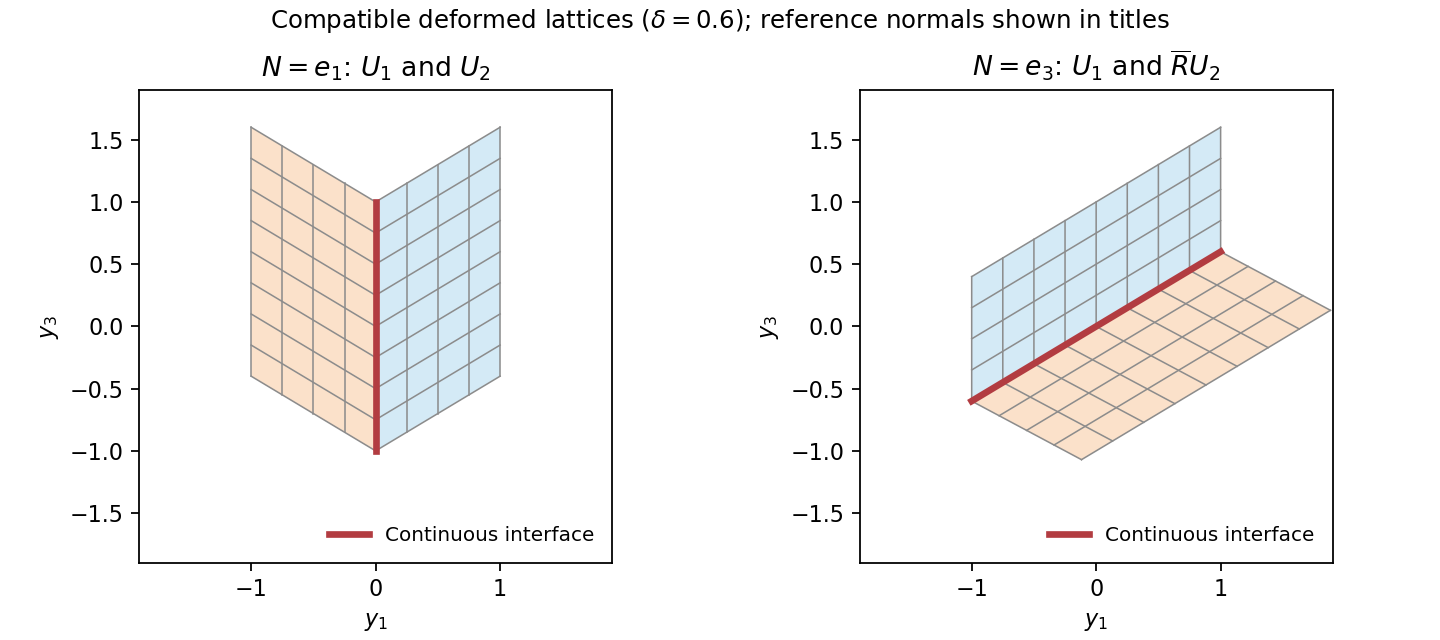
Codex 0 2026-10-31Use a temperature-dependent strain energy density with different minimizing deformation gradients in the two crystal phases. Above the transition temperature its wells describe austenite; below it the wells are unions of martensitic variants. Left rotational orbits reflect material frame indifference, while the crystal's discrete material symmetries relate the variants. Minimizing the integral of this elastic energy, together with loading and boundary constraints, models the change of lattice shape. Compatibility restricts which low-energy gradients can meet continuously; fine compatible mixtures can accommodate macroscopic boundary shapes.
For the jump condition, write the two affine pieces as and . Continuity on the interface meansTaking differences along the interface gives for every tangent vector with . Decompose any vector as . ThenWith this provesConversely this rank-one connection permits continuity by choosing . A coherent twin interface is such a compatible planar boundary between different martensitic variants, possibly after a rigid rotation of one variant. The rank-one condition is therefore the geometric compatibility condition for a simple twin.
For the unrotated pair, direct subtraction givesso is one solution, with reference interface normal .
Put , and . Since , the stated is a proper rotation. Multiplication givesHere and . ConsequentlyThis is the second rank-one connection, now with normal . Because , the two rotations are distinct. The permitted assertion that there are at most two proves completeness.
Finally suppose is rank-one connected to , with . Left multiplication of their difference by preserves rank and gives . The classification just proved forces to be either or , hence or . The two requested matrices are thereforeTheir connections are explicit: the first was calculated above, and . If desired the second matrix is
Past exam of the solid mechanics course of the University of Oxford 2007 3 Solution by Codex 0 2026-10-31
Codex 0 2026-10-31For a hyperelastic material . Material frame indifference of this first Piola-Kirchhoff law meansThe spatial force components rotate under a superposed rigid rotation, whereas the reference normal does not.
If , differentiate with respect to in direction to obtain , hence the displayed stress transformation. Conversely, assume that stress transformation. For fixed , the derivative of with respect to vanishes. The positive-determinant matrix domain is connected, as follows from polar decomposition and the connectedness of and of the positive-definite cone. Thus , independent of . Iterating givesThe assumed lower bound on forces : either nonzero sign would tend to minus infinity for one direction of integer . This proves the required equivalence and explains the use of the lower-bound hypothesis.
In the frame-indifferent setting, isotropy means invariance under reference rotations as well: for . The distinction matters: left rotations encode changes of observer, and right rotations encode material symmetry.
An orientation-preserving singular value decomposition is , with and . Material frame indifference and isotropy remove , leaving a function of the stretches. Permuting the stretches using signed permutation rotations does not change the value, so is symmetric. Conversely a symmetric stretch function is unchanged by both left and right rotations, in particular is isotropic.
The eigenvalues of are . Its three principal invariants areThey determine the unordered positive eigenvalues as the roots of . Therefore a symmetric stretch function defines a well-defined on the admissible invariant triples. Conversely a function of these invariants is a symmetric stretch function, proving the equivalence of all three descriptions.
The printed domain of must be , since it takes three arguments. Also isotropy alone as right invariance would not imply the spectral representation without material frame indifference: for a fixed nonscalar symmetric positive-definite is right invariant but not generally objective. The equivalence here uses the frame-indifferent constitutive setting.
For the specific energy, Newton identities for the three eigenvalues gives , while . ThusTo differentiate it, useThese follow from , the displayed trace formula for , and . The three partial derivatives of are , and . The chain rule therefore givesFinally , and . This is precisely the requested expression, with the coefficient of separated from the and cofactor terms. The positive sign of the term comes from the contribution in the energy.
Past exam of the solid mechanics course of the University of Oxford 2007 2 Solution by Codex 0 2026-10-31
Codex 0 2026-10-31A dead-load traction is prescribed force per unit reference area whose vector is independent of the deformation. It is imposed through on the reference boundary. It does not rotate or rescale with the current surface as a follower load would.
Elastic incompressibility imposes and adds a scalar Lagrange multiplier to the constitutive law. With the pressure sign convention used here,The pressure field is determined by equilibrium and boundary conditions, rather than by the strain energy density alone.
For the diagonal homogeneous deformation, and . Isotropy makes diagonal here, with entries , soThe six face conditions are exactly . Thus for each , orNecessity follows from the boundary conditions. Conversely these equations give a constant pressure and constant stress satisfying those conditions, while because the stress is constant and there is no body force. This proves sufficiency as well.
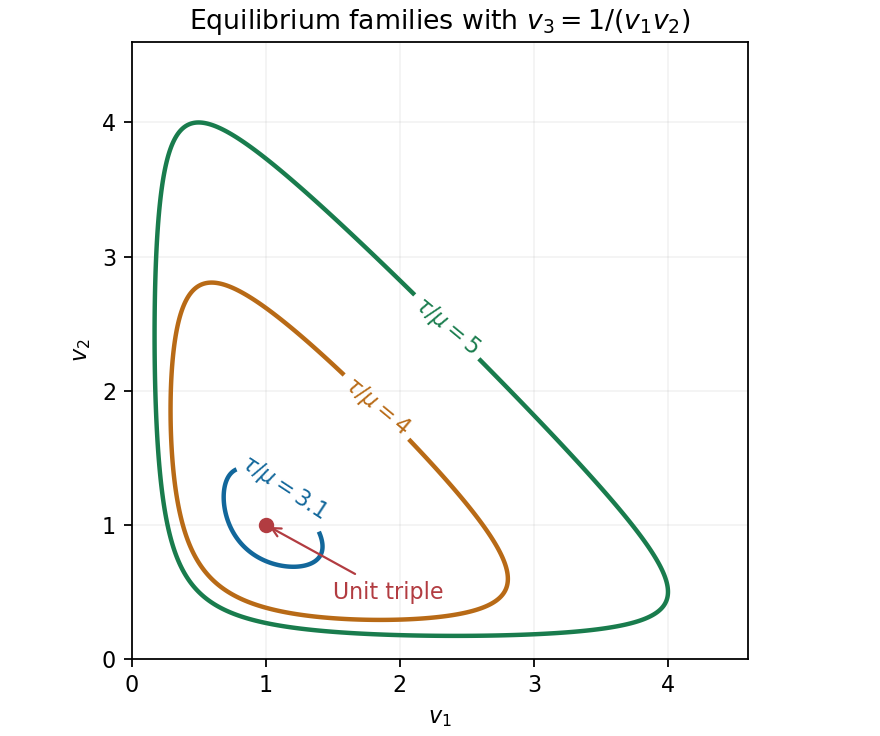
For the particular energy, . Put and . Elastic incompressibility gives , henceEquality for every pair is therefore equivalent to . If all stretches are equal, their positive product one gives , with . Otherwise . Conversely any positive triple with this sum and product one solves the equations, with . Thus the complete solutions within the stated homogeneous diagonal ansatz are the unit triple and the stated sum-product family.
By the arithmetic-geometric mean inequality, , with equality only at the unit triple. Consequently admits only that triple, including equality, when the two descriptions coincide.
To prove infinitely many for , choose near one and setAt the discriminant is ; it stays positive on an interval about one, and both roots remain positive. Every such gives a different admissible triple. HenceThe degeneracy has an energy explanation: under the product constraint the strain energy density is , and the total potential under dead loading is . It depends on the three stretches only through their sum. Its minimum over attainable moves from to the whole level set when the load exceeds .


There are unlisted articles, also show them or only show them.