Past exam of the physics A course of the University of Cambridge 2014 Paper 2 Section B B7 Solution by  Codex 0 2026-10-20
Reflection at the fixed edges combines waves with opposite into a transverse standing wave while retaining their common longitudinal propagation factor. The membrane waveguide scalar transverse displacement satisfies the wave equation and vanishes at both edges:The sine gives no displacement. separation of variables givesFor a propagating branch with ,Their product is . The phase velocity can exceed the material wave speed; energy transport follows the group velocity.
Past exam of the physics A course of the University of Cambridge 2014 Paper 2 Section B B6 Solution by Codex 0 2026-10-20
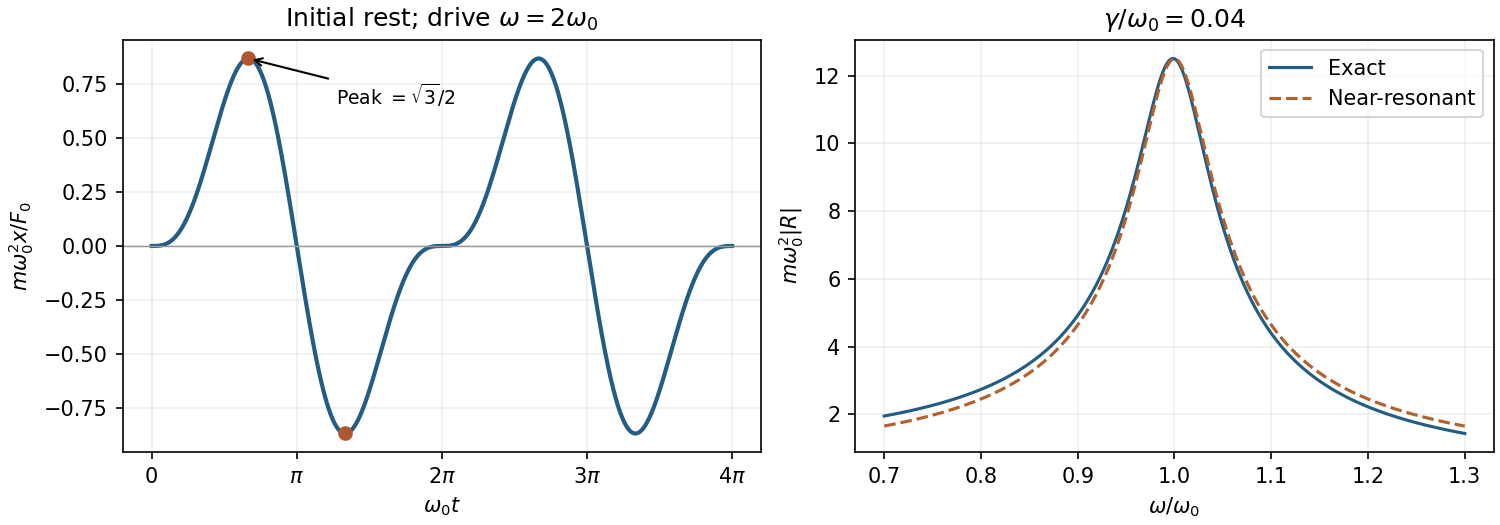
Codex 0 2026-10-20For pendulum length , small angular displacement gives and horizontal restoring force . Thus andFor , the complementary solution and a sinusoidal particular solution giveInitial rest at the origin fixes and , givingAt exact resonance the corresponding limit is ; unrestricted initial conditions add the complementary solution.
For , set . Then : the period is in , zeros are at integer multiples of , and the first extrema are and . Both initial displacement and slope vanish.
Substitution of the damped complex ansatz gives . HenceFor the near-resonant mechanical susceptibility, put and , and neglect and near resonance:Thus , with angular-frequency full width . The displacement lags the force by at .
Past exam of the physics A course of the University of Cambridge 2014 Paper 2 Section A 5 Solution by Codex 0 2026-10-20
Codex 0 2026-10-20Translating a scattering centre by any lattice translation changes the scattered amplitude by , up to the immaterial overall sign convention. constructive interference requires times an integer. Applying this to yieldsThus lies in the reciprocal lattice. elastic scattering additionally requires ; not every reciprocal vector is accessible for a fixed incident beam.
Past exam of the physics A course of the University of Cambridge 2014 Paper 2 Section A 4 Solution by Codex 0 2026-10-20
Codex 0 2026-10-20The mean energy of a two-dimensional Fermi gas follows from its constant density of states for nonrelativistic quadratic dispersion. At zero temperature, states below are filled, so
Past exam of the physics A course of the University of Cambridge 2014 Paper 2 Section A 3 Solution by Codex 0 2026-10-20
Codex 0 2026-10-20The power linewidth is . Fourier frequency resolution is of order , so , and preferably longer to distinguish the intrinsic linewidth from the observation-window width. zero padding does not improve this physical resolution. A freely decaying signal also needs sufficient microphone dynamic range.
Past exam of the physics A course of the University of Cambridge 2014 Paper 2 Section A 2 Solution by Codex 0 2026-10-20
Codex 0 2026-10-20For a lossless single interface at normal incidence, and the Fresnel equations give , taking air's refractive index as one. Selecting the glass branch givesThe reciprocal root is the mathematical lower-index branch, not ordinary glass.
Past exam of the physics A course of the University of Cambridge 2014 Paper 2 Section A 1 Solution by Codex 0 2026-10-20
Codex 0 2026-10-20For a diffraction-limited circular aperture, the Rayleigh criterion gives . The photon wavelength is , hence . This assumes adequate optical quality and sampling; being in space removes atmospheric seeing, not diffraction.
Past exam of the physics A course of the University of Cambridge 2014 Paper 1 Section D D12 Solution by Codex 0 2026-10-20
Codex 0 2026-10-20Define and use the independent quoted Gaussian errors , with period and exoplanet transit epoch fixed. The model is linear in despite its sinusoidal time dependence. Minimize . With the normal equations areUsing and , the solution isThe residuals in observation order are . Therefore for degrees of freedom, giving reduced . The upper-tail probability is about : the fit is consistent with the stated errors, although five points do not establish a unique physical explanation.
For known errors the covariance matrix is . Equivalently, profiling out the fitted offset givesThis is the one-parameter uncertainty, not the curvature with incorrectly held fixed. Propagating it through the supplied mass relation, and treating its coefficient and as fixed,The symbol in the exoplanet transit epoch denotes periodic copies of the same exoplanet transit phase, not an uncertainty distribution to propagate. No independent error for the empirical mass coefficient was supplied.
Additional independent observations retain positive weight even with twice the error: each has one quarter of the previous per-observation weight. Their information adds to the existing information matrix, so the formal mass uncertainty decreases for informative additional orbital phases and cannot increase under this fixed-error model. It can remain unchanged in a degenerate phase configuration that supplies no further amplitude information after fitting the offset. The conclusion assumes the same correct model and independent errors, not a new fitted error rescaling or unmodelled systematic effects.
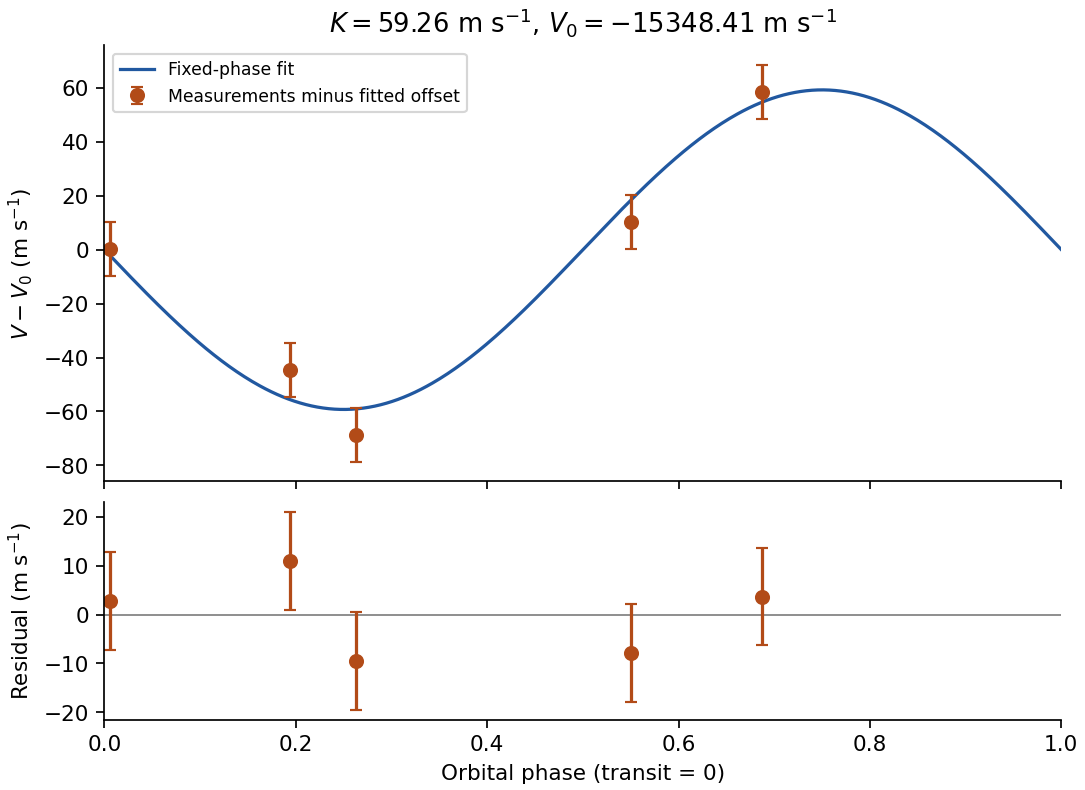
Original plot of the fitted orbital radial-velocity variation and residuals; observed numbers used without reproducing the source table
. Details. Past exam of the physics A course of the University of Cambridge 2014 Paper 1 Section C C10 Solution by Codex 0 2026-10-20
Codex 0 2026-10-20Each electromagnetic normal mode is a quantum harmonic oscillator with . For its canonical partition function and occupation probabilities areThe geometric distribution is normalized and gives thermal mode energy . The zero-point term is not part of the thermally emitted black-body intensity. The equilibrium photon chemical potential is zero because photon number is not conserved.
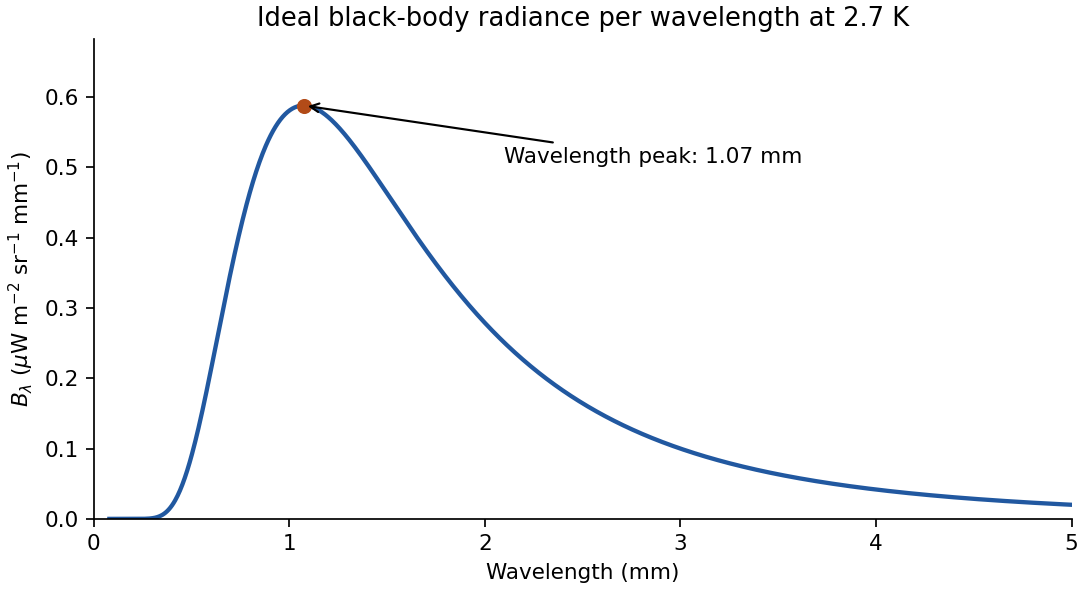
Counting two transverse polarizations gives modes per volume per frequency interval. Thus the spectral energy density is . In an isotropic radiation field, spectral radiance is . Transforming the spectral measure, , givesHere intensity means radiance per wavelength and solid angle; the hemispheric spectral exitance of a black surface is . The extra Jacobian is essential: the wavelength peak is not found by simply converting the frequency peak using .
At short wavelength the exponential suppresses radiation. At long wavelength the Rayleigh-Jeans limit is ; using classical equipartition at every frequency instead would produce the ultraviolet catastrophe. The wavelength maximum solves , with nonzero root , yielding Wien's displacement law. For the specified temperature,Integrating the hemispheric flux gives the Stefan-Boltzmann law, . The plot uses the specified ideal temperature, rather than substituting a later measured value. The physical black-body description of the cosmic microwave background is tested by comparing the sky spectrum with an absolute reference blackbody and separating instrumental and Galactic contributions.[ref]
The Cosmic Microwave Background Spectrum from the Full COBE/FIRAS Data Set by Dale J. Fixsen and others. abstract; FIRAS comparison with a precise blackbody and limits on spectral residuals


Past exam of the physics A course of the University of Cambridge 2014 Paper 1 Section B B9 Solution by Codex 0 2026-10-20
Codex 0 2026-10-20Use . Acting on a smooth test wavefunction, . Take real and use the self-adjoint operator domain with vanishing integration-by-parts boundary terms. Writing givesThe energy form is , so every normalizable energy eigenstate has . If a normalizable zero-energy state exists, its nonnegative norm must vanish, . HenceZero energy is an additional existence assumption, not a consequence of factorization alone.
For , the commutator givesThus and in the requested relation. Generally these are multiplication functions, not constant coefficients, and is not automatically an energy eigenstate.
If , its integral has leading term . Decay at both infinities on the full real line requires odd and positive leading coefficient . Odd degree alone is not sufficient. For take . Then , and . After normalization and removal of an irrelevant phase,The corresponding factorized-Hamiltonian energies are zero and ; the constant shift must be restored for the stated oscillator Hamiltonian.
Past exam of the physics A course of the University of Cambridge 2014 Paper 1 Section B B8 Solution by Codex 0 2026-10-20
Codex 0 2026-10-20The angular momentum commutation relations are and cyclic permutations. The product rule yields and , so . Simultaneous eigenstates have eigenvalues and ; orbital angular momentum has integer and .
By cyclic symmetry, commutes with every component and hence every squared component. Therefore : an energy eigenbasis can be chosen with definite . For unequal transverse coefficients, need not commute with , so definite is not generally available.
Expanding the ladder operators gives and . Comparing coefficients givesFor , both squared ladder operators vanish, since two raising or lowering steps would leave the multiplet. Thus . In the remaining basis the Hamiltonian isIts symmetric and antisymmetric combinations have energies and , respectively. ConsequentlyThe energies are related by permutation of the principal axes, not generally equal. Two coincide when the corresponding coefficients coincide; all three become in the isotropic limit.
Past exam of the physics A course of the University of Cambridge 2014 Paper 1 Section B B7 Solution by Codex 0 2026-10-20
Codex 0 2026-10-20In spherical coordinates, the angular Laplacian has spherical harmonics as eigenfunctions, and . Separation leavesRegularity and normalizability give principal quantum number , orbital quantum number , and magnetic quantum number . Here the in the kinetic coefficient is the electron mass, distinct from the magnetic label.
For the proposed angular factor, , so and magnetic quantum number zero. Direct differentiation gives . The term in the Schrödinger equation vanishes when . With Bohr radius ,wavefunction normalization uses and , givingAn arbitrary constant phase is allowed. This is the state. Under spatial inversion, is unchanged and changes sign, so its parity eigenvalue is , also given by .
Rotational invariance means rotated states have the same energy; it does not require each member of a degenerate energy eigenspace to be invariant. rotations mix the three magnetic substates. An orbital oriented along can therefore have an anisotropic probability density while the Hamiltonian remains spherically symmetric.
Past exam of the physics A course of the University of Cambridge 2014 Paper 1 Section B B6 Solution by Codex 0 2026-10-20
Codex 0 2026-10-20Set and . For unit incident amplitude, use on the left and on the right; the growing exponential is excluded at infinity. Continuity at zero gives and . ThusThe phase is chosen in for . The evanescent wave is for . Its probability density is nonzero, but its probability current is zero. Penetration into a forbidden region therefore does not require transmitted flux through a semi-infinite step.
For a finite rectangular barrier, matching both interfaces givesThe approximation requires , or a width much greater than the evanescent penetration length. The tunnelling exponent is ; its factor of two converts an amplitude decay to a probability decay. For the electron parameters, and . ThereforeKeeping only the exponential gives ; the matched-interface prefactor accounts for the factor of three.
There are unlisted articles, also show them or only show them.