Past exam of the physics A course of the University of Cambridge 2016 Paper 1 Section C C10 Solution by  Codex 0 2026-10-20
identical particles have the same intrinsic properties, including mass, charge and spin. Their labels are bookkeeping devices rather than measurable identities. When wave functions overlap, quantum mechanics supplies no observable trajectory that permanently identifies “particle 1” independently of “particle 2”. A many-particle description must therefore treat exchange consistently. The Hamiltonian and physical observables are invariant under relabelling identical particles.
For two particles, the exchange operator obeys . The usual three-dimensional symmetrization postulate selects states symmetric under exchange for bosons and antisymmetric for fermions. In relativistic quantum theory, the Spin-statistics theorem associates integer spin with bosons and half-integer spin with fermions under its locality and positivity assumptions; the connection is not derived merely from in elementary nonrelativistic mechanics. For orthonormal one-particle states and , the two-particle spatial combinations areThe sign concerns the complete state, including spin and other internal variables, not necessarily the spatial factor alone.
The antisymmetric state vanishes if both fermions occupy the same one-particle state: this is the Pauli exclusion principle. For fermions in orthonormal spin orbitals , the normalized Slater determinant supplies the required exchange sign. Bosonic occupation has no corresponding upper limit, and symmetrized products describe many bosons. Fermionic occupation is zero or one per complete one-particle state; two electrons can still occupy the same spatial atomic orbital with opposite spin.
Spin and spatial symmetry are linked. A two-electron spin singlet state is antisymmetric, so its spatial factor must be symmetric. A symmetric triplet state instead requires an antisymmetric spatial factor. Exchange then changes pair correlations and the energies available when interactions depend on particle separation, even without introducing a new classical “exchange force”. It contributes to atomic shell structure, bonding and magnetic behaviour.
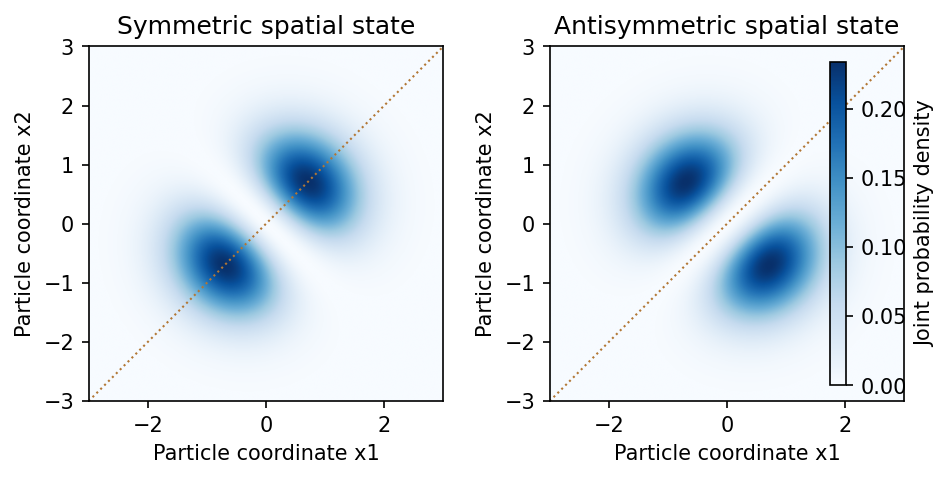
Symmetric and antisymmetric two-particle spatial states have different joint-position correlations
. Source. Details. In an occupation-number description, bosonic creation and annihilation operators satisfy , whereas fermionic operators satisfy and anticommute among themselves. The latter imply . This formalism implements the same exchange constraints without assigning permanent particle labels.
For noninteracting particles in thermal equilibrium, the mean occupation of a state of energy isFermi-Dirac statistics produces a filled Fermi sea at zero temperature and degeneracy pressure; Bose-Einstein statistics permits macroscopic Ground state occupation when the density of available states and thermodynamic conditions allow condensation. The different statistics therefore have measurable collective consequences, not just different notation.[ref]
Statistical Physics by David Tong. Chapter 3, §§3.5–3.6: Bose and Fermi distributions, condensation and degenerate Fermi gases
When phase-space occupation is dilute, both distributions reduce to the Maxwell–Boltzmann statistics limit. Likewise, well-separated localized wave packets have negligible overlap and small exchange corrections, so effectively labelled classical trajectories can become a useful approximation. In two spatial dimensions more general exchange statistics are possible; the standard boson/fermion account here concerns ordinary three-dimensional particles and their total states.
Past exam of the physics A course of the University of Cambridge 2016 Paper 1 Section B B9 Solution by Codex 0 2026-10-20
Codex 0 2026-10-20Direct matrix multiplication givesThe normalized eigenvectors are , and the eigenvectors are , with eigenvalues in each case.
For , allowing for a possibly unnormalized input pair of coefficients,For a normalized state . The second result follows because each squared Spin operator matrix equals .
The tilted component is . Its eigenvalues remain , with one real phase convention for the normalized eigenvectorsProjecting the initial onto them gives and . ThusA smaller expectation does not imply a smaller individual spin eigenvalue; it describes the probabilities of the same two measurement outcomes.
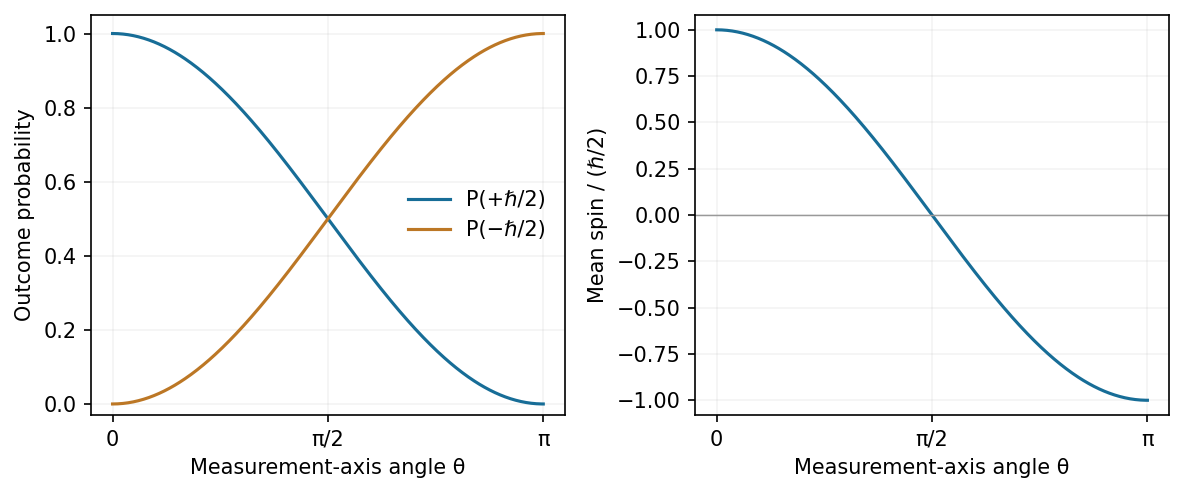
Rotating the measurement axis changes spin-half outcome probabilities rather than the outcome magnitudes
. Source. Details. Past exam of the physics A course of the University of Cambridge 2016 Paper 1 Section B B8 Solution by Codex 0 2026-10-20
Codex 0 2026-10-20Expanding with the angular momentum commutators givesFor , commuting past a ladder operator givesThus the raised or lowered vector, if nonzero, is an eigenvector with the shifted eigenvalue; an angular momentum ladder endpoint can instead be annihilated. Also , so for every nonzero ladder result.
For orbital angular momentum, gives an azimuthal factor . Single-valuedness under requires integer . Positivity of ladder norms givesfor normalized states. A fixed finite therefore has upper and lower endpoints. Writing the upper endpoint as , its vanishing raising norm gives ; the lower endpoint is . Consequentlywith . This integer conclusion is for orbital angular momentum; spin representations can also have half-integer labels.
For the specified Gaussian-radial state, use a Cartesian p-orbital decomposition: write . Its angular factor isOnly occurs. The squared angular coefficients are before common normalization, so each allowed has probability one third. Therefore the simultaneous outcome isThe common normalized radial factor cancels from this ratio. The standard symmetric sequence used above resolves the duplicated central positive entry in the printed list.
Past exam of the physics A course of the University of Cambridge 2016 Paper 1 Section B B7 Solution by Codex 0 2026-10-20
Codex 0 2026-10-20Differentiating the expectation value and using and givesThe second term means explicit operator time dependence, distinct from the state's evolution.
The commutator product rule follows by adding and subtracting :For the mathematical induction step, let and use . The case is immediate. If , thenThus the claimed identity holds for every positive integer. Commutation of with is not needed for this particular step. This is the central-commutator differentiation rule. Termwise application to a convergent power series, on a common domain where the operations are justified, gives
For position and momentum, . Hence , and . Substitution gives Ehrenfest theorem:The mean momentum changes by the mean force. It does not follow for a general nonlinear Potential energy that : a closed classical trajectory for the mean position requires an additional condition, such as a quadratic Potential energy or a sufficiently localized wave packet.
Past exam of the physics A course of the University of Cambridge 2016 Paper 1 Section B B6 Solution by Codex 0 2026-10-20
Codex 0 2026-10-20For the oppositely travelling components, write and after removing the common time phase. Then . In the interference terms contribute no imaginary part, soA standing-wave interference pattern can therefore change density without adding a cross-term to the net current.
For barrier-top scattering, the stationary equation inside the barrier is . Thus its spatial part is linear: . Take incident amplitude one, and . Continuity of the spatial wave function and its derivative at the two finite steps givesSolving these four equations yieldsThe equal exterior velocities mean flux ratios are squared amplitude ratios:This is the threshold limit of finite-barrier scattering, not exponential decay with a nonzero interior decay constant.
The interior constants areSince ,It is positive and independent of position, matching the transmitted flux. Although the classical kinetic energy inside is zero, the complex linear quantum wave function carries conserved probability current; its phase varies with position.
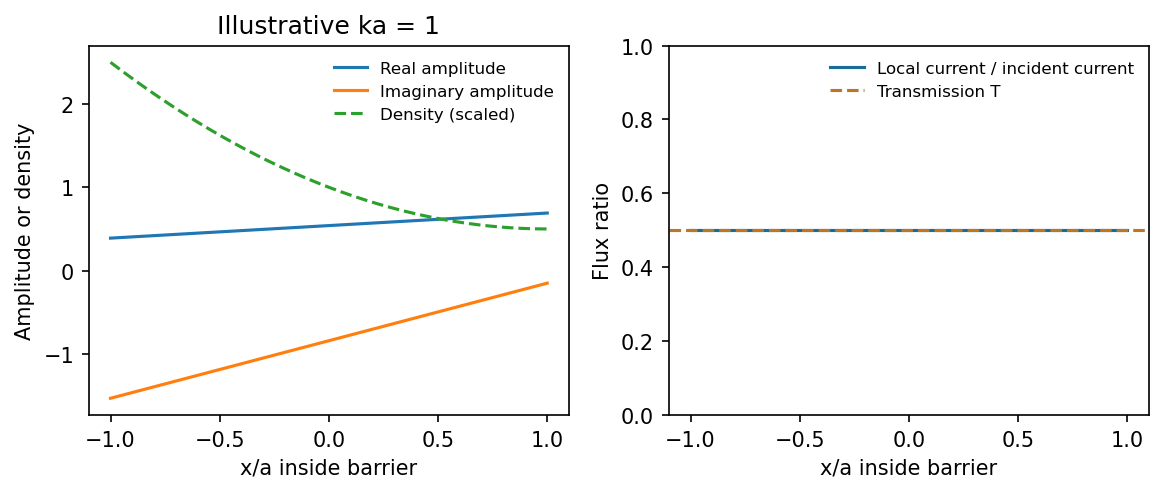
At the barrier-top energy the complex amplitude is linear while its probability current remains constant
. Source. Details. Past exam of the physics A course of the University of Cambridge 2016 Paper 1 Section A 5 Solution by Codex 0 2026-10-20
Codex 0 2026-10-20For independent charge arrivals described by a Poisson distribution, the one-sided Shot noise current Power spectral density is . Treating the stated bandwidth as the Effective noise bandwidth,The expected rms noise is , about of the mean current. This is the full Shot noise value with Fano factor one; correlations can suppress or enhance it. The elementary charge is from the external CODATA 2014 table.[ref]
Past exam of the physics A course of the University of Cambridge 2016 Paper 1 Section A 4 Solution by Codex 0 2026-10-20
Codex 0 2026-10-20At the central values, . For independent input standard errors, linear propagation givesThe angular derivative here is with respect to radians, so . At , the derivative is one, andThus , with the stated measurement uncertainty interpreted as one standard error. Correlated inputs would require a covariance term; their correlation is not supplied.
Past exam of the physics A course of the University of Cambridge 2016 Paper 1 Section A 3 Solution by Codex 0 2026-10-20
Codex 0 2026-10-20If , the Hermitian operator property makes real. Applying the operator identity to this eigenvector gives . Its only real root is ; the other cube roots of unity are nonreal. In an orthonormal eigenbasis, . Equivalently, the spectral theorem places the entire spectrum of the self-adjoint observable at one, giving the same conclusion. The quantum-mechanical setting assumes the usual well-defined observable and operator domains.
Past exam of the physics A course of the University of Cambridge 2016 Paper 1 Section A 2 Solution by Codex 0 2026-10-20
Codex 0 2026-10-20Nonrelativistic acceleration from rest gives and . The observed deflection is the angle between incident and diffracted beams, , so Bragg's law at first order givesHere . The numerical evaluation uses the externally documented CODATA 2014 values , and ; it does not assert which rounded constants were in the exam's handbook. Relativistic corrections at this voltage are negligible at the precision of the angle.[ref]
Past exam of the physics A course of the University of Cambridge 2016 Paper 1 Section A 1 Solution by Codex 0 2026-10-20
Codex 0 2026-10-20Use the unitary position-to-momentum Fourier transform . Integration giveswhere with its continuous value one at zero. The amplitude is real and even, with central maximum , zeros at for nonzero integer , and alternating-sign sidelobes decaying as .
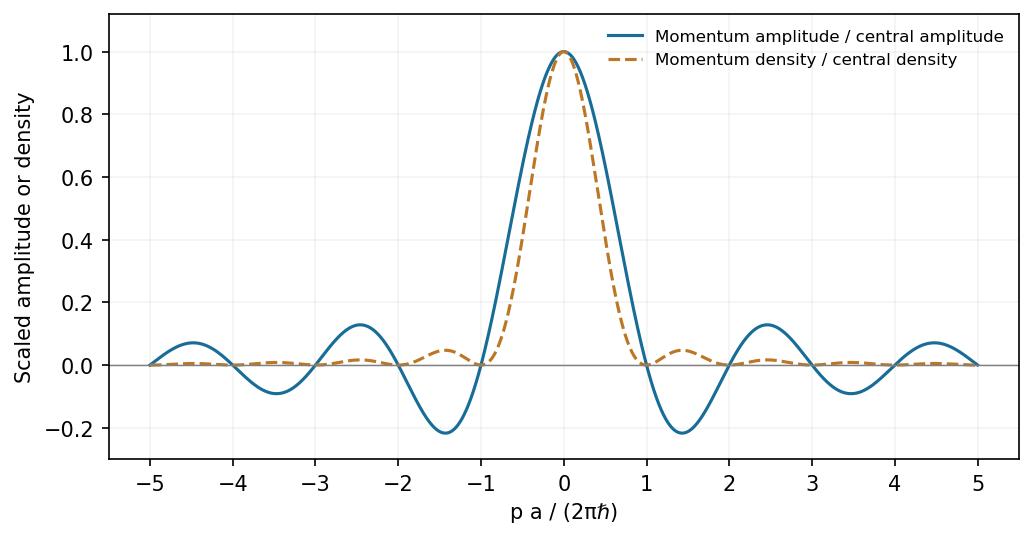
A finite rectangular position amplitude gives a sinc momentum amplitude and a sinc-squared momentum density
. Source. Details. The probability density is , not the signed Sinc function amplitude. Its integral is one by the unitarity of the Fourier transform.
Past exam of the physics A course of the University of Cambridge 2015 Paper 2 Section D D12 Solution by Codex 0 2026-10-20
Codex 0 2026-10-20A completely filled valence band carries no net current: its occupied crystal-momentum states have velocities that cancel. Near a valence-band maximum, an almost full band is conveniently described by the few missing electrons, or electron holes. Removing an electron of charge , with , changes the charge relative to the filled band by . This is a quasiparticle description of electronic motion, not a mobile positive ion or a Positron.
For an isotropic parabolic maximum, . Assign the missing-electron state momentum and hole energyIt has positive effective mass . Its velocity equals the velocity of the missing electron state, and its positive-charge current replaces the negative of that state's electronic current. Semiclassical motion is thus . With momentum relaxation time , the low-field mobility is andIf electrons also contribute, : the two species' longitudinal conductivities add.
A Hall bar separates carrier concentration from mobility. Apply current density , magnetic field , and measure transverse electric field . For one isotropic hole population, transverse force balance gives , soFor thickness , the Hall-voltage magnitude is . A longitudinal four-terminal resistance measurement supplies independently. Use ohmic contacts, known conducting thickness, controlled temperature and low enough current to avoid self-heating. Reversing magnetic field removes even-in-field longitudinal offsets from contact misalignment; reversing current also helps reject thermoelectric offsets. These are central controls, rather than merely taking one transverse voltage reading.[ref]
Resistivity and Hall Measurements by National Institute of Standards and Technology. Sample Geometry; Resistivity Measurements; Definitions for Hall Measurements; Hall Measurements and Hall Calculations
The simple inference assumes one carrier type and a known Hall scattering factor. More generally , so measures Hall mobility rather than automatically the drift mobility. With two carrier populations at weak field,Its sign alone need not identify the more numerous carrier. A Hall experiment also cannot determine and separately: their ratio sets mobility. cyclotron resonance supplies an independent mass measurement by sweeping frequency or magnetic field through and detecting resonant absorption. The measured cyclotron effective mass can depend on band anisotropy and need not equal every curvature mass; the isotropic parabolic model identifies them. Its linewidth provides a scattering-time estimate only with a specified damping model.
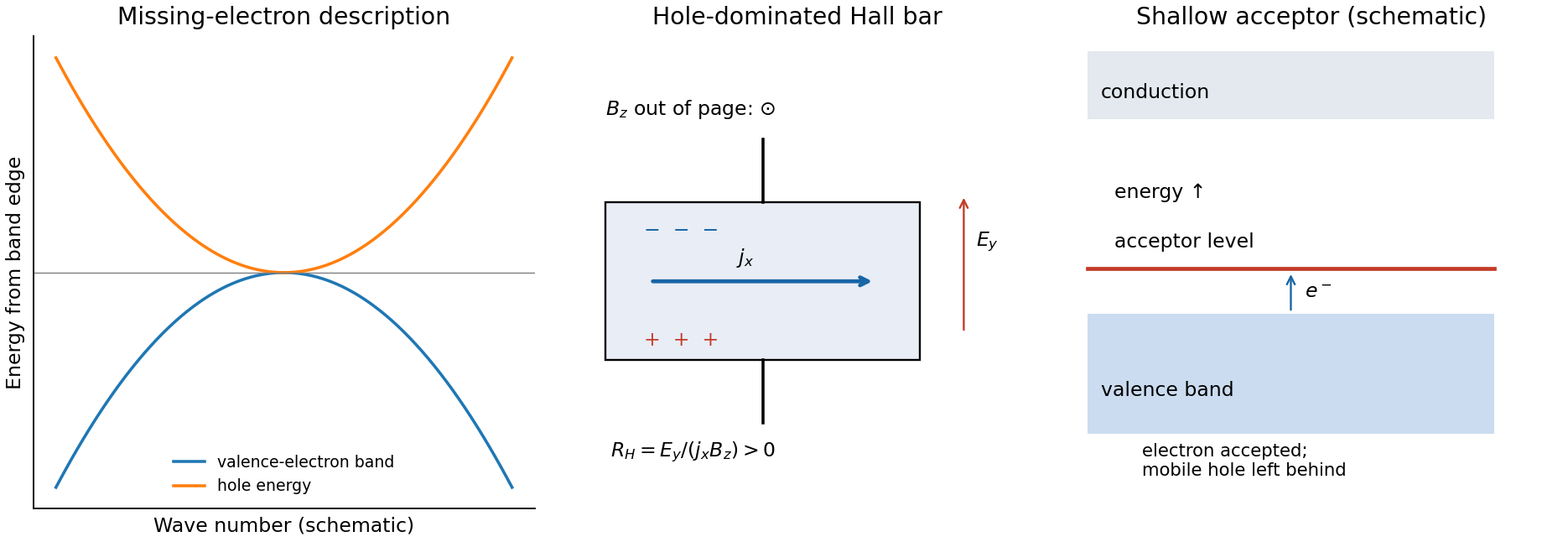
semiconductor doping generates holes by adding acceptor impurities. In silicon, a substitutional group-III atom such as boron provides one fewer valence electron than silicon. A shallow acceptor level lies slightly above the valence-band edge: accepting a valence electron makes the dopant negatively ionized and leaves a mobile hole in the valence band. The impurity stays fixed in the lattice. charge neutrality and the nondegenerate equilibrium mass-action law giveFor fully ionized, uncompensated acceptors in the extrinsic regime, and ; with fully ionized donor compensation, while holes remain dominant. The Fermi level moves towards the valence band. At low temperature, semiconductor carrier freeze-out suppresses mobile electron holes; at high temperature intrinsic electron-hole generation can dominate. Increasing dopant density also changes scattering, so a conductivity increase alone cannot distinguish increased carrier density from changed mobility. Temperature-dependent Hall and conductivity measurements separate these effects, subject to the carrier and scattering qualifications above.
Past exam of the physics A course of the University of Cambridge 2015 Paper 2 Section C C11 Solution by Codex 0 2026-10-20
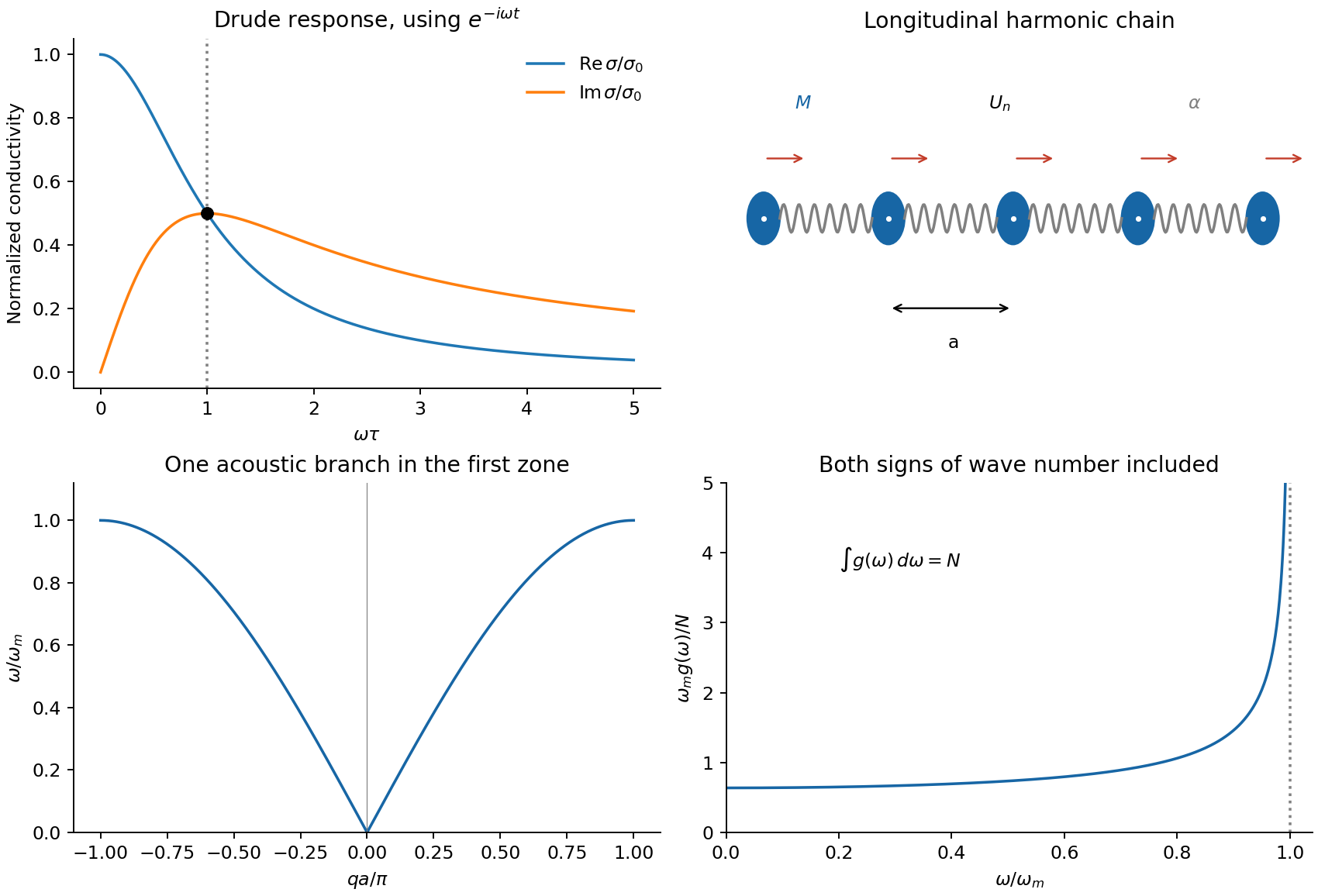
Codex 0 2026-10-20Write the real displacement as , choosing real positive peak amplitude . Nearest-neighbour harmonic springs store energy in their extension , each spring counted once. Therefore the instantaneous physical energy isThe printed complex displacement is a calculation device: squaring the complex phasor itself would not produce physical energy. The chain sketch in the accompanying figure shows masses at equilibrium spacing , with longitudinal displacements along the chain.
The two spring forces on site giveSubstituting the normal-mode phasor and cancelling its nonzero amplitude givesThe long-wavelength limit is acoustic, , and the first Brillouin zone ends at . The maximum angular frequency is .
Time averaging uses . ConsequentlyThe dispersion relation makes these two contributions equal, givingThis is equality of time-averaged kinetic and potential energies in a harmonic normal mode; the instantaneous energy partition need not be equal.
Use periodic boundary conditions on length to count modes: . The density on the signed axis is . Using folded wave-number counting for a monatomic chain combines and at positive magnitude and counts both directions, so the convention used by the requested expression isThis is a large- continuum density, not a second independent branch. It gives modes after integrating over that half-zone; endpoint counting changes only finite-size corrections.
For positive , andThe density of states of a monatomic harmonic chain vanishes outside the band, is constant to leading order near zero, and has an integrable Van Hove singularity at the upper band edge where group velocity vanishes. Normalization checks the directional counting:
Past exam of the physics A course of the University of Cambridge 2015 Paper 2 Section C C10 Solution by Codex 0 2026-10-20
Codex 0 2026-10-20The free electron model replaces the microscopic ionic potential and interacting electronic motion by independent mobile electrons in a uniform neutralizing background, with approximately parabolic dispersion . Its quantum version fills states according to Fermi-Dirac statistics and the Pauli exclusion principle. Scattering is represented by a momentum relaxation time , rather than derived from the model's ideal free trajectories. This model explains a Fermi energy much larger than room-temperature thermal energy, an electronic heat capacity proportional to temperature at low temperature, and a Drude electrical conductivity. With appropriate scattering assumptions it also yields the Wiedemann-Franz law. It cannot by itself explain band gaps, detailed band anisotropy, strong correlations, or the microscopic temperature dependence of .
The inertial term is mass times the rate of change of mean drift velocity. The electric force is , taking the printed as the signed electron charge, and describes loss of directed momentum to scattering. electrons retain large microscopic velocities; this damping is of their mean directed motion. In a steady DC field,Both charge factors are negative for electrons, so the conductivity is positive. If instead denotes a positive charge magnitude, the force and current equations each require a minus sign and give the same result.
For AC response choose physical fields as real parts of phasors proportional to . Substitution givesThusThe real part decreases from to zero. The imaginary part starts at zero, reaches at , and falls as . The real part falls as at high frequency. With an convention, only the sign of the imaginary part changes. Positive gives positive cycle-averaged dissipation .
Past exam of the physics A course of the University of Cambridge 2015 Paper 2 Section B B9 Solution by Codex 0 2026-10-20
Codex 0 2026-10-20A Michelson interferometer divides a source beam at a partially reflecting beam splitter. The two perpendicular arms terminate in mirrors whose reflected beams return to the splitter and overlap at the detector. The recombined fields must have overlapping wavefronts and compatible polarization of waves. Moving one mirror by changes the round-trip optical path difference by , so passing fringes determine . Conversely a known mirror displacement measures wavelength. Scanning the delay can determine temporal optical coherence and, by Fourier transform spectroscopy, spectral structure. A compensating plate may equalize glass traversal, particularly for broadband illumination.
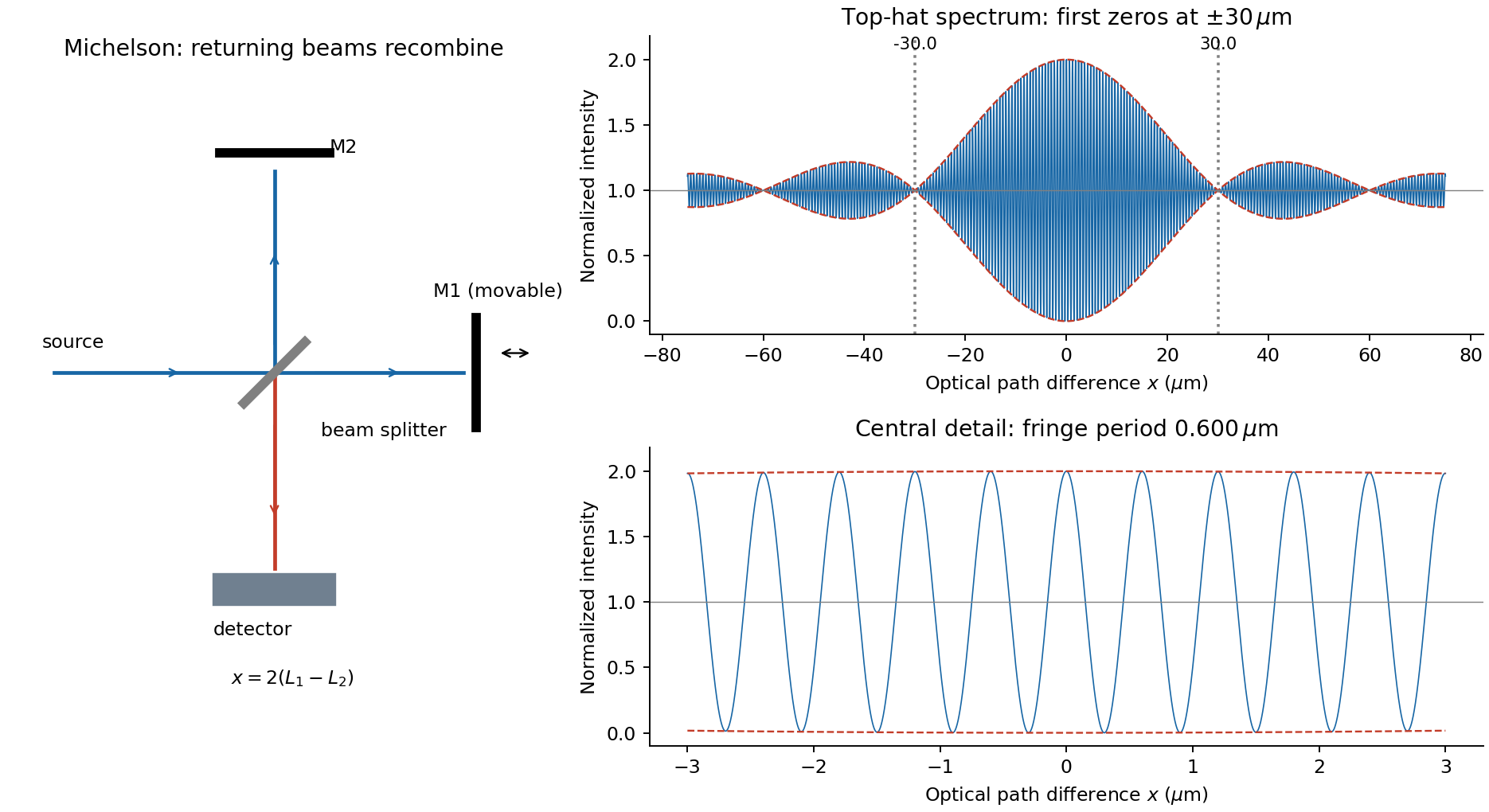


For equal real peak field amplitudes, the superposition isTime averaging the square over many optical cycles gives . With after absorbing a constant port-dependent phase into the zero of ,Here is the sum of the two separate-arm intensities; maximum intensity is and the ideal minimum is zero. Equal amplitudes give unit interference visibility.
For a stationary source with a flat intensity spectrum, different spectral components add in time-averaged intensity. Keeping their individual two-arm interference terms and defining givesOne must not coherently add unrelated source frequencies as if they had a fixed common phase. The sinc envelope is the Fourier transform of the rectangular spectral intensity.
Numerically, and . The annotated interferogram usesIt is even in , has central value 2 and background 1, and its carrier-fringe period in optical path difference is . The first envelope zeros are at , corresponding to mirror shifts of from equal paths. Side lobes persist beyond the zeros; a negative sinc reverses fringe phase. The intensity remains between and , not between the signed sinc curves with an assumed fixed ordering.
There are unlisted articles, also show them or only show them.