Past exam of the physics A course of the University of Cambridge 2014 Paper 1 Section A 5 Solution by  Codex 0 2026-10-20
Interpret the quoted r.m.s. as the root-mean-square fluctuation about the mean, namely the standard deviation . Standardization gives . The supplied cumulative Gaussian curve gives , henceThe exact Gaussian value is . A raw r.m.s. temperature of could not coexist with a mean of ; the spread interpretation is required.
Past exam of the physics A course of the University of Cambridge 2014 Paper 1 Section A 4 Solution by Codex 0 2026-10-20
Codex 0 2026-10-20Let denote detection. Weight each incident fraction by its detection efficiency, not by its loss probability. Bayes' theorem givesThus about 2.83% of detected particles are in the high-energy group. Energy-dependent detector dead time changes the composition of the observed sample.
Past exam of the physics A course of the University of Cambridge 2014 Paper 1 Section A 3 Solution by Codex 0 2026-10-20
Codex 0 2026-10-20Confinement to length gives a momentum scale by the Heisenberg uncertainty principle. Using the alpha-particle mass , its speed scale is . Counting encounters with either wall,This is an order-of-magnitude collision-rate estimate, not a classical trajectory of a stationary quantum state. Taking , a different geometric interpretation of the well size, or successive returns to the same wall changes the coefficient by factors of order unity; the robust scale is .
Past exam of the physics A course of the University of Cambridge 2014 Paper 1 Section A 2 Solution by Codex 0 2026-10-20
Codex 0 2026-10-20Choose the centre of the finite square well as the origin and its edges as . The first three bound wavefunctions have even, odd, even parity, with respectively zero, one and two interior nodes. They oscillate inside and decay exponentially outside, with . Both the wavefunction and its first derivative are continuous at each finite potential step. The higher bound states have longer external decay lengths because they lie closer to the barrier height. Overall sign is arbitrary.
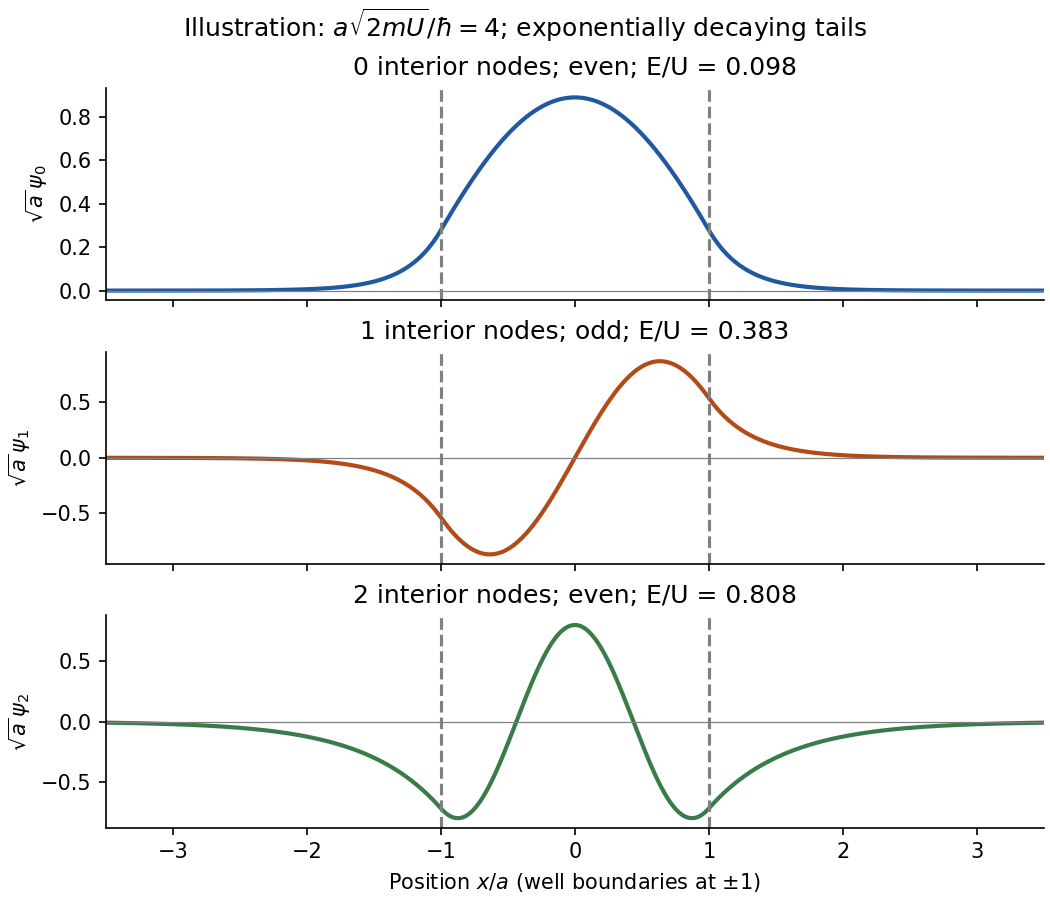
Original normalized finite-well eigenfunctions with parity, nodes and exponential tails; illustrative dimensionless depth, not supplied numerical data
. Details. 
Past exam of the physics A course of the University of Cambridge 2014 Paper 1 Section A 1 Solution by Codex 0 2026-10-20
Codex 0 2026-10-20Write the one-electron Coulomb energies as , . The Pauli exclusion principle allows electrons in shell , including spin. The ground configuration therefore has two electrons in and seven in , giving . The least energy-increasing promotion is from to :Rearranging the partly occupied degenerate shell does not produce a higher energy. Both total energies are negative, so this ratio is below one even though .
Past exam of the physics A course of the University of Cambridge 2013 Paper 2 Section D D12 Solution by Codex 0 2026-10-20
Codex 0 2026-10-20The Debye model replaces the crystal by a harmonic elastic continuum with acoustic dispersion . It counts three polarizations and introduces a cutoff so that the total number of vibrational modes is , where is the atom count. Periodic-box counting givesFor an isotropic average speed, . With cutoff frequency fixed by the mode count,This density of states is quadratic because a three-dimensional shell has volume proportional to and the acoustic dispersion is linear. The cutoff is a mode-counting device; it is not a claim that every actual branch stays linear to the zone boundary.
Each phonon mode has mean thermal energy , using Bose-Einstein statistics with zero phonon chemical potential. The fixed harmonic zero-point contribution has zero temperature derivative. With ,and differentiating at fixed volume givesFor , extend the upper limit to infinity. Expanding gives . integration by parts makes the heat-capacity integral , soOnly modes with are appreciably excited; their number scales as , explaining the power law physically. At high temperature every mode contributes , giving the Dulong-Petit limit .
The model assumes the harmonic approximation, a macroscopic three-dimensional solid and acoustic continuum behaviour for the thermally populated modes. Anisotropic sound speeds change the low-temperature coefficient rather than its cubic power. Real optical branches and nonlinear acoustic dispersion limit the full-temperature approximation; electronic excitations can add a linear term in a metal, and anharmonicity produces thermal expansion and distinctions between and . At temperatures below the lowest finite-sample mode, the bulk continuum law also fails. Thus the result is the low-temperature lattice contribution, not a universal total heat capacity for every solid.
Past exam of the physics A course of the University of Cambridge 2013 Paper 2 Section C C11 Solution by Codex 0 2026-10-20
Codex 0 2026-10-20One mass per cell. If is the displacement from equilibrium, the two springs give . Substituting yieldsThe first Brillouin zone is ; adding leaves the sampled displacements unchanged. The branch is linear near zero, with sound speed , and reaches at either zone edge.
Two masses per cell. Take a cell of length , with light displacement and heavy displacement . The coupled equations reduce toA nonzero displacement requires determinant zero:Solving this quadratic in givesNow the first zone is . The minus branch is acoustic: as , both sublattices move together and . Its sound speed is . The plus branch is optical: at the atoms move oppositely with , giving finite frequency . This terminology describes relative motion; optical activity itself also requires coupling to the electromagnetic field.
diatomic-chain zone-edge polarizations and dimensionality. At the edge, , so the heavy and light sublattices decouple: the acoustic edge frequency is and the optical edge frequency is . HenceThe acoustic edge mode moves only the heavy sublattice; the optical edge mode only the light one. If , the gap closes and the two branches are the zone-folded monatomic branch.
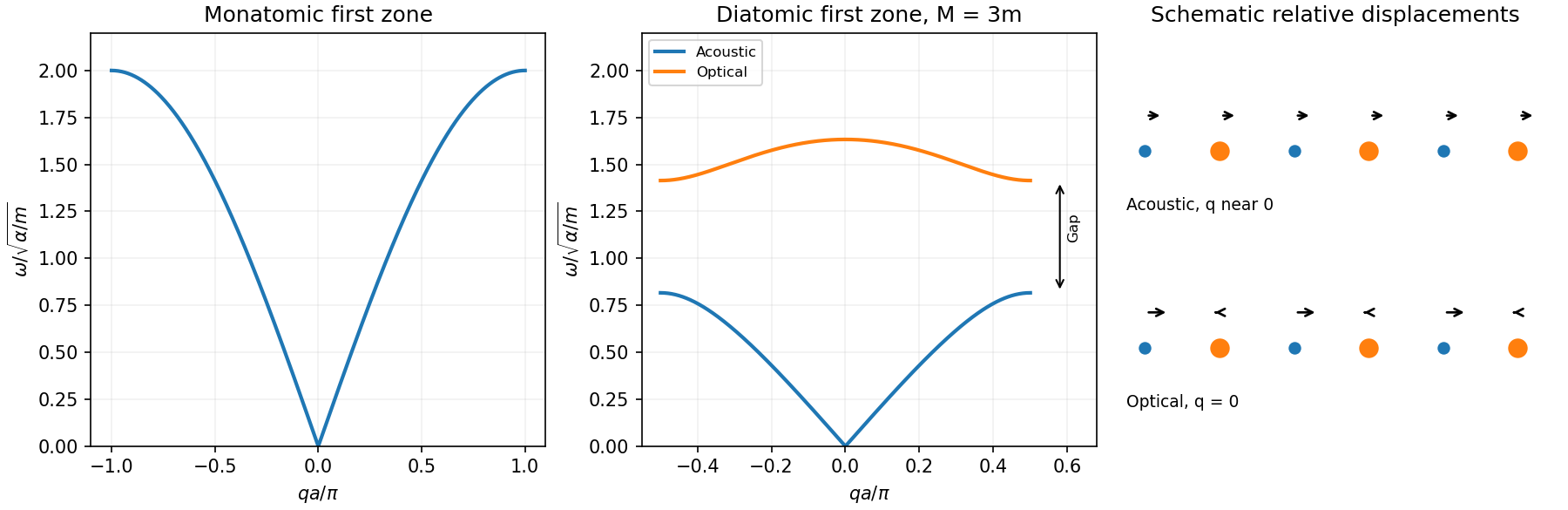
Original monatomic and diatomic chain dispersions, zone-edge gap and long-wavelength displacement patterns
. Details. 
A three-dimensional crystal with two atoms per primitive cell has six branches: three acoustic and three optical. For propagation along a suitable symmetry direction these resolve into one longitudinal and two transverse branches of each type. The wavevector and Brillouin zone are three-dimensional; anisotropic force constants determine the dispersions, and polar crystals can have longitudinal–transverse optical splitting. A universal six-branch curve cannot be specified from masses alone.
Past exam of the physics A course of the University of Cambridge 2013 Paper 2 Section C C10 Solution by Codex 0 2026-10-20
Codex 0 2026-10-20spin normalization in two-dimensional free-electron state counting. Treat the mobile electrons as independent particles in a constant interior potential, with parabolic dispersion , and impose confinement or periodic boundary conditions. electron–electron interactions and the detailed periodic ionic potential are neglected, while Fermi statistics are retained. Each spatial state occupies area in two-dimensional wavevector space. For spin degeneracy ,The printed coefficient is the per-spin density of states. Unpolarized spin-one-half electrons have , doubling it. Actual graphene near its Dirac points has approximately linear dispersion, so its energy-dependent density of states is not this parabolic-model result; the plane geometry alone does not establish the free-electron dispersion.[ref]
Two-Dimensional Gas of Massless Dirac Fermions in Graphene by Konstantin Novoselov and others. Abstract: massless Dirac charge carriers rather than a finite-mass parabolic band
Occupied disk and Fermi energy. At zero temperature fill the lowest states up to a disk of radius . State counting givesThus the physical spin-degenerate result is . If instead counts one spin species, the per-spin convention gives . Each occupied wavevector can contain one electron of each allowed spin, never two in the same complete one-particle state.
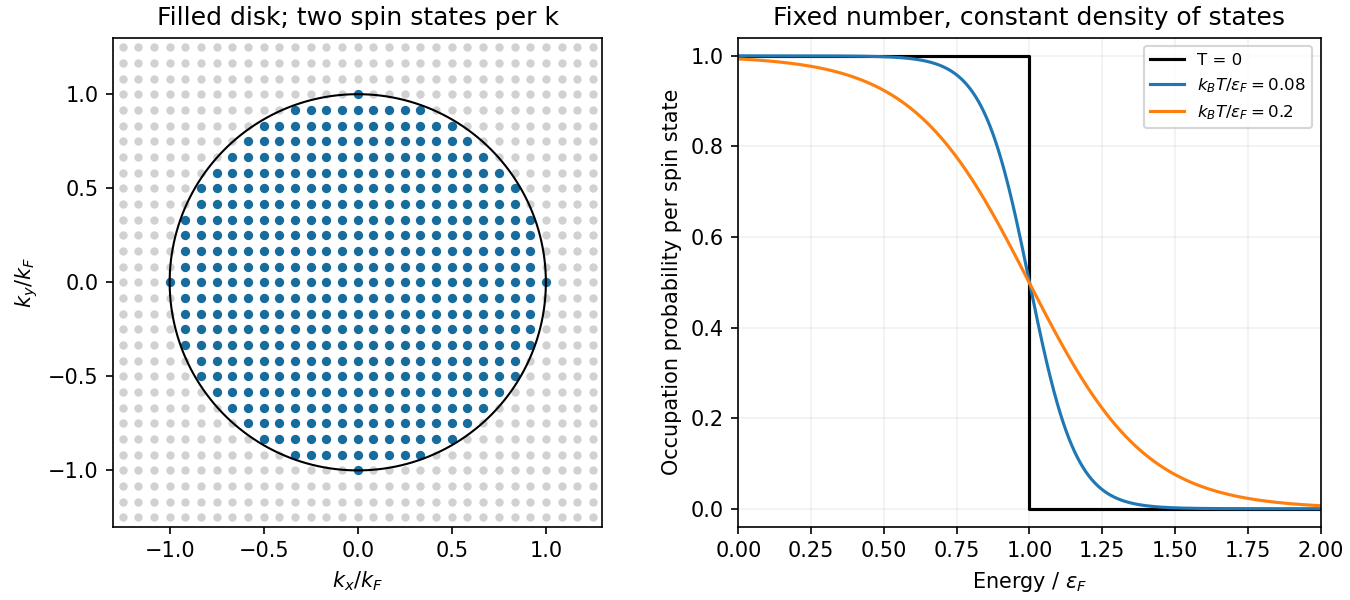
Original occupied wavevector disk and Fermi-Dirac occupations for a parabolic two-dimensional electron gas
. Details. 
Occupation probability and chemical potential of a two-dimensional ideal Fermi gas. A single fermion state permits occupation zero or one. In a grand canonical ensemble their relative weights are and . Normalizing givesThe chemical potential is fixed by the total particle number. Here the total density of states is constant above the band bottom. Integrating the occupation gives , and thereforeThe approach is exponentially close in this ideal two-dimensional constant-density-of-states model; a three-dimensional correction should not be inserted here. A narrow interval of width of order around is thermally smeared.
Past exam of the physics A course of the University of Cambridge 2013 Paper 2 Section B B9 Solution by Codex 0 2026-10-20
Codex 0 2026-10-20Far-field transform. For transverse aperture scale and screen distance , the quadratic phase across the aperture is negligible when , equivalently a small Fresnel number up to geometrical factors. Expanding the source-to-screen distance at transverse screen coordinate givesDropping the final aperture-dependent term and treating the prefactor as constant givesThus intensity is the modulus squared of the aperture Fourier transform. A lens focal plane supplies the same angular transform without a very distant screen. The infinitely extended vertical dimension is treated per unit vertical extent.
half-slit phase-reversal diffraction. Put on the left half and on the right half. With and ,ThereforeThe apparent singularity at zero angle is removable: , so the centre is dark. Normalizing by the uncoated slit's on-axis intensity gives . Noncentral zeros have , or . The two largest lobes are symmetric, at the first nonzero root of , , giving when those directions propagate. Smaller lobes lie farther out under a decaying envelope.
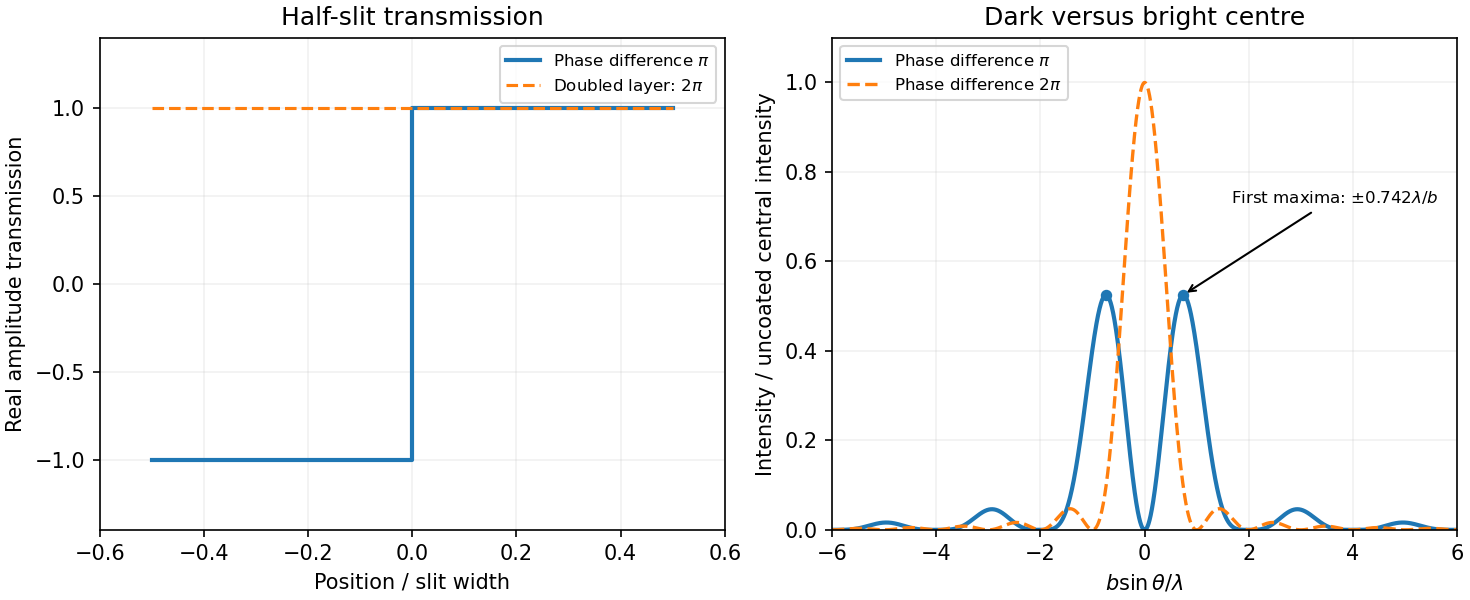
Original calculated half-slit phase-reversal pattern and its change when the phase-layer thickness is doubled
. Details. 
Doubled thickness. Neglecting absorption and interface reflection, the phase delay doubles from to . Both halves then transmit with the same phase, recovering the ordinary single-slit patternIt has a bright centre and first zeros at . The phase layer redistributes transmitted power rather than absorbing it in this idealization.
Past exam of the physics A course of the University of Cambridge 2013 Paper 2 Section B B8 Solution by Codex 0 2026-10-20
Codex 0 2026-10-20Packet and group index. A wave packet superposes nearby wavevectors to form a localized envelope. The phase velocity is ; for a narrow packet with weak distortion the envelope velocity is . Since ,For the stipulated linear index, , not simply .
bandwidth and speed spread. A pulse lasting has Fourier bandwidth of order , so ; an exact width coefficient depends on pulse shape and width convention. At the carrier,Across a full bandwidth ,Higher-frequency components have the lower group velocity. For a band symmetric about , the endpoint velocities are approximately .
dispersion-limited digital-fibre link length. Differential group delay accumulates asThe pulse spacing is . Pulse overlap and intersymbol interference become serious when the dispersive spread approaches that spacing, givingA conservative full-width estimate gives about 45 km; this refinement is not a universal sharp boundary because pulse shape, chirp and detection tolerance are unspecified. Attenuation and modal or waveguide dispersion could impose further limits, but are not quantified by the supplied index law.
digital optical pulse regeneration. Each stage must recover and regenerate the data with fresh, short pulses and correct timing, as well as restore signal level. Amplifying the already broadened waveform alone does not remove accumulated dispersion; explicit dispersion compensation is an alternative to full regeneration.
Past exam of the physics A course of the University of Cambridge 2013 Paper 2 Section B B7 Solution by Codex 0 2026-10-20
Codex 0 2026-10-20Response and resonance. The terms , and describe inertia, linear viscous resistance and the spring's restoring force; the right side is the applied harmonic force. Substituting the complex trial motion and taking real parts givesThe steady response excludes the decaying homogeneous transient. Its magnitude is . Differentiating the denominator gives , soA nonzero-frequency amplitude maximum exists only for ; otherwise the maximum is at zero frequency. Increasing damping lowers and broadens the peak and shifts it downward. Every curve starts at and tends to at high frequency.
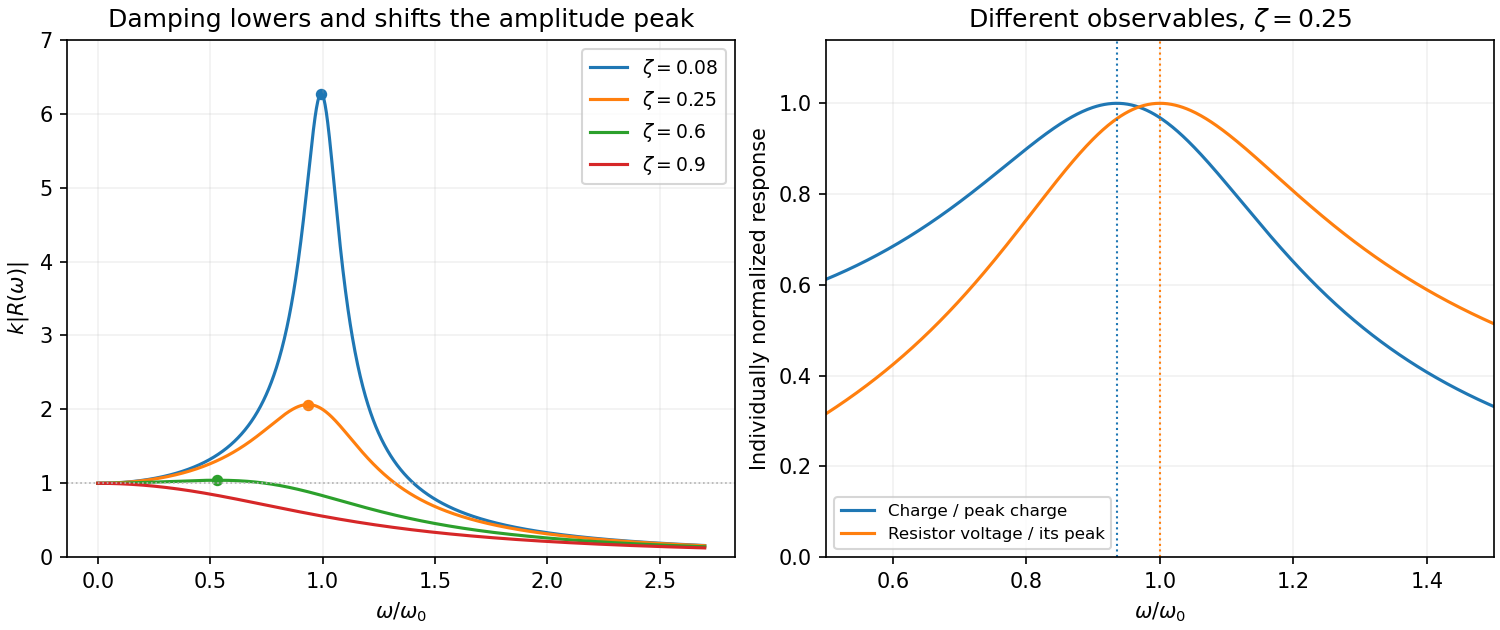
Original normalized oscillator response for several damping ratios, distinguishing amplitude and current resonance
. Details. 
Series circuit. The PDF circuit has the resistor, inductor and capacitor in one loop. With current , Kirchhoff's voltage law gives , henceThus correspond to . The resistor's rms voltage isIt is maximized exactly at for . The charge-amplitude resonance is lower. Expanding its square root for givesThe two maxima refer to different observables: resistor voltage follows current, whereas charge follows displacement.
Past exam of the physics A course of the University of Cambridge 2013 Paper 2 Section B B6 Solution by Codex 0 2026-10-20
Codex 0 2026-10-20time average of harmonic power. Expand the two real parts:The terms proportional to average to zero over complete periods, while is time-independent. For real peak amplitudes this is .
String dynamics. A short element of length experiences transverse force . Newton's second law therefore gives , orThe approximation is a flexible, lossless string with small slope and constant tension; is its linear mass density.
energy transport. Across a cut toward increasing , the transverse force is and the transverse velocity is . For a rightgoing wave these have complex amplitudes and . HenceThis real mechanical impedance is force divided by transverse velocity for a travelling wave, with units .
Matching and power ratios. At an ordinary massless junction without an external transverse force, displacement is continuous and transverse tension is balanced: , . For the same tension, the slope is therefore continuous even if density changes. With real positive impedances,Their sum equals ; the transmitted power includes the impedance ratio and is not simply .
Past exam of the physics A course of the University of Cambridge 2013 Paper 2 Section A 5 Solution by Codex 0 2026-10-20
Codex 0 2026-10-20In the Hall effect, the Lorentz force deflects drifting charge carriers until a transverse electric field balances it: . Choose current along , field along and define . Since ,The sign is negative for electrons with this convention. If the sample's mass density is and its molar mass is , the atomic number density is , soMeasure the transverse voltage, specimen thickness, current and magnetic field; reversing field and current helps remove longitudinal-voltage pickup and offsets. This free-electron count from a Hall coefficient assumes one approximately free carrier band. Multiple bands, unequal mobilities or a complicated Fermi surface can make a Hall coefficient differ from .
Past exam of the physics A course of the University of Cambridge 2013 Paper 2 Section A 4 Solution by Codex 0 2026-10-20
Codex 0 2026-10-20For conventional cubic cell side , the face-centered cubic lattice has corner and face-centre sites, giving four lattice points per cell; the body-centered cubic lattice has corners and a body centre, giving two. Their primitive unit cells each contain one lattice point. With reciprocal vectors written , face-centered cubic lattice allows all even or all odd, while body-centred cubic allows even. HenceHere is the side of the reciprocal lattice's conventional cubic cell. The parity conditions describe the reciprocal point sets; reciprocal space contains wavevectors, not a second arrangement of physical atoms.
Past exam of the physics A course of the University of Cambridge 2013 Paper 2 Section A 3 Solution by Codex 0 2026-10-20
Codex 0 2026-10-20 There are unlisted articles, also show them or only show them.