Past exam of the physics course of the year 1 of the natural sciences course of the University of Cambridge 2014 Paper 1 E14 Solution by  Codex 0 2026-10-20
An inverse-square field spreads through area proportional to squared distance. More generally the flux contribution of a point source is proportional to the solid angle subtended by a surface element; the oriented solid angles sum to for an enclosed source and zero for an exterior one. Superposition extends this to a mass distribution.
Newton's law of universal gravitation gives for a point mass. A surrounding sphere therefore has flux , soFor the tunnel, approximate its water as an infinite uniform cylinder with and density . The bob is at radial distance . A coaxial Gaussian surface givesFor the plumb-line deflection from cylindrical gravity, horizontal equilibrium gives . Draining removes the attraction toward the tunnel, so the bob shifts away byThe unchanged rock and ordinary gravitational field cancel in the before/after comparison; end effects and mechanical disturbances are neglected.
For the tidal water loading of a spring balance, approximate the extra water at high tide as an infinite plane slab of thickness , with the suspended mass above it. The gravitational field of an infinite plane sheet, derived with a pillbox Gaussian surface, gives added downward field . With initial spring extension ,The extension increases at high tide. These estimates use and the stated water-density approximation; salinity, finite estuary geometry and terrestrial tidal deformation alter a real measurement.
Past exam of the physics course of the year 1 of the natural sciences course of the University of Cambridge 2014 Paper 1 D13 Solution by Codex 0 2026-10-20
Codex 0 2026-10-20Represent each wave by a complex phasor. Add phasors before squaring: two amplitudes give . For equally illuminated narrow slits, adjacent phasors differ by , soAll phasors align when , giving the grating equationThe nearest zero has adjacent-phase increment : the phasor polygon closes once. Thus , givingThe angular linearization is valid away from grazing directions; the underlying exact first-zero condition is .
For the first subsidiary maximum of a large slit array, use the stipulated phasor wraps: relative to a principal maximum. Its amplitude is approximately times one slit's amplitude. ThereforeThis uses the question's approximate maximum position, not the exact extremum of the slit-array intensity.
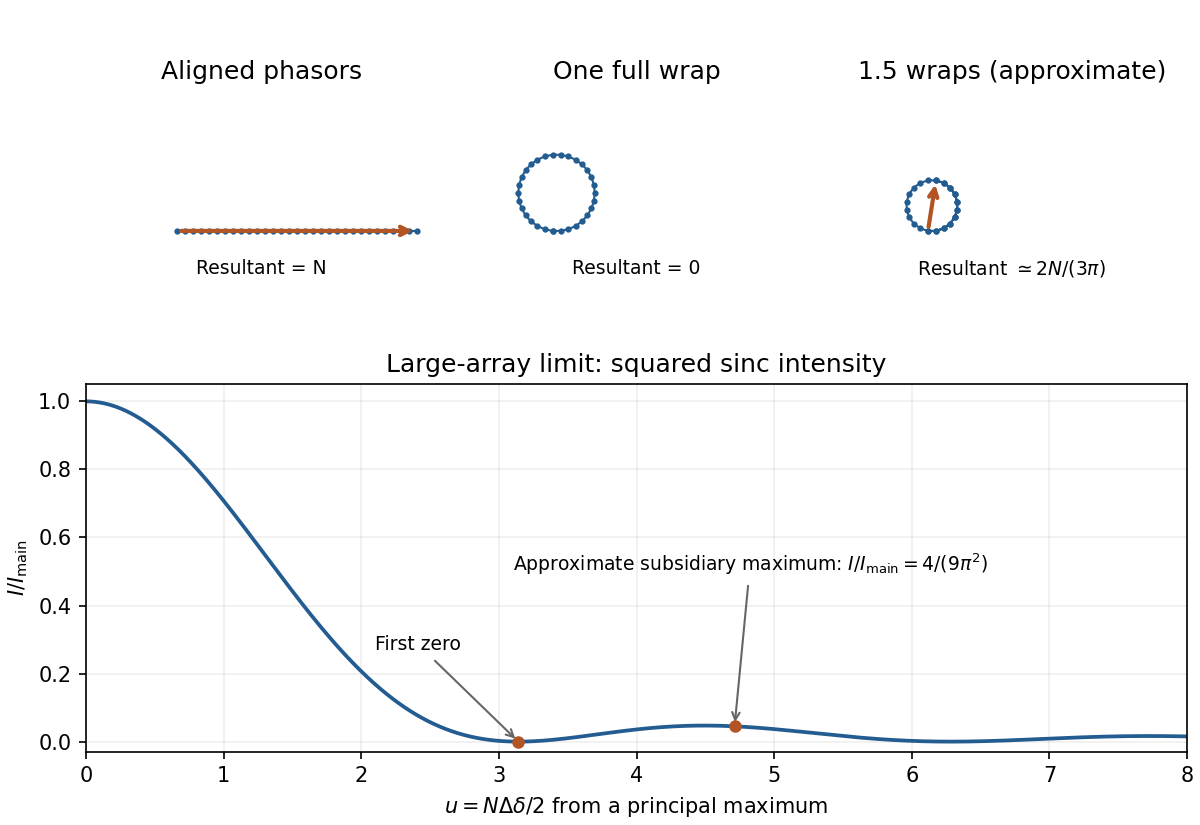
Original phasor sums for a principal maximum, the adjacent zero and the approximate first subsidiary maximum; calculated large-array intensity shown below
. Details. 
The Rayleigh criterion places one line's principal maximum at the other's first minimum. Grating dispersion then gives . Combining with normal incidence, , gives the normal-incidence grating width bound:The value is an ideal lower bound approached near grazing diffraction. A usable finite angle needs greater width; for example requires about . The exact sine first-zero relation still gives the lower bound when the local angular approximation fails near grazing.
Such a coherently illuminated grating is very large and needs accurate groove placement and suitable collection optics; an unaided far-field screen would require distances much greater than . Focusing optics avoid that screen distance but not the required resolving power of a diffraction grating. Real linewidth, slit width and aberrations can require more resolution. The unequal isotope abundances also make this ideal Rayleigh estimate less decisive than for equally bright lines.
Past exam of the physics course of the year 1 of the natural sciences course of the University of Cambridge 2014 Paper 1 D12 Solution by Codex 0 2026-10-20
Codex 0 2026-10-20A travelling wave, for example , has moving constant-phase surfaces. A standing wave, for example , has stationary nodes and can be formed from two equal counterpropagating waves.
For the half-line finite well with , define and . The hard wall requires for and , so the general allowed forms areAt the finite step both and are continuous:There is no requirement to match the derivative to zero across the infinite wall.
For a bound state , put . Normalizability excludes the growing exponential, leaving inside and outside. Matching their logarithmic derivatives givesThe exterior expression is equivalent to by rescaling its constant. Negative cotangent first occurs for ; all higher allowed intervals also have . Thus . Since , a normalizable bound state requiresThis is also sufficient: on the lowest negative-cotangent branch, the two matching sides cross whenever . The printed non-strict inequality includes the threshold limit. At equality and the exterior is not square-integrable, so it is not itself a bound state.
Past exam of the physics course of the year 1 of the natural sciences course of the University of Cambridge 2014 Paper 1 C11 Solution by Codex 0 2026-10-20
Codex 0 2026-10-20For U-tube liquid oscillation, define positive as the fall of the left surface, equal to the rise of the right surface. The hydrostatic height difference is . Moving a volume against this height difference gives , henceEnergy conservation yields . Equivalently the net pressure force is , so the equation holds also at turning points:With negligible added volume, , . ThusThe graph starts at zero with positive slope and first reaches its maximum after .
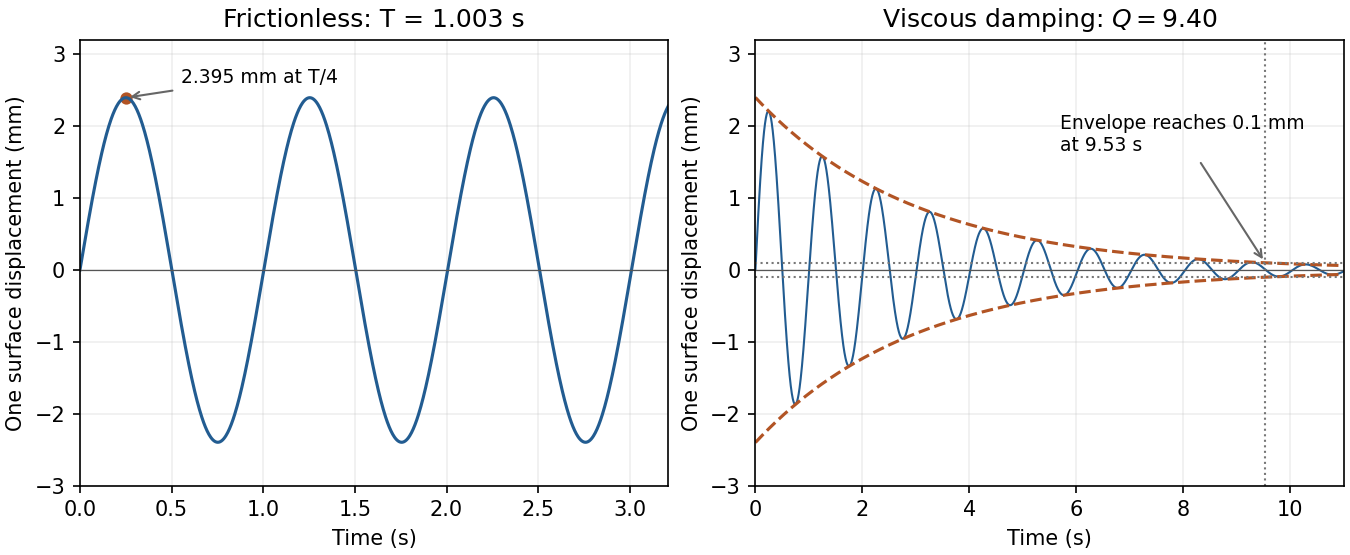
Original U-tube displacement solutions: the requested frictionless oscillation and the viscously damped response with exponential envelopes
. Details. 
For viscously damped U-tube oscillation, the total damping force is , not . ConsequentlyThe underdamped initial-value solution is , where . Setting its amplitude envelope equal to givesThis is the decay of the envelope, not the first time the instantaneous displacement passes through .
Past exam of the physics course of the year 1 of the natural sciences course of the University of Cambridge 2014 Paper 1 C10 Solution by Codex 0 2026-10-20
Codex 0 2026-10-20For sinusoidal steady state with convention , complex impedance is the voltage phasor divided by the current phasor. Its modulus is the amplitude ratio and its argument is the voltage-current phase difference. Since ,The original circuit is a series RLC circuit with output across the inductor. Its transfer function isFor the original capacitance, the outputs are at and at , a ratio . The current resonance is , so the circuit favors the first transmitter.
The resistor voltage is in phase with the current; the inductor voltage leads it by and the capacitor voltage lags by . Large reactive voltages therefore nearly cancel in their phasor sum. A large inductor voltage is consistent with a small supply voltage: it is inductor voltage magnification, not power gain in a passive circuit.
Reducing the capacitance raises to , between the two transmitters. Direct evaluation gives and , respectively. Their similar detunings give approximately equal amplitudes; they are not exactly equal, partly because the numerator of also depends on frequency.
The two-tone output of a linear resonant circuit, for coherent monochromatic sources of equal input amplitude and arbitrary fixed input phases, isWith , this is approximatelyThus a rapid oscillation has a beat envelope repeating in magnitude at . The signed envelope cosine has frequency . Unequal amplitudes leave a small nonzero envelope minimum; independently drifting transmitter phases make the beating drift. No new frequency is generated by this ideal linear circuit.
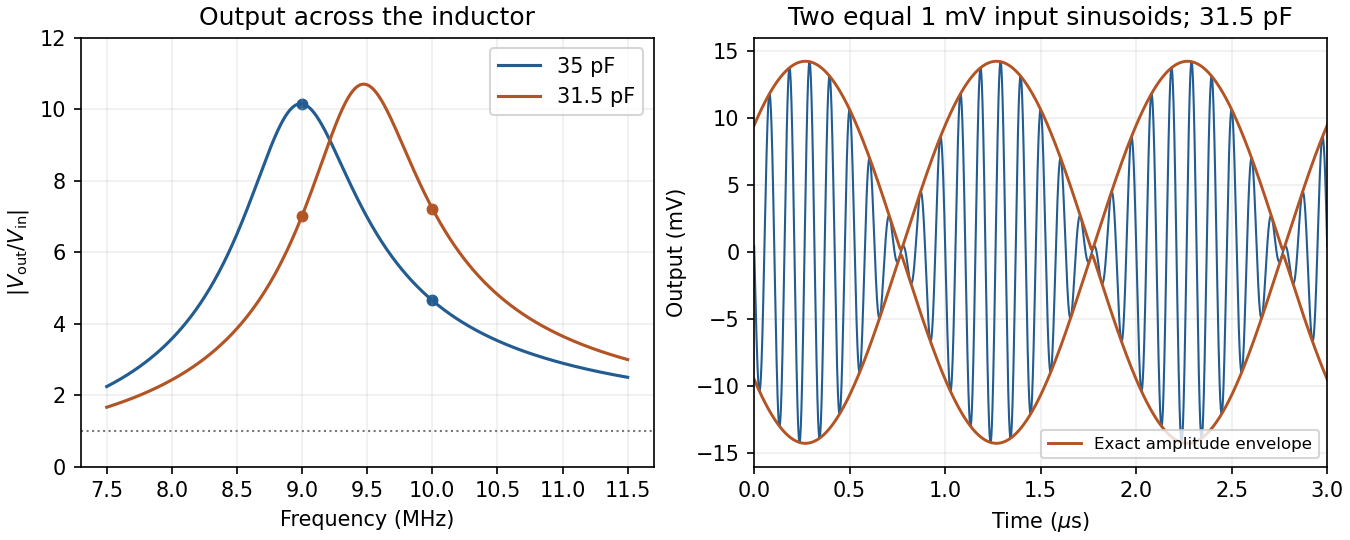
Original calculated inductor-voltage gains and illustrative two-tone output, including the circuit's frequency-dependent phase shifts
. Details. 
Past exam of the physics course of the year 1 of the natural sciences course of the University of Cambridge 2014 Paper 1 B9 Solution by Codex 0 2026-10-20
Codex 0 2026-10-20About a specified axis, the moment of inertia is , giving rotational kinetic energy for fixed-axis rotation. With square coordinates centred on the plate,The in-plane inertia isotropy of a square plate follows using the perpendicular axis theorem, which gives . For any in-plane central axis at angle , the perpendicular in-plane axis has the same inertia by the square's rotational symmetry. Their sum is , so every such in-plane axis has .
The parallel axis theorem gives hinge inertia . During the short impulse gravity is negligible, and the hinge impulse has no moment about the hinge. ThereforeThe hinge impulse of an edge-pivoted square plate follows from linear momentum: . Taking its positive direction to be that of the applied impulse,Generally alone does not supply the centre-of-mass momentum compatible with rotation about the fixed hinge, so the hinge supplies the difference. Its impulse vanishes at the centre of percussion,
Past exam of the physics course of the year 1 of the natural sciences course of the University of Cambridge 2014 Paper 1 B8 Solution by Codex 0 2026-10-20
Codex 0 2026-10-20In standard configuration the frames are inertial, their corresponding axes are parallel, S moves at along the positive axis of S, and their origins coincide at . Here and label the same event, is the speed of light and .
A clock fixed in S has . The inverse time transformation givesso the moving clock accumulates less proper time between its two ticks than the elapsed S-coordinate time.
Without time dilation the flight time from the given altitude would be , about rest-frame mean lifetimes, giving survival fraction only even at speed . Relativistic muons can instead reach the ground with appreciable survival. Momentum-selected decay measurements test this clock-rate dependence experimentally.[ref]
Variation of the Rate of Decay of Mesotrons with Momentum by Bruno Rossi and David B. Hall. Physical Review 59, 223 (1941), primary abstract: different momentum groups have different observed decay rates consistent with relativistic moving clocks
A mean-lifetime survival energy estimate requires a mean flight time no greater than the dilated mean lifetime:This corresponds to survival probability at least about . There is no sharp minimum energy for an individual random decay. For a required probability , use . Energy loss in the atmosphere is neglected in this estimate. In the muon's frame the atmospheric path is length-contracted to ; the ground reaches it in about , giving the same survival probability.
Past exam of the physics course of the year 1 of the natural sciences course of the University of Cambridge 2014 Paper 1 B7 Solution by Codex 0 2026-10-20
Codex 0 2026-10-20Take positive when the hanging mass descends and the other mass moves uphill. For the sliding block, Newton's second law gives and . ThereforeFor the pulley coupled to a rolling disc, tension and weight act through its centre; the contact normal is perpendicular to the slope. Static friction provides the torque required for rolling without slipping. Define signed down the slope, so for uphill acceleration.
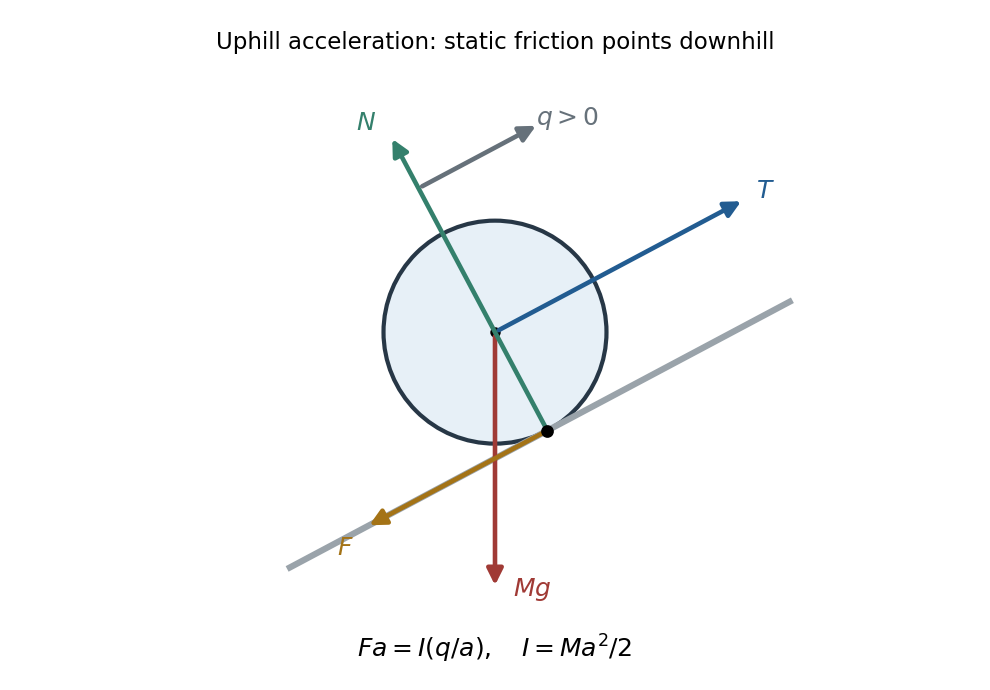
Original force diagram for an uphill-accelerating disc: centre-applied tension and weight, contact normal and downslope static friction
. Details. 
The rotational equation and rolling constraint give , hence . The translational equations become and , givingThus the threshold remains : the moment of inertia increases the effective mass but does not change the sign of the driving force. For downhill acceleration reverses. The normal force is ; static friction does no work at the stationary contact point and sufficient roughness is assumed.
Past exam of the physics course of the year 1 of the natural sciences course of the University of Cambridge 2014 Paper 1 A6 Solution by Codex 0 2026-10-20
Codex 0 2026-10-20 Past exam of the physics course of the year 1 of the natural sciences course of the University of Cambridge 2014 Paper 1 A5 Solution by Codex 0 2026-10-20
Codex 0 2026-10-20For the real object and real image, take positive distances and . The thin lens equation yieldsThis is Newton's lens formula. The distances refer to the adjacent focal points, not the lens plane.
Past exam of the physics course of the year 1 of the natural sciences course of the University of Cambridge 2014 Paper 1 A4 Solution by Codex 0 2026-10-20
Codex 0 2026-10-20Converting all lengths to metres gives . Logarithmic differentiation givesIf the quoted uncertainties are independent standard uncertainties, monomial uncertainty propagation givesIf the quoted uncertainties instead mean bounds, the first-order conservative fractional error is , giving approximately . The question does not specify their statistical meaning; these two error conventions should not be combined.
Past exam of the physics course of the year 1 of the natural sciences course of the University of Cambridge 2014 Paper 1 A3 Solution by Codex 0 2026-10-20
Codex 0 2026-10-20Use and . Equating mass, length and time exponents giveshenceDimensional analysis leaves undetermined. If positive denotes flow along increasing , the signed pressure derivative is negative and its minus sign belongs in the proportionality constant; alternatively use the pressure-drop magnitude.
Past exam of the physics course of the year 1 of the natural sciences course of the University of Cambridge 2014 Paper 1 A2 Solution by Codex 0 2026-10-20
Codex 0 2026-10-20For this equal-mass Coulomb circular orbit, let be the separation and . Each particle describes a circle of radius about the centre of mass. Coulomb's law and centripetal acceleration giveUsing as each particle's orbital radius would miss the equal-mass two-body motion.
Past exam of the physics course of the year 1 of the natural sciences course of the University of Cambridge 2014 Paper 1 A1 Solution by Codex 0 2026-10-20
Codex 0 2026-10-20Each photon has energy , giving the photon emission rate from monochromatic power and wavelengthHere is radiated signal power, not the phone's total electrical consumption.
There are unlisted articles, also show them or only show them.