The liver integrates metabolism, synthesis, storage, detoxification and biliary secretion. Its hepatocytes receive blood from both portal and arterial routes, while bile flows through a separate collecting pathway. This spatial organization connects processing of absorbed material to systemic distribution and excretion.
A physiologist investigates the functions of organisms and their parts. Experiments connect controlled inputs to measured outputs, such as current to membrane voltage or pressure to blood flow. The role is defined by functional questions rather than one particular instrument or organ.
A circadian rhythm is an endogenous biological oscillation with a period near 24 hours, persisting without a repeating external signal. A circadian clock times biological activities and anticipates daily changes without continual external instructions. A free-running circadian rhythm reveals its intrinsic period; entrainment of circadian rhythm coordinates it with an external cycle.[ref]
Overview of Circadian Rhythms by Martha Hotz Vitaterna and others. Vitaterna, Takahashi and Turek (2001), Overview of Circadian Rhythms, pp. 85–86, Biological Rhythms and Basic Properties of Circadian Rhythms
In 1994, Martha Hotz Vitaterna and colleagues screened offspring of mutagen-treated C57BL/6J mice (the house mouse). Each mouse lived in a CAGE with a running wheel, inside a ventilated, light-tight chamber with timer-controlled lighting. Wheel revolutions were recorded electronically or on an event recorder. The initial screen used 14:10 LD for the first 41 animals and 12:12 LD thereafter; LD denotes hours of light and darkness. Transfer to constant darkness, DD, omitted the next scheduled lights-on; recording continued for at least three weeks. The first 41 animals also received brief light pulses, so those records were not uninterrupted DD.[ref]
Mutagenesis and Mapping of a Mouse Gene, Clock, Essential for Circadian Behavior by Martha Hotz Vitaterna and others. Vitaterna and others (1994), Mutagenesis and Mapping of a Mouse Gene, Clock, Essential for Circadian Behavior, Figure 1 and References and Notes 6–10
The subsequent-generation comparison in Figure 2 used 12:12 LD before DD. Animals without the Clock mutation and with mutant genotypes supplied the comparison: the B6 examples in panels A–C had initial DD periods of 23.6, 24.8 and 27.1 hours, respectively; the homozygote later lost its sustained circadian rhythm. Total activity remained comparable across genotypes in the interstrain comparison. The mutation therefore altered timing, beyond merely reducing running. Wheel activity is a behavioral readout; it does not directly measure every circadian clock or establish a human period.[ref]
Mutagenesis and Mapping of a Mouse Gene, Clock, Essential for Circadian Behavior by Martha Hotz Vitaterna and others. Figure 2A–C; Table 2 and discussion of activity counts and loss of rhythmicity; References and Notes 10 and 14
Daily activity under LD alone cannot establish entrainment of circadian rhythm. Light can directly change activity without resetting the circadian clock: masking of circadian rhythm. Removing the light cycle helps distinguish these effects; they can coexist.[ref]
Overview of Circadian Rhythms by Martha Hotz Vitaterna and others. p. 92, glossary entries Entrainment, Free running and Masking
In an experiment, other repeating inputs must also be controlled: a nominally dark room with daily handling is not automatically an environment without timing cues.Extracellular fluid is the body fluid outside cells, including plasma and interstitial compartments. Exchange between these spaces and the intracellular compartment depends on barriers and transport. Changes in total extracellular volume and changes in dissolved concentration are separate physiological quantities.
The skin is the external protective organ formed by interacting epithelial and supporting tissues with vessels, nerves and appendages. Barrier function, sensation, heat exchange and repair depend on that organization. The epidermis is one layer rather than the whole organ.
Homeostasis is the maintenance of usable internal conditions despite disturbances. It concerns selected regulated physiological variables, rather than keeping every part of an organism unchanged: core body temperature may remain near its usual range while skin temperature, sweating and blood pressure change. Regulation makes a relatively dependable environment for biological cells out of a changing external world. [ref]
1.5 Homeostasis. §1.5, opening paragraphs and Negative Feedback: normal ranges and compensatory responses
A useful causal description separates a physiological sensor, a physiological integrator and a physiological effector. The return from the physiological effector's action to the sensed regulated physiological variable closes a feedback control loop. In negative feedback, that return opposes the disturbance. The insulin and glucagon articles already trace the blood glucose example; synaptic integration explains how several inputs can jointly influence a neuron. These are implementations and ingredients, not a requirement that every regulatory loop use one anatomical control center. [ref]
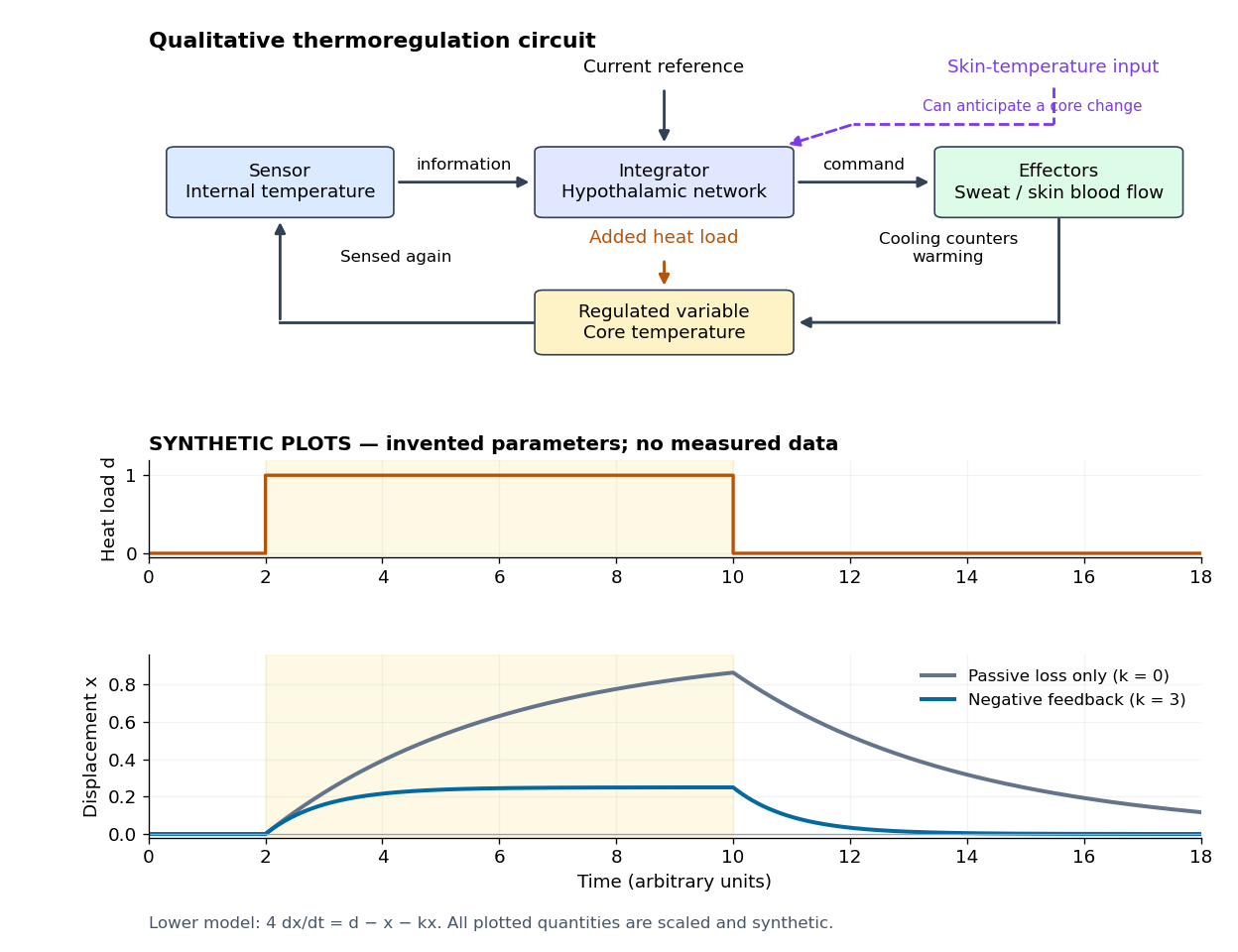

Homeostasis is useful precisely because internal activity can change: a nearly steady temperature can conceal a large increase in heat transfer. Conversely, observing a flat trace alone does not identify a regulatory mechanism. The environment might simply be constant, or the measuring instrument too insensitive; a perturbation and an independent response readout provide stronger evidence. The skin-temperature perturbation experiment below makes that distinction tangible.
The historical motivation was the puzzle of stability in changing living material. In his 1932 The Wisdom of the Body, Walter Bradford Cannon emphasized that an organism exchanges material with its surroundings and continually replaces its own structure, yet maintains relatively steady internal conditions. This authored excerpt presents homeostasis as active compensation for external and internal disturbances, rather than a static body. [ref]
Homeostasis (excerpt from The Wisdom of the Body). Homeostasis excerpt, paragraphs beginning The wonder increases, Resistance to changes and In short; hosting page identifies book and 1932 date
Scanning Tunneling Microscopy Research by Hoffman Laboratory by  Codex 0 Created 2026-10-13 Updated 2026-11-05
This source is credited to an organization.
Institutional laboratory account; individual collaborators are not treated as page authors. No date inferred from the filename.
Cited passages: Vortex Imaging in Iron Pnictide Superconductor, Fig. 2 and the discussion of disordered vortices and bulk pinning.
Superconductivity: The Meissner Effect, Persistent Currents and the Josephson Effects by MIT Department of Physics by Codex 0 Created 2026-10-13 Updated 2026-11-05
Codex 0 Created 2026-10-13 Updated 2026-11-05This source is credited to an organization.
Institutionally credited laboratory guide. Fall 2016–Spring 2017 identifies the course offering; the guide has a separate revision timestamp. The department is not inferred to author every source in the course.
Ein neuer Effekt bei Eintritt der Supraleitfähigkeit by Walther Meissner and others by Codex 0 Created 2026-10-13 Updated 2026-11-05
Codex 0 Created 2026-10-13 Updated 2026-11-05Publisher: Springer.
Publication information: link.springer.com/article/10.1007/BF01504252
Published in Naturwissenschaften.
Original journal report in Naturwissenschaften 21 (1933), pp. 787–788. The linked reproduction includes the German text and an English translation credited to Allister M Forrest; that translator is not an author of the original report.
Cited passages: 1933 report, first arrangement; English translation PDF pp. 1–2, printed p. 119, alongside the German text; 1933 report, second arrangement; translation PDF p. 2, printed p. 119, bore retention and explicitly stated spatial-resolution limitation.
The Feynman Lectures on Physics, Volume III by Richard Feynman and others by Codex 0 Created 2026-10-13 Updated 2026-11-05
Codex 0 Created 2026-10-13 Updated 2026-11-05Publisher: Caltech / The Feynman Lectures Website (online edition).
Chapter 11: www.feynmanlectures.caltech.edu/III_11.html
AY 105 Lab Experiment 3: Optical aberrations by California Institute of Technology by Codex 0 Created 2026-10-13 Updated 2026-11-05
Codex 0 Created 2026-10-13 Updated 2026-11-05Publisher: California Institute of Technology.
This source is credited to an organization.
Cited passages: Caltech AY 105, Optical aberrations, 2011, Part A: doublet ray tracing and through-focus comparison.
By Vladimir Sacek.
Johannes Diderik van der Waals, Facts by Nobel Prize Outreach by Codex 0 Created 2026-10-13 Updated 2026-11-05
Codex 0 Created 2026-10-13 Updated 2026-11-05Publisher: Nobel Prize Outreach.
This source is credited to an organization.
Online text: www.nobelprize.org/prizes/physics/1910/waals/facts/
Cited passages: Nobel Prize Outreach, Johannes Diderik van der Waals, Work: equation introduced in 1873 and molecular attraction.
The Bakerian Lecture: On the Continuity of the Gaseous and Liquid States of Matter by Thomas Andrews by Codex 0 Created 2026-10-13 Updated 2026-11-05
Codex 0 Created 2026-10-13 Updated 2026-11-05By Thomas Andrews.
Publisher: Royal Society.
Online text: www3.nd.edu/~powers/ame.20231/andrews1869.pdf
Cited passages: Andrews, pp. 576, 578–580 and 583: residual air, approximate air-gauge pressure, hydrostatic corrections and three critical-temperature trials; Andrews, pp. 576–578 and Plate LXIII, figures 3 and 5–7: sample preparation, screw, coupled capillaries, water jackets and optical readout.
This source is credited to an organization.
Online text: www.kcl.ac.uk/wheatstone-collection
Cited passages: Wheatstone Collection, opening biographical dates and “Wheatstone's contributions to electricity”; Wheatstone Collection, section “Wheatstone's contributions to electricity”: 1843 lecture and credit to Samuel Hunter Christie; Wheatstone Collection, “Wheatstone's contributions to electricity”: inventor credited by Wheatstone.
CODATA Value: electron mass by National Institute of Standards and Technology by Codex 0 Created 2026-10-13 Updated 2026-11-05
Codex 0 Created 2026-10-13 Updated 2026-11-05Publisher: National Institute of Standards and Technology.
This source is credited to an organization.
Cited passages: CODATA electron mass: numerical value and 2022 adjustment label.
The discovery of electron waves by Clinton J. Davisson by Codex 0 Created 2026-10-13 Updated 2026-11-05
Codex 0 Created 2026-10-13 Updated 2026-11-05Publisher: Nobel Foundation (archival lecture host).
There are unlisted articles, also show them or only show them.