
The rules for forming programs in a programming language. A parser checks and structures text according to these rules; an abstract syntax tree records the resulting constructs.
An abstract syntax tree is a rooted tree recording the meaningful syntactic pieces of a program and how they fit together. A program identifier such as
x, a literal value such as 2, and a node representing addition have different roles. Their arrangement answers structural questions: which program expression supplies an operand, which name is a variable assignment target, and which construct encloses another. This makes an abstract syntax tree useful to a compiler, an interpreter, and the type system that checks a program.The word "abstract" describes what is omitted. Lexical analysis first recognizes lexical tokens, such as
x, =, 2, +, 3, *, 4. A concrete parse tree can retain grammar derivation structure, including punctuation and intermediate context-free grammar categories such as expression, term and factor. An abstract syntax tree usually keeps the operation and its operands without all those grammar scaffolds. Parentheses can determine its shape without surviving as separate nodes. A parser may construct the abstract syntax tree directly; it need not first allocate a concrete parse tree.An abstract syntax tree records programming language syntax, but does not by itself supply all programming language semantics. In
a+b, the names do not reveal their current values, and + might perform addition of integers or concatenate strings. The programming language rules, name bindings, and operand types determine the meaning. In Python, successfully calling ast.parse also does not guarantee that later compilation will accept the result: parsing return 42 succeeds, but compiling that statement outside a function fails. [ref]ast — Abstract syntax trees, Python 3.14 documentation. ast.parse: parsing performs no scoping checks; the return 42 example
An abstract syntax tree is not machine code. Its nodes describe language constructs. A compiler can check and transform this structure before translating it into executable instructions; an interpreter can evaluate an appropriate tree directly. The little evaluator below demonstrates this distinction without pretending to implement an entire programming language.
Base-sixteen representation, with digit values zero through fifteen conventionally written
0 through 9 and a through f. A group of four binary digits selects one hexadecimal digit.// Destination: computer-science.bigb
A fixed-width left shift discards high bits and inserts low zeros. A logical right shift inserts high zeros; an arithmetic right shift propagates the sign bit. In Java,
<<, >>> and >> distinguish these operations. Left shift by is multiplication by modulo the word modulus.// Destination: computer-science.bigb
A word selecting specified binary positions under a bitwise operation. To extract a stored bit at position , logically shift by and combine with the mask
1. Grouping thirty-two cells into one Java integer permits a compact representation of a Conway Game of Life board.// Destination: computer-science.bigb
For equally weighted positions, the squared radius of gyration is the average squared distance from the center of mass: , where . Expanding pair differences gives , and thereforeFor a Gaussian chain or freely jointed chain with these positions and mean squared link length , each pair variance is . Summing separations yields . Counting all endpoints of links instead gives positions and the corresponding finite-size formula.
A nucleic acid is a polymer built from linked nucleotides. The two principal kinds are DNA and RNA. Each nucleotide contributes a sugar, a nucleobase, and phosphate to the chain; the nucleobase is only the letter-bearing component, not the entire nucleotide. DNA uses deoxyribose, whereas RNA uses ribose. A chain of six nucleotides is therefore not six free nucleobases placed beside one another. See NHGRI: nucleic acids.
The chemical scaffold and the variable lettering do different jobs. Covalent bonds maintain the sugar–phosphate backbone, while the order of attached nucleobases specifies the nucleic acid sequence. A phosphodiester bond links the position of one sugar to the position of the next through phosphate. These position numbers refer to carbon chemical atoms in the sugar; they define a strand's direction even when it bends or forms a circle. See Brown, Genomes, 2nd edition: the human genome.
This division is useful: the backbone supplies a connected physical record, and base pairing allows its letters to recognize partners. DNA replication copies that record, and transcription uses a DNA template to make RNA. RNA can also fold into functional shapes through base pairing within one chain; a nucleic acid sequence specifies chemical order, not a requirement for a straight shape. The beauty is that the same kind of polymer can carry a message and form a structure that acts on messages.
A monomer is a chemical substance whose molecules can undergo polymerization and contribute units to the essential structure of a polymer. A monomer molecule is the individual reactant; its incorporated monomeric unit is the portion identifiable as derived from that reactant. Incorporation can change chemical bonds and release small byproducts, so the unit in the chain need not have the complete molecular formula of the feed molecule. See IUPAC: monomer molecule and IUPAC, A brief guide to polymer terminology: monomeric units.
Three different counts answer three different questions. Monomer molecules describe the feed; monomeric units trace that feed's contributions to the product; a constitutional repeating unit describes the smallest chemical pattern repeating along a regular chain. In Nylon 6,10, two different monomers supply one interior constitutional repeating unit,Its molecular formula is . The diamine feed is , and the diacid-chloride feed is ; subtracting two gives the interior-repeat budget. For a finite linear chain made from of each reactant, there are joining connections, hence formal eliminations, rather than . One amine end and one acid-chloride end remain in that ideal unmodified chain. This is a stoichiometry check on the depicted reaction, not a claim that the washed experimental thread retains those ends. The reacting end-group chemistry is documented in Hammond, lecture 5, p. 4; the specified Nylon 6,10 reactant pair is reported in Polymer Day, nylon demonstration.
Ethene shows the reverse counting mismatch. One monomer molecule contributes a two-carbon monomeric unit to ideal linear polyethylene, without a small byproduct in that growth step. But the smallest constitutional repeating unit of its uniform backbone is just : a chain containing incorporated ethene monomeric units contains such interior one-carbon repeats. End groups are additional bookkeeping. The frequently drawn is useful for tracing the feed, although it is not the smallest constitutional repeat. The minimum-pattern definition is given in IUPAC: constitutional repeating unit; the ethene growth chemistry is described by [ref].
A segment of a freely jointed chain or Gaussian chain instead belongs to a statistical model. It can represent many chemical bonds and several constitutional repeating units; its length and the segment count are chosen to describe chain conformation at the intended scale. The three-repeats-per-segment drawing in Figure "From two liquid layers to a Nylon 6,10 thread: monomers, a constitutional repeating unit, and statistical segments" is a deliberately arbitrary coarse-graining example, not a measured Kuhn length. Always state the counting convention before substituting a segment count for a degree of polymerization. This separation lets chemistry track which chemical atoms entered the material while statistical models track how the material bends and extends.
In ideal linear polyethylene, incorporated ethene contributes monomeric units; the smallest constitutional repeating unit is . See monomer for the counting distinction.
Nylon 6,10 has an amide-linked chain whose constitutional repeating unit contains a six-carbon diamine contribution and a ten-carbon diacid-derived contribution. See monomer for its stoichiometry and polymerization for the authored demonstration.
A constitutional repeating unit is the smallest chemical unit whose repetition describes a regular chain. Its boundaries mark repetition, not necessarily the origin of the chemical atoms from a single monomer. See IUPAC: constitutional repeating unit.
The degree of polymerization counts monomeric units in a chain. is its number average over a specified collection of chains. State whether unreacted monomers are included and distinguish this count from constitutional repeating units or statistical segments. See IUPAC: degree of polymerization.
A polyurethane contains repeated connections of the form . Suitable hydroxy groups and isocyanate groups can produce those connections by polyaddition; exactly two suitable groups per feed molecule give the bifunctional linear model only when competing reactions and ring closure are excluded.
Polymerization converts a monomer, or a mixture of monomers, into a polymer: repeated chemical reactions establish a connected molecular chain or network. The central question is how connections form, not merely whether a material becomes solid. Joining small molecules can produce a thread that can be handled, while the individual molecules remain invisible. See IUPAC, Basic Definitions of Terms Relating to Polymers, definition 2.2.
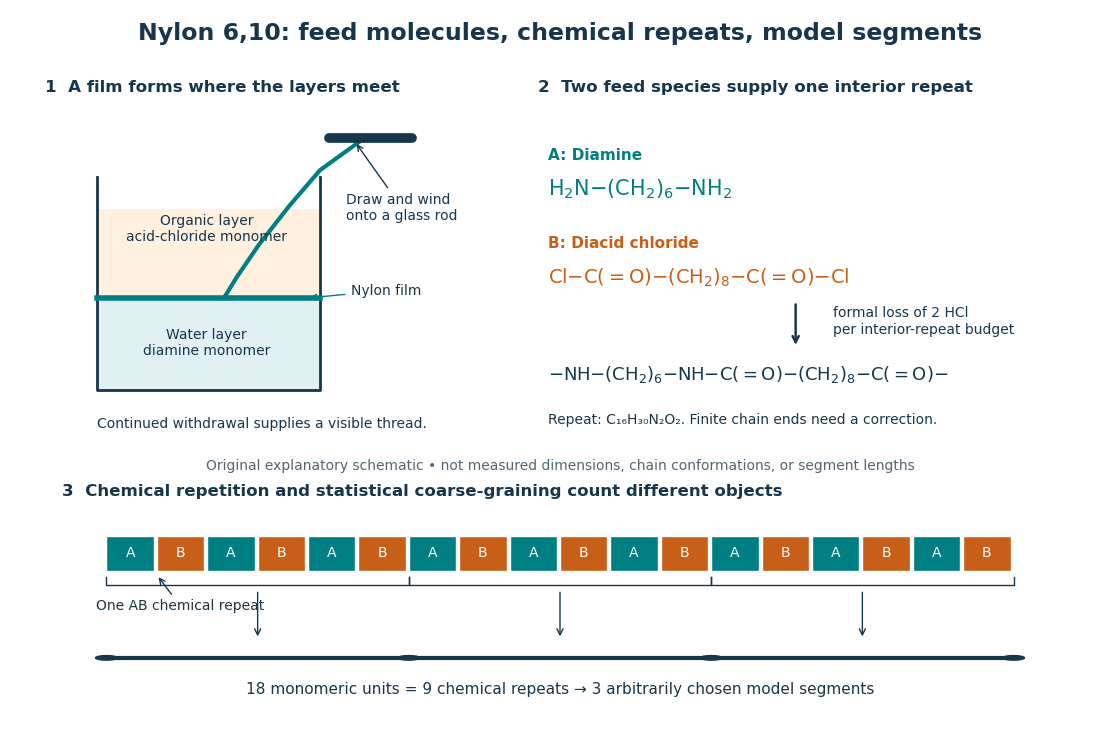
From two liquid layers to a Nylon 6,10 thread: monomers, a constitutional repeating unit, and statistical segments
. Original schematic of the authored UCSB polymerization demonstration described below. Chemical formulas identify the actual reactants and interior repeat; colored blocks identify their contributions. The lower coarse-graining sketch deliberately groups three repeats per model segment. Shapes, sizes, and that grouping are illustrative, not measured molecular geometry or a fitted Kuhn length. Details.
In step-growth polymerization, complementary reactive groups on monomers and on shorter or longer chains can react with one another. A two-unit chain can join a three-unit chain to make a five-unit chain; growth does not require a specially active end to add only free monomers. An example is the Nylon 6,10 reaction of with : each amine end can form an amide connection with an acid-chloride end, with formal elimination of . Both reactants have two suitable ends, allowing repeated joining. See Paula Hammond, MIT 10.569 lecture 2: step-growth joining and Hammond, lecture 5, p. 4: acid chloride–amine reaction.
In chain-growth polymerization, a monomer reacts with an active site on a growing chain, and the growth step regenerates an active site. Schematically, , where counts incorporated monomeric units and the star denotes reactivity rather than a particular electric charge. Ethene forming polyethylene is an example: the double chemical bond is converted into single chemical bonds as the carbon backbone grows. Initiation creates the active chains; subsequent reactions can deactivate them or transfer reactivity to another molecule. See IUPAC: chain polymerization and John McMurry, Organic Chemistry, 31.1: chain growth. Whether growth is stepwise or carried by an active site is a different question from whether small byproducts are released: chain-growth polymerization can also release them.
A motivating experiment: drawing nylon from a liquid interface. Feldwinn's UCSB demonstration places of an aqueous chemical solution of hexamethylenediamine, , in a beaker, then gently adds of sebacoyl chloride, , in an organic solvent. The procedure specifies hexane; other parts of that handout list cyclohexane. The layers remain separate. The instructor catches material at their interface with tweezers and winds it slowly onto a glass rod; the handout reports continued spooling of Nylon 6,10. It specifies freshly prepared acid-chloride chemical solution and washing the thread before touching it. These are observations and conditions of a supervised laboratory demonstration, not measurements of chain lengths. See Feldwinn, UCSB Demonstration Library, Demo 044, pp. 1–3.
The mechanistic interpretation is that the monomers encounter one another near the interface, where amide connections produce the film; withdrawing it exposes a region where more material can form. An authored research demonstration independently reports a rapidly formed interfacial film collapsing into a thread on withdrawal, using cyclohexane and an aqueous chemical solution containing potassium hydroxide. See Polymer Day: Outreach Experiments for High School Students, Journal of Chemical Education (2017), nylon demonstration. This is the striking observation: a thread much longer than the beaker can emerge because material is continually supplied to the formation region, rather than because a pre-existing thread was hidden in the liquid.
Useful proposed controls, not results reported in those demonstrations, omit one monomer at a time while retaining the same solvents, liquid amounts, and pulling procedure. The prediction is loss of a renewable drawable Nylon 6,10 film; merely finding cloudiness would not establish polymerization, since other chemical reactions, including acid-chloride hydrolysis, can occur. See McMurry, 21.4: competing acid-chloride hydrolysis. Stopping and restarting withdrawal would probe renewal at the interface. Even successful drawing does not measure the degree of polymerization, establish a chain-length probability distribution, or prove the entire growth mechanism. Chemical identification and a molecular-size measurement would be needed for those stronger conclusions. These controls and limits are inferences from the setup, not invented experimental data.
Why almost complete reaction matters in step growth. For ideal linear step-growth polymerization, assume exactly two reactive groups per starting molecule, equal numbers of complementary groups, only joining of different chains, no rings, no branching, and no loss of chain material. Let count starting monomer molecules, including both reactant species, and let be the fraction of either type of reactive group consumed. There are initially groups of each type, so connections reduce the number of chain-bearing molecules to ; the count excludes small byproducts but includes unreacted monomers. The number-average degree of polymerization, measured in monomeric units, is thereforeThus , , and give , , and . Losing the last fraction of unreacted groups matters enormously. See Hammond, lecture 3: balanced step-growth conversion. This counts residues of both feed species; a Nylon 6,10 interior constitutional repeating unit contains two such monomeric units.
For an feed with initial reactive-group counts, put and now let denote the fraction of the limiting groups consumed. Under the same linear, no-ring assumptions, and , givingFor , even complete consumption of gives . Stoichiometry controls chain length as well as yield. See Hammond, lecture 2, pp. 2–3: stoichiometric imbalance. The liquid-interface demonstration is not a homogeneous, balanced reactor, so its thread length cannot be inserted into this formula as a molecular chain length.
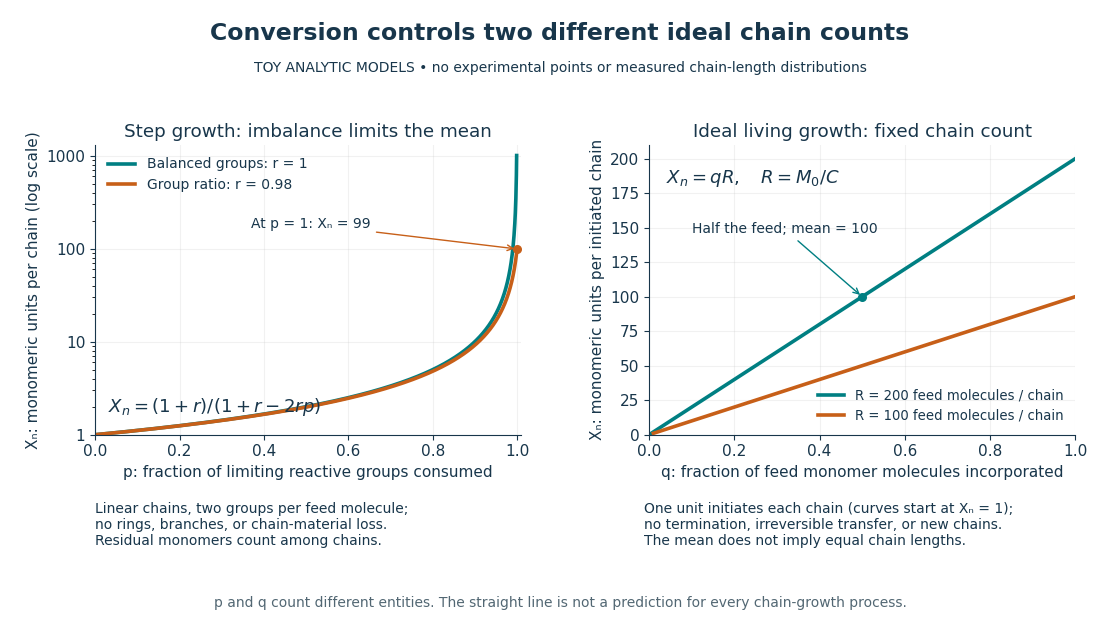
Two ideal degree of polymerization counts: late growth in step-growth polymerization and fixed-chain growth in ideal living polymerization
. Toy analytic curves, not measured data. Left: , with the limiting-group conversion and the initial reactive-group ratio. Right: , with the fraction of feed monomer molecules incorporated and their initial number per initiated chain. The two horizontal axes count different entities; the right plot represents a special ideal model, not all chain-growth polymerization. Details.
A contrasting chain count. In ideal living polymerization, assume no chain termination or irreversible chain transfer, all chains initiated before the counted growth, one chain per effective initiator, a fixed chain count , and every consumed monomer molecule incorporated into those chains. If is the initial number of feed monomer molecules and their incorporated fraction, conservation gives in monomeric units, excluding initiator fragments. For , incorporating half the feed gives . If initiation consumes one monomer molecule per chain, the fixed-chain interval starts at , rather than . See Hammond, lecture 21, p. 1: ideal living-chain count. The mean does not imply identical chain lengths. Living polymerization does not require reversible loss of monomers; the defining absence of chain termination and irreversible chain transfer is explained in Devon Shipp, IUPAC Polymer Education workshop, Radical Polymerizations II, slide 50. Ordinary chain-growth polymerization with new chains, termination, or transfer need not follow the straight line.
The useful connection is between local chemistry and a macroscopic material: selecting reactive ends and their proportions controls connectivity, while the resulting polymer's conformation is a separate problem described by models such as the freely jointed chain or Gaussian chain. Formation of chemical bonds, the count of monomeric units, and the count of statistical segments must be kept distinct.
The Flory approximation balances the entropic cost of expanding an ideal chain against a mean-field excluded volume interaction. For segments of length in spatial dimensions, minimizing gives . This yields the scaling exponents in three dimensions and in two dimensions. It is a scaling approximation, not an exact numerical free energy or proof of critical exponents; confinement replaces by the accessible coil volume.
For a singly charged ion species in Gaussian units, is its plasma frequency and . The ion skin depth marks a characteristic scale below which ion and electron motion can separate in a magnetized plasma. Together with the Alfvén speed, it satisfies , the coefficient of guide-field propagation in electron magnetohydrodynamics.
The plasma frequency is the characteristic electrostatic oscillation frequency of a charged species displaced against a neutralizing background. For number density , charge and mass , the displayed formula uses SI units; in Gaussian units it is . The ion skin depth is for the ion species. Different species have different plasma frequencies.
Adipose tissue stores energy-rich lipid and also performs endocrine and mechanical functions. Its adipocytes, vascular supply and other cell populations interact. Changes in tissue mass do not uniquely describe its metabolic or signaling state.
Skeletal muscle is striated muscle tissue organized into long multinucleate fibers and supporting connective tissues. Neural activation recruits force that is transmitted to attachments. Its output depends on fiber properties, recruitment and mechanical loading, not only the amount of muscle present.
There are unlisted articles, also show them or only show them.