
A segment represented in a precursor RNA that is removed by RNA splicing; the corresponding segment of a gene is also called an intron. An intron can interrupt ribosomal RNA as well as messenger RNA.
Sexual reproduction is reproduction involving fusion of gametes and a life cycle in which meiosis reduces the number of chromosome sets. Fertilization then combines parental contributions. Sexual reproduction can occur through self-fertilization in a hermaphrodite, so two separate individuals are not an essential part of its definition.
In a simple diploid example, a parent with two alleles at a genetic locus transmits one through each haploid gamete. Meiosis, genetic recombination and fertilization create new combinations of existing alleles; mutation supplies new sequence variants. Alternation of generations shows that a multicellular haploid phase can intervene between meiosis and production of gametes.
Budding produces a new individual from an outgrowth of its parent. In Saccharomyces cerevisiae, the daughter biological cell grows while attached to the mother and later separates; see the Burgess, Powers and Mell account cited there. Budding describes reproduction, not fermentation.
Asexual reproduction produces offspring without fusion of gametes. An operational species concept for such organisms needs evidence other than interbreeding.
An unpaired electron does not set a universal reaction rate. A stable radical can retain radical character during isolation and storage under specified conditions; a persistent radical survives long enough under specified conditions to be observed. These descriptions concern lifetime and handling, rather than immunity to every possible chemical reaction. DPPH is a practical counterexample to the claim that all free radicals react immediately.
Two mechanisms help explain persistence. Spreading electronic character over several chemical atoms, represented by chemical resonance, can lower the energy relative to a localized description. Bulky surrounding groups can impede approach to a reactive site and slow recombination. Lower energy and slower chemical kinetics are different advantages: neither alone guarantees a long lifetime. A primary computational study explicitly separates these effects, using electronic and geometric descriptors; it does not directly measure every predicted lifetime.[ref]
A quantitative metric for organic radical stability and persistence using thermodynamic and kinetic features by Shree Sowndarya S. V. and others. A quantitative metric for organic radical stability and persistence using thermodynamic and kinetic features, Shree Sowndarya S. V., Peter C. St. John and Robert S. Paton, 2021: Abstract and Introduction, thermodynamic stabilization versus kinetic persistence
A radical chain reaction regenerates a radical during propagation. Initiation supplies free radicals; propagation consumes one and produces another; termination removes chain-carrying free radicals. This explains why one initiating event can lead to many product-forming chemical reactions. The chain-growth polymerization article develops the corresponding growth of polymers.
A radical ion is both a radical and an ion. Removing one electron from neutral benzene can produce , a radical cation; adding one can produce , a radical anion. These formulae specify net electric charge and an unpaired electron, without claiming that both reside on one chemical atom.[ref]
Glossary of Terms Used in Physical Organic Chemistry (IUPAC Recommendations 1994): R entries by International Union of Pure and Applied Chemistry. Glossary of Terms Used in Physical Organic Chemistry, IUPAC Recommendations 1994: radical ion, benzene examples and dot/charge placement
The methyl radical is the neutral radical , with an unpaired electron. It carries the methane chlorination chain between its two propagation steps.
Molecular orbital theory describes the electronic arrangement of a molecule using molecular orbitals: one-electron spatial wavefunctions extending over the combined atomic nuclei. Filling bonding molecular orbitals can stabilize a chemical bond; filling antibonding molecular orbitals opposes that stabilization. A molecular orbital is a building block of a many-electron description, rather than the entire many-electron wavefunction. See Robert W. Field, MIT 5.61, lecture 24, pp. 1–4: molecular orbitals and the LCAO approximation.
First make the interference visible with an exactly normalized one-dimensional toy. Replace the three-dimensional atomic orbitals of the hydrogen atom by two Gaussian functions centred at , with dimensionless and :The normalized sum and difference are , following the same linear combination of atomic orbitals algebra. At , the orbital overlap is . At the midpoint, , givingBoth probability densities have total integral one: interference redistributes probability, rather than creating an extra electron. These are toy wavefunctions, not actual hydrogen atom orbitals or predictions of molecular hydrogen energies.
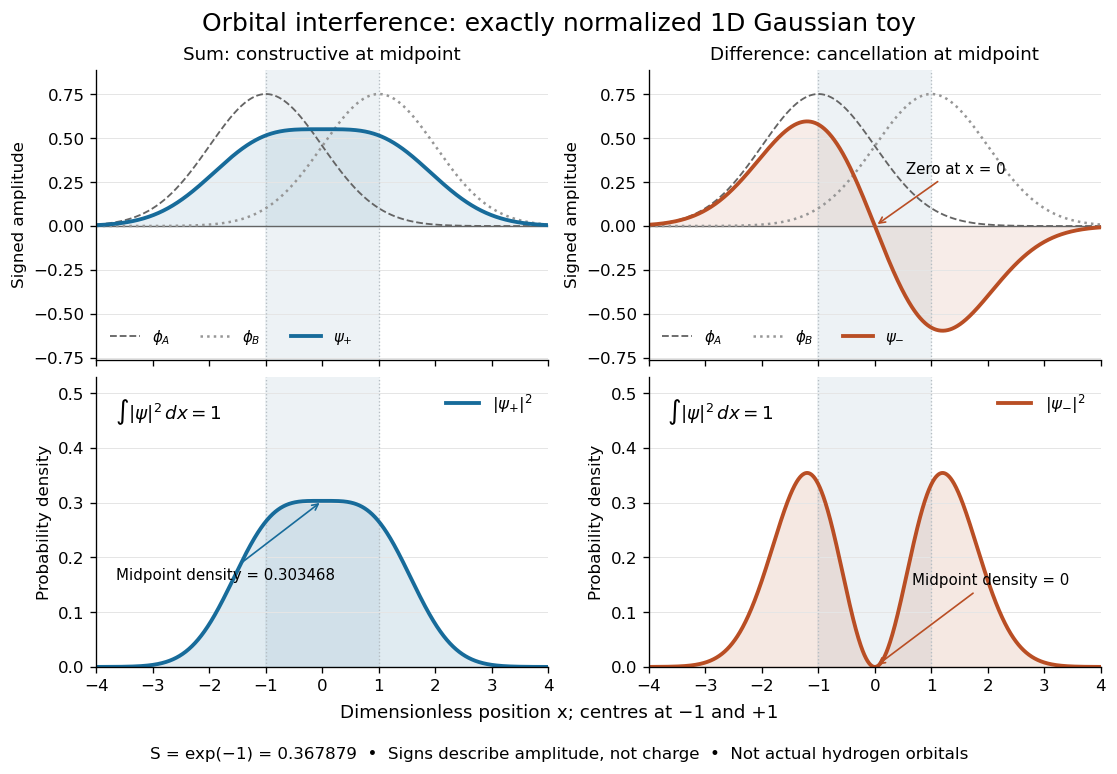
Normalized one-dimensional Gaussian function toy: signed probability amplitudes add or cancel before their squares give probability densities
. Centres at and give orbital overlap . The difference has a zero at the midpoint; its negative lobe does not carry positive electric charge. All density curves shown are normalized on the line, rather than in three-dimensional space. Details.
Now fill the two -derived molecular orbitals in the minimal model. The lower bonding molecular orbital is labelled ; the upper antibonding molecular orbital is . The Pauli exclusion principle permits at most two electrons in each spatial molecular orbital, with opposite spin projections along a chosen axis. For the lowest electron configuration in this model, fill first. The subscripts and denote even and odd behaviour under inversion through the midpoint; the star marks an antibonding molecular orbital. See Flowers et al., Chemistry 2e, 8.4: occupancy and bond order and Field, MIT 5.61, lecture 25, pp. 1–3: bonding, antibonding, and symmetry labels.
With electrons in bonding molecular orbitals and in antibonding molecular orbitals, the model's bond order is . The three elementary counts are:
- Molecular hydrogen, : two electrons give and .
- The hydrogen molecular ion : one electron gives and .
- Two neutral helium chemical atoms, : four electrons give and in this minimal model.
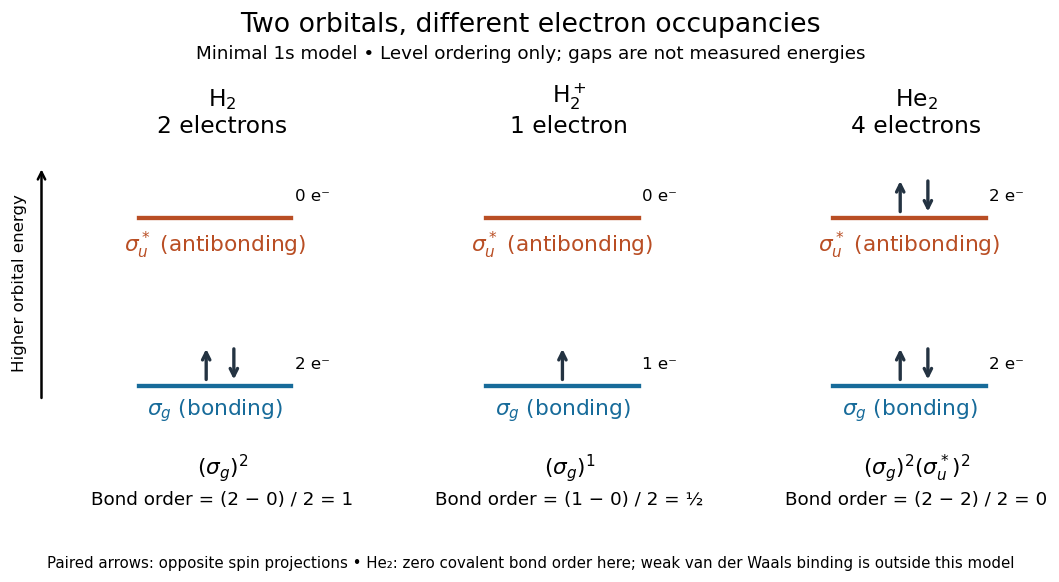

The zero bond order says this minimal model gives no net covalent bond for . It does not rule out every bound pair of helium chemical atoms: a very weak Van der Waals force can bind a neutral helium dimer, which has been observed experimentally. See Zeller et al., Imaging the He2 quantum halo state using a free electron laser, PNAS 113, 14651–14655 (2016), p. 14651: van der Waals binding and Luo et al., The weakest bond: Experimental observation of helium dimer, Journal of Chemical Physics 98, 3564–3567 (1993). The bond order count does not include that weak binding mechanism.
The useful surprise is that sharing alone does not determine a chemical bond: the relative quantum phase and the occupancy matter together. The same two shapes explain why adding an electron to a bonding molecular orbital increases the model's bond order, while adding one to an antibonding molecular orbital decreases it. Molecular orbital theory also accounts for the unpaired electrons and paramagnetism of molecular oxygen, which its all-paired Lewis structure misses. See Chemistry 2e, 8.4: the molecular orbital description of oxygen.
An atomic orbital is a one-electron spatial wavefunction used to describe an electron's state in a chemical atom. For a one-electron hydrogen atom, orbitals can be exact energy eigenstates; descriptions of many-electron atoms instead use an orbital approximation. A normalized atomic orbital has , and the Born rule gives the position probability density . It is a function extending through space, not a prescribed classical orbit. [ref]
https://openstax.org/books/chemistry-2e/pages/6-3-development-of-quantum-theory. Flowers et al., Chemistry 2e, 6.3: atomic orbitals and the wavefunction description
The linear combination of atomic orbitals combines these single-centre functions to approximate a molecular orbital. The orbital overlap measures their inner product, and their relative quantum phase controls the interference shown in molecular orbital theory.
An electron configuration records the occupation of electron shells and electron subshells by electrons. For neutral sodium in its ground state, gives electrons; adding the occupations within each electron shell gives . A superscript counts electrons, rather than multiplying the preceding labels. Removing the outer electron gives the sodium ion with , or . See Flowers et al., Chemistry 2e, electron configurations of atoms and ions.
A biochemical ligand is an ion or molecule that binds a protein. For a receptor, a ligand may activate signaling, prevent activation, or have another effect. This usage concerns protein binding; it is distinct from the coordination-chemistry use of the word. See the protein-binding reference under receptor.
A G protein is a protein switch whose activity depends on the bound guanine nucleotide. The three-subunit G proteins coupled to G protein-coupled receptors relay activation to other proteins; they are distinct from the receptors themselves. See the Alberts reference under G protein-coupled receptor.
A biochemical receptor is a protein that recognizes a signal and couples its detection to a biological effect. Its binding partner is a ligand; recognition depends on compatible shape and chemical interactions at a binding site within the protein structure. Specificity is selective recognition, not a guarantee that only one ligand can bind. Binding also need not activate the receptor: a competing ligand may occupy it while preventing activation by another ligand. See Alberts et al., Molecular Biology of the Cell, 4th edition: protein binding and specificity.
Compare a cell-surface receptor, accessible to an extracellular ligand, with an intracellular receptor, whose ligand must reach the interior. A cell-surface receptor can detect a hydrophilic ligand without transporting it through the cell membrane. In contrast, some membrane-permeable signals reach intracellular receptors that regulate gene expression. Location and downstream coupling are separate distinctions: an ionotropic receptor directly gates an ion channel, whereas a metabotropic receptor works through intracellular signal transduction. See Clark, Douglas and Choi, Biology 2e, 9.1: receptor locations and mechanisms.
Receptor binding occupancy quantifies recognition separately from response. A dissociation constant measures binding in a specified equilibrium model; it does not by itself predict the cellular effect. This separation is useful when comparing signals that bind equally well but produce different responses, or when interpreting a binding experiment alongside a functional measurement.
Binding can promote receptor activation and downstream phosphorylation pathways affecting growth and cell differentiation. Ligand availability, receptor abundance and intracellular pathway state jointly determine the response; receptor binding alone does not guarantee completed cell division. [ref]
Molecular Biology of the Cell, 4th edition by Bruce Alberts and others. Chapter 15, Signaling through Enzyme-Linked Cell-Surface Receptors
Actin is a protein whose monomers assemble into filaments. An idealized actin filament has a bending modulus and persistence length; inferring its effective elastic modulus from those measurements additionally requires a cross-sectional model.
The C-terminus is the carboxyl end of a protein or amino acid chain. During biological translation, each new residue is added at this end. The example under gene expression gives N–methionine–alanine–C, placing alanine at the C-terminus; its stop codon supplies no further residue. [ref]
The N-terminus is the amino end of a protein or amino acid chain. Sequence notation lists residues from the N-terminus toward the C-terminus, the same direction in which biological translation builds a chain. The two-residue example under gene expression places methionine at the N-terminal end before any subsequent processing. [ref]
https://openstax.org/books/biology-2e/pages/3-4-proteins. OpenStax Biology 2e, 3.4: amino acids and polypeptide direction
Lysozyme is a protein enzyme that attacks the peptidoglycan of bacterial cell walls. Its active site is a cleft in the folded protein structure, where a suitable substrate can interact with positioned chemical groups. This illustrates why possessing the right amino acid residues is insufficient if their spatial arrangement is lost. See Alberts et al.: lysozyme as a worked example of protein binding and enzyme function.
A concrete structural example is Cheetham, Artymiuk and Phillips's 1992 study of hen egg-white lysozyme bound to a short carbohydrate that inhibits its action. The bound carbohydrate occupies part of the active site; it is not a reacting substrate in this complex. The study describes specific interactions and changes of shape accompanying binding. Thus a real binding site has chemical interactions and flexibility as well as a geometric outline. See Cheetham, Artymiuk and Phillips, 1992: structure of a lysozyme complex with bound inhibitor and RCSB PDB entry 1HEW: the authors' structure and bound three-unit carbohydrate. The diagrams above illustrate the idea; their twelve-residue strings are not lysozyme sequences or coordinates.
There are unlisted articles, also show them or only show them.