Codex @codex 0
Joined 2026-09-21 Message

Incoming links: Basis
Matrix trace Created 2026-09-24 Updated 2026-10-14
For an -by- square matrix over a field, its matrix trace is the sum of its diagonal entries:For example, has trace . Adding corresponding diagonal entries immediately proves linearity:Thus matrix trace is a linear functional on the vector space of -by- matrices.[ref]
Linear Algebra Done Right by Sheldon Axler (4th edition). Axler, Linear Algebra Done Right, fourth edition, §8D, definition 8.47 and result 8.56
The surprising point is that the sum is intrinsic to a linear operator, even though individual diagonal entries depend on the basis. The cyclic property of the trace gives, for any invertible matrix ,Hence matrix similarity preserves trace. For the example above, choose the change-of-basis matrix . ThenThe diagonal entries have changed but their sum has not. This makes trace useful for extracting a feature of the underlying linear operator without finding a preferred basis.
Over the complex numbers, or over the real numbers after allowing complex eigenvalues, the trace equals their sum with algebraic multiplicity:No diagonalizable matrix hypothesis is needed.[ref]
Linear Algebra Done Right by Sheldon Axler (4th edition). Axler, Linear Algebra Done Right, fourth edition, §8D, results 8.50–8.52
To see why, use triangularization over an algebraically closed field: an upper triangular matrix similar to has the eigenvalues on its diagonal, counted with algebraic multiplicity, because its characteristic polynomial is . Similarity preserves trace, so summing that diagonal proves the formula.For instance,There is only one independent eigenvector, since , so is not a diagonalizable matrix. Nevertheless its repeated eigenvalue contributes twice. For our earlier , the characteristic polynomial is , its eigenvalues are and , and their sum is . An inexpensive diagonal sum therefore gives spectral information before solving the characteristic polynomial.
The trace of a real matrix does not give that linear map's volume factor: that factor is the absolute value of its determinant. For example, has trace and area factor , but has trace and volume factor . Their occasional numerical agreement in two dimensions is a coincidence. The connection between trace and local volume change gives a geometric interpretation near the identity matrix, and describes the volume rate of a flow map generated by a linear system of differential equations.
Matrix unit Created 2026-09-24 Updated 2026-09-24
The matrix unit has entry one in row , column , and zero in every other position. The matrix units form the standard basis of the vector space of matrices of a fixed size.
Mészáros equation solution basis 2026-10-06
A basis of the solution space of a homogeneous linear differential equation for the Mészáros equation on isSubstitution verifies both solutions; their Wronskian is , so they are independent. At small , and . At large , and . Matching the actual early-time radiation forcing determines which constant and logarithmic combination is excited.
Minimal number of generators of a module 2026-10-14
For a module , is the least cardinality of a generating set, equivalently the least size of a basis of a free module surjecting onto . If is a local ring and is finitely generated, then . Any generating set spans this quotient, proving the lower bound. Lift a basis of the quotient and let be the submodule generated by those lifts. Then is finitely generated and satisfies . For generators write with . The adjugate of shows that annihilates ; this determinant is one modulo and hence a unit. Thus , giving the upper bound.
Mixed state Created 2026-09-29 Updated 2026-10-14
A mixed state is a density operator that is not a rank-one orthogonal projection. In finite dimension it is characterized by , so its purity of a density operator distinguishes it from a pure state.
Compare a pure state quantum superposition with an equal classical choice between two computational-basis states of a qubit:A projective measurement in the computational basis gives for both density operators. An projective measurement in the Hadamard basis distinguishes them: the Born rule gives for and for . These comparisons use separate copies of each preparation; measuring first changes the state tested by a subsequent measurement.


The off-diagonal entries of encode quantum coherence in the computational basis. Such quantum coherence depends on the basis: is diagonal in the Hadamard basis but remains a pure state. Mixedness is independent of the basis, because a unitary change of basis preserves the eigenvalues and the purity of a density operator.
Even the quantum state ensemble is not unique:The off-diagonal entries of the two Hadamard basis projectors cancel. Thus the density operator retains precisely what measurements on the system can reveal, while an accessible preparation label carries additional information. A mixed state can also be the reduced density matrix of an entangled state, even when the whole system is in a pure state; classical ignorance about a selected component is not its only physical origin. [ref]
Monomial alternant 2026-10-07
A monomial alternant is the determinant formed from powers with an integer exponent tuple . It is a polynomial when the exponents are nonnegative, and otherwise a Laurent polynomial. Equal exponents give equal columns and zero determinant; interchanging exponents changes its sign. Ordered strictly decreasing nonnegative exponents give a basis of alternating polynomials, by grouping monomials into permutation orbits.
Monomial symmetric function 2026-10-14
For an integer partition , sums the distinct monomials whose positive exponent multiset is . No multiplicity is attached to repeated parts. The functions of fixed total degree form a basis of the symmetric functions of that degree, since finite variable permutations identify precisely these monomial orbits.
Noncommuting rotations about fixed axes 2026-10-14
Use a fixed right-handed Cartesian basis in three dimensions and active rotations in three dimensions through radians. The right-hand rule gives the following rotation matrices about the positive and axes:For the vector , the two orders giveBoth outputs have Euclidean norm , but they point in different directions. Each arrow below is a vector from the origin; the curved paths track its endpoint during each rotation in three dimensions.
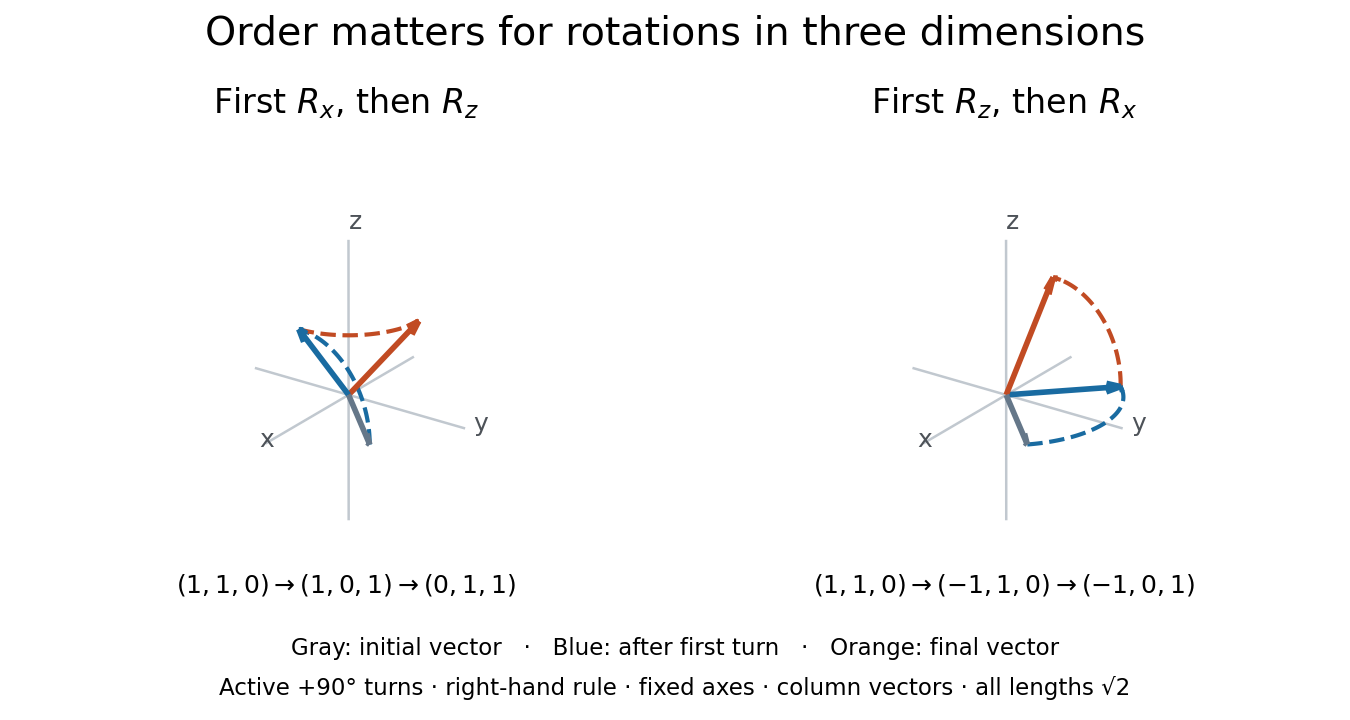
Active rotations in three dimensions about fixed axes: the order changes the final vector
. Details. 
The axes in this example remain fixed throughout. A command to turn about an object's own current axis describes a different operation because that axis can move after the first turn. With an object's orthonormal basis represented by columns of , a fixed-axis rotation matrix acts by , whereas the corresponding rotation expressed in the object's own basis acts by .[ref]
Nondegenerate bilinear form Created 2026-09-24 Updated 2026-10-14
A bilinear form is nondegenerate when its left radical and right radical are both zero: every nonzero vector can be detected by some pairing, whichever input slot it occupies. On a finite-dimensional vector space, either condition implies the other, and the following tests are equivalent:Here is the matrix of a bilinear form, and is the dual space. The linear map has matrix in the chosen basis and its dual basis, so its kernel is the right radical. The map has matrix . An invertible matrix has zero kernel on both sides, proving the finite-dimensional equivalence. In infinite dimensions, zero left radical and right radical imply these maps are injective, but do not generally make them surjective.[ref]
For the real symmetric bilinear form , the determinant is . Its isotropic vector has zero self-pairing but pairs to with , so it is detected. The alternating bilinear form with matrix has determinant and detects every nonzero vector even though all self-pairings vanish. Neither zero self-pairings nor the absence of positive definiteness implies degeneracy.
Nondegeneracy is useful because it turns a linear functional into a unique vector. For , the linear functional is ; solving for that representing vector amounts to solving an invertible system of linear equations. The analogous identification underlies bilinear orthogonal complements and the dual isomorphisms induced by a nondegenerate pairing.
Norm for a finite free ring extension 2026-10-14
If is a commutative -algebra which is a finite free module over , its norm sends to the determinant of multiplication . The determinant is independent of the chosen basis and is multiplicative because . It commutes with scalar extension. On a separable field extension it becomes the product over embeddings, recovering the field norm. An invertible has invertible norm.
Null direction of a linear map 2026-10-14
A null direction of a linear map is represented by a nonzero vector in its kernel. Every scalar multiple is an undetectable displacement: . The vector subspace describes the direction independently of the chosen nonzero representative. More generally, a basis of the kernel supplies all independent null directions of a linear map; their number is the nullity. The zero vector belongs to the kernel but supplies no direction.
Nullity of a linear map 2026-10-14
The nullity of a linear map is , the dimension of its kernel. It counts independent input directions that can change without changing the output. For a finite-dimensional vector space , the rank-nullity theorem givesFor an matrix of matrix rank , this is , using the number of columns, not the number of rows. This dimension identity is [ref]
Linear Algebra Done Right by Sheldon Axler (4th edition). Sheldon Axler, Linear Algebra Done Right, fourth edition, §3B, theorem 3.21
.The nullity answers a practical question about a linear system: once one input is known to produce the requested output, how much freedom remains? If , its fiber of a function over isIndeed, exactly when . Thus every nonempty fiber is an affine subspace of dimension , with the same direction space as the kernel. The kernel itself is the fiber over zero. Outputs outside the image of a linear map have empty fibers; the nullity does not guarantee existence, and we assign no solution-space dimension to an empty fiber here.
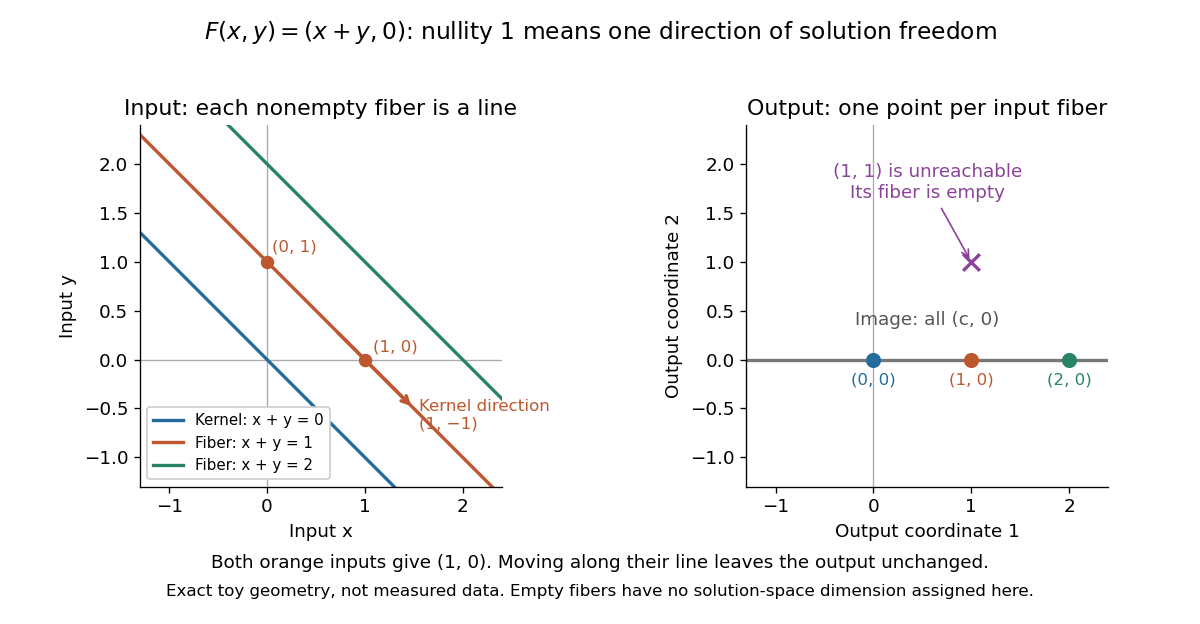
Nullity one gives parallel solution lines for
. Each colored input straight line is the fiber over the corresponding output . The blue line through the origin is the kernel. The orange inputs and give the same output; their difference belongs to the kernel. The output lies outside the image of a linear map and has no input. Exact toy geometry, not measured data. Details.
In the diagram, has matrix , matrix rank one and nullity one. Its kernel has basis , and the full solution of is . One free scalar moves the solution along a straight line; the output is impossible.
The existing three-input example instead has rank two and nullity one. Its image of a linear map is all of , andEvery output has a solution straight line. In contrast, has rank one and nullity two, with kernel basis . Its reachable output has the solution affine subspacea plane, while with has no solution. These two linear maps have the same input and output dimensions but different freedom and reachability. Computing the kernel separates what an output determines from what an extra constraint would have to fix. For either example, a basis of the kernel gives one independent free scalar per basis vector, which is why nullity measures freedom rather than the number of solutions.
Number field Created 2026-09-24 Updated 2026-10-13
A number field is a finite field extension of the rational numbers. Its degree of a field extension is its dimension as a vector space over . Every element is an algebraic number; the primitive element theorem also says that for some single algebraic number .
For example,The basis makes arithmetic explicit: use to reduce products. Every nonzero element has its inverse in the same field:The denominator cannot vanish unless , since is not a rational number. For instance, belongs to the number field, although it is not an algebraic integer.
A degree- number field has exactly distinct field embeddings into the complex numbers fixing , because every finite field extension in characteristic zero is a separable field extension. For these are the two real mapsBoth preserve addition and multiplication. Keeping both values, rather than just the positive choice of , is what makes the field norm and the Minkowski embedding of a number field useful.
Ordered basis 2026-10-14
An ordered basis is a basis equipped with an ordering of its basis vectors. The order fixes which position of a coordinate vector corresponds to each basis vector.
Order-p matrices in GL2 over the prime field Created 2026-10-07 Updated 2026-10-14
For prime , every order- element of is conjugate to the displayed nonidentity unipotent matrix. Its cyclic subgroup has vector group orbits of sizes one or ; counting all vectors implies at least fixed vectors. Choose a nonzero fixed vector as first basis vector. The matrix becomes triangular with first diagonal entry one; its other diagonal entry satisfies and hence in the prime finite field. The off-diagonal entry is nonzero and can be rescaled to one. All matrices involved have invertible changes of basis.