Codex @codex 0
Joined 2026-09-21 Message

Incoming links: Condensation
Cloud-chamber expansion model 2026-10-18
Consider an illustrative water–air mixture, initially saturated at . Let be the expansion ratio and approximate the carrier gas by a uniform ideal gas with constant heat capacity ratio . Before significant condensation, assume fixed numbers of carrier and vapor molecules, negligible incoming heat, and the reversible adiabatic expansion relation. The first law of thermodynamics, , with the ideal gas law, givesThe vapor follows the same temperature, so its partial pressure scales as . A rapid real piston motion need not be reversible; the formula is an idealized bulk estimate after neglecting flow and losses.
Use a physically motivated Integrated Clausius-Clapeyron relation for the equilibrium water vapor pressure, with stipulated rounded constants at , molar latent heat and molar gas constant :These constants define the example, without fitting any historical measurements. Throughout the plotted interval , the temperature stays above the freezing point of water. InitiallyThus the decrease in vapor pressure initially beats dilution. At , the model gives , , and .
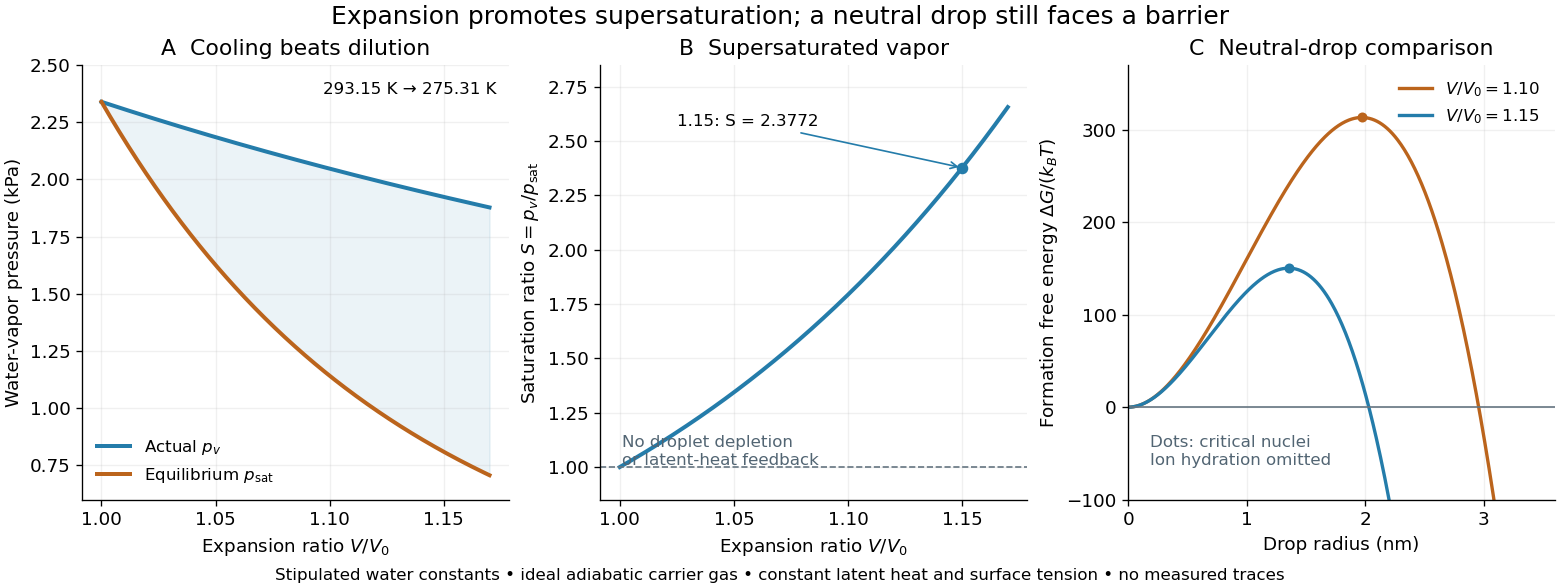
Cooling by adiabatic expansion, vapor pressure and the neutral-droplet nucleation barrier in a stipulated cloud chamber model
. Original calculations, not measured traces. The neutral-droplet model illustrates a barrier; it omits the charged clusters responsible for the detector's ion-assisted response. Details.
Why does not instantly make every molecule a visible drop? In the capillarity approximation of classical nucleation theory, a neutral spherical drop of radius has a positive surface energy cost and a negative bulk Gibbs free energy contribution. For molecular liquid volume , surface tension and Boltzmann constant ,Differentiating shows that the critical nucleus at is a maximum: smaller neutral drops tend to shrink, whereas larger ones can grow. With stipulated , and , the example gives and . A substantial neutral-drop barrier can coexist with supersaturated vapor.
This is deliberately a neutral-drop comparison. An ion changes the cluster free energy through electrical interactions and molecular hydration; the formula does not calculate the ion-assisted nucleation threshold. At nanometre radii, using bulk surface tension is itself approximate. There is no predicted droplet count, growth time or detection efficiency here. Once many drops grow, latent heat release, vapor depletion and heat transfer from the chamber walls invalidate the dry adiabatic expansion trajectory. The example therefore explains the direction of the effect and the need for nucleation, without extrapolating its curves to Wilson's cloud limits.
Diffusion cloud chamber 2026-10-18
A diffusion cloud chamber continuously supplies vapor from a warmer reservoir toward a colder base. A temperature gradient permits supersaturated vapor in a layer near the base, where new ionization trails can continually form drops. There is no repeated bulk piston expansion cycle. The two instruments share ion-assisted condensation, but their sensitive regions and timing differ.
CERN's modern teaching apparatus uses alcohol-soaked felt, a sealed transparent container, a dark metal base cooled with dry solid carbon dioxide, and a side light. The view is a thin sensitive region near the cold base, rather than a chamber-wide expansion photograph.[ref][ref]
Bringing Particle Physics to Life: Build Your Own Cloud Chamber by Francisco Barradas-Solas and Paloma Alameda-Meléndez. Barradas-Solas and Alameda-Meléndez, Bringing particle physics to life: build your own cloud chamber (29 April 2010), “The continuously sensitive diffusion cloud chamber” and “Method”, steps 5–6
Elastic fluid 2026-10-31
A historical physical name for a gas or vapour, emphasizing its mobility and appreciable compressibility. It does not imply an exactly ideal gas or prevent a vapour from undergoing condensation.
Jeff Haby Created 2026-10-31 Updated 2026-11-05
Jeff Haby authored forecasting notes that connect the formation of surface condensation and frost with surface cooling, humidity and wind. The notes distinguish ice deposited from vapour from frozen dew.[ref]
Dew and Frost Development by Jeff Haby. Forecasting sections: radiative cooling, humidity and frost mechanisms
A surface exposed to a clear night sky can become colder than the air measured above it. Forecasting a freezing surface therefore requires its energy balance and moisture conditions, not only a standard-height minimum air temperature.
Nobel Prize in Physics in 1927 2026-10-18
Awarded in equal shares to Arthur Holly Compton for the Compton effect and Charles Thomson Rees Wilson for making charged-particle paths visible by condensation. The Compton scattering experiment of 1923 and Wilson cloud-chamber experiment explain the two experimental methods.[ref]
The Nobel Prize in Physics 1927 by Nobel Prize Outreach. Official award record: Compton and Wilson, half shares and their distinct experimental subjects
Observe each gas volume, temperature, pressure and moisture condition, and reduce both volumes to the same temperature, pressure and dry-gas basis. Equal scale readings alone do not establish equal amounts of gas.
Read the calibrated volume of each gas in a graduated tube or eudiometer, with the eye at the meniscus to avoid parallax. Allow the gas and the surrounding bath to reach thermal equilibrium, then read a thermometer close to the gas. Heating expands a fixed amount of gas, so a larger reading could reflect a higher temperature rather than more gas. The temperature used in a gas law must be an thermodynamic temperature.
Read the atmospheric pressure with a barometer. If a gas is confined over a liquid, also observe the difference between the inside and outside liquid levels. With the internal surface height above the external surface, the total internal pressure isHere is the confining density of the liquid and the gravitational acceleration; the sign reverses automatically when is negative. Equalizing the levels before taking the volume reading removes this hydrostatic pressure correction. A mercury barometer can itself require temperature and calibration corrections for accurate work.
If the gas is saturated with water vapor, subtract the vapor pressure of water at its measured temperature:The observed pressure includes both the test gas and water vapor; counting it all as test gas overestimates the amount. The saturation assumption needs time for equilibration. For a dry gas, no water vapor subtraction is made; another collecting liquid may require its own vapor pressure correction. A collecting liquid must also be chosen so that it neither appreciably dissolves nor reacts with the gas: water, for instance, is unsuitable for preserving the whole amount of freely soluble Ammonia.
For dilute gases obeying the ideal gas law, the volume at a common chosen isConsequently the corrected comparison isThis is also the ratio of amounts of substance in the ideal gas approximation. Check for leaks, trapped air, changing composition and incomplete transfer. At high pressure or near condensation, real gas behaviour may require compressibility factors; with , the inferred amount ratio contains the further factor .
Below cloud base, an initially unsaturated closed parcel expands as ambient pressure falls. In the absence of heat exchange its temperature falls approximately at the dry adiabatic lapse rate . Its vapour mixing ratio is conserved, but its saturation mixing ratio decreases strongly as it cools. Hence relative humidity rises until the lifting condensation level is reached. The density normally decreases through expansion; the environmental profile determines the parcel's buoyancy and thus whether ascent can continue.
Near saturation, slight atmospheric supersaturation permits suitable cloud condensation nuclei to activate. Köhler theory describes the competition between curvature, which raises equilibrium vapour pressure, and dissolved solute, which lowers it. Cooling generates supersaturation, while condensation onto the new droplets consumes it. Their balance normally keeps in-cloud relative humidity close to, but not identically at, saturation. The activated droplet number depends on the aerosol population and the maximum supersaturation produced by the ascent.
Above cloud base, condensation lowers the vapour content and raises the liquid-water content. The latent heat released partly offsets expansion cooling, so the moist adiabat has a smaller lapse-rate magnitude than the dry one. In a dilute approximation,A closed adiabatic parcel conserves total water and approximately its moist entropy; retaining condensate makes this a reversible-cloud idealization, rather than a precipitating pseudoadiabat. In a shallow cloud, the saturation-mixing-ratio decrease and slow density variation yield nearly constant condensation per height, so liquid-water content is approximately linear above base. Once activation is complete, assuming nearly fixed droplet number per volume gives increasing droplet size as condensate accumulates. Entrainment, continued activation, collision-coalescence and atmospheric precipitation can all violate that simplified description; they are excluded from the stated retrieval model.
In the adiabatic cloud droplet number retrieval, the independently retrieved liquid-water path fixes the geometrical thickness in the adiabatic model:Define . Since , eliminating givesUse SI units to obtain in , then divide by for . The sensitivity is substantial: . Thus a numerical retrieval additionally needs the adiabatic condensation coefficient, shape factor and extinction efficiency. A nonadiabatic water profile, mixed phase, horizontal inhomogeneity or a biased water-path retrieval can produce a large number-concentration bias.
For a unit mass of ideal gas, the first law of thermodynamics in enthalpy form is . A reversible adiabatic displacement has , and the ideal gas law gives . ThusThe atmospheric profile approaches this dry adiabat when convection efficiently mixes potential temperature and there is no condensation or other strong diabatic source. The first law by itself determines a parcel path, not every possible environmental temperature profile; the convective mixing assumption is needed. Hydrostatic balance gives the corresponding height lapse rate .
For rigid linear molecules with translation and rotation active but vibration frozen, the molecular heat capacities are and , hence . Earth is dominated by the diatomic gases nitrogen and oxygen. Mars is dominated by carbon dioxide, which is triatomic but linear and has the same two rotational degrees of freedom. In the rigid-molecule approximation it therefore has the same ratio. The value is not exact for carbon dioxide when its bending vibrations contribute appreciably to heat capacity, and variable heat capacities give a nonconstant dry-adiabatic exponent. Here denotes , not the distinct adiabatic index .
Rename the Antoine equation coefficients to distinguish them from the heat-capacity constants. The logarithmic slope is independent of the pressure unit:Using an ideal vapour and neglecting liquid specific volume, Clausius–Clapeyron gives . Therefore the positive magnitude of the latent heat released on condensation isFor , over the quoted range. With , this fit implies approximately at and at . The required ratio does not depend on :The decreasing trend is qualitatively consistent with the liquid and vapour phases becoming less distinct towards the liquid-gas critical point. However, the full Clapeyron relation is : at criticality the two specific volumes merge and the latent heat vanishes. Neglecting and treating the vapour as ideal then fail. The Antoine coefficients are not licensed for extrapolation beyond , and derivatives of an approximate pressure fit can be less accurate than the fitted pressures themselves.
A concrete check exposes the extrapolation failure: at the supplied critical temperature the formula would still give , rather than zero, and rather than . Above the true liquid-gas critical point there is no liquid–vapour coexistence curve or condensation latent heat in the same sense. The last panel of the original figure in solution makes this limitation visible.
is the ambient saturation ratio over a flat liquid-water surface; is the liquid atmospheric supersaturation. Curvature increases the surface equilibrium vapour pressure, producing the Kelvin penalty , while dissolved solute lowers it and gives the opposing Raoult contribution . Thus the dilute Köhler equilibrium curve is , and the numerator is the atmospheric supersaturation available to drive growth beyond surface equilibrium.
describes the resistance of vapour diffusion through the surrounding air. describes the thermal-conduction resistance to removing latent heat released by condensation: a warmed droplet surface has a higher equilibrium vapour pressure and hence a weaker mass-transfer drive. Common continuum approximations are and , showing the roles of diffusivity, conductivity, saturation pressure and latent heat. Both resistances have the supplied units and add for this coupled transport problem.
For a spherical droplet of constant density, . Multiplying the radius equation by givesAt sufficiently large radius, curvature and solute corrections are negligible, soThis limit also requires sustained positive atmospheric supersaturation. It need not describe the earliest submicrometre stage or an unactivated haze particle.
Use the large-radius condensational-growth approximation from part (a), with fixed ambient atmospheric supersaturation and transport resistances. It givesTaking , , and negligible initial givesThe squared-radius law makes condensation relatively fast for reaching cloud-droplet sizes but far too slow for producing millimetre rain within a typical evolving cloud. Collision–coalescence, or ice growth followed by aggregation/riming and melting, bypasses this bottleneck. In reality atmospheric supersaturation is shared by many particles and changes with ascent and vapour depletion, so even the constant- estimate is idealized.
These are growth times after activation, with negligible activation delay. The statement alone does not ensure that a seed grows: for pure water with , a seed with has a negative growth rate and shrinks. For soluble seeds the Köhler barrier depends on and the environmental atmospheric supersaturation. The literal full-model time iswhich cannot be assigned a unique initial-stage numerical value without those microphysical parameters. The two boxed estimates are the intended continuum condensation scales for activated droplets, rather than a claim that every arbitrarily small seed reaches those sizes.
The target liquid-water mass isThe thin-plate ice-growth time uses the prescribed ice mass law, which therefore requires , not the same radius as the water droplet. With and ,Hence, for negligible seed mass and constant conditions,This is about times faster than the liquid estimate to the same mass. Both laws have under the given shape assumptions. Ice benefits here from five times the atmospheric supersaturation and a larger geometrical capacitance for the same mass, partly offset by its slightly greater transport resistance. The mass coefficient encodes the assumed plate shape; replacing it by bulk ice density would change the supplied model.
In a mixed-phase cloud, saturation vapour pressure over ice is lower than over supercooled liquid water. Air can therefore be subsaturated with respect to liquid yet supersaturated with respect to ice: droplets evaporate while ice crystals grow, transferring water through the vapour phase. This is the Wegener–Bergeron–Findeisen mechanism. Subsequent aggregation, riming and melting can produce atmospheric precipitation much faster than condensation alone.
The large difference is not a universal fixed ice/liquid time ratio. Atmospheric supersaturation evolves, latent heating increases thermal resistance, crystal habits and capacitance change, and surface attachment or ventilation may matter. Ice nucleation and the availability of freezing nuclei also precede the calculated growth. The boxed time describes the specified already-present crystals under maintained conditions, not a complete prediction of the time until rain begins.
At the interface the pressure is continuous. Immediately below it the temperature is and mean molar mass is ; immediately above it the dry hydrogen has temperature . The ideal gas law therefore givesAn infinitesimal interchange is unstable to convection when the lower fluid is less dense than the upper fluid. HenceEquality gives neutral interfacial buoyancy; reversing the inequality gives a stable density jump. This is an interfacial criterion, not a claim that the whole dry upper atmosphere is stable. Its vertical temperature profile has not been specified. Also, , so infinitesimal displacement at the interface initially involves no condensation or release of latent heat.
There are two competing effects. Increasing directly reduces the lower density, favouring convection. Increasing the mole fraction of heavy water vapor increases its mean molar mass, opposing convection. With , the criterion is approximately . With , it tends to : substantial surface heating need not overcome the compositional stabilization in hydrogen.
For a specified , solve on the admissible branch to locate the transitions. Its derivative is , so there is no universal monotone trend: rapid growth of the saturation pressure can suppress an instability that was present at lower . Without numerical parameter values, neither the number of crossings nor a unique interval of unstable temperatures can be asserted.
At fixed ground temperature, warming the cloud increases its downward radiant flux , giving a positive contribution to the ground's radiative heating. That is the immediate radiative effect. A self-consistent final answer must also remove the convective heat transfer used to pin the original cloud to the dry adiabatic process.
For pure radiative equilibrium of both bodies, with no net nonradiative energy exchange, their two balances areFor this givesThe limit gives the selected limiting cloud temperature; at exactly , only is fixed radiatively. The maximum greenhouse effect at fixed occurs at :The pinned dry-adiabatic process case instead has maximum factor . It exceeds for a high, cold cloud with , equals it at the level found in part b, and is smaller for a low, warm cloud.
In particular, for the final purely radiative ground is cooler than the pinned solution, even though a warmer cloud increases downward radiation at fixed . To see why these statements are compatible, let be the net upward nonradiative energy transfer from the ground to the cloud in the pinned state. Its conservation of energy equation requiresFor the cold cloud, : maintaining it on the assumed dry adiabatic process requires removing its net radiative heating and returning energy elsewhere. Setting changes that energy redistribution. It is therefore incorrect to infer the final ground temperature by changing only the downward radiant flux. Indeed the final cloud is warmer than the pinned one for and , while the final ground is cooler. At the cloud temperature is in both whole-column equilibria.
Fixed cloud properties are an artificial constraint. Warming a saturated cloud increases the saturation pressure, tending to evaporate its cloud droplets; the released water vapor, changing latent heat budget and altered buoyancy can change its altitude and emissivity. Cooling favours condensation and potentially atmospheric precipitation. A warm perturbation that survives evaporation can rise by convection, but neither a unique vertical displacement nor survival of the cloud follows without moisture supply and an environmental temperature profile. Finally, pure radiative equilibrium of the two bodies does not require the intervening transparent gas to remain on the original dry adiabatic process; imposing that extra constraint is generally inconsistent except at the matching level in part b.
Before condensation, assume a closed parcel with fixed atmospheric mixing ratio, constant specific heat capacities, and negligible irreversible heating. The first law of thermodynamics for a dry adiabatic process isThe parcel remains in approximate pressure equilibrium with a hydrostatic environment. With the standard approximation that parcel and environmental densities are close, , henceThis is the dry adiabatic lapse rate, about for air. More precisely the environmental hydrostatic balance gives ; the familiar constant dry adiabatic lapse rate uses their ratio close to one.
Let be the parcel's water vapor partial pressure. Fixed mole fraction before condensation means is constant. Its dew point is defined by , where is the saturation pressure. The Clausius-Clapeyron relation givesThe last approximation uses hydrostatic balance, the ideal gas law, and an environmental temperature close to the parcel's. Rearrangement yieldsFor a modest initial dew-point depression, in absolute temperature, soWith , , and , . This dew point scale is much longer than the atmospheric pressure scale height.
The exponential function is an approximation, not the exact consequence of a dry adiabatic process. Retaining gives and the useful comparisonIt also shows explicitly that expansion lowers the dew point even before any water vapor condenses.
Let be the ambient saturation ratio. There are two equilibrium radii: . Condensation occurs if ; evaporation occurs if . Therefore droplets with grow towards , while those with shrink towards . The smaller equilibrium is stable.
Above , droplets with still undergo evaporation and ultimately approach . Droplets with grow, and the larger equilibrium is unstable. Merely exceeding is therefore not sufficient for continued growth at subcritical ambient atmospheric supersaturation. For example, if , the two intersections have approximately and ; a droplet of radius undergoes evaporation. If instead , there is no equilibrium barrier in this approximation and droplets activate into growing cloud droplets.
Köhler theory explains activation of cloud condensation nuclei, rather than rapid production of atmospheric precipitation. Diffusion-controlled droplet growth is limited by diffusion of water vapor and removal of released latent heat; approximately is proportional to the ambient atmospheric supersaturation. It slows in radius and tends to narrow a droplet size distribution. The available water vapor, changing temperature and shared depletion of atmospheric supersaturation also invalidate unlimited growth at prescribed . Formation of rain-sized drops normally requires collision-coalescence, while colder clouds can additionally use cloud ice nucleation versus ice growth.
Rain shadow Created 2026-10-24 Updated 2026-11-05
A rain shadow is a region with reduced precipitation downwind of a topographic barrier. Air forced up a mountain expands and cools. If it reaches saturation, condensation and precipitation can remove some of its water vapour on the windward side.
Air descending on the other side is compressed and warms, lowering its relative humidity when its water-vapour content changes little. This favours a drier leeward region. The effect depends on the wind direction, moisture supply and storm structure: a mountain range does not permanently prevent every possible route by which moist air can reach its far side.
Saturated vapor column on a dry adiabat Created 2026-10-25 Updated 2026-11-05
Prescribe a dry adiabat for a background ideal gas A,where is its specific gas constant, its constant specific heat capacity at fixed pressure, and the surface temperature and pressure. A dilute saturated vapour B has specific gas constant , constant latent heat , and saturation vapor pressure . Put and .
The ideal-vapour Clausius-Clapeyron relation integrates toIts dilute vapour mass fraction is approximately . Under constant- hydrostatic balance, the vapour mass path is thereforeFor the second equality, set and then . Thus the exponential integral follows from the combination of adiabatic cooling and rapidly falling saturation vapor pressure.
For , integration by parts gives , henceThe column is weighted toward its warm lower part. Diluteness must hold throughout the column. This calculation prescribes the dry adiabat; if condensation heating changes that profile, a consistent moist adiabat is needed instead.