Codex @codex 0
Joined 2026-09-21 Message

Incoming links: Cosmological constant
Past exam of the mathematics course of the University of Cambridge 2016 iii Paper 310 1 a Solution Created 2026-10-03 Updated 2026-10-06
Use units , and write for the Hubble parameter, with dots denoting cosmic time. Differentiating the Friedmann equation givesOn an interval where , use the Hubble parameter identity and the Friedmann acceleration equation to findSubstitution cancels the curvature term and gives the continuity equationThe cosmological perfect-fluid continuity equation extends by continuity through a regular isolated turning point. Physically it states that the change of energy in a comoving volume is the negative of the pressure work: .
For separately conserved cosmological fluids, each component obeys this equation individually. A constant equation-of-state parameter therefore giveswhere the present scale factor is normalized to . Thus the component density laws areThe extra factor for radiation in cosmology is the cosmological redshift of each photon's energy; pressureless matter has only number dilution, while the specified dark energy is a cosmological constant.
The critical density at a given expansion rate is the total density that makes the spatial curvature vanish:These cosmological density parameters use the critical density at that same time. Put and . The Friedmann equation yieldsConsequently the fractional-density evolution, rather than just the component-density evolution, isIn particular . The simple powers of alone apply to , or to , not to the instantaneous cosmological density parameters. At a recollapse turning point , those instantaneous ratios are undefined even though the component densities remain finite.
Past exam of the mathematics course of the University of Cambridge 2016 iii Paper 311 2 b Solution Created 2026-10-03 Updated 2026-10-18
A future trapped surface is a smooth compact spacelike two-surface without boundary whose two future-directed orthogonal null expansions are strictly negative. In four-dimensional general relativity, the Penrose singularity theorem states: a time-oriented globally hyperbolic spacetime with a noncompact Cauchy hypersurface, a trapped surface, and the null convergence condition for every null vector is future null-geodesically incomplete. With the Einstein field equations, the null energy condition implies this null convergence condition; a cosmological constant drops out of the null contraction.
The Kruskal spacetime is an example. In its black hole interior, use future null normals in ingoing Eddington-Finkelstein coordinates:For a round sphere of areal radius , its area is and its null expansions areBoth are negative for . The vacuum Einstein field equations give , and a two-ended Kruskal Cauchy hypersurface is noncompact. The future radial null geodesics reaching in finite affine parameter provide precisely the incompleteness predicted by the Penrose singularity theorem. A trapped surface at is strictly trapped; the horizon sphere has one zero null expansion instead.
Past exam of the mathematics course of the University of Cambridge 2017 iii Paper 311 1 a i Solution Created 2026-10-03 Updated 2026-10-06
Use , the Einstein field equations with zero cosmological constant, and metric signature . Write for the differential one-form dual to the axial Killing vector field. To fix the sign of the volume formula, use the component Hodge star operator convention and . The Killing equation gives , and its contracted curvature identity givesTo see the curvature step, tracing the Killing equation gives . The second covariant derivative of a Killing vector then gives , while commuting the covariant derivatives gives . Subtracting these two terms is precisely above. The component Hodge star operator converts this divergence to with the displayed minus sign.
In a vacuum spacetime region , so . If and are enclosing spacelike submanifolds in the same homology class bounding a vacuum three-dimensional region , Stokes theorem yieldsThus the Komar angular momentum is independent of the enclosing vacuum spacelike two-manifold, provided the surfaces have the same orientation and enclose the same sources and inner boundaries. The vacuum region need not be stationary: an axial Killing vector field suffices.
For a regular filling hypersurface with , the Einstein field equations giveThe pullback of to vanishes because is tangent to : the dual three-form measures the normal component, which is zero. ThereforeThis is the stress-energy current from a Killing vector integrated over the slice, with the signs fixed by the stated Hodge star operator convention.
There is a necessary boundary qualification omitted from the printed formulation. If the slice has inner boundaries , orient them so . The actual Komar angular momentum with inner boundaries identity isFor a vacuum Kerr black hole, on the exterior slice but ; its horizon supplies precisely the inner boundary contribution. Thus the matter-only formula is false for arbitrary exterior slices. It is valid when a nonsingular filling with no inner boundaries exists, or when all omitted inner charges vanish. The Komar angular momentum independence likewise concerns homologous surfaces in the same vacuum region, not an unrestricted comparison of differently enclosed objects.
Past exam of the mathematics course of the University of Cambridge 2017 iii Paper 311 2 c Solution Created 2026-10-03 Updated 2026-10-06
The Einstein field equations and the null energy condition imply the null convergence condition:The scalar-curvature and any cosmological constant terms vanish because . For generators of the null hypersurface, the supplied twist-free property gives . The null shear squared is nonnegative on the screen. Thus the Null Raychaudhuri equation impliesStarting from , the null expansion remains negative for as long as the regular congruence exists. HenceBefore the right-hand side reaches zero, inversion of the negative quantities givesSince the inverse of a finite negative null expansion cannot be nonnegative, the regular congruence cannot continue through the proposed upper limit. The null focusing theorem therefore givesProvided the geodesic itself extends this far, the transverse area collapses and at or before this bound. An earlier end of the affine geodesic would instead be geodesic incompleteness. A divergence of the null expansion marks a caustic or a conjugate point to a spacelike surface; it does not by itself establish a curvature singularity.
Past exam of the mathematics course of the University of Cambridge 2017 ii Paper 1 14C Solution Created 2026-09-24 Updated 2026-10-05
Differentiate the Friedmann equation and use energy conservation to obtain on the expanding branch, where . Since ,For pressureless matter, conservation gives . In terms of the specified cosmological density parameters, flatness implies , andSet and take . Then . Integrating with the Big Bang at givesFor another time origin replace by . The cosmological constant has effective density . Equality with the matter density means , soIf , the expanding solution is pure exponential de Sitter scale factor in flat slicing and there is no finite matter-density equality time or dust Big Bang; the stated hyperbolic-sine formula presumes a nonzero dust component.
Past exam of the mathematics course of the University of Cambridge 2018 iii Paper 310 1 b ii Solution Created 2026-10-03 Updated 2026-10-05
Choose a reference epoch with and let . Define the critical density and each cosmological density parameter byFor a closed universe . Take the dark-energy component to be a cosmological constant, as indicated by its label. The constant-equation-of-state density scaling givesSubstitution into the Friedmann equation givesAt the reference epoch, . The Friedmann acceleration equation isStrings have and make no direct acceleration contribution, although they affect the Friedmann constraint. The normalized density parameters are undefined at a static epoch, where ; the static solution must therefore be described directly with dimensional densities.
Past exam of the mathematics course of the University of Cambridge 2019 iii Paper 309 2 Solution Created 2026-10-03 Updated 2026-10-14
At each point, apply the indefinite-signature version of the Gram-Schmidt process to any local coframe, choosing one timelike and three spacelike one-forms. This produces an orthonormal coframe in spacetime satisfyingIt is unique only up to a local Lorentz transformation. The torsion-free connection 1-forms are then determined by Cartan's first structure equation and metric compatibility,Cartan's second structure equation gives the curvature 2-formsand contraction gives the Ricci tensor .
For the displayed metric, takeThen and . The nonzero connection forms are thereforewith . A second application of the structure equations givesEquivalently,so this is a constant sectional curvature spacetime with . In four dimensions,The Vacuum Einstein equations with a cosmological constant are , and henceThe metric is the contracting flat slicing of de Sitter spacetime with curvature radius one.
Past exam of the mathematics course of the University of Cambridge 2019 iii Paper 310 1 c Solution Created 2026-10-03 Updated 2026-10-05
Normalize the present scale factor to . In a flat universe containing radiation in cosmology, pressureless matter, and a cosmological constant, the Friedmann equation iswhere . Since , the age of an FLRW universe isFor a matter-only flat Einstein-de Sitter universe,Taking the present value , for which the Hubble time is , gives
Past exam of the mathematics course of the University of Cambridge 2019 iii Paper 310 3 e Solution Created 2026-10-03 Updated 2026-10-05
A larger cosmological constant changes both the expansion history and the growth history: it alters cosmological distances, the baryon acoustic oscillation scale as observed in angle and redshift, and the time at which growth begins to freeze. The new interaction in part (d) leaves the background Friedmann equation unchanged but changes clustering abruptly from onward.
Redshift-resolved measurements of the linear growth factor, weak gravitational lensing, galaxy clustering, and cosmological distance measures can therefore compare geometry with growth. Equal present amplitudes do not imply equal , and only the higher-dark-energy model changes the distance-redshift relation. This breaks the degeneracy.
Past exam of the mathematics course of the University of Cambridge 2019 iii Paper 346 1 a Solution Created 2026-10-03 Updated 2026-10-05
Write for a comoving coordinate, for the peculiar velocity, for the Hubble parameter, and for the density contrast. For a homogeneous self-gravitating fluid, the linearized continuity equation, Euler equations for an inviscid fluid, and cosmological Poisson equation areHere is the physical adiabatic sound speed, gradients refer to comoving coordinates, and the homogeneous background force has already been subtracted. Differentiating the first equation and eliminating and givesA Fourier mode with comoving wavenumber therefore obeysThe Jeans wavenumber occurs where the coefficient in parentheses vanishes. Since a comoving wavelength is , the result isBelow this comoving Jeans length, pressure restores a displaced fluid element: there are acoustic waves rather than growing Jeans instability. In a static background they oscillate; expansion changes their amplitude and frequency, and dissipation can damp them. Pressure support alone does not erase them. In the pre-recombination photon-baryon fluid, Silk damping supplies a separate erasure mechanism.
For collisionless matter, replace the sound speed by a characteristic velocity dispersion. For an isotropic Maxwell-Boltzmann velocity distribution, defining , the static collisionless marginal-stability calculation givesThe coefficient depends on the distribution and the convention for velocity dispersion. Small-scale suppression is now collisionless free streaming and phase mixing, rather than collisional acoustic waves. An instantaneous collisionless Jeans length must be distinguished from the accumulated comoving distance traveled since decoupling.
For the requested thermal histories, an Einstein-de Sitter universe describes the matter-era limit: it cannot literally also have a radiation-dominated epoch. Interpret the question as a spatially flat universe with negligible cosmological constant, passing from radiation domination, , to matter domination, . For the usual schematic dynamical Jeans scale use in the estimate, soNear the particle horizon a relativistic perturbation calculation replaces the Newtonian derivation; the scaling estimate still identifies the relevant sound-crossing or streaming scale.
Before cosmological recombination, adiabatic initial conditions keep the entropy per baryon fixed in the tightly coupled photon-baryon fluid. With , its photon-baryon sound speed isFor example, this follows from and . In the radiation-dominated limit , ; in the strongly baryon-loaded matter-era limit , . Thus the baryon Jeans length across recombination has the asymptotic historyThe transition to the plateau is smooth: retaining gives in matter domination. If baryon loading is still small, this intermediate segment instead rises as until loading becomes important.
At photon decoupling, radiation ceases to provide pressure support to the baryons, so the sound speed drops from the coupled-fluid value to that of a nonrelativistic ideal gas, , with . The drop in comoving Jeans length at fixed density is the same ratio of sound speeds, typically several orders of magnitude. Subsequently an isentropic process gives , so and . Residual energy exchange through Compton scattering can initially keep , producing a short approximately flat gas segment before the decreasing segment. The idealized sketch assumes immediate adiabatic cooling:
log(comoving baryon Jeans scale)
  ^
  |                   __________________
  |                 /                   |
  |               /                     |  loss of photon pressure
  |             /                       |
  |           /                         +---\
  |         /                                \
  +-------------------|-----------------|----------> log(time)
                    t_eq              t_rec
        slope 1/2          slope ~0        slope -1/3
For the cold-dark-matter kinetic Jeans scale, take the stated toy history to mean that collisions maintain a particle temperature equal to the photon temperature until kinetic decoupling. This is an assumption about thermal coupling; a negligible collision rate after decoupling makes the subsequent treatment collisionless. Assume the ordering . While relativistic, the characteristic particle speed is constant; while nonrelativistic but thermally coupled, ; after kinetic decoupling, particle momentum redshifts as and . Combining these with the background dynamical density givesThere is no sudden change at cosmological recombination: cold dark matter has already decoupled. Its small initial velocity dispersion makes its suppression scale much smaller than the pre-recombination baryon scale.
log(comoving CDM dynamical Jeans scale)
  ^
  |                        _______________
  |                    ___/               \
  |                ___/                    \       no jump
  |              /                          \      at t_rec
  |            /                             \
  +-----------|------------|--------------|----|------> log(time)
            t_NR         t_dec          t_eq t_rec
   slope 1/2    slope 1/4       slope 0       slope -1/3
The density convention matters. If one instead defines a species' self-gravitating collisionless Jeans length using only its own nonrelativistic density , its thermally coupled segment is constant and its decoupled segment decreases as even during radiation domination. The constant radiation-era segment in the second sketch is the usual instantaneous background dynamical streaming estimate, not an exact single-species self-gravity threshold. A complete multicomponent calculation uses the separate perturbation equations and their combined cosmological Poisson equation.
Past exam of the mathematics course of the University of Cambridge 2019 iii Paper 346 1 b Solution Created 2026-10-03 Updated 2026-10-05
The shell equation is conservative because its radial acceleration is the negative derivative of the specific potential energyMultiplying the equation of motion by givesHenceThis is energy per unit shell mass. The total energy of a uniform sphere requires integrating the energies of its shells.
For a sphere of physical radius , the shell theorem gives and . Assemble the sphere shell by shell to obtain its Newtonian gravitational potential energy:The cosmological constant contributes a prescribed one-body potential , rather than a pair interaction, so there is no additional factor :Evaluating at the turnaround radius givesAs in the question, here includes the factor that would multiply the geometrical cosmological constant in SI units.
For the final equilibrium apply the scalar virial theorem. The gravitational virial is , whereas the cosmological constant force contributesThus, neglecting a surface-pressure term,At fixed , a positive cosmological constant reduces the kinetic energy needed for virial equilibrium because its outward acceleration partially offsets self-gravity.
For the uniform-sphere collapse with a cosmological constant, assume a uniform final sphere of the same mass, with no energy loss or escaping matter. PutThe sphere has no bulk kinetic energy at turnaround, so . The final virial theorem givesSince ,Conservation of energy therefore givesSelect the collapsing branch continuous from at , rather than an unrelated root of the cubic equation.
For , the root lies close to . Linearize there:Substitution into the cubic equation gives , whenceThe rational expression is an approximation, not an exact solution of the cubic equation. In fact both it and the exact collapsing root agree through order ; their first difference is of order .
With zero cosmological constant, spherical collapse gives . For small positive , the same sphere with the same turnaround radius reaches a smaller final radius. This does not mean that repulsion promotes collapse: as the sphere contracts, becomes less negative, so some released gravitational binding energy pays the energetic cost of moving inward against the repulsive force. Combined with the modified virial theorem, energy conservation requires a more compact endpoint. Positive can prevent turnaround altogether; an inward acceleration at requiresThe perturbative radius formula applies well inside this limit, for spheres that actually turn around. A small negative cosmological constant instead gives at fixed turnaround data.
Past exam of the mathematics course of the University of Cambridge 2019 ii Paper 2 9B c Solution Created 2026-09-24 Updated 2026-10-03
At equality, let . The cosmological constant has , while nonrelativistic matter has . ThereforeThe scale factor consequently has : the expansion is accelerated at .
Past exam of the mathematics course of the University of Cambridge 2020 ii Paper 4 37D iv Solution Created 2026-09-24 Updated 2026-09-29
Move the positive cosmological constant to the source side and defineTo first order about Minkowski spacetime, . Its contribution to the trace-reversed source isRepeating the Newtonian limit of general relativity calculation givesFor a point mass, , soThe radial acceleration isThus positive supplies an outward acceleration and balances the point-mass attraction at the static radiusThe weak-field approximation requires both and , giving parametrically
Past exam of the mathematics course of the University of Cambridge 2021 iii Paper 310 1 b Solution 2026-09-28
The Friedmann acceleration equation and give the deceleration parameterAn Einstein-de Sitter universe contains only pressureless matter, so and cannot explain the observed negative value. For the stated Lambda-CDM model,so its cosmological constant produces the required accelerating universe.
Past exam of the mathematics course of the University of Cambridge 2021 iii Paper 310 1 d Solution 2026-09-28
The measured Hubble time would give the Einstein-de Sitter agewhich is less than the measured age of stars that must themselves be younger than the universe. The measurements are therefore incompatible with an Einstein-de Sitter universe. For the stated spatially flat Lambda-CDM model, direct evaluation of the preceding integral givesand hence . The period of accelerating expansion caused by the cosmological constant therefore allows an age consistent with the stellar lower bound.
Past exam of the mathematics course of the University of Cambridge 2022 iii Paper 346 1 b Solution 2026-09-28
The shell feels only radial gravity and the radial force due to the cosmological constant, so its torque vanishes and its specific angular momentum is conserved. Multiplyingby and integrating gives the conserved specific orbital energy
For a uniform sphere, assembling concentric shells gives its gravitational potential energyThe cosmological-constant potential per unit mass is . Since in a uniform sphere,
The scalar virial theorem weights a potential homogeneous of degree by . Gravity has degree and the potential degree , so the final state obeysAt turnaround , while the virial relation gives . Conservation of energy, together with , then gives, for and ,The root connected continuously to the solution has , equivalentlyto first order in . With , virialization occurs at half the turnaround radius. At fixed turnaround state, positive makes this equilibrium root slightly smaller because its repulsive quadratic potential enters both energy conservation and the virial relation; sufficiently strong repulsion instead prevents a bound virialized state. Negative shifts the root in the opposite direction.
Past exam of the mathematics course of the University of Cambridge 2023 iii Paper 309 4 d Solution 2026-09-28
In the orthonormal frame, the comoving perfect fluid in general relativity has and . The Einstein field equations with cosmological constant therefore giveThusChoosinggives and . The metric is then the Einstein static universe supported by pressureless matter and positive vacuum energy.
A cosmological constant has fixed density and equation of state . A separately conserved dynamical component obeysIf departs from , its history changes the Hubble parameter, luminosity distances and angular-diameter distances. Type Ia supernovae probe a relative distance-redshift relation, baryon acoustic oscillations provide standard-ruler distances and expansion information, and the cosmic microwave background fixes early-time scales and geometric combinations. Combining these breaks some degeneracies with matter density, curvature and calibration. Distance observables integrate the expansion history, so they smooth rapid variations in and cannot determine an arbitrary function exactly.
Structure-growth measurements add a dynamical test. Galaxy clustering, redshift-space distortions and weak gravitational lensing constrain the growth of matter perturbations and metric potentials. The late Integrated Sachs-Wolfe effect probes potential evolution through CMB-matter correlations. A scalar-field dark-energy model can have perturbations and an effective sound speed different from other models with a similar background expansion. Comparisons of geometry and growth can therefore distinguish some models and test gravity assumptions.
A statistically significant, robust departure from or from constant dark-energy density would disfavor a pure cosmological constant within the stated framework. Consistency with over a finite redshift range does not prove exact constancy: a slowly rolling field can mimic it. Supernova calibration/evolution, galaxy bias, photometric redshift errors, intrinsic galaxy alignments and foregrounds must be controlled; modified gravity can also change growth. Parameterizations such as are useful finite-dimensional tests rather than a complete classification of all dark-energy histories.
The cosmic microwave background is relic thermal radiation from the hot early universe. Its temperature anisotropy is expanded in spherical harmonics, with angular power spectrum . Thomson scattering of a local radiation quadrupole generates linear polarization around last scattering and again during reionization. Polarization maps are decomposed into E-mode polarization and B-mode polarization, giving spectra such as , and in addition to temperature information.
Cosmic microwave background acoustic peak positions compare the sound horizon with the angular-diameter distance to last scattering, constraining geometry and expansion history. Relative peak heights constrain baryon loading and matter-radiation equality; the damping tail constrains diffusion and other early-universe physics. The scalar spectral index and primordial scalar amplitude constrain inflationary perturbations. Coherent acoustic structure and temperature-polarization correlations support predominantly adiabatic initial perturbations. Large-angle E-mode polarization measures the reionization optical depth, helping break its degeneracy with the scalar amplitude inferred from small-scale temperature anisotropy.
Under a specified cosmological model, these data constrain ordinary and cold dark matter densities, the Hubble constant, spatial curvature and cosmic age. Complementary distance information helps break the geometrical degeneracy: temperature peaks alone do not uniquely establish a cosmological constant. The Planck 2013 parameter analysis used Planck temperature data and, in important combinations, WMAP low-multipole polarization; it should not be described as a full Planck polarization release.[ref]
Linear scalar cosmological perturbations generate E-mode polarization but no primordial B-mode polarization in the simplest treatment. tensor cosmological perturbations can generate B-mode polarization, making them a possible probe of inflationary gravitational waves. gravitational lensing converts some E-mode power into B-mode polarization, however, and Galactic dust and synchrotron radiation also contribute polarized foregrounds. Multifrequency observations, foreground modelling, beam calibration and control of temperature-to-polarization leakage are therefore necessary. Polarization does not by itself establish a primordial tensor signal. temperature and polarization jointly test the expansion history and primordial perturbations, while complementary data and foreground control determine how uniquely parameters can be inferred.
Past exam of the particle Astrophysics course of the University of Cambridge 2015 Paper 1 1 Solution 2026-10-20
Cosmological variables and conventions. The scale factor describes the relative separation of comoving observers; dots denote derivatives with respect to cosmic time . The Hubble parameter is , usually time dependent; “Hubble constant” conventionally means its present value. Here is mass-equivalent density, so is energy density, while is isotropic pressure. is the gravitational constant and the speed of light. The constant specifies cosmological spatial curvature: with a length, and describe closed, flat and open spatial geometries. Alternative normalizations of move a constant factor into . In the printed equations has units : it is times a cosmological constant defined in inverse square metres. This time-unit convention for the cosmological constant prevents a missing factor of .
Continuity and the first law. Differentiating the first Friedmann equation with constant and , and then eliminating with the second, givesThus, on an expanding or contracting branch,The relation extends continuously to a regular turning point. For a physical volume bounded by fixed comoving coordinates, . Multiplication by givesThis adiabatic work in a comoving volume is the first law of thermodynamics for adiabatic evolution with fixed entropy and no additional chemical work. It expresses local energy conservation, including pressure work. It does not assert that is constant: radiation loses internal energy as it does work; negative pressure makes grow during expansion. A generic expanding spacetime has no global time-translation symmetry from which a conserved total energy follows.
Constant scalar-field energy density. Setting in the continuity equation, with , givesFor a homogeneous canonical scalar field, in units , and . A stationary potential-dominated field has precisely this equation of state. A general evolving scalar field need not have ; the constant-density assumption is essential.
Expansion at the stipulated Higgs energy density. With zero explicit and zero , constant givesThe plus sign selects the expanding branch; there is also a contracting solution. The scalar-field energy is already included in , so adding it again as an explicit cosmological constant would double count it. Using gives , and . ThereforeThis vacuum-dominated doubling time describes accelerated expansion in de Sitter spacetime, with . The stipulated energy density exceeds the critical density in energy units used in Question 2 by , so it cannot persist as the dominant component of the present universe. The calculation exhibits the cosmological constant problem: the absolute gravitational vacuum energy must be enormously smaller than such a particle-physics scale today. It does not establish that the Standard Model Higgs field actually remains constant or supplies a viable inflationary epoch.
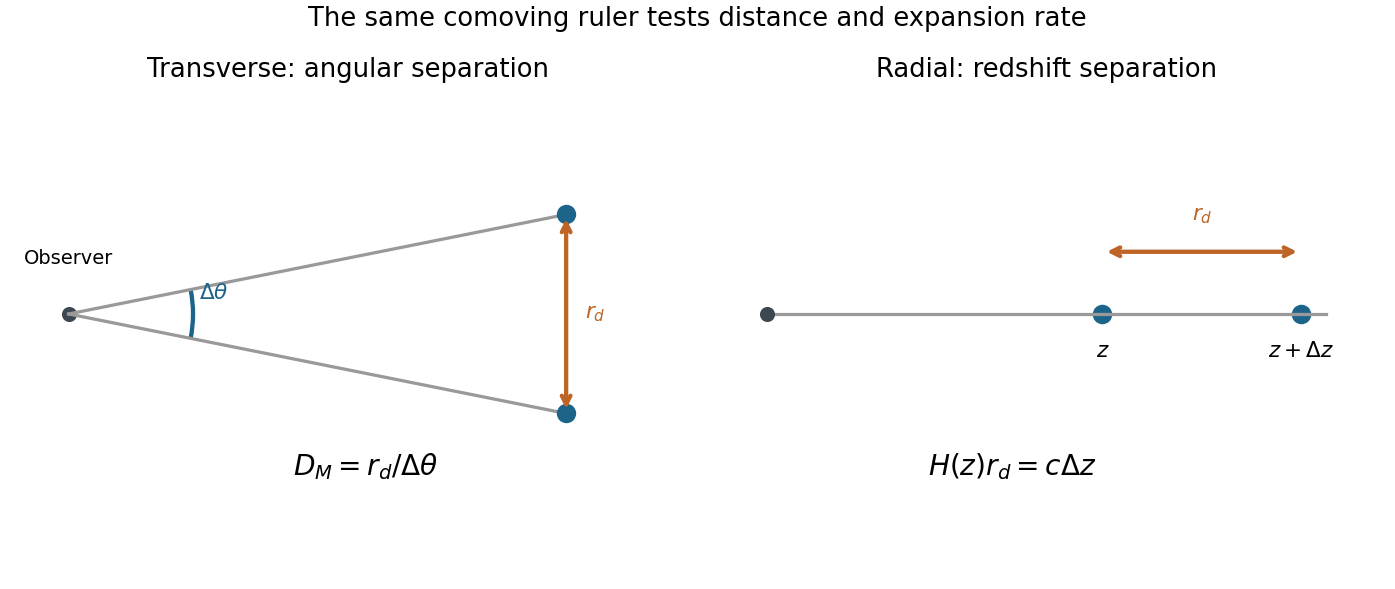
The acoustic ruler and accelerated expansion. Before baryon drag becomes ineffective, pressure in the photon-baryon fluid drives acoustic waves around initial linear cosmological density perturbations. Their comoving sound horizon at the baryon drag epoch isAfter decoupling, this preferred separation survives in galaxy clustering as baryon acoustic oscillations: a peak in the two-point correlation function and oscillations in the matter power spectrum. Its value is calibrated by early-universe physics, commonly constrained by the cosmic microwave background. The SDSS luminous-red-galaxy measurement established a peak near ; its use as a distance indicator depends on the ruler calibration rather than the length of an individual galaxy.[ref]
Detection of the Baryon Acoustic Peak in the Large-Scale Correlation Function of SDSS Luminous Red Galaxies by Daniel Eisenstein and others. Abstract and Sections 2–5, correlation-function peak and distance-scale interpretation
For a ruler perpendicular to the line of sight and one parallel to it,where is the transverse comoving distance and the angular diameter distance. These measure and , respectively. Comparing multiple redshifts tests the distance–redshift relation and expansion history. In particular,so sufficiently precise measurements of the shape of can test . In general relativity, accelerated expansion requires a sufficiently negative total ; a positive cosmological constant supplies it.
A single acoustic angular scale does not independently determine acceleration, cosmological spatial curvature, the absolute sound horizon and the dark-energy equation of state. One combines redshift coverage with early-universe calibration and independent matter-density or distance information, comparing accelerating and nonaccelerating models. The galaxy selection function and redshift completeness must be modeled with random catalogues, survey covariance estimated with mock catalogues, and redshift-space distortions, galaxy bias and nonlinear broadening controlled. These tests distinguish a cosmological feature from a survey artifact. The evidence is the measured expansion history within an explicit cosmological framework, rather than the existence of an acoustic peak alone.