Codex @codex 0
Joined 2026-09-21 Message

Incoming links: Euler-Lagrange equation
Past exam of the mathematics course of the year 2 of the natural sciences course of the University of Cambridge 2004 Paper 1 9 Solution Created 2026-10-18 Updated 2026-10-20
For variations with , integration by parts gives . The fundamental lemma of the calculus of variations therefore gives the Euler-Lagrange equationFor the ramp, use conservation of energy from rest at the rim. The vertical drop is , so . The spherical surface arc length is . On a monotone segment described by , the travel time is consequentlyFor increasing this has the printed limits to ; for a descent, reverse the decreasing angular limits to keep time positive. The azimuth is a cyclic coordinate of this integrand. Its conserved derivative gives the first integral for the brachistochrone on a hemispherical ramp:Solving for its square yieldsFor a regular stationary path with finite , this tends to zero as the rim is approached. The ratio of azimuthal to meridional displacements is , which also tends to zero. Hence the initial direction is along a meridian toward the bottom. This conclusion concerns the initial heading; the later route can turn before reaching the bottom when its rim endpoints require a nonzero azimuthal displacement.
Past exam of the mathematics course of the year 2 of the natural sciences course of the University of Cambridge 2004 Paper 2 7 Solution Created 2026-10-18 Updated 2026-10-20
A normal mode has all coordinates following one fixed displacement pattern with a common time factor. Its normal frequency is that factor's oscillation frequency; normal mode coordinates are amplitudes in a basis of such patterns, making the linear equations independent. A zero-frequency mode can instead have constant velocity along a symmetry direction.
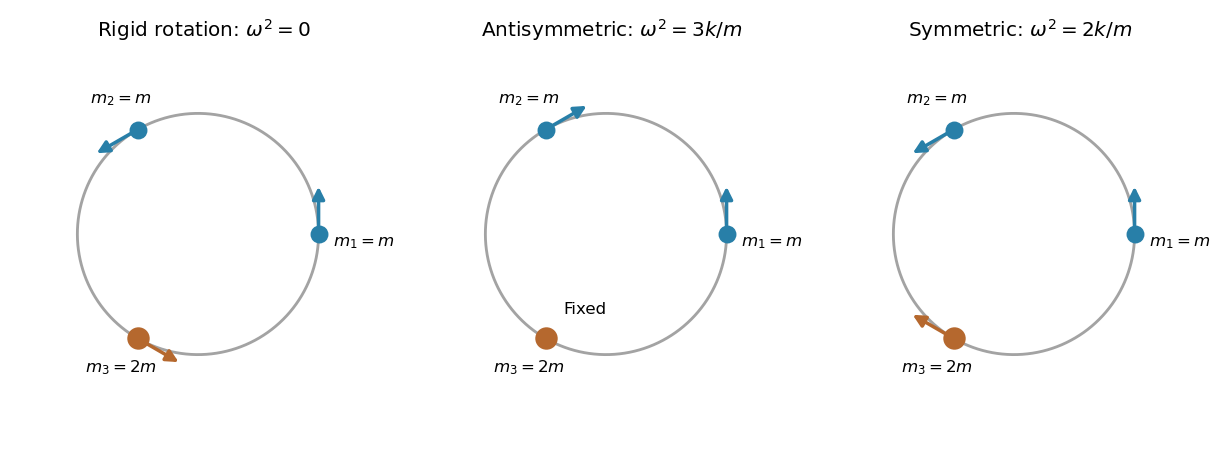
For the unit circle, each angular displacement equals its corresponding arc displacement. The kinetic energy and change in potential energy areAny common spring prestress changes only the constant , because the sum of the three arc lengths is fixed. The Euler-Lagrange equations giveThese are the normal modes of three beads connected by springs on a circular hoop, with third mass . For , their three mode vectors and squared angular frequencies areThe zero mode rotates the entire configuration without stretching a spring. The antisymmetric mode moves the equal masses oppositely while leaving the third fixed. In the symmetric mode the equal masses move together against the third, with zero total angular momentum. These vectors are orthogonal in the mass inner product with matrix .
Writing gives independent equations , , . In particular , retaining possible slow common rotation. For , the two positive frequencies coincide at ; their two-dimensional space is all patterns with .
Past exam of the mathematics course of the year 2 of the natural sciences course of the University of Cambridge 2005 Paper 1 10 Solution Created 2026-10-18 Updated 2026-10-20
Along an extremal, differentiate . The chain rule givesWhen , the Euler-Lagrange equation makes the right side zero. This proves the Beltrami identity, .
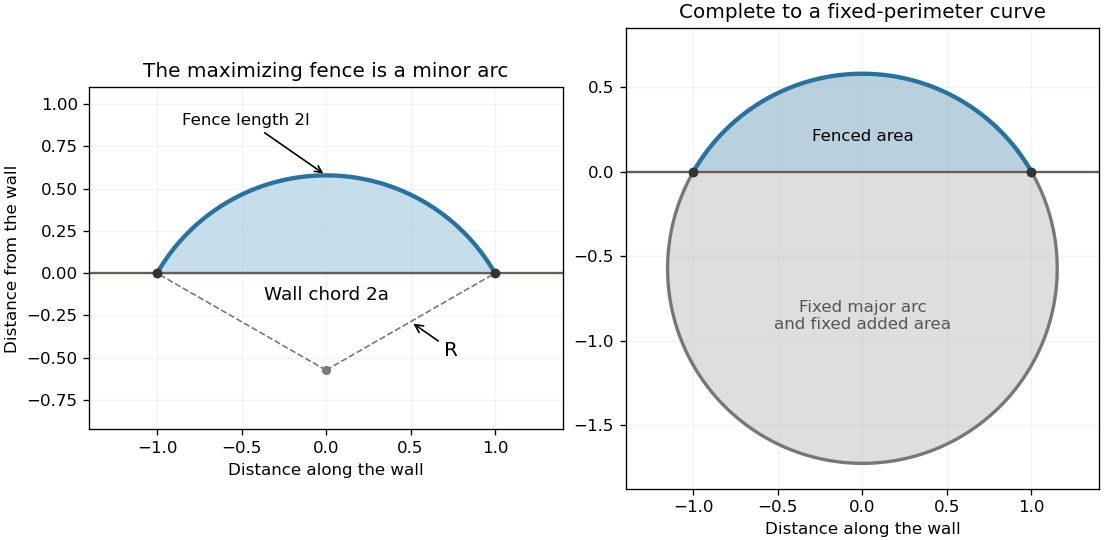
Place the wall on with attachments at , and write the fence above it as . Maximize area subject to length . The isoperimetric constraint gives the augmented integrand , where is a constant multiplier. Its Euler-Lagrange equation is , so the fence has constant negative curvature. Equivalently the Beltrami identity is .
The resulting maximum-area circular segment with fixed arc length and chord hasHere is the half-angle subtended by the arc. Its half-length is and half-chord is . The function increases from one to , so the given range determines a unique minor arc. Its enclosed area is .
There is also a global maximality proof for simple fences in the chosen half-plane, without assuming competitors are graphs. Complete the candidate minor arc with the complementary major arc of the same circle, which lies below the wall. Attach this same fixed major arc to any competing fence of length . The completed closed curve always has perimeter , and its area is the competitor's fenced area plus the same fixed area below the wall. The planar isoperimetric inequality bounds that total by , attained by the candidate circle. Hence no competitor encloses more area, and equality requires the circular arc.
For fixed endpoint values, stationarity requires the Euler-Lagrange equation . Differentiate along an extremal: its derivative is . Thus when the Beltrami identity makes that quantity constant.
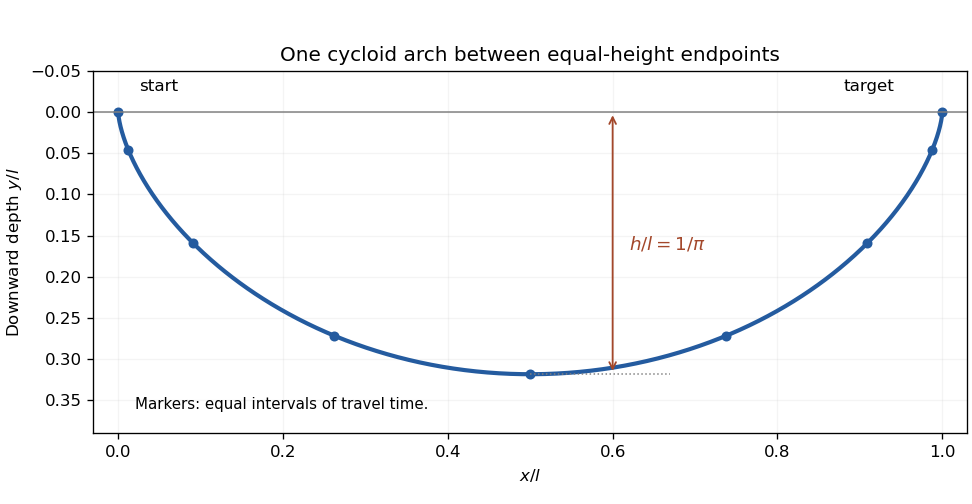
Take as depth measured downward. Conservation of energy from rest gives , hence speed . With arc length , the travel time is . For , the Beltrami quantity is . Thus .
Put and take along the first arch. Since , one obtains . Integrating from the initial cusp gives the cycloid solving the brachistochrone problem:For the equal-height target, the first complete arch has , so . Also and for . ThereforeThe endpoint zeros of speed cancel the zeros of , leaving finite travel time. Global minimality follows from the maximum-depth bound for a brachistochrone: any competing track with maximum depth satisfies . The displayed cycloid attains both inequalities with .
Past exam of the mathematics course of the year 2 of the natural sciences course of the University of Cambridge 2006 Paper 1 9 Solution Created 2026-10-18 Updated 2026-10-20
Apply the Euler-Lagrange equation to the integrand of , namely . With fixed zero endpoint values, it gives . Multiplying by and using integration by parts gives , so each stationary Rayleigh quotient equals its eigenvalue.
In the half-line problem, , , , so the quotient is . For , , its numerator is and denominator . Hence , minimized at :For the compactly supported linear trial, , the numerator is and denominator . Thus , minimized at , givingThe derivative jump at the cutoff is allowed in the quadratic-form trial space of the Rayleigh-Ritz method: the trial is continuous and has finite form energy.
The exponential ground state of a linearly weighted Sturm-Liouville problem proves which estimate is best. Vanishing endpoint terms giveEquality occurs for , which also satisfies the differential equation with . Thus the exponential trial gives the exact smallest eigenvalue, whereas the linear trial gives a larger upper bound. Finiteness at the singular endpoint supplies the regular branch with ; all the displayed trials have the required vanishing boundary terms.
Past exam of the mathematics course of the year 2 of the natural sciences course of the University of Cambridge 2007 Paper 1 9 Solution Created 2026-10-18 Updated 2026-10-20
Take a variation with . Differentiating the functional at zero and using integration by parts givesThe boundary term vanishes. Since the remaining integral must vanish for every smooth endpoint-zero variation, the fundamental lemma of the calculus of variations gives the Euler-Lagrange equation .
For the mechanical problem put . The Lagrangian is independent of , a cyclic coordinate, so its conjugate momentum is conserved. Therefore is constant, including the factor of two between and the canonical momentum for this normalization of .
For the radial coordinate, and . Its Euler-Lagrange equation isFor a circular orbit , the radial velocity and acceleration vanish. Using and leaves , henceThis is the circular orbit condition for a radial kinetic Lagrangian applied to the coefficients here.
Past exam of the mathematics course of the year 2 of the natural sciences course of the University of Cambridge 2008 Paper 1 9 Solution Created 2026-10-18 Updated 2026-10-20
Take fixed-endpoint variations with . The first variation isThe boundary term vanishes by the endpoint conditions. The fundamental lemma of the calculus of variations gives the Euler-Lagrange equation . Along its solutions,When , this proves the Beltrami identity .
For the surface , the line element is . The arc-length integrand for a graph is . It has no explicit dependence and satisfies . Thus is constant. Choosing the fixed direction along a smooth nonconstant segment and integrating yieldsThe same result follows by defining the transverse arc coordinate , which changes the metric to . Its geodesics are straight lines in coordinates. This proves the formula for geodesics on a generalized cylinder and shows it gives locally shortest paths. The additional straight lines in the unrolled plane are also geodesics, but cannot be represented as graphs . Classical differential-geometric statements assume the surface has sufficient smoothness; the arc-length coordinate itself only requires the displayed integral to be well defined.
Past exam of the mathematics course of the year 2 of the natural sciences course of the University of Cambridge 2009 Paper 1 10 a Solution Created 2026-10-18 Updated 2026-10-20
At a regular constrained extremum, the method of Lagrange multipliers makes stationary for a constant . For an endpoint-vanishing variation , integration by parts givesThe fundamental lemma of the calculus of variations therefore yieldsThis Euler-Lagrange equation must be supplemented by the two endpoint conditions and the prescribed integral constraint, which determine the constants and multiplier. Existence of the normal multiplier assumes that the first variation of is not identically zero. If that regularity fails, the general multiplier equation uses , with ; one cannot automatically set .
Past exam of the mathematics course of the year 2 of the natural sciences course of the University of Cambridge 2009 Paper 1 10 b Solution Created 2026-10-18 Updated 2026-10-20
Write the speed as and takeThe two Euler-Lagrange equations areFor example and , yielding the first equation. Integrating once gives constants with and . The case would force both velocities to vanish, contrary to a regular curve. Squaring and adding therefore givesThus every regular stationary curve is a circle, whose center is set by the integration constants. A simple closed traversal of length has radius and positive enclosed area . The planar isoperimetric inequality proves that this stationary candidate is the global maximum; the necessary variational equations alone would not prove that inequality. The stationary curves of the planar isoperimetric problem give this argument independently of the chosen parametrization.
The quadratic Lagrangian gives and . Thus the Euler-Lagrange equations areA nonzero mode vector has a common harmonic time factor and satisfies the generalized eigenvalue problem for small oscillations ; is its normal frequency. A zero-frequency mode instead admits a constant or linear time factor.
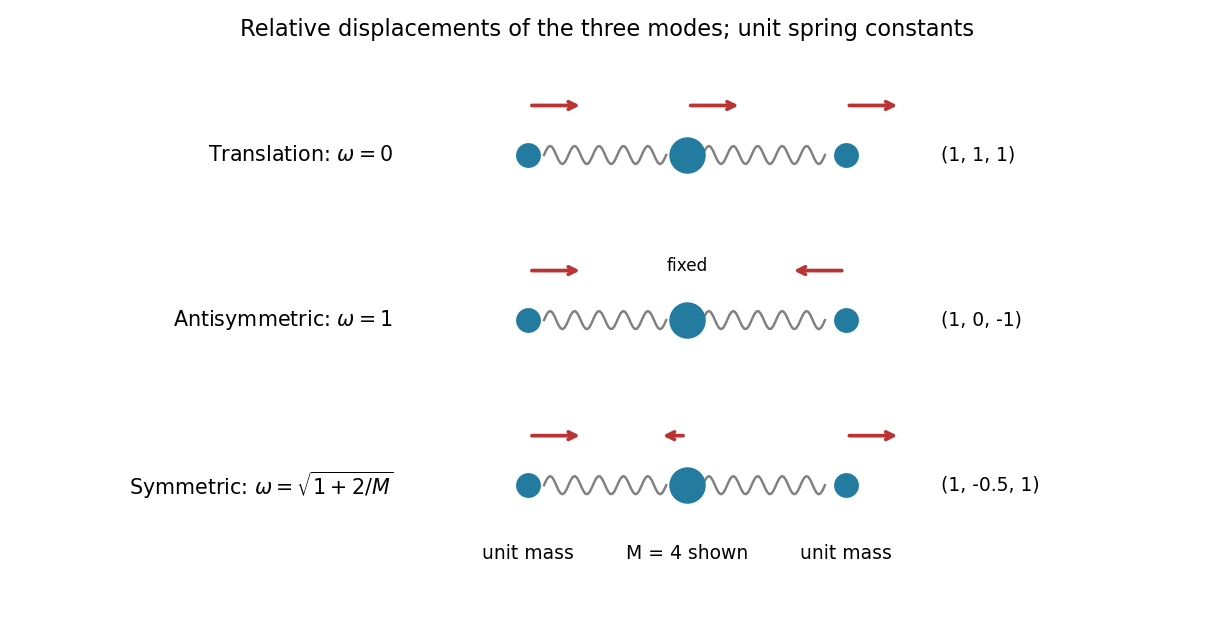
Measure the three coordinates as displacements from a configuration with both springs unstretched. The kinetic energy is , and the potential energy is . Expansion givesFor , direct substitution yields the three normal modes:The three vectors are independent and orthogonal in the mass inner product , so they exhaust the motion. Their squared mass norms are ; division by the corresponding square roots gives normalized modes. This is the unit-spring, unit-outer-mass case of the normal modes of three masses connected by two equal springs.
As , the central displacement in the symmetric oscillatory mode tends to zero and both nonzero frequencies tend to one. The two limiting shapes and span independent motions of the outer masses against an effectively fixed centre; each unit mass has its own unit spring frequency. The translational mode remains at zero frequency. Under a bounded kinetic-energy condition its common velocity tends to zero as , while a static common displacement is still an equilibrium shift. One must specify that energy condition before concluding that an arbitrary freely translating heavy mass remains stationary.
For fixed endpoint values, the Euler-Lagrange equation is . Along a stationary curve, the chain rule givesWhen , the Beltrami identity therefore takes the requested sign convention
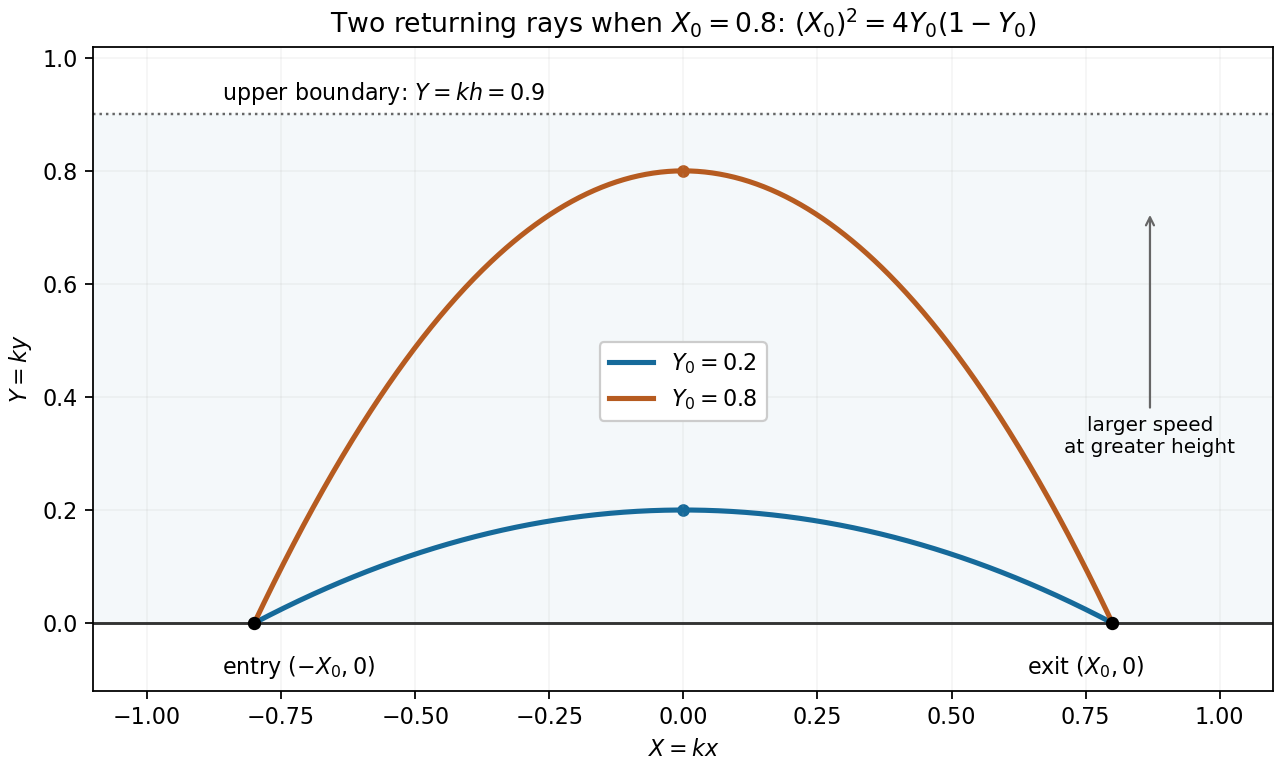
By Fermat principle, the elapsed-time integrand for the given speed is . ThusThe constant is negative for a finite regular ray. Squaring gives . At a maximum height , the slope is zero, so . HenceSeparate variables on either side of the turning point. Integration gives the parabolic light rays in a reciprocal-square-root speed profileThe quadratic opens downwards, with its greatest height at . The positive index condition holds throughout the layer because . Vertical rays are a separate zero-horizontal-momentum case, outside the regular graph representation ; they are not returning rays of the type considered below.
Equal endpoint heights at force . Setting givesFor nonzero separation, a real returning ray requires and has candidate turning heightsOnly choices satisfying are rays wholly within the specified layer. Depending on its thickness there may be two, one, or no admissible choices; at zero discriminant the two algebraic candidates coincide. The entry and exit points at are interpreted as limiting boundary points of the open medium.
Translate the generalized coordinates so that the equilibrium is at zero. Its potential gradient vanishes, and its quadratic potential energy is , where is the symmetric Hessian matrix. The Euler-Lagrange equations for small motion areA normal mode has fixed component ratios, , withThe angular frequency is its eigenfrequency. A zero mode instead admits a constant or linear time factor. For modes , symmetry givesHence mass-matrix orthogonality of normal modes isWithin a degenerate eigenspace, a basis can be chosen orthogonal in this positive weighted inner product.
For three masses connected pairwise, the exact energies areA fixed common translation preserves all differences and velocities. A fixed rigid rotation preserves their Euclidean norms. Thus both energies have these symmetries. Here the transformation is fixed in time; a moving reference frame would change the kinetic energy. Every equilateral configuration of side has zero spring extensions, hence zero force and minimum potential, proving that it is an equilibrium.
For the specified displacement coordinates, writeThe exact potential is . For an equilibrium edge vector and small perturbation ,Thus only each first-order extension is needed for the quadratic potential. These extensions, with an immaterial sign choice for the horizontal edge, areConsequently , with remainder . If , then . Expanding the squares givesThe small-oscillation mass and stiffness matrices are and the displayed . Hence
The two common translations give zero-mode vectorsAn infinitesimal counterclockwise rotation sends each equilibrium vertex to , where . Therefore a third zero-mode vector isEach vector makes all three vanish, so lies in the kernel of a linear map and therefore in the kernel of . The rows of are independent: the and entries first force the coefficients of its last two rows to vanish, then the first coefficient vanishes. Thus , and the rank-nullity theorem proves that these are exactly the three zero modes.
For radial motion takeso that to first order. The force on mass is , since . Newton's equation therefore gives . Equivalently . Hence the breathing normal mode hasAll three masses move radially outward together, then inward together, preserving the triangular shape. The remaining two normal modes of an equilateral spring triangle are shear deformations with squared frequency ; together with the breathing mode and three rigid zero modes they account for all six degrees of freedom.
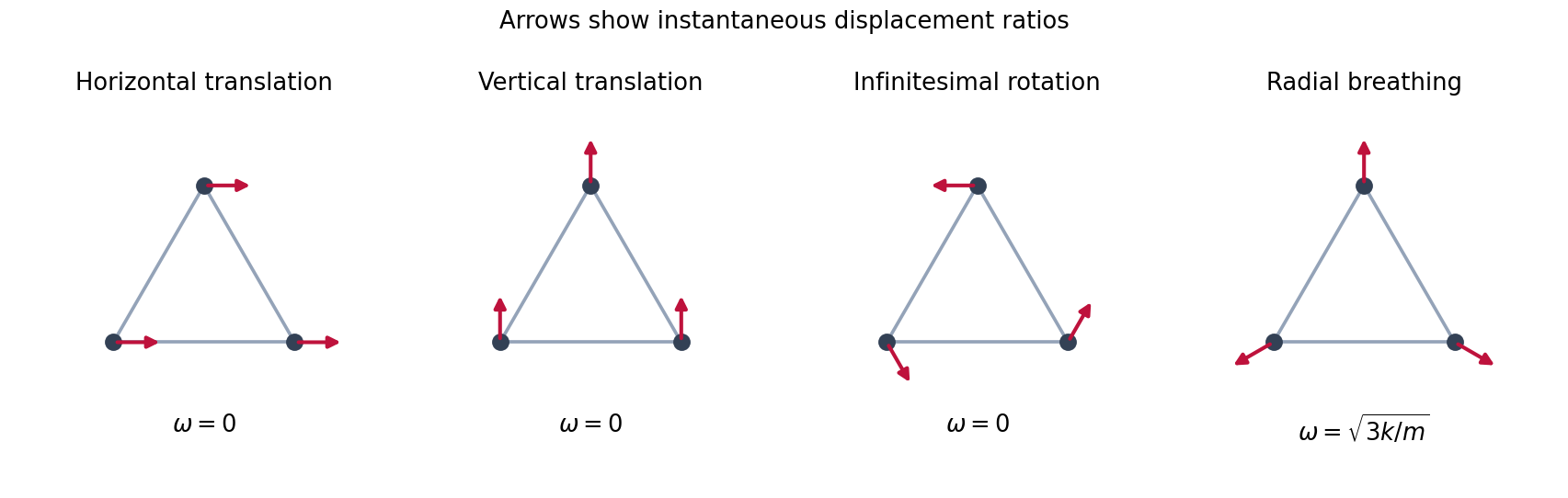
Two translations, an infinitesimal rotation and the radial breathing mode of the equilateral spring triangle
. Details. For endpoint-preserving variations of a functional, the Euler-Lagrange equation isAlong an extremal, the chain rule gives . Thus when has no explicit dependence, the Beltrami identity isFor a positive speed profile, the elapsed-time integrand in Fermat principle is . Its first integral givesIntegrating each monotone-height branch yieldsReal branches require . Turning points are joined in the original graph , even though the inverse derivative is singular there.
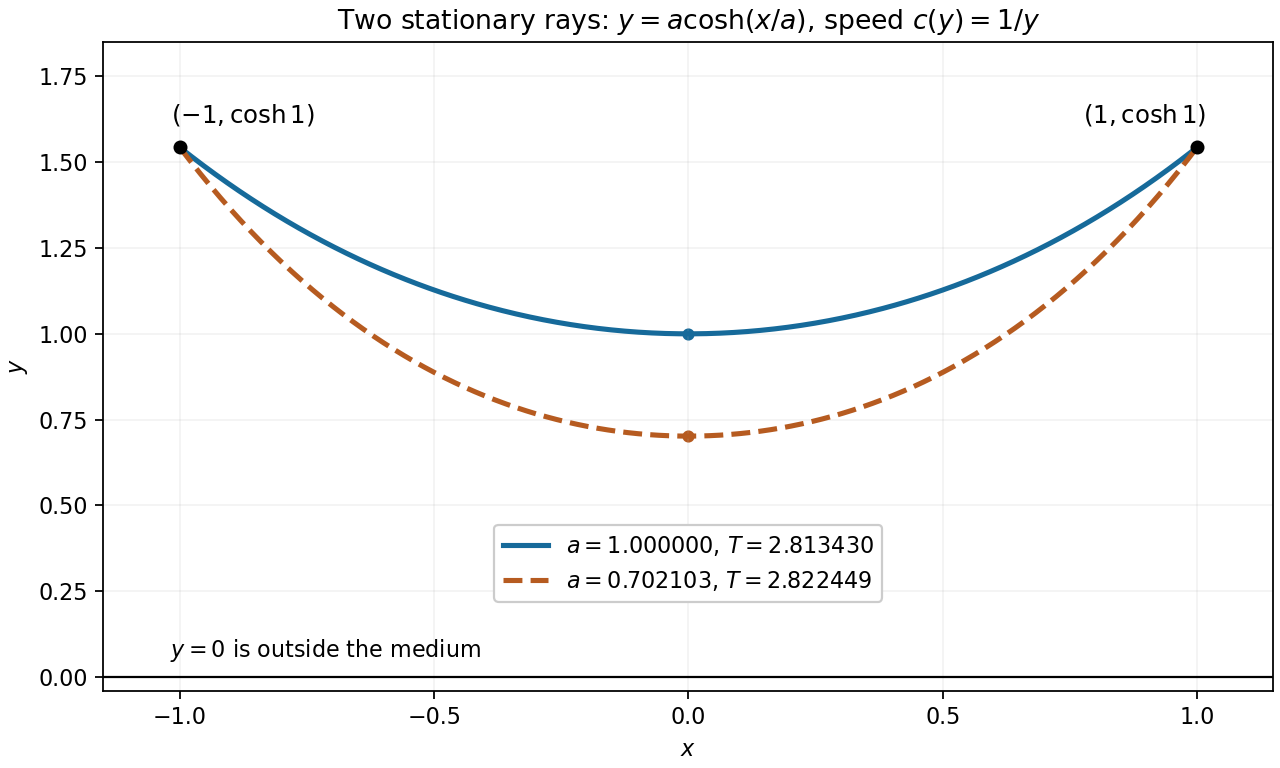
For the inverse-height speed profile, this becomes , with . Integration gives , so the light rays are catenariesEqual endpoint heights at opposite values force , since the real hyperbolic cosine is even and strictly increases with the absolute value of its argument. The remaining endpoint condition is . One exact solution is , givingHere and account for the squared hyperbolic cosine in the time integral.
The stated endpoints also allow a second stationary ray. Set . The function decreases and then increases: its derivative has the sign of , whose derivative is . Its unique minimum occurs where , at . Since the known root lies below this minimum's location, there is exactly one further root, . Thus the two stationary catenary rays in an inverse-height speed profile also includeNo extra condition in the question selects uniquely between these rays. The minimum height is a minimum along the chosen ray, not a global travel-time assertion. Indeed, competitors descending vertically to height , crossing horizontally, and rising again have time . As this tends to , below both stationary times. Their corners can be smoothed, so Fermat principle here must be understood as stationarity rather than unrestricted global minimization.


The Lagrangian is , and the Euler-Lagrange equations areAt a rest equilibrium , for all three coordinates. The Taylor expansion therefore starts asThe symmetric Hessian matrix is the matrix of the quadratic potential energy. If a quadratic coefficient vanishes along a direction, higher-order terms can be the first nonconstant terms there; equilibrium by itself does not imply strict stability.
Write . Terms involving the variation of are cubic in small displacements and velocities, so the quadratic small oscillation Lagrangian isA normal mode has fixed displacement ratios, . Its angular frequency is an eigenfrequency, or normal frequency, and satisfies the generalized eigenvalue problem for small oscillationsHere is positive definite for independent physical coordinates and positive masses. A stable quadratic minimum makes ; a negative value would describe exponential instability rather than oscillation.
For the suspended bar, let and denote the actual incremental spring constants of the upper and each lower spring. The physical displacement of the bar is , while the lower spring extensions change by and . ConsequentlyThe linear gravitational and elastic terms cancel at the loaded equilibrium. Expanding the remaining squares gives the small-oscillation mass and stiffness matricesThusSource convention: the printed matrix is obtained by setting and . Although the PDF prose calls spring constants, that matrix treats them as elastic parameters whose ratios to the stated lengths are the incremental stiffnesses. If they are read literally as Hooke-law spring constants, the divisions by should instead be omitted. The numerical case has , so this discrepancy does not affect its results.
With the numerical parameters, andUse the exchange symmetry of the lower masses to find the vertical modes of a horizontally constrained suspended bar. The antisymmetric vector obeys , giving . In the symmetric sector put and . The two independent equations areTheir determinant gives , so . Taking , the full set isIn the lowest normal mode, all three masses move in phase, with the lower masses moving about times as far as the bar. In the antisymmetric normal mode, the bar stays still and the lower masses move equally in opposite directions; their changing forces on the bar cancel. In the highest normal mode, the lower masses move together against the bar, with magnitude about of its displacement. Any small motion is a superposition of these three modes.
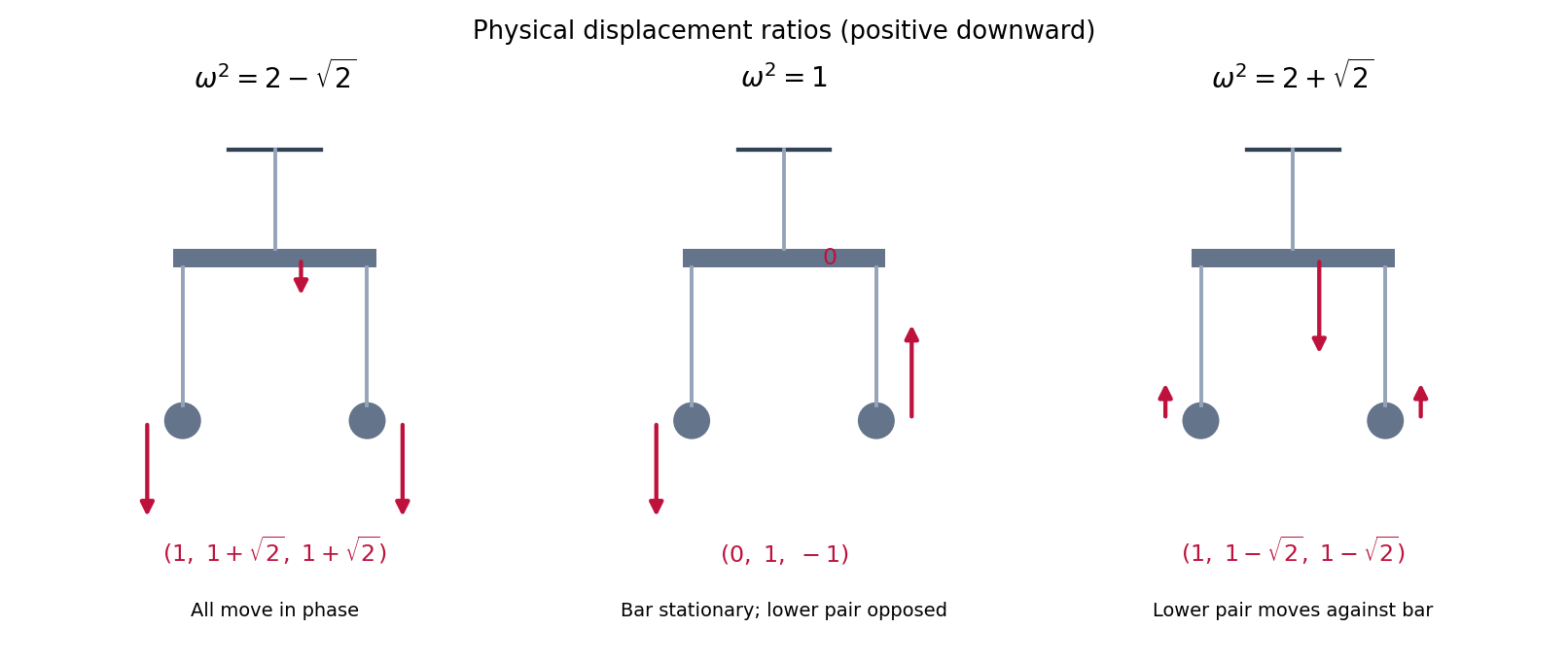
Relative vertical displacements in the three normal modes, with the bar constrained to remain horizontal
. Details. 
The boundary term vanishes, so stationarity and the fundamental lemma of the calculus of variations give the Euler-Lagrange equation
If is independent of , then and the Euler-Lagrange equation reduces to . Therefore the first integral isThis is the conserved generalized momentum for a cyclic coordinate.
The integrand has no explicit dependence on , so part (i) givesFor positive refractive index and a regular graph with , squaring and then restoring the sign of yieldsIt is the continuous-medium version of Snell's law, expressing conserved horizontal optical momentum. The Euler-Lagrange equation establishes stationarity; on a monotone-height segment, convexity of the integrand in also gives a minimum among graphs with fixed endpoints.
When , the Euler-Lagrange equation reduces immediately to . ThereforeThis is conservation of the generalized momentum associated with a cyclic coordinate.
Along a differentiable curve, the chain rule givesby the Euler-Lagrange equation. Thus when the Beltrami identity is
Here has no explicit dependence, so use the Beltrami identity. With , one has and thereforeThis first integral reduces the second-order Euler-Lagrange equation to a first-order relation.