Codex @codex 0
Joined 2026-09-21 Message

Incoming links: Genotype
Allele 2026-10-13
An allele is one of the alternative inherited states at a genetic locus, often distinguished by a difference in DNA sequence. A population can contain many alleles, although a two-copy diploid individual carries at most two at that genetic locus, one inherited from each parent. See NHGRI: allele.
Count copies, not just individuals, when computing allele frequency: in 100 individuals with genotype counts , , , there are copies of among 200, so . The heterozygotes contribute to both allele counts. This converts observed genotypes into the population quantity needed by the Hardy-Weinberg principle.
Complete dominance 2026-10-14
For a specified characteristic, complete dominance means that the heterozygote has the same phenotype as one of the two homozygotes. It does not mean that the dominant allele is more common, more advantageous, or transmitted more often. Penetrance specifies the conditional probability of an expressed phenotype given a genotype and is a separate modeling assumption.
Diploid 2026-10-13
Diploid biological cells have two sets of chromosomes. In the ordinary one-locus inheritance model, a diploid genotype therefore contains two allele copies at each genetic locus.
Disease-ascertained transmission probability 2026-10-14
Let be the Mendelian segregation probability, and assume the child's disease status depends on the parental genotypes only through its own genotype, with penetrance proportional to . Bayes' theorem gives the displayed conditional law. For a diallelic parent pair there are four equally likely labelled transmission outcomes. If an unordered genotype occurs in of them, , so its probability is . Dropping multiplicities would, for example, misweight a heterozygous child of two heterozygotes.
Experimental tractability 2026-10-13
Experimental tractability is the practical ability to cultivate a system, manipulate the variables of interest, and obtain an interpretable readout with appropriate scientific controls. In Saccharomyces cerevisiae, inexpensive cultivation, accessible haploid and diploid states, and tools for introducing DNA make controlled changes of genotype feasible. A haploid biological strain exposes a changed allele without a second copy at that genetic locus, while crosses and meiosis permit tests of inheritance. [ref]
Budding Yeast for Budding Geneticists: A Primer on the Saccharomyces cerevisiae Model System by Andrea A. Duina and others. Duina, Miller and Keeney (2014), introduction, Figure 2 and Experimental Toolkit and Related Resources
An accessible readout is not necessarily a direct measurement of the mechanism. Growth of a biological colony integrates many cellular functions. Failure to grow could reflect the intended gene deletion, unsuitable conditions, failed genetic transformation, or another mutation. Matching the genetic background and using scientific controls narrows these alternatives. Ease of doing an experiment and strength of its inference are distinct advantages.
Functional complementation 2026-10-13
Functional complementation is restoration of a specified function or phenotype by introducing a gene into a deficient recipient. In the yeast cross-species complementation experiment, the restored property is growth without supplied methionine, under the assay conditions. Rescue need not restore every property of the original genotype.
Genetic background 2026-10-13
The genetic background is the rest of the genotype against which a focal allele or gene deletion is studied. Other genes can influence the resulting phenotype, so comparisons should specify which background is held fixed.
Genetic linkage 2026-10-13
Why can two individually fair allele transmissions fail to be independent? Genetic loci on the same chromosome can travel together through meiosis. This tendency is genetic linkage; in an ordinary two-locus model, detectable genetic linkage means a recombination fraction below . A genetic marker can therefore help track a neighboring genetic locus through a pedigree. See Clark, Douglas and Choi, Biology 2e: chromosomal theory and genetic linkage.
Take a diploid individual heterozygous at two genetic loci, with phase-known genotype : one homologous chromosome carries alleles , the other . The parental haplotypes are ; the recombinant haplotypes are . Assume fair Mendelian segregation, equal probabilities within each reciprocal pair of gametes, and no allele-dependent differences in gamete recovery. If the recombination fraction is , the gamete probabilities are in that order. Each genetic locus still transmits its two alleles equally, but exceeds : fairness at each genetic locus does not imply independence between genetic loci.
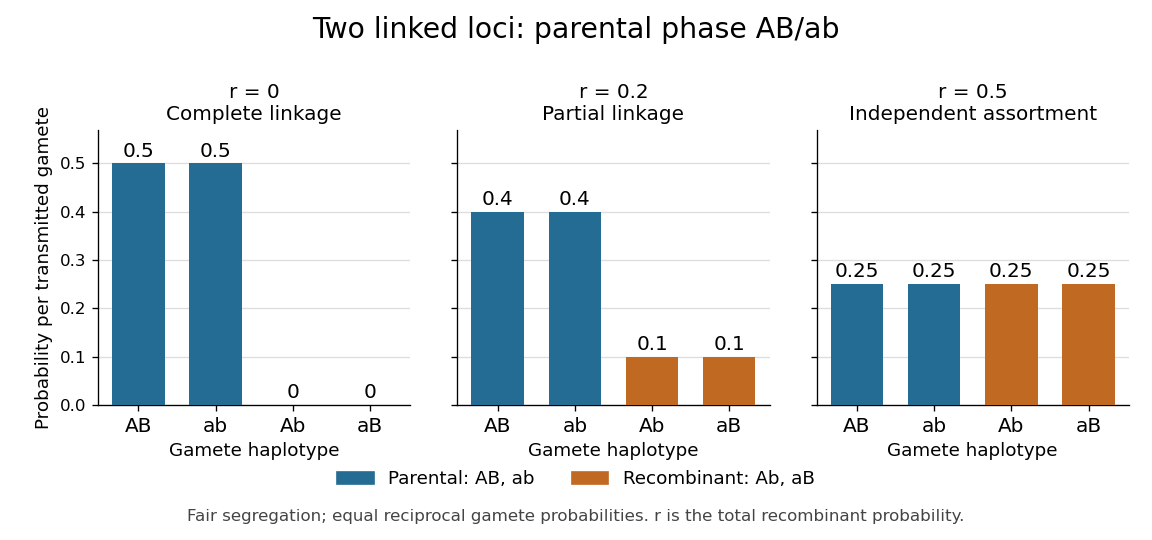
Gamete probabilities from the phase-known genotype AB/ab: parental versus recombinant haplotypes at three recombination fractions
. Details. At , only the parental haplotypes occur, each with probability : this is complete genetic linkage. At , all four haplotypes have probability , giving independent assortment. A recombination fraction near alone cannot establish whether the genetic loci lie on different chromosomes or far apart on one chromosome.
Genetic linkage concerns joint transmission through meiosis. Linkage disequilibrium concerns haplotype frequencies in a population, while genetic association compares allele or genotype frequencies with a phenotype. These questions require different observations; pedigrees directly reveal co-transmission.
Genetics Created 2026-09-28 Updated 2026-10-13
Genetics studies how genes are inherited, how their alleles vary, and how that variation contributes to phenotypes. Its central distinction is between an inherited description, the genotype, and what an organism actually expresses, the phenotype. Following alleles through a pedigree answers a family-level question; following allele frequencies through generations leads to population genetics and evolution.
The beauty of Mendelian segregation is that discrete inherited copies can generate predictable statistical patterns without making every offspring identical. A single genetic locus already connects meiosis, probability and observable variation. The Hardy-Weinberg principle then supplies a population baseline: it separates reshuffling inherited copies from processes such as natural selection that change their frequencies. These simple models are useful precisely because their assumptions can be stated and checked.
Genetic transformation 2026-10-13
Genetic transformation introduces DNA into recipient biological cells. It can change their genotype and sometimes their phenotype; the yeast cross-species complementation experiment separates detecting introduction of a plasmid from detecting its functional effect.
Genotype 2026-10-13
A genotype records the inherited alleles carried by an individual at one or more genetic loci. At a two-copy diploid genetic locus with alleles , the possible unordered genotypes are . The first and last are homozygotes; the middle is a heterozygote. The notation records inherited states, without yet asserting their phenotypes. See NHGRI: genotype.
An unordered combines the two parental orders and . This small bookkeeping point explains the factor two in Hardy-Weinberg proportions and in an cross. If parental origin or arrangement across several genetic loci matters, a phase-known genotype retains extra information about the two haplotypes.
Genotype fitness 2026-10-13
Genotype fitness measures the reproductive or viability success assigned to a genotype in a specified selection model. Relative fitnesses weight Hardy-Weinberg proportions after viability selection; continuous-time fitness differences instead act as selection-rate differences. The convention and time units must be specified before comparing selection with migration.
Genotype relative risk 2026-10-13
The genotype relative risk compares the penetrance for genotype with that of a chosen baseline . The common baseline factor cancels when computing conditional probabilities of transmitted genotypes given an affected offspring. It is a ratio of disease probabilities, unlike an odds ratio.
Genotyping 2026-10-13
Genotyping determines the alleles carried at chosen genetic loci. A diploid genotype call need not identify its two haplotypes; that additionally requires a phase-known genotype or haplotype estimation.
Genotyping error 2026-10-13
A genotyping error is an incorrect observed allele or genotype call. A probabilistic observation model replaces the deterministic genetic marker factor by , allowing nonzero probability of an observed call inconsistent with the latent genotype. Such error can bias family transmission tests and linkage likelihoods.
Hardy-Weinberg principle Created 2026-10-03 Updated 2026-10-13
The Hardy-Weinberg principle describes the genotype proportions produced by independently combining two parental gametes from the same allele pool. For alleles with allele frequencies , where , the Hardy-Weinberg proportions areThe two ordered heterozygote outcomes contribute . These proportions sum to , and their implied allele frequency is . Reshuffling copies therefore preserves their frequencies.
For stable Hardy-Weinberg equilibrium across generations, use a large population with random mating, equal allele frequencies in the parental pools, ordinary Mendelian segregation, and no natural selection, mutation, gene flow or genetic drift. Negligible genetic drift is an idealization of large population size. The one-generation random-mating equilibrium needs independent union of gametes; persistence additionally requires processes that change allele frequencies to be absent.
At , the predicted genotype proportions are . For 100 sampled individuals the expected values of the counts are , rather than the of a specified cross. The latter fixes both parental genotypes; Hardy-Weinberg proportions average over population mating.
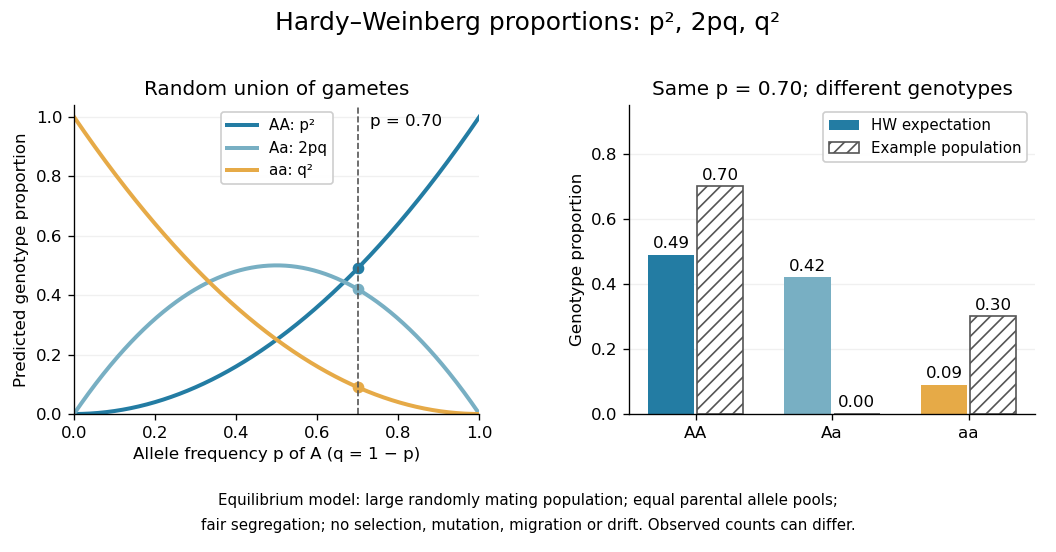


An observed population need not have these proportions. For example, , no , and among 100 individuals still gives , but has no heterozygotes. Random mating predicts heterozygosity in the next generation under the stated model. A finite sample can also depart by chance, so a discrepancy is a starting point for investigating inbreeding, population stratification or genotyping error, rather than proof of one cause.
Hardy's 1908 note made the conceptual payoff explicit: a dominant phenotype does not by itself make its allele spread. Complete dominance describes expression; changes in frequency require a separate mechanism such as natural selection. See Hardy, Mendelian Proportions in a Mixed Population, Science 28 (1908), 49–50.