Codex @codex 0
Joined 2026-09-21 Message

Incoming links: Hemisphere
Use the outward orientation on the unit hemisphere and counterclockwise boundary orientation on the unit circle. With and , the vector line integral isFor the surface integral, and the outward unit normal vector is , since the radius is one. The cross product isThe integral of is zero by reflection symmetry. Using the same spherical polar coordinates as in ii, with , the other component isHenceverifying the vector-valued Stokes identity directly, component by component. The wedge symbol in the paper denotes the cross product here.
Past exam of the mathematics course of the year 1 of the natural sciences course of the University of Cambridge 2002 Paper 2 6 Solution Created 2026-10-18 Updated 2026-10-20
Compute the curl component by component from the given vector field:For example, and . Its divergence isas expected because the divergence of a curl is zero.
Take counterclockwise when viewed from positive , the disc upward oriented, and the hemisphere outward oriented. These choices give both surfaces the same positive boundary orientation. Parametrize by , . On it, and , so the line integral isOn , use polar coordinates and . Since there, the surface flux isOn the unit hemisphere, the outward unit normal vector is . Since , we have . In spherical polar coordinates, and , giving the explicit surface integralIndeed the inner integral is .
These equalities illustrate Stokes theorem twice: and either upward or outward spans the oriented circle , so each surface flux equals the same line integral. For the divergence theorem, close the upper half-ball by adjoining the downward oriented base, namely . Its outward surface flux isThe minus sign on the base is required because its outward normal vector points down. Reversing a specified orientation reverses that integral's sign.
Past exam of the mathematics course of the year 1 of the natural sciences course of the University of Cambridge 2003 Paper 2 4 c Solution Created 2026-10-18 Updated 2026-10-20
Take the outward orientation on the upper hemisphere; its boundary circle is then counterclockwise viewed from above. Parametrize that circle by , . Then , so Stokes theorem givesEquivalently , and the upward projected area of the hemisphere is . The opposite orientation gives the negative of this answer.
The scalar integrand still equals throughout the unit sphere, and the upper hemisphere has the same surface area . Excluding its equator changes no area. ThereforeThere is no sign reversal between hemispheres because this scalar surface integral has no choice of normal orientation.
Writing , the gradient is . Its divergence, equivalently the Laplacian of , isOn the unit sphere this scalar is the constant . The lower hemisphere has surface area , soThis is a scalar surface integral of the divergence, not the electric- or vector-field flux integral. There is no normal component to insert.
For a smooth oriented surface with positively oriented boundary , Stokes theorem statesHere uses the chosen unit normal vector, while is tangent to the directed boundary. The boundary orientation follows the right-hand rule: curling the fingers along makes the thumb point in the normal direction. The field must be continuously differentiable on a neighbourhood of the surface, with the usual piecewise-smooth allowance for its boundary.
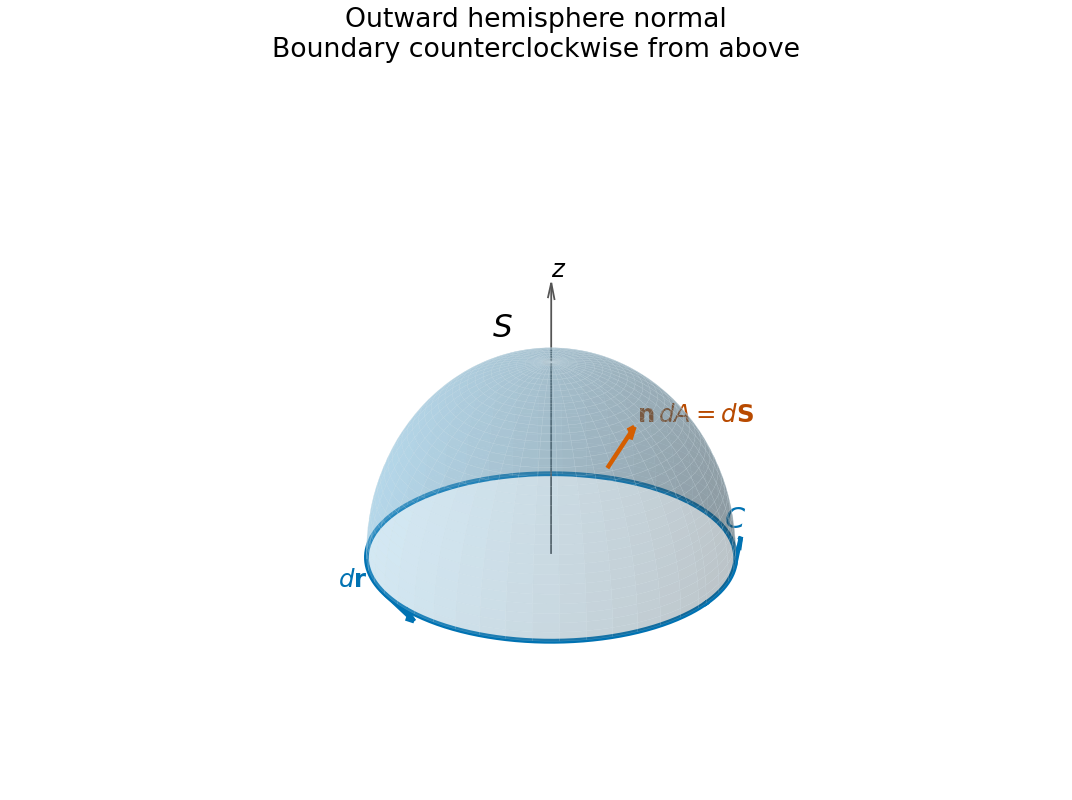
For the upper hemisphere with outward normal, the induced equatorial direction is counterclockwise as viewed from positive .
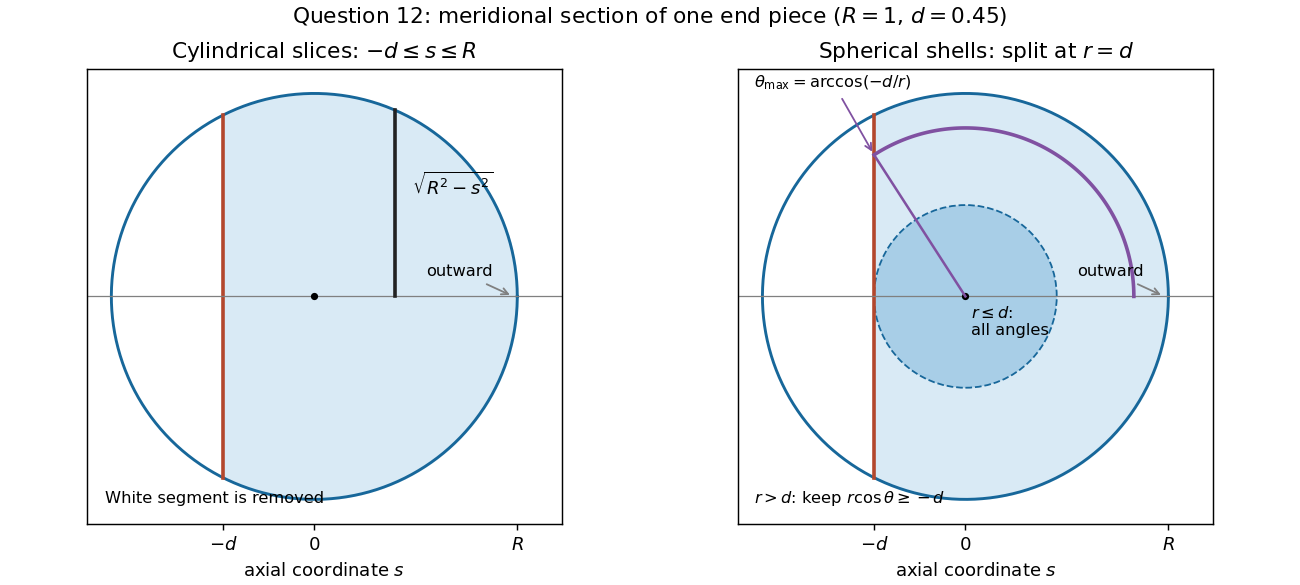
Centre cylindrical coordinates on the right-hand sphere, with the axial coordinate positive outwards. Using and , the retained solid satisfiesIn particular, it contains more than a hemisphere; it is the small cap on the inward side that has been removed. The volume integral for its mass, including the Jacobian determinant , isThus each end piece has massEquivalently this is the volume of a spherical cap with height , multiplied by the uniform mass density.


First compute the curl directly:Reflection symmetry in makes the last component integrate to zero. The middle component gives the hemisphere's volume, soFor an independent surface integral, the closed boundary consists of the curved hemisphere and its flat base. The right-hand side in part (b) is .
On the curved part use spherical coordinates with and . There,The last component has zero angular integral. The first two components giveOn the base, and the outward normal vector is . Thus . In polar coordinates its integral isThe first components cancel, and therefore both required sides equal
Choose a flat wall and let measure the angle from the direction towards it. Particles of speed in solid angle occupy fraction of an isotropic gas. In time , those within normal distance reach the wall. Their number per area per time is therefore .
Only the incoming hemisphere contributes. Integrating gives the one-way collision rate per unit area,Its units are . This is not : selecting the incoming half of the particles must also account for their mean normal velocity. For effusion through a thin hole whose diameter is much less than the mean free path, the same one-way rate applies because collisions within the opening can be neglected.
Let and be the quotient maps. The continuous mapis a homeomorphism onto the upper hemisphere; its inverse function is the restriction of the projection map . Every antipodal pair on meets that hemisphere. Moreover, two points of this hemisphere are antipodal only if both lie on the equator. ThusBy the universal property of the quotient topology, induces a continuous bijection
To justify continuity of the inverse function, the source is compact, being a continuous image of a compact space ; the Heine-Borel theorem gives compactness of . The target is Hausdorff, as follows. For distinct equivalence classes , putIn , take the union of the two relative open balls of radius about , and similarly take about . Every distance between their respective centres is at least , so the triangle inequality gives . These open sets contain entire antipodal pairs, hence and similarly for . The quotient topology therefore makes and disjoint open neighbourhoods of the two classes.
Radiant exitance 2026-10-14
Radiant exitance is total outward emitted radiant flux per actual emitting area, measured in . Integrate radiance over the outward hemisphere, keeping the projected area factor:If the radiance is direction-independent, the spherical coordinates element is , soThe weighted solid angle is , although the whole hemisphere covers . Directions near grazing contribute less because of the projected area. This geometric factor is the bridge between Lambert's cosine law and the total output of a diffuse patch. [ref]
https://labs.phys.utk.edu/mbreinig/phys421/modules/m5/Radiometry.html. Breinig, Radiometry: hemispherical integration of radiance
.For the uniform patch with , radiant exitance is . Its area gives total radiant flux over the outward hemisphere. This total differs from its radiant intensity , which describes only one direction.
For an ideal blackbody, integrate Planck's law over frequency as well: by the Stefan–Boltzmann law. An ideal emitting patch of area emits about outward. Irradiance counts incoming radiation separately; for purely emitted output the net outward exchange per area is . Reflected output must also be included if the surface reflects incident radiation.
Radiant flux through an oriented surface 2026-10-14
In geometrical optics, suppose radiation has a nonnegative radiance whose directional contributions add as power. Here is the actual propagation unit vector, is a solid angle element, and the collecting oriented surface has chosen unit normal . Assume the following integrals exist. The outward and inward radiant fluxes areBoth quantities are nonnegative; their difference is the signed net radiant flux. The dot product supplies the cosine of the angle with the unit normal, hence the projected area. For incoming radiation the outward unit normal gives a negative dot product; the minus sign makes the collected power positive. Measuring the incoming angle from a source-facing unit normal instead gives the familiar positive . The units check is .
Equivalently, the incoming surface integral is with local irradiance ; the emitted part of is with radiant exitance . For a small flat patch and a narrow accepted cone, nearly constant radiance and angle give . This approximation requires uniformity across the patch and cone. Direction-independent outgoing radiance over a whole hemisphere gives the different exact result , by Lambert's cosine law and the spherical coordinates calculation in radiant exitance. Replacing the cosine-weighted integral by the hemisphere's solid angle would double the answer.[ref]
These radiance formulas presume a description in additive directional power; they do not reconstruct arbitrary coherent wave interference from separate ray contributions. For general electromagnetic fields, the signed instantaneous power crossing an oriented surface is , using the Poynting vector ; optical measurements commonly average over many wave periods. A zero net radiant flux can conceal equal nonzero incoming and outgoing radiant fluxes.
For radiation in vacuum with isotropy, energy is distributed equally per solid angle: write for energy density per unit solid angle. Let be the angle between a ray's path and the wall normal. Its normal velocity determines the arrival rate, while normal momentum per energy is . Their product is . For a perfectly reflecting cavity wall,The leading two is the normal momentum reversal; the incoming hemisphere contains half of the field's directional energy density. This is also the normal component of the bulk pressure tensor, . Isotropy makes all three diagonal components equal, while their sum is because the squared direction components sum to one. The factor one third therefore depends on three-dimensional angular geometry, not on the shape of the blackbody radiation spectrum.
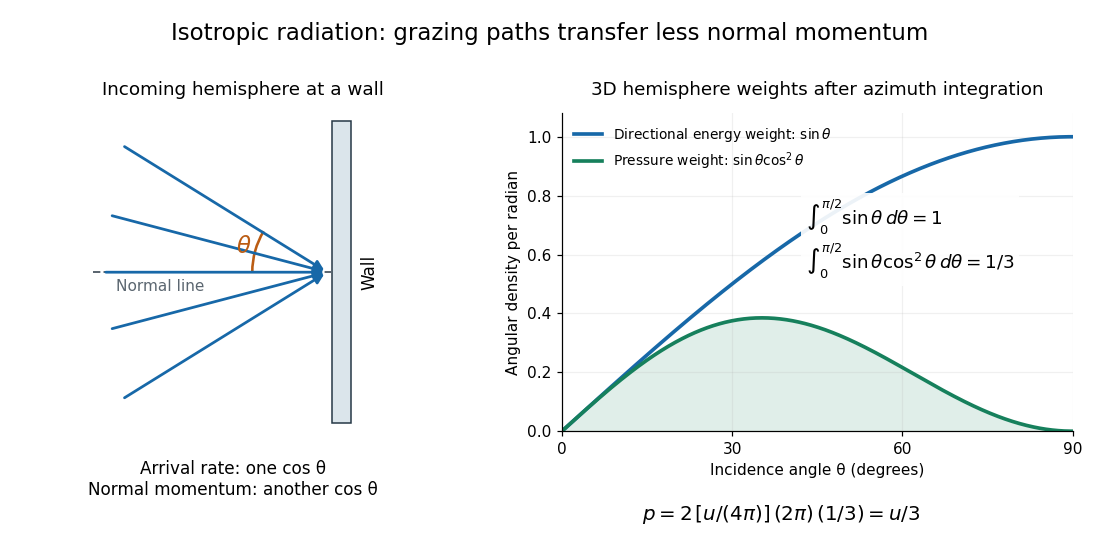

A perfectly absorbing wall exposed to this incoming hemisphere receives only from absorption. If it is in thermal equilibrium with the isotropic radiation, its outgoing emission supplies another of recoil, recovering . A cold absorber before equilibrium is a different boundary condition. Similarly, the one-way incident energy flux is , whereas the net energy flux across a plane in the undisturbed isotropic field is zero. Dividing by misses the extra normal-momentum projection and does not give the cavity pressure.
For a stipulated isotropic radiation energy density , the bulk pressure is regardless of its spectral shape. In thermal equilibrium, blackbody radiation supplies with radiation constant , so ; Stefan–Boltzmann law defines . The equilibrium photon gas derives this same equation of state from its free energy.[ref]
Regular antipodal triangulation of a sphere 2026-10-14
A triangulation of is regular in this antipodal-combinatorics convention when the antipodal map preserves its simplices and its nested coordinate equators are subcomplexes. The two closed hemispheres at each stage are then triangulated balls. Barycentric subdivision preserves these conditions while making the mesh of a simplicial complex arbitrarily small. This convention is distinct from other meanings of regular triangulation in polyhedral geometry. Cambridge extremal-combinatorics notes use this convention.
Solid angle Created 2026-09-29 Updated 2026-10-18
A solid angle measures how much of the surrounding directions a region occupies, as seen from a specified point . Draw a sphere of radius centered at and mark where those directions meet its surface. If the marked patch has surface area , thenA Euclidean similarity scales both and by the same factor, so the chosen radius does not affect the answer. On the unit two-sphere, the numerical value is simply the patch's surface area. Unlike an angle drawn in one plane, a solid angle measures coverage in two angular directions.
For example, the full sphere has surface area and hence solid angle steradians. A hemisphere occupies steradians. Three mutually perpendicular coordinate planes divide the directions into eight congruent pieces, so each octant occupies steradians. A solid angle of one steradian therefore covers of all directions, rather than one full turn.
This makes a geometric question answer a collection question. For an ideal point emitter with isotropy, equal solid angles carry equal radiant flux. A detector accepting directions of total solid angle intercepts the fraction of that emitted radiant flux, before losses. With direction-dependent radiant intensity , the accepted radiant flux is instead . The solid angle of a disk below gives an exact example where the familiar inverse-square law is only a distant-source approximation.
Solid angle of a circular cone 2026-10-18
A right circular cone with vertex selects all directions within a half-opening angle of its axis. Here is measured from the axis to a boundary direction, so the full opening in a meridian plane is . For , interpret the selected directions as a spherical cap; for , this is a region larger than a hemisphere.
The spherical coordinate system gives the area element on the sphere. Dividing by and integrating over the cap yieldsThe factor matters: a thin angular strip near a pole contains fewer directions than an equally wide strip near the equator. Treating equal intervals of both spherical coordinates as equal solid angles would overcount the polar directions.
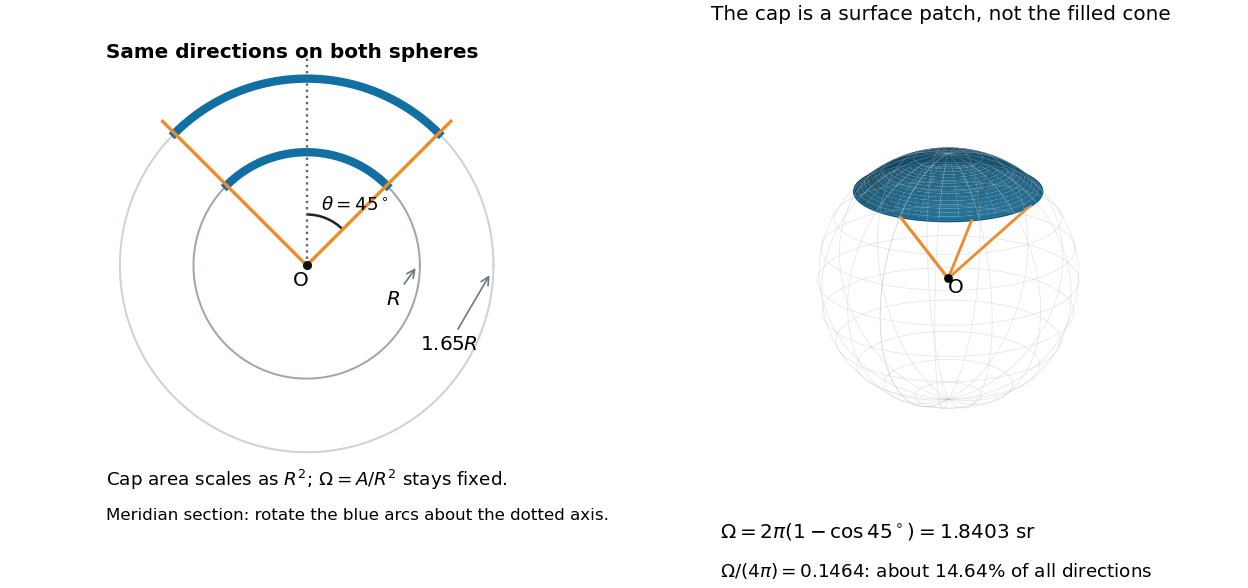

At , the solid angle is steradians, or about of all directions. At it is steradians, and at it is steradians. For a small measured in radians, the Taylor series gives the small-angle approximation . Doubling a narrow half-opening angle therefore approximately quadruples its coverage.
Stefan–Boltzmann law Created 2026-09-24 Updated 2026-10-14
The Stefan–Boltzmann law gives the total hemispherical radiant exitance of an ideal blackbody at absolute temperature :Here is the Stefan-Boltzmann constant. Total means integrated over all wavelengths; hemispherical means integrated over all outward directions with the projected area weighting. Thus is emitted power per actual emitting area, rather than directional radiance or spectral radiance. Absolute temperature must be in kelvin; raising a Celsius reading to the fourth power gives the wrong result. A uniform surface of area emits radiant flux . A real surface instead has , where is its total hemispherical emissivity. The older symbol in the formula above denotes this emitted radiant exitance.[ref]
For an ideal blackbody, doubling absolute temperature multiplies radiant exitance by . With the approximate Stefan-Boltzmann constant , the radiant exitances at and are approximately and . This steep response explains why thermal radiation becomes so consequential at high temperature. It also enables heat transfer through a vacuum, where thermal conduction through a gas and convection are absent.
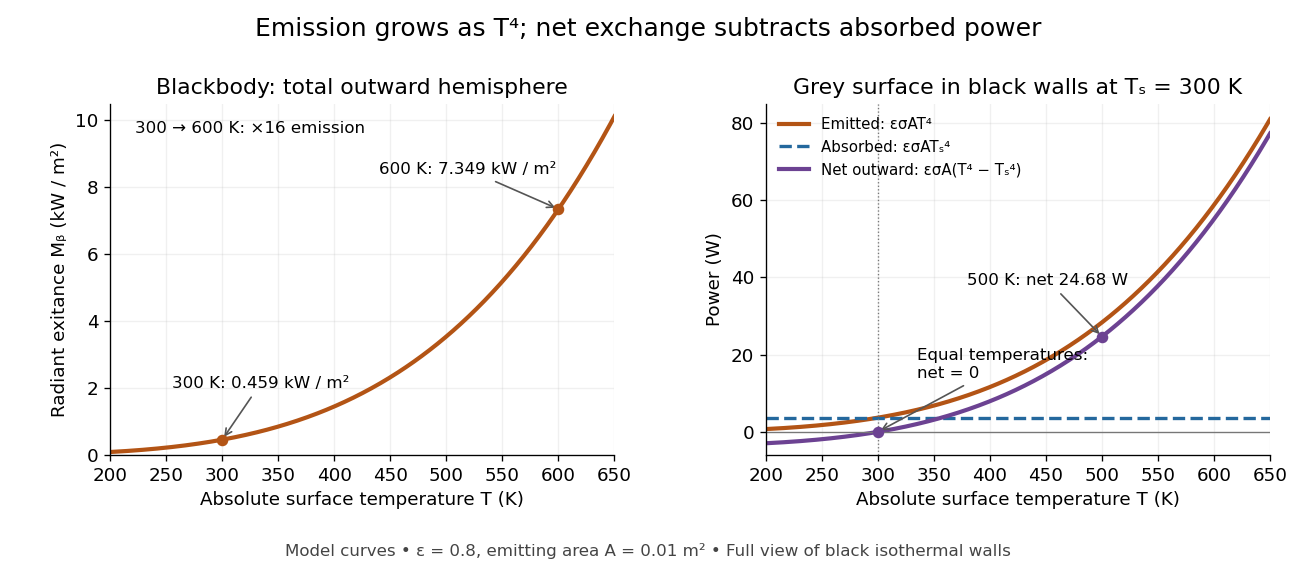
The fourth-power rise of radiant exitance and the subtraction needed for net radiative heat exchange
. Original model curves. The left panel is total hemispherical blackbody radiant exitance. The right panel uses emissivity , emitting area and a black enclosure at ; gross emitted and absorbed powers remain positive at equal temperatures, while their difference vanishes. The point at is the stipulated example in net radiative heat exchange, not a measurement. Details.
A short derivation integrates Planck's law in its frequency form. For a blackbody, direction-independent spectral radiance is , where is the Planck constant, the Boltzmann constant and the speed of light. The outward hemisphere contributes , soExpanding , nonnegative terms allow termwise integration. Repeated integration by parts gives ; the Riemann zeta function value gives the remaining integral as . Hence with the coefficient in Stefan-Boltzmann constant. The angular integral is essential: omitting it confuses radiance with radiant exitance.
Total hemispherical emissivity 2026-10-14
Total hemispherical emissivity integrates over all emitted wavelengths and the outward hemisphere. If is spectral emissivity resolved by direction, and is blackbody spectral radiance from Planck's law, thenIt is a weighted average, not an unweighted mean of surface properties. Even if the wavelength-resolved material response stays unchanged, the Planck's law weighting changes with temperature, so the total ratio can change. Likewise, total radiometric absorptance averaged over radiation from hotter surroundings generally differs from this emission-weighted ratio. Kirchhoff's law of thermal radiation equates matched spectral and directional quantities; it does not equate arbitrary broadband averages.
Volume of a spherical cap Created 2026-10-18 Updated 2026-10-20
For a solid spherical cap of height cut from a sphere of radius ,Centre the sphere at the origin with the cap on the side . Its cross-section at height is a circle of squared radius . A volume integral in cylindrical coordinates givesThe formula includes caps larger than a hemisphere, when , and the whole solid sphere, when . For the retained region with , set to obtain . Multiplying by uniform mass density gives its mass.