For a stellar homologysequence with R∝MX and L∝MY, the Stefan–Boltzmann law gives Teff∝M(Y−2X)/4. Eliminating mass gives the displayed Hertzsprung-Russell diagramslope when Y=2X. The usual horizontal axis decreases in temperature toward the right, reversing the visual left-to-right sign. The relation is between logarithmic variables and depends on the specified structural assumptions.
The usual graphical convention puts increasing temperature to the left, so the line descends as one moves right. If the horizontal coordinate is −logTeff, its plotted slope is −132/29.
The three relevant thresholds are approximately 13.6, 24.6 and 54.4eV, for H0, He0 and He+ respectively. Higher stellar temperature increases the relative supply of the harder photons. These cumulative photonrates cannot be assigned independently to the three species: a photon above a helium threshold can instead ionize hydrogen, and helium recombination radiation can also ionize hydrogen. The absorption cross-sections and the diffuse radiation determine the effective allocation.
Thus the small helium abundance partly compensates for the smaller hard-photon supply. A cooler central star produces little He++ and can have a substantially smaller helium-ionized zone. A sufficiently hot star can ionize helium throughout most of the hydrogen region. If independent radius estimates place a helium front beyond the hydrogen front, the independent photon allocations are inconsistent: the fronts and transfer must be treated together. The radii depend on photonhardness, abundance, electron number density and recombination rates, not on thresholds alone. The sharp-front equations are an approximation; they do not assert three exact independently conserved photon budgets for a real mixed nebula.
When the inferred recombination budget traces the full appropriate ionizing-photon supply, define ΦE0(T)=∫E0/h∞Bν(T)/(hν)dν and obtain the Zanstra methodequation
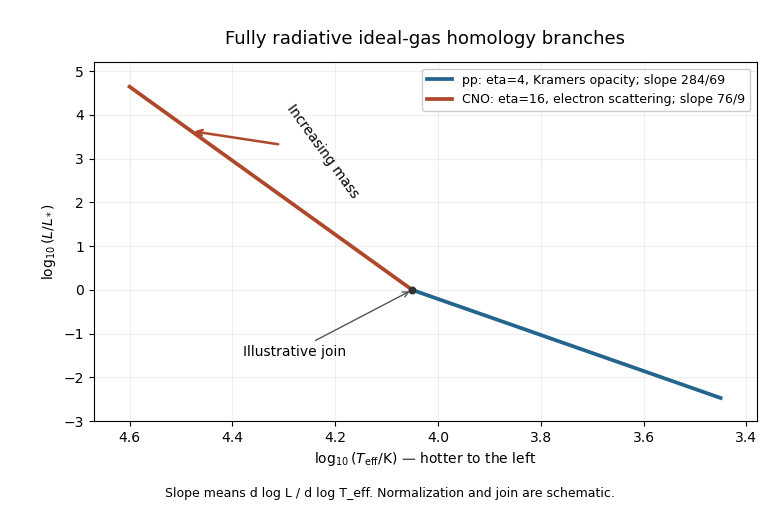
This branch retains the deliberately idealized fully radiative assumptions, even though real CNO cycle cores are often convective.
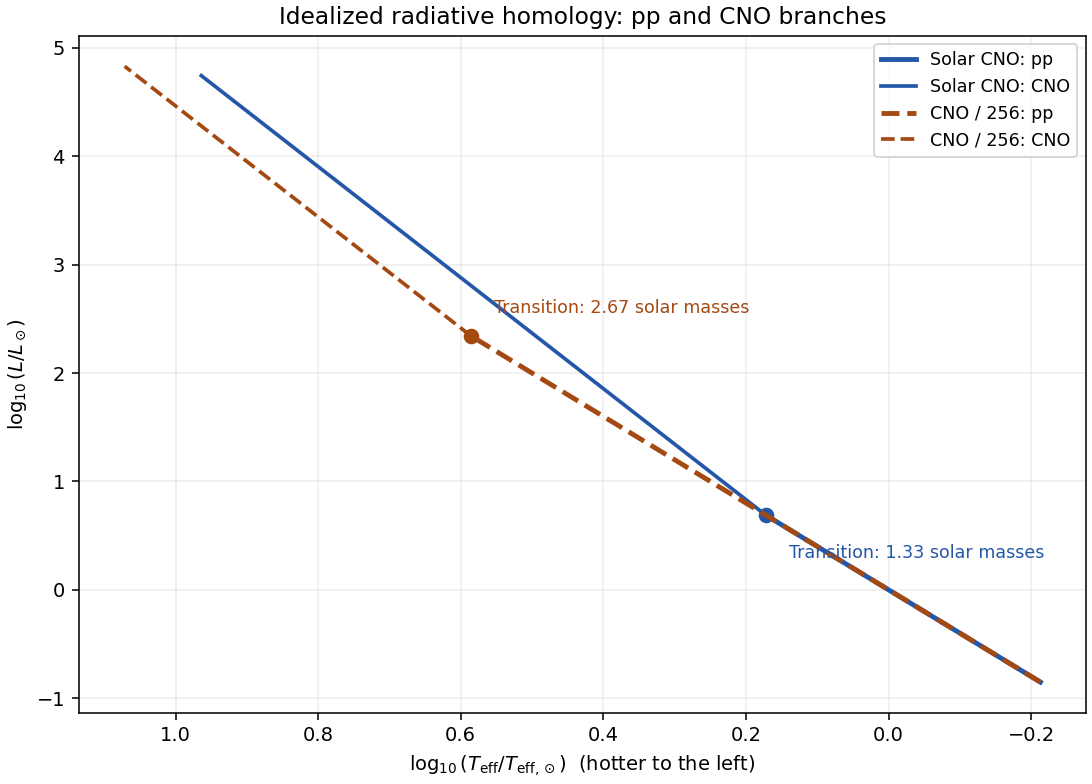
For a Hertzsprung-Russell diagram, use the Stefan–Boltzmann law, L=4πR2σTeff4. On the proton–proton chain branch Teff∝M11/8, so L∝Teff4. On the CNO cycle branch Teff∝M57/56, giving L∝Teff292/57. Thus the upper branch rises slightly more steeply toward the hot, luminous upper left in a logarithmic Hertzsprung-Russell diagram. The sketch below matches the approximate branches continuously at their respective burning crossovers; the true crossover has both heating terms and is smooth.
The low-CNO proton–proton chainsequence therefore lies on the same locus, but extends to twice the transition mass. Beyond its later crossover the low-CNO CNO cyclesequence has the same logarithmic slope 292/57 but a different normalization. At a fixed mass where both sequences are CNO-dominated, lowering the nuclear coefficient by 256 gives
Thus those low-CNO models are smaller, hotter and modestly more luminous at the same mass. At the same effective temperature, their CNO branch is lower in luminosity than the solar-composition CNO branch; these comparisons hold different quantities fixed.
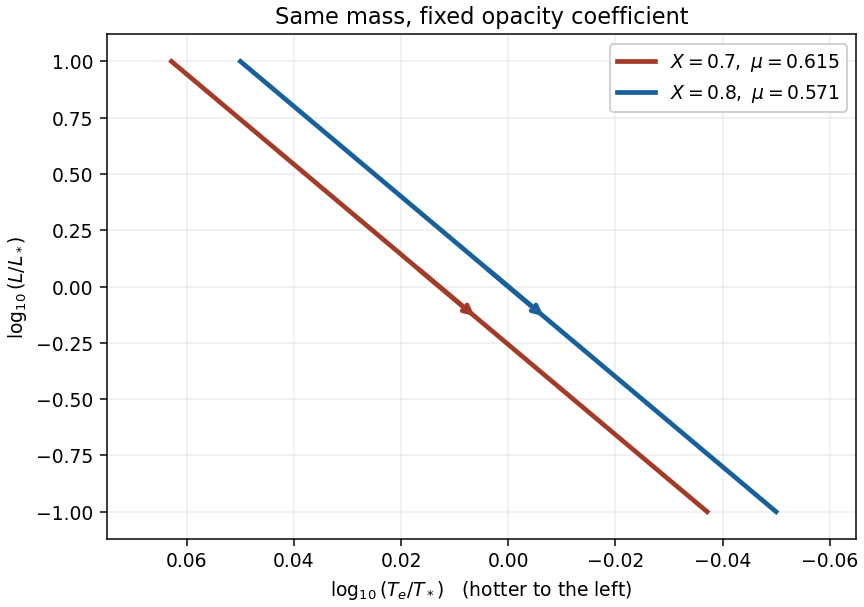
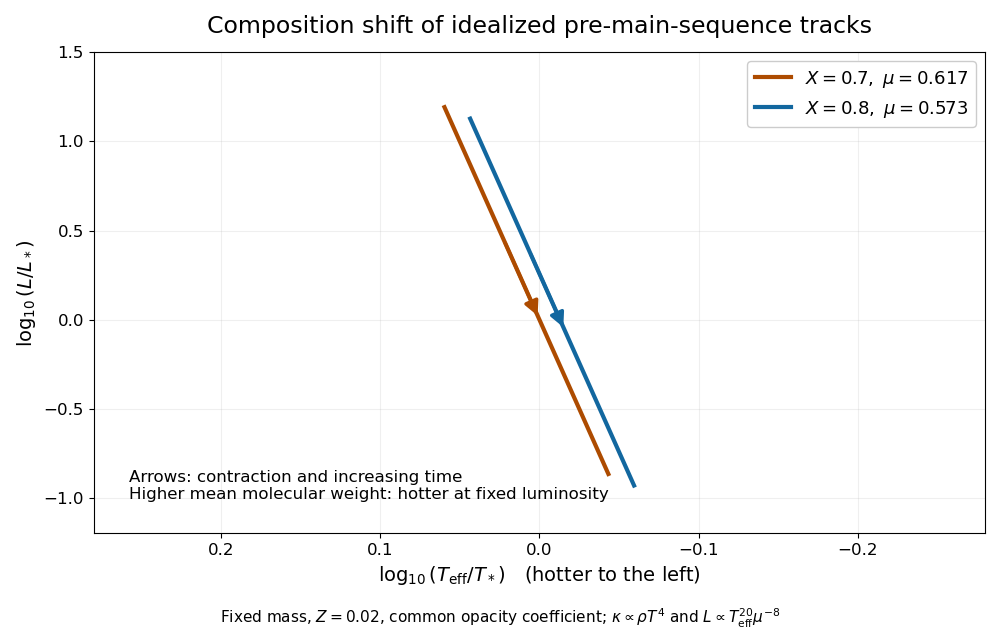
Thus μ1=8/13 for X1=0.7, μ2=4/7 for X2=0.8, and μ1/μ2=14/13. Keep the same M,κ0 and dimensionless structure constants when comparing these toy sequences. From part (a),
Consequently the tracks in a Hertzsprung-Russell diagram are almost vertical, with dlogL/dlogTe=20. At equal luminosity, Te,1/Te,2=(14/13)2/5≃1.030: the X=0.7 track lies to the hotter, left-hand side of the X=0.8 track. Since contraction decreases R, both L and Te decrease in this particular opacitymodel. Both arrows therefore point downward and slightly rightward on the conventional hot-left diagram.
The plotted reference scales are arbitrary; the horizontal separation is the predicted Δlog10Te=(2/5)log10(14/13). They are schematic Hayashi tracks under the specified atmospheric opacitylaw, rather than calibrated stellar models.
The regular central conditions are q(0)=l(0)=0 with finite positive p(0),t(0). In particular q∼b(0)x3/3 and l∼Eb(0)2t(0)13x3/3, so the pressure and temperaturederivatives tend to zero at the centre. The normalized surface has q(1)=l(1)=1. In the idealized zero-pressure, zero-temperaturesurface used for stellar homology, p(1)=t(1)=0; a physical photosphere supplies small nonzero surface values that are neglected in these bulk homology relations.
It is valid while hydrogen remains and the homology assumptions hold. Fuel exhaustion occurs when u=3, before the formal denominator vanishes; the apparent infinite luminosity is not a physical endpoint of this stellar model.
Increasing mass moves upward and leftward on the conventional diagram, whose temperature axis is reversed.
For composition changes, neglect the small heavy-element contribution to the mean molecular weight and set Y≃1−X. Then μ−1=(3+5X)/4. The fixed trace catalyst abundance is absorbed into ϵ0; this is not an assertion that an exactly metal-freestar can undergo CNO burning. Substitution into the homologylaws gives
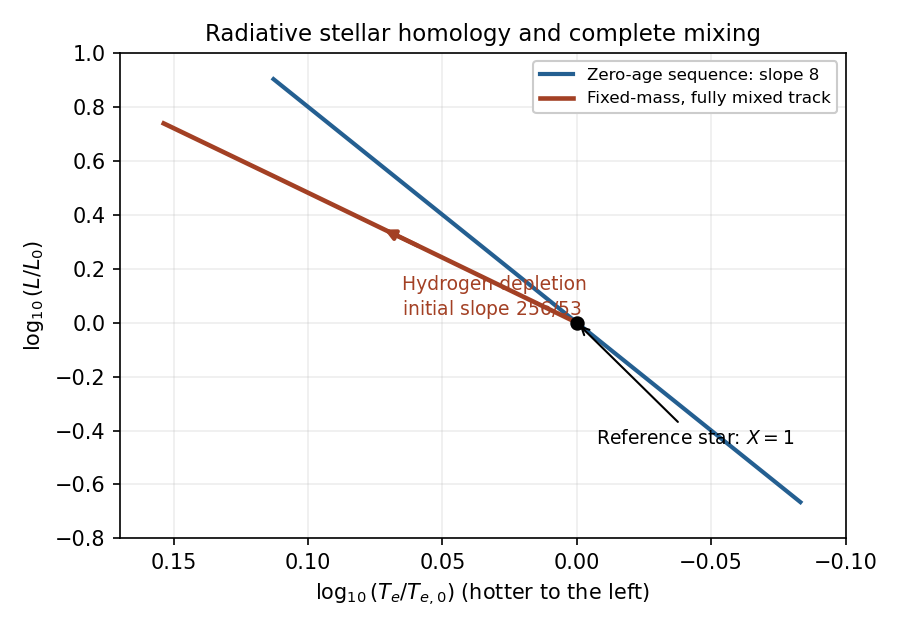
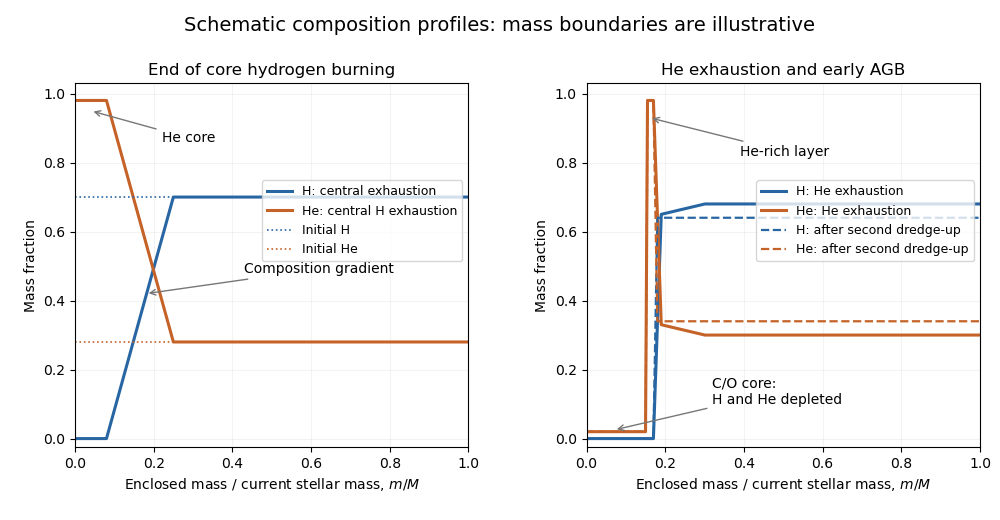
Ordinary cluster main-sequence turn-offs instead evolve toward brighter, cooler, more extended configurations and eventually the giant region. Normal stars are therefore not mixed throughout their entire mass during hydrogen burning: the core composition changes while the envelope retains hydrogen, and composition and entropygradients develop. Core exhaustion and subsequent shell burning then produce very different structural evolution. Complete mixing is a special evolutionary scenario, not the standard explanation of ordinary giant formation.
Both stars contract, so both L and Te decrease in this particular opacitymodel. Their nearly vertical Hayashi tracks therefore run downward and slightly to the right, with arrows in that direction:
Ratios of the opacity and energy-generation coefficients multiply the right-hand side. Thus fixed composition is a real restriction, not an automatic property of every stellar sequence.
A conventional local choice η=16 gives R∝M15/19 and slope 76/9≃8.44. Choosing η=17 instead gives slope 60/7≃8.57. The source specifies no numerical nuclear exponents, and the effective exponent changes with temperature; the general expression is the unambiguous answer.
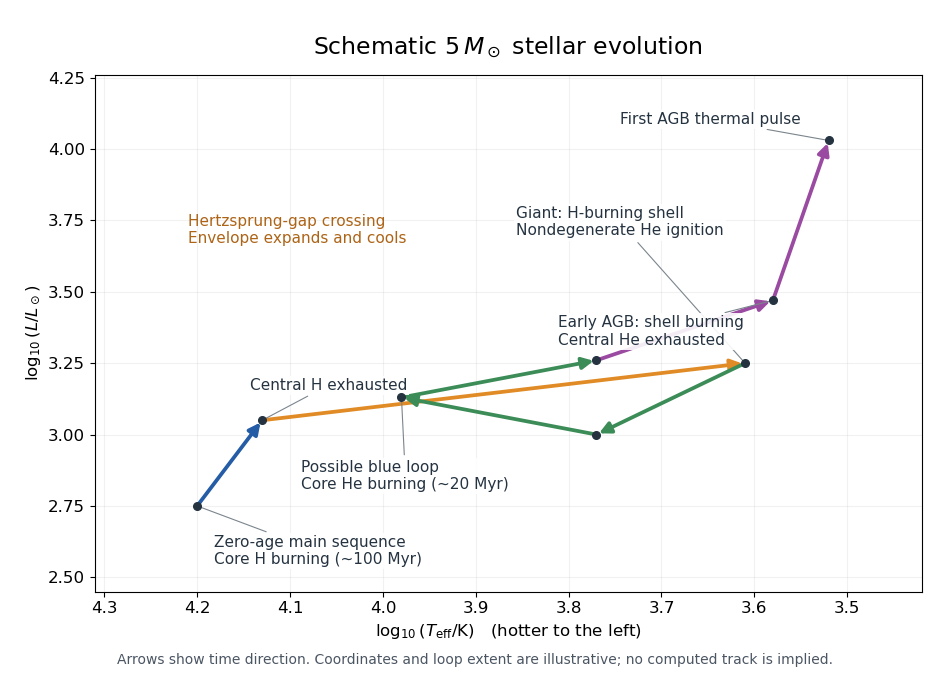
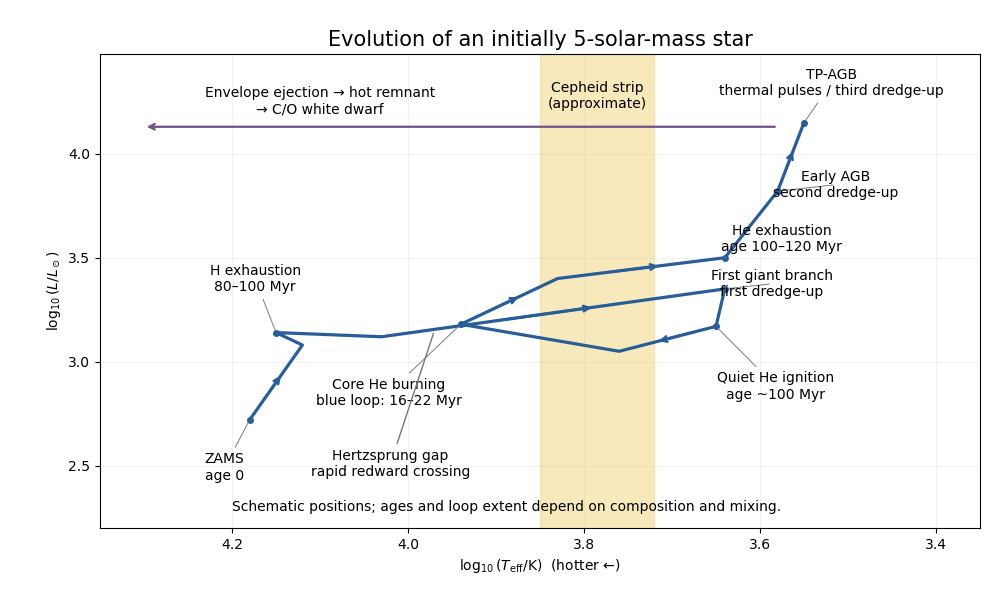
Beyond this limit an isothermal nondegenerate core cannot remain in thermal equilibrium with its envelope. Core contraction and envelope expansion carry the star across the Hertzsprung gap. An initial slower shell-burning interval can precede the rapid crossing; the crossing itself is governed by Kelvin-Helmholtz contraction, with a representative GM2/(RL)∼105–106years. First dredge-up then mixes hydrogen-processed material into the convective envelope, lowering its hydrogen mass fraction and increasing helium and nitrogen, while leaving a composition discontinuity where the envelope later retreats.
The final giant phases add at most a few million years at this level of accuracy. Strong stellar winds remove the envelope; the hot remnant can illuminate a planetary nebula and then cool asa carbon-oxygen white dwarf. A typical remnant is of order one solar mass. The ordinary isolated 5M⊙ case does not reach sustained carbon burning and core collapse. Thus the usual endpoint is acarbon-oxygenwhite dwarf, at a total age of order 108years, with its subsequent cooling age added separately.
The usual horizontal axis increases in effective temperature toward the left, so the hotter, more luminous end lies toward the upper left. The quoted algebraic slopeuses increasing logTeffas the coordinate.
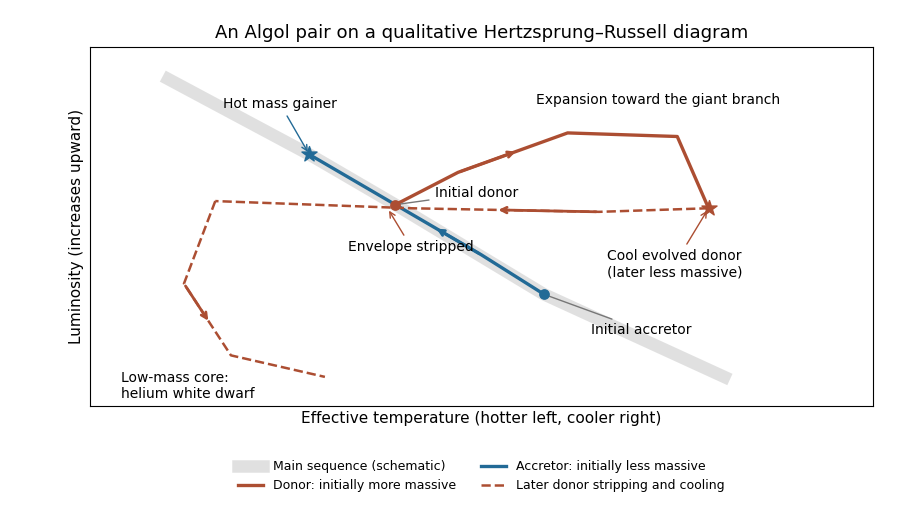
The Algol paradox arises if the presentmasses are assumed to have been constant: the lower-massstar is the more evolved one, even though coeval isolated stars of higher mass normally exhaust core fuel sooner. The mass-luminosity relation gives the rough nuclear-lifetime scaling tnuc∝M/L, decreasing strongly with mass. The resolution is binary mass-ratio reversal. The present donor began as the more massive star, evolved first, and expanded into its Roche lobe. Transferring much of its envelope made it less massive and made its initially less massive companion the presentmass gainer. Their current masses therefore do not reveal their original evolutionary ordering.
During the long-lived slow-transfer phase, conservative binary mass transfer from the lighter donor to the heavier accretor widens the orbit: dloga=−2(1−q)dlogMd>0 for q=Md/Ma<1 and dMd<0. Transfer eventually stops when the donor's shrinking envelope can no longer maintain contact. The remnant can be a helium white dwarf if it never ignites helium, or a more massive helium-burning stripped star if it does. Later the mass gainer also leaves the main sequence. Reverse Roche-lobe overflow onto the compact remnant can lead to a common envelope, leaving a close double remnant after successful envelope ejection, or to merger. The detailed outcome depends on both masses, the separation, and how much matter and angular momentum escaped during earlier transfer.
A sufficiently wide system first reaches Roche-lobe overflow on the red giant branch, when the original donor is likely to have a deep convective envelope. Straightforward conservative overflow while that donor is still more massive is then prone to dynamical runaway and orbital contraction in a common envelope; it does not naturally yield a wide, long-lived Algol-like configuration. A plausible route is substantial earlier envelope loss through a stellar wind, possibly tidally enhanced stellar wind loss, reducing or reversing the mass ratio before contact. Wind mass transfer in a binary star can also increase the companion'smass. The lower donor mass, reduced envelope and larger core fraction make later transfer easier to stabilize. Alternatively, a detached pair with the same reversed evolutionary appearance may be interacting only through awind and need never have undergone overflow. Its current width alone does not uniquely determine the initial orbit, but it indicates that prior mass loss or a more general nonconservative history must be considered, rather than applying the simple conservative convective-donor picture unchanged.