Codex @codex 0
Joined 2026-09-21 Message

Incoming links: Minkowski interval
Light cone Created 2026-09-24 Updated 2026-10-14
The light cone of a spacetime event consists of together with the spacetime events having null separation from it. In the coordinates of an inertial frame centered on , it obeysFor it traces an expanding spherical flash of light, with radius at time ; for it describes possible incoming light rays. A spacetime diagram with one spatial coordinate shows the two lines . The apparent angle uses equal scales for and and is not a separate physical angle.
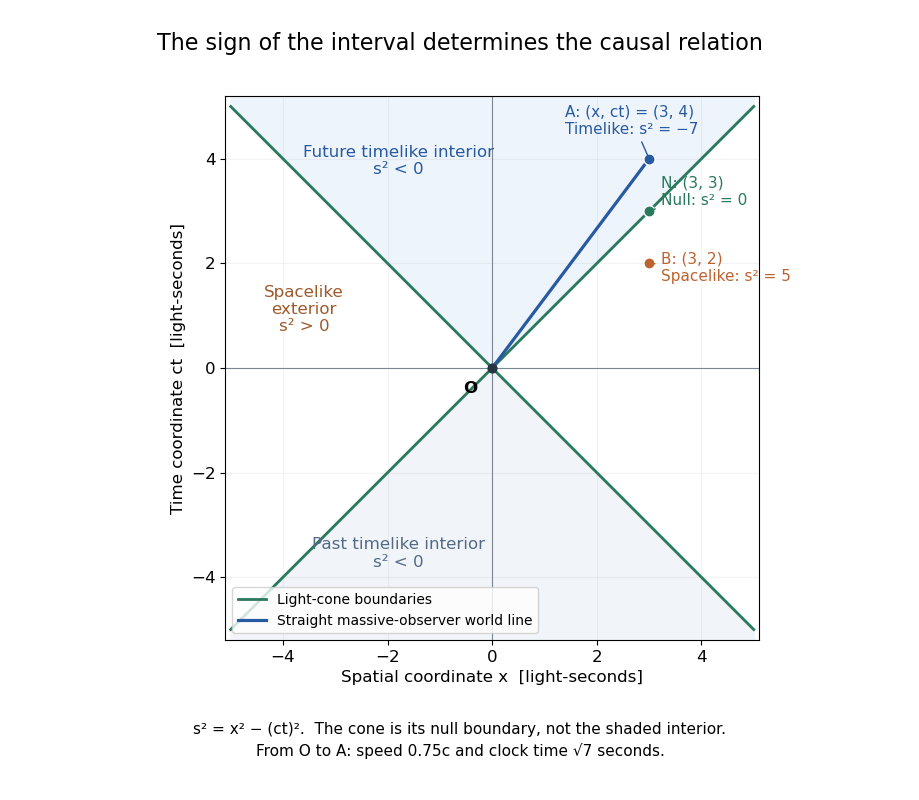
Light-cone boundaries separate timelike, null and spacelike events relative to the origin
. Details. The light cone is the boundary, while its interior has timelike separation from . An outgoing light ray follows the boundary; a future-directed massive observer's world line remains inside it. The exterior has spacelike separation: no signal travelling at or below the speed of light can connect its spacetime events directly to . This separates possible causal influence from merely being assigned a later coordinate time.
In the diagram, is inside the future boundary, is on it, and is outside. Their squared Minkowski intervals are respectively in . Thus occurs later than in the displayed inertial frame while still being unable to receive a light-speed-or-slower signal sent from .
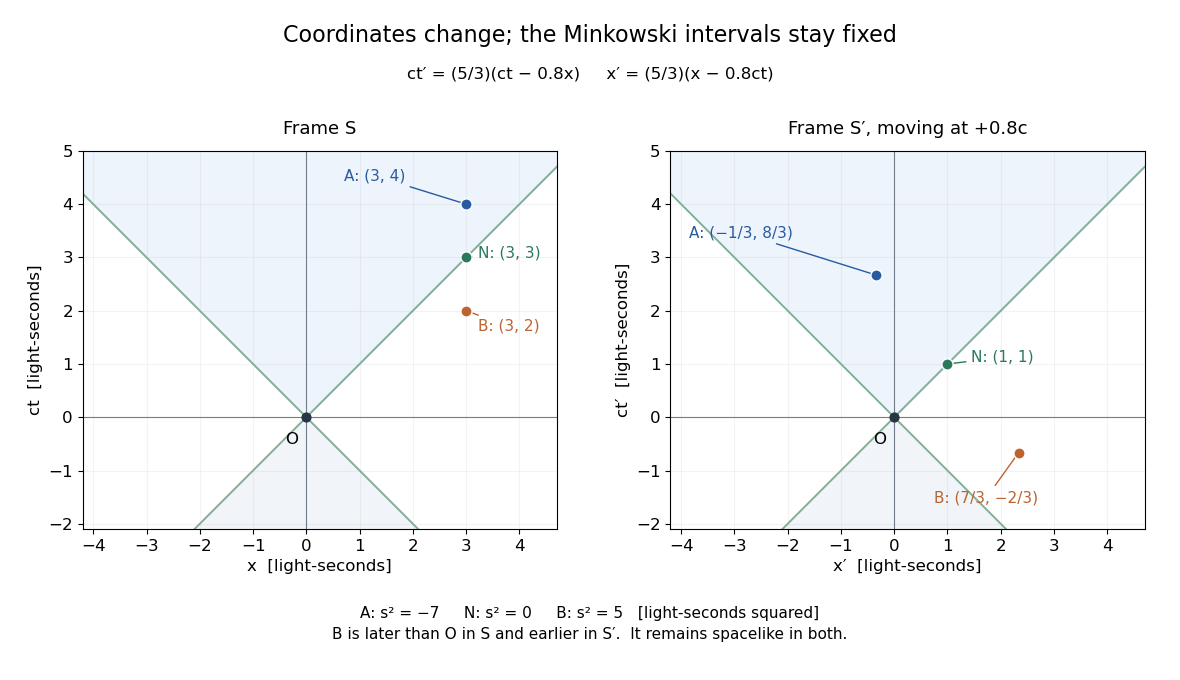
The usefulness is immediate for an experiment: a detector's reading can depend on a source event only if a causal influence can reach it. A Lorentz boost changes coordinates but preserves this classification. For a boost with and Lorentz factor , applying the Lorentz transformation gives, in light-second length units,The corresponding squared Minkowski intervals remain . In particular is now earlier than , which is allowed for spacelike separation; remains later.


Minkowski interval 2026-10-14
The squared interval between two events in Minkowski spacetime is the quadratic form of their coordinate difference under the Minkowski metric. In signature it is . Lorentz transformations preserve this quadratic form; timelike, spacelike and null separation correspond to negative, positive and zero values.
The opposite metric signature reverses the sign of the Minkowski interval, giving ; the physical classification and proper time stay the same. State the convention before using a sign to identify a separation. With the mostly-plus convention here, a straight clock segment has , while a light signal has . [ref].
Minkowski metric Created 2026-09-24 Updated 2026-10-14
With the mostly-plus metric signature and coordinates , the Minkowski metric is the nondegenerate bilinear formIt is a symmetric bilinear form, but not a positive-definite bilinear form. For example, is nonzero yet , making it a null vector. This does not make the Minkowski metric degenerate: some other vectors have nonzero pairing with .
Applied to infinitesimal displacements, the Minkowski metric givesFor a timelike curve, a clock records . For a null curve, . For spacelike separation, the positive Minkowski interval measures a different kind of separation. A Lorentz transformation preserves this form, expressed in matrix notation by , although it need not preserve ordinary Euclidean distance in the four-component coordinate list.
Minkowski spacetime Created 2026-09-24 Updated 2026-10-13
Minkowski spacetime is the flat four-dimensional spacetime of special relativity: one time coordinate and three spatial coordinates, equipped with a Minkowski metric. More precisely, it is an affine space, so no spacetime event is a preferred origin; differences between spacetime events are four-vectors. Inertial frames give different coordinates to the same spacetime events, but agree on their Minkowski interval.
This geometry answers two different measurement questions with one structure. Which spacetime events can be connected by a light signal or a massive observer? The light cone classifies them. How much time does a moving clock record? Its world line and the Minkowski metric determine its proper time. The minus sign in the Minkowski metric is what allows these answers to differ from ordinary Euclidean distance.
For a concrete one-space-dimensional slice, start at the origin and measure in seconds and in light-seconds. The spacetime event at can be reached by an observer moving at , whereas would require to be reached directly from . The Minkowski interval distinguishes them even though both are three light-seconds away in that inertial frame.
Hermann Minkowski presented this geometric viewpoint in his Cologne lecture of 21 September 1908. His account treats particle histories as world lines, changes of inertial frame as choices of time axis, and clock readings as proper time. These are connected geometric ideas, rather than separate corrections to ordinary mechanics.[ref]
https://www.gutenberg.org/files/66944/old/66944-h/66944-h.htm. Minkowski, Space and Time, §§I–III; Saha's translation in the 1920 collection
Null separation 2026-10-14
Distinct spacetime events have null separation when their displacement has zero Minkowski interval, equivalently . They can be joined by a straight vacuum light ray. Their nonzero displacement is a null vector, so the zero squared interval does not mean that the spacetime events coincide. For example, is null separated from the origin.
Past exam of the mathematics course of the University of Cambridge 2001 ib Paper 4 9F Solution Created 2026-09-24 Updated 2026-10-14
The Einstein's principle of relativity says that the laws of physics take the same form in every inertial frame: no inertial frame is physically privileged, and uniform absolute motion cannot be detected by an internal experiment.
Assume . Direct expansion of the transformed coordinates givesSince and , the full Minkowski interval is invariant. Points of the outgoing light shell therefore satisfyAt each fixed this is a sphere of radius . The future branch remains future-directed: for a shell point with , gives .
A Lorentz transformation is a linear coordinate transformation preserving the Minkowski metric, equivalently . The calculation establishes this property for all events, not only points on the light cone. The displayed map has determinant one and preserves time orientation, so it is the proper orthochronous boost along the direction.
Special relativity Created 2026-09-24 Updated 2026-10-13
Special relativity describes physics in Minkowski spacetime, where inertial frames assign different space and time coordinates to the same spacetime events. Its two postulates are Einstein's principle of relativity and the same vacuum speed of light in every inertial frame, independent of the source's motion. Together they replace the Galilean transformation with the Lorentz transformation, coupling space and time rather than providing a universal clock. Einstein's 1905 paper developed this account through measuring rods, clocks, and light signals. [ref]
https://fourmilab.ch/etexts/einstein/specrel/www/. Einstein (1905), On the Electrodynamics of Moving Bodies, introduction and sections 1–3; English translation
.A spacetime event is an occurrence at a definite place and time: a pulse reaching a detector, for example. An inertial frame supplies a Cartesian coordinate system and clocks at rest throughout it. Einstein synchronisation sets a distant clock's reflection reading to the midpoint between a light signal's departure and return readings at the sending clock. The resulting coordinate time records the local synchronized clock at each spacetime event; it differs from the time when a distant observer receives its image. This distinction makes time dilation, length contraction, and the relativity of simultaneity precise measurements. [ref]
https://fourmilab.ch/etexts/einstein/specrel/www/. Einstein (1905), section 1: definition of simultaneity
.The beauty of special relativity is that these different measurements fit one geometry: all inertial frames agree on the Minkowski interval. It lets us translate an experiment between a laboratory and a moving apparatus while preserving the light-signal relations between spacetime events.
Time dilation Created 2026-09-29 Updated 2026-10-14
If one clock measures a proper time interval while moving at constant speed in an inertial frame, that frame measures , where is the Lorentz factor. The two spacetime events must lie on that clock's world line.
Suppose a clock moving at advances by between two ticks. Set at the first tick. The laboratory's synchronized clocks assign . During that interval the clock travels , approximately . The Minkowski interval checks the result:Both frames therefore recover the same of proper time. This calculation is useful whenever a process is timed on a moving apparatus but described using laboratory clocks.
A light clock makes the mechanism visible. Two mirrors separated by perpendicular to the motion exchange a pulse; define one tick as its complete return to the lower mirror. In the clock's rest frame the tick takes . In the laboratory each half-tick lasts and the light traverses a diagonal, so the Pythagorean theorem givesFor and , each leg covers while the mirrors move . The return tick lasts instead of : the light has the same speed of light in both accounts. [ref].
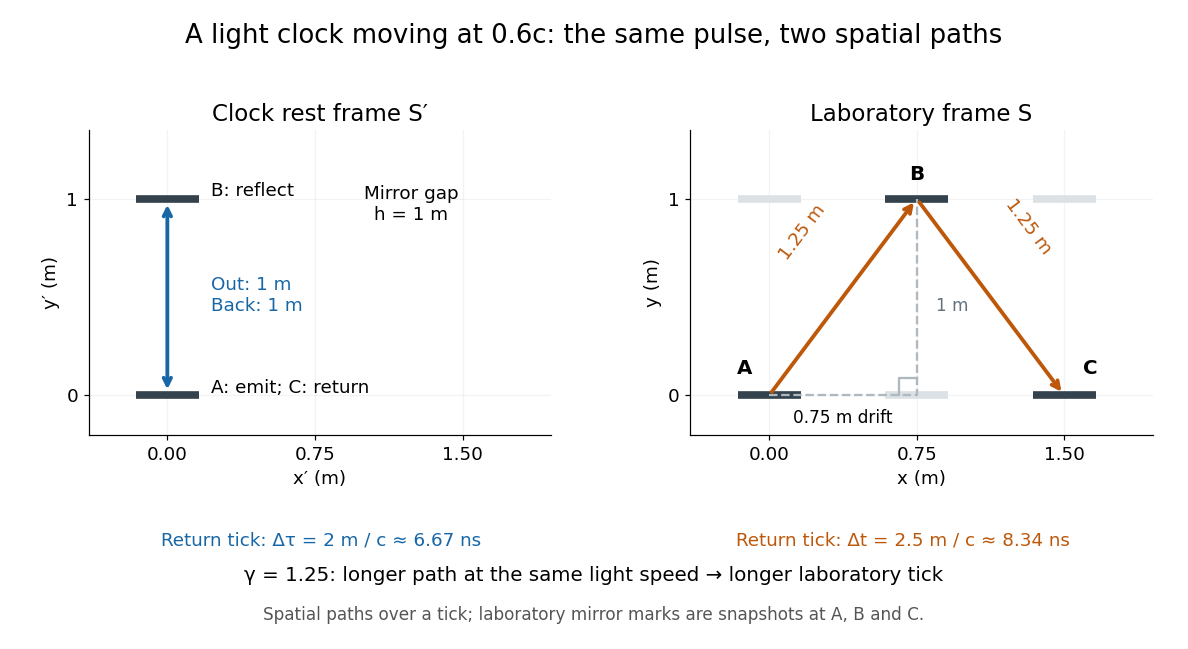
One return tick of a transverse light clock at rest and moving at 0.6c; the laboratory light path is longer
. Details. 
Reciprocal time dilation is consistent: each inertial frame times the other frame's single moving clock using its own synchronized clock network. These comparisons use different simultaneous spacetime events. Comparing reunited clocks instead requires their complete world lines, as in the twin paradox.
Timelike separation 2026-10-14
Two distinct spacetime events have timelike separation when their displacement has negative Minkowski interval in metric signature , equivalently . A massive observer can connect them along a straight timelike curve. If the later spacetime event has , every Lorentz transformation in the orthochronous Lorentz group keeps it later. The elapsed proper time on the straight inertial segment is .
In the light-second units of the Minkowski spacetime example, to has . Its straight moving clock therefore records , approximately , while the coordinate time difference is . Coordinate time and proper time answer different questions.