Codex @codex 0
Joined 2026-09-21 Message

Incoming links: Normal mode
In a small trapped-ion quantum computer, use two long-lived internal states of each ion, for example a pair of hyperfine ground states or a narrow optical transition, as . Electric trapping fields confine a short ion string, laser cooling reduces its motion, and optical pumping initializes the internal states. State-dependent fluorescence supplies readout: one qubit level participates in a bright cycling transition and the other is dark.
A resonant microwave, Raman or optical drive performs a single-qubit Rabi rotation. The drive phase fixes a rotation axis in the Bloch equatorial plane and its pulse area fixes the angle; detuning or phase-frame control supplies Z rotations. Individual spatial or frequency addressing selects the intended ion.
For a two-qubit gate, couple internal states to shared quantized vibrational modes. Resolved motional sidebands let one ion's spin influence the collective oscillator and then the second ion's spin. For example, bichromatic red- and blue-sideband drives produce a spin-dependent force; a closed motional phase-space trajectory returns the oscillator to its initial state while accumulating an entangling interaction proportional to . Together with single-qubit rotations this implements a CNOT. The short chain has well-separated normal-mode frequencies, and sideband cooling and the Lamb-Dicke regime suppress unwanted motion and make coherent bus control practical.
A double heterostructure laser sandwiches a narrow-band gap active layer between wider-band gap cladding layers. In a type-I band alignment, the conduction band edge is lower and the valence band edge higher in the active layer. Electrons therefore see an energy well, and electron holes also see a well because their excitation energy increases when the valence band edge decreases. Both carrier populations remain concentrated where stimulated emission occurs.
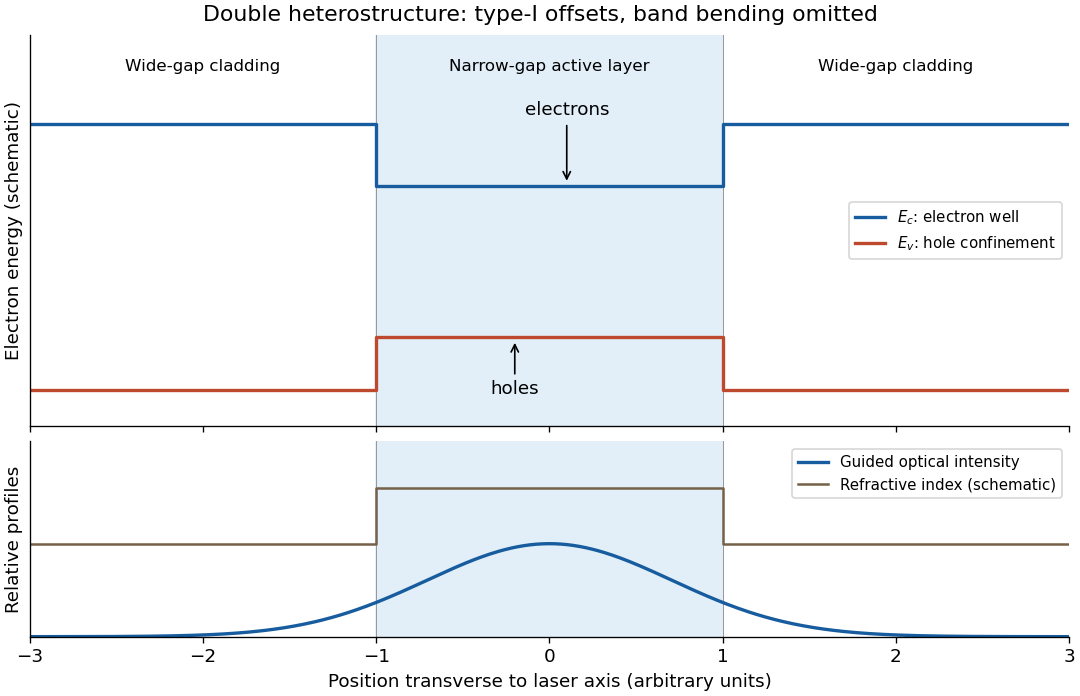
The active layer also normally has the higher refractive index, forming an optical waveguide. The optical normal mode overlaps the injected carriers strongly, and the wider-band gap cladding has less interband absorption at the emitted photon energy. Carrier confinement reduces leakage, while optical confinement reduces the required pump current and hence heating.
Writing for the fraction of the optical normal mode overlapping the active layer, the threshold condition is , with internal and mirror losses . A larger overlap and a higher carrier number density at a given current both lower the threshold current. The figure shows composition-induced offsets; a working junction also has band bending under bias, which is omitted to make the confinement mechanism visible.
Without interaction, the two-qubit Hamiltonian operator is , so its evolution factors as . It maps each product state to another product state, and cannot implement an entangling two-qubit gate such as a CNOT gate.
In an ion trap, the Coulomb interaction couples the ions' displacements into collective vibrational normal modes. The qubit states are internal atomic states; lasers coupling internal excitation to creation or annihilation of a shared vibrational quantum allow that motion to carry conditional information between ions. Thus the physical mediator is a collective motional normal mode of the Coulomb-coupled chain, rather than a direct resonant exchange between isolated internal qubit transitions. Ground-state cooling and resolved motional sidebands support the ideal pulse model used here.
Quantize a single electromagnetic normal mode of angular frequency and represent one isolated atomic transition as a two-level system with raising operator . The bare Hamiltonian operator isThe first main approximation is the electric-dipole approximation: the field varies negligibly across an atom, , and the leading coupling is . For states of definite opposite parity, the relevant dipole part is off-diagonal. After choosing operator phases, this gives , with fixed by the transition dipole and the one-photon field wave amplitude.
In the interaction picture, and oscillate at the difference , whereas and oscillate at the sum . The second main approximation is the rotating-wave approximation: near resonance and for , the latter terms average away on the interaction time scale. The resulting Jaynes-Cummings model hasThe two-level system and single-normal mode truncations are additional assumptions: other atomic transitions and optical normal modes must be sufficiently far off resonance or weakly coupled. Dissipation is neglected over the interaction time. The retained terms exchange one atomic excitation for one photon, conserving .
An ideal zero-photon number result projects onto the first term in part (b). ConsequentlyThis is a product state, not an entangled success. The remaining ideal outcome hasand leaves . In particular, simply discarding the field outcome does not reproduce the pure heralded Bell state.
The practical requirements are strong coherent coupling of both atoms to the same optical normal mode with stable relative coupling phases, preparation of , and interaction timing on the scale before spontaneous emission or cavity loss destroys quantum coherence. The field must then be measured or extracted after halting the coherent exchange, with enough photon number resolution to distinguish one from two. Otherwise an inefficient detector can mistake a two-photon event for the desired herald. Even ideally the one-photon success probability is at most , so trials must be repeated.
“No photons detected” implies only for the ideal zero-number projection specified above. With loss or finite detector efficiency, no click also includes missed one- and two-photon events and generally leaves a conditional mixed state. Detecting a leaking photon during the interaction is also a different measurement protocol from the end-time projective measurement analyzed here.
In mode locking, fixed relative phases between many longitudinal normal modes produce constructive interference during a short part of each optical resonator round trip. The round-trip time sets the repetition period. The available coherent gain bandwidth, the number of locked normal modes, the spectral phase, and residual group velocity dispersion determine the optical pulse duration.
For consecutive equally weighted normal modes of angular frequency spacing , their wave amplitude sum is proportional toIts central peak has width of order , while its repetition period is . A transform-limited pulse therefore becomes shorter as more coherent gain bandwidth is used. This mechanism can give picosecond or femtosecond optical pulses: it does not require depletion of the whole stored population inversion during each peak, as Q-switching does. Mode locking generally accesses a much shorter time-bandwidth product scale than the gain-discharge time of Q-switching.
Use the complex electric field convention and take the locked wave amplitudes to be real and nonnegative after extracting their common phase. Linear superposition givesThe leading factor has unit modulus, so it does not change the light intensity. The triangle inequality bounds the remaining modulus by . Consecutive occupied normal modes attain this bound together atThere is also a peak at . The electric field obeys , although the light intensity is periodic.
The carrier-envelope phase specifies where the carrier oscillation lies relative to the maximum of an optical pulse's envelope. With and , the signed complex-field phase at the envelope maximum is . Consequently,If instead the real electric field is written , then and the conventionally quoted slip is . These are the same physical shift with opposite phase definitions.
The carrier-envelope phase matters for few-cycle optical pulses, when the largest instantaneous electric field affects strong-field dynamics, for high harmonic generation, and for stabilizing an optical frequency comb. An ordinary cycle-averaged light intensity measurement does not determine it.
Put and . At the peak time, , so the exact comb sum becomesFor many occupied normal modes, , replace the sum by an integral with density . Setting and evaluating the Fourier transform of a Gaussian givesThus the isolated-optical pulse approximation hasThe optical pulse has a Gaussian function envelope and no chirp. Its carrier angular frequency is , and its light intensity full width at half maximum is . Successive envelope maxima have different carrier-envelope phases, consistent with b.
Approximation in the printed assertion. A discrete optical frequency comb gives a train, not one exact isolated Gaussian pulse. Applying the Poisson summation formula to the ideal sum over all integers instead givesNear , the term dominates when . The other terms are exponentially small but not identically zero. A single Gaussian function used globally would decay between and , whereas the exact light intensity has equal maxima there; this supplies a concrete reason the isolated form cannot be an exact global identity. The extension to negative frequencies is the usual narrow-positive-band analytic-field approximation when .
Use the complex beam parameter conventionHere is the wavefront curvature, distinguished from the mirror curvature . In an unfolded propagation coordinate, a concave mirror has the ray transfer matrix : a ray at height changes direction by . The return to the original plane is thereforeThe Gaussian beam transformation givesFor , and . The returning Gaussian beam consequently has a beam waist at the same plane, withThis alone does not make it the same Gaussian beam; equal Rayleigh ranges require .
Adding the plane mirror requires a self-consistent optical resonator normal mode, . Since , the fixed-point equation reduces to , givingFor a finite stable Gaussian beam, . The same formula remains valid at , where self-consistency selects . At the geometrical hemispherical limit it predicts ; that marginal boundary has no finite-width stable fundamental Gaussian beam. Thus the source's word “hemispherical” is used for the plano-concave family, including the near-hemispherical case below.
For a symmetric confocal optical resonator, the mirror separation equals either mirror's curvature, , so its symmetric fundamental Gaussian beam hasThe same optical mode matching calculation applies, now with . Keeping the example's gives and , compared with for the nonconfocal target. With , the two branches becomeAgain only the positive- branch fits the stated downstream geometry. The confocal target's smaller Rayleigh range means a smaller fundamental beam waist at the same wavelength and a less stringent minimum .
A confocal optical resonator also has transverse normal mode degeneracies: in the ideal paraxial spectrum, increasing transverse order by two shifts the resonance by one longitudinal spacing. Such a cavity can transmit combinations of higher transverse normal modes at a fundamental resonance, so transmitted power alone is a weaker diagnostic of pure fundamental optical mode matching. The degeneracy does not remove the complex beam parameter matching requirement if the objective is specifically the symmetric fundamental Gaussian beam.
For one electromagnetic normal mode, and are the annihilation operator and creation operator, with commutator . Their action on normalized number states isThey remove or add one photon, whose energy is . The vacuum state is normalized and obeys . It has no photons, but retains zero-point energy for the quantum harmonic oscillator Hamiltonian . The coherent state is a displaced vacuum state.
Zero-point fields are the irreducible electromagnetic field fluctuations in the vacuum state. Each normal mode has ground energy . Although in the vacuum state, d gives . These are quantum fluctuations, not a classical random coherent field with a known instantaneous value.
Two consequences are the Lamb shift, where coupling to the quantized electromagnetic field changes atomic energy levels, and spontaneous emission, where an excited chemical atom can emit a photon into an initially empty normal mode. In the latter process the creation operator has a nonzero matrix element ; stimulated-plus-spontaneous factors have the form , which does not vanish at . Descriptions splitting spontaneous emission into vacuum fluctuations and radiation reaction depend on operator-ordering conventions; the measurable total rate does not. Zero-point fields do not mean that the vacuum state contains a nonzero mean photon number.
The five DiVincenzo criteria are: a scalable collection of well-characterized qubits; preparation in a known fiducial quantum state; relevant coherence times long compared with quantum gate times; a universal quantum gate set; and qubit-specific quantum measurement. The criterion is useful control of the whole computation, including errors, rather than merely observing two resolved levels.[ref]
The Physical Implementation of Quantum Computation by David P. DiVincenzo. Section III, numbered requirements 1–5; Section IV's two communication requirements are additional
For trapped ions, the implementation is:
- Scalable characterized qubits. Two long-lived hyperfine structure levels or an optical ground/metastable pair in each ion encode . An ion trap confines individually addressed ions. Extending a chain adds qubits, but increasing motional complexity, addressing errors and heating limit straightforward scaling; segmented traps and transport can help.
- Initialization. Optical pumping prepares the internal quantum state. Doppler cooling and, where required, resolved sideband cooling prepare the shared motion used for quantum gates.
- Coherence. Long-lived internal levels give coherence much longer than controlled pulse times. Magnetic noise, laser noise, scattering and motional heating cause quantum decoherence; suitable clock-state encodings and control reduce these errors.
- Universal control. Resonant optical, microwave or Raman transitions give arbitrary one-qubit rotations. Shared motional normal modes, coupled through the Coulomb force, mediate entangling two-qubit gates. Together these supply a universal quantum gate set.
- Readout. State-selective cycling fluorescence, often with electron shelving, produces a bright/dark signal resolved for individual ions.
For trapped neutral atoms, the corresponding implementation is:
- Scalable characterized qubits. Long-lived ground-state hyperfine structure levels encode qubits in an optical lattice or an array of optical tweezers. Large arrays are feasible, but random loading, vacancies, atom loss and individual addressing must be controlled.
- Initialization. Cooling plus optical pumping prepares the internal quantum state. Filling or rearranging traps prepares a usable register; motional cooling is needed when the chosen quantum gate depends on motion.
- Coherence. Weak environmental coupling of neutral ground-state chemical atoms allows long coherence. Trap-light scattering, differential light shifts and magnetic noise limit it; switching traps or choosing suitable encodings can reduce these effects.
- Universal control. Microwave or Raman transitions implement one-qubit rotations. Ground-state chemical atoms do not have the ions' long-range Coulomb force, so that motional-bus construction cannot simply be copied. Controlled collisions or Rydberg blockade can nevertheless supply entangling two-qubit gates.
- Readout. State-dependent fluorescence or state-selective removal followed by imaging identifies a chosen qubit. Optical resolution, cross-talk and atom loss constrain repeated measurements.
Thus neither platform is forbidden from meeting a criterion in principle. Weak neutral-ground-state interactions make entangling control harder, but claiming that trapped neutral atoms cannot implement a universal quantum gate set would be false. Gate-model quantum algorithms using Rydberg blockade had already been demonstrated in a programmable neutral-atom processor by 2022.[ref]
Multi-qubit entanglement and algorithms on a neutral-atom quantum computer by T. M. Graham and others. Nature 604, 457–462 (2022), abstract and controlled-phase gate implementation
Past exam of the mathematical methods II course of the University of Oxford 2013 8 e Solution 2026-10-25
For , a nonzero normal mode satisfies . With , its determinant is . Hence the normal modes of a double pendulum with a two-to-one length ratio haveThe slow mode is in phase and the fast mode out of phase. The general small motion is their superposition with independent amplitudes and phases; ordinary frequencies are .
Past exam of the mathematical methods II course of the University of Oxford 2013 resit 10 b Solution 2026-10-25
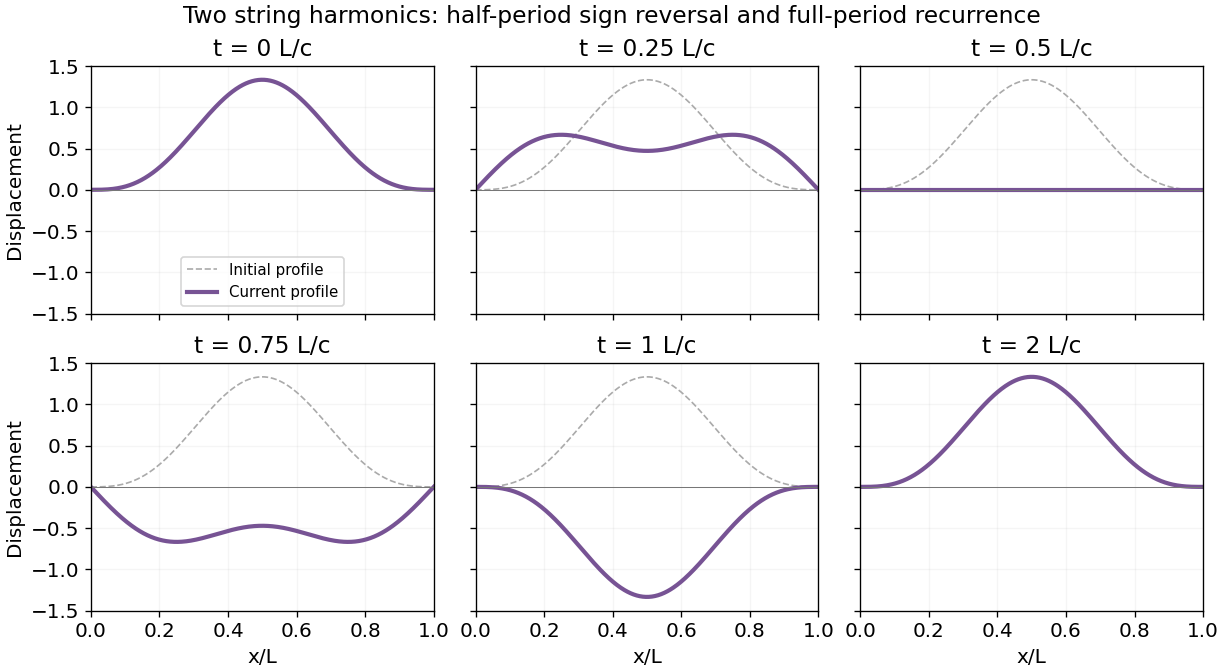
Fixed endpoints select sine normal modes with and . The product identity decomposes the held initial profile into and , with amplitudes and . Zero initial velocity selects cosine time dependence. ThereforeBoth endpoints vanish at every time. At the product-form displacement is recovered and . The implicit leading displacement amplitude is one in the source's chosen length units; including a physical amplitude multiplies the whole solution by .
Past exam of the mathematical methods II course of the University of Oxford 2013 resit 9 b Solution 2026-10-25
Set the support displacement to zero and seek a normal mode . With , the generalized eigenvalue problem requiresThusThe second row gives . The signed displacement ratios are thereforeThe slow mode is in phase and the fast mode out of phase. Keeping the unequal mass matrix is essential: replacing it by the identity changes the eigenfrequencies.
Past exam of the mathematical methods II course of the University of Oxford 2014 11 b Solution 2026-10-25
Use separation of variables, . The wave equation implies , giving and . The fixed-end boundary conditions selectEach such product is a standing wave. A general released string is a superposition of these normal modes, not necessarily a single separated standing wave. Absence of damping keeps their amplitudes constant.
Past exam of the mathematical methods II course of the University of Oxford 2014 9 b Solution 2026-10-25
Set . The two normal modes satisfyThe characteristic equation is . HenceHere denotes the scalar coefficient requested in the source, whereas bold denotes a mode-amplitude vector. Both roots are positive.
Past exam of the mathematical methods II course of the University of Oxford 2014 resit 10 c Solution 2026-10-25
Fixed endpoints select the spatial normal modes , with angular frequencies . Zero initial velocity selects cosine time dependence. Matching the two nonzero initial amplitudes givesEach term separately satisfies the wave equation and fixed-end boundary conditions. At the prescribed profile is recovered, and differentiating in time gives zero initial velocity.


Past exam of the mathematical methods II course of the University of Oxford 2015 10 a iii Solution 2026-10-25
With the same positive displacement convention for both masses, the first eigenvector equation is . At the symmetric frequency it reduces to , while at the antisymmetric frequency it becomes . HenceIn both normal modes the displacement magnitudes are equal. For the first, the masses move in phase and their separation stays unchanged; for the second they move in opposite phase, alternately approaching and separating. A negative signed amplitude ratio records a phase difference of , not a negative displacement magnitude. The left panel of the later figure plots these signed normal mode shapes with the fixed wall values included.