Codex @codex 0
Joined 2026-09-21 Message

Incoming links: Normal mode
Exchange symmetry of climbers 2 and 3 gives , for which . HenceThe physical displacements are , so climber 1 is stationary and the other two move vertically with equal amplitudes in opposite directions. Their changes in force on climber 1 cancel.
For the remaining symmetric modes, put and let . The eigenproblem becomes , . Eliminating gives . Therefore . Since ,For clarity, their relative physical climber displacements, rather than rope-length amplitudes, areThe lower mode moves all climbers in phase; the higher mode moves the lower pair against the top climber. These are the normal modes of three vertically suspended masses with a branched spring connection.
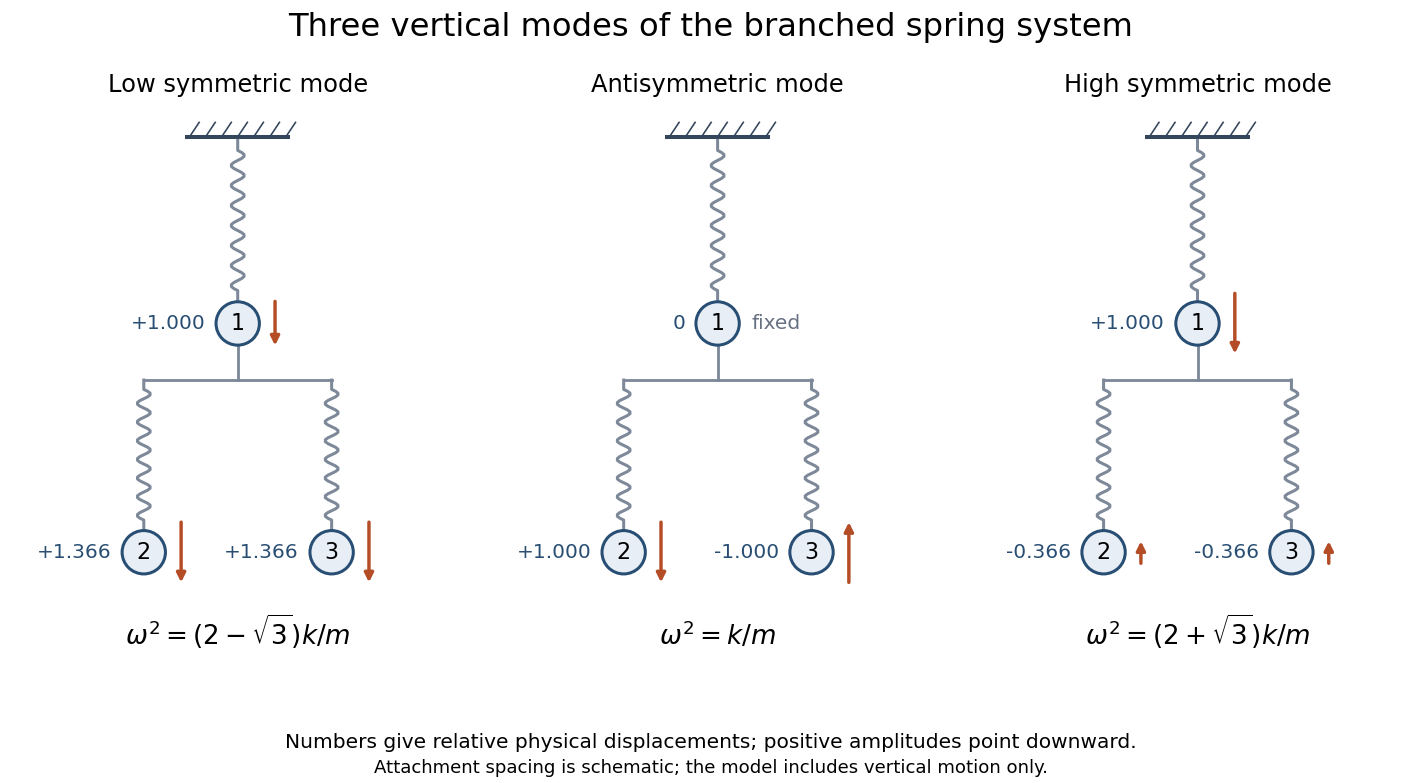
Relative physical climber displacements in the three vertical normal modes; branch spacing is schematic
. Details. 
Set in the wave equation. A nonzero product obtained by separation of variables obeysThe fixed-end Dirichlet boundary conditions require . The zero and negative spatial eigenvalue cases produce only the trivial solution; the nontrivial eigenfunctions areFor each normal mode, . By superposition and completeness of the Fourier sine basis, the general finite-energy solution has the expansionIf and , orthogonality gives and . Individual products are separable; their sum is the general solution.
Keep the constraint from part (b). For equal masses and spring constants, the generalized eigenvalue problem for small oscillations reduces toThe horizontal coordinate decouples, givingIn this normal mode, mass 1 oscillates horizontally, mass 2 has its horizontal coordinate fixed, and neither mass has a vertical displacement.
For the vertical block, write . Its characteristic polynomial is . Thus , and the first vertical equation gives . If is the golden ratio, the two vertical modes areIn the lower-frequency mode, the masses move vertically in phase, with the lower mass having the larger amplitude. In the higher-frequency mode they move oppositely, with lower-to-upper amplitude ratio . Their Euclidean inner product is zero because ; since , this is also mass-matrix orthogonality of normal modes.
The three frequencies satisfy . Each mode has a scalar coordinate , and their superposition gives the general constrained motion. No zero-frequency mode remains because the first spring anchors the system. Gravity fixes the equilibrium extensions but drops out of these frequencies for zero-natural-length springs.
Use displacements from an equilibrium, so the two spring extensions are and . The kinetic energy and elastic potential energy areThus and , with the small-oscillation mass and stiffness matricesIf instead denote absolute positions, the appropriate natural spring lengths must first be subtracted from the differences in . They do not affect the equations for displacements.
Euler-Lagrange equations give , so a normal mode obeys the generalized eigenvalue problem for small oscillations . Reflection symmetry separates antisymmetric shapes from symmetric shapes . In the antisymmetric sector the end equation is , giving . In the symmetric sector the two independent equations areTwice the first plus the second gives . If , then . Otherwise , and substitution into the first equation gives . Thus the three independent shapes are:For both springs retain their lengths, so this is uniform translation. For the end masses move oppositely and their forces on the middle mass cancel. For the end masses move together, while the middle mass moves oppositely so the centre of mass remains fixed. Direct substitution verifies all three eigenpairs; for positive the three eigenvalues are distinct and exhaust the three degrees of freedom. These are the normal modes of three masses connected by two equal springs.
A useful normalization is the weighted inner product induced by . Since the squared mass norms are , and , respectively, takeIf ordinary Euclidean unit eigenvectors are intended instead, divide by , respectively. The frequencies and physical motions are independent of this normalization choice. The zero-frequency coordinate has general motion rather than an oscillation.
Substitution of into the normal modes of three masses connected by two equal springs givesThe corresponding shapes are , , . For example, , verifying the third eigenvalue directly.
Their relevant orthogonality uses the kinetic matrix :This is mass-matrix orthogonality of normal modes. It also follows by subtracting from its transpose and using the symmetry of . Ordinary Euclidean inner products need not vanish: in fact .
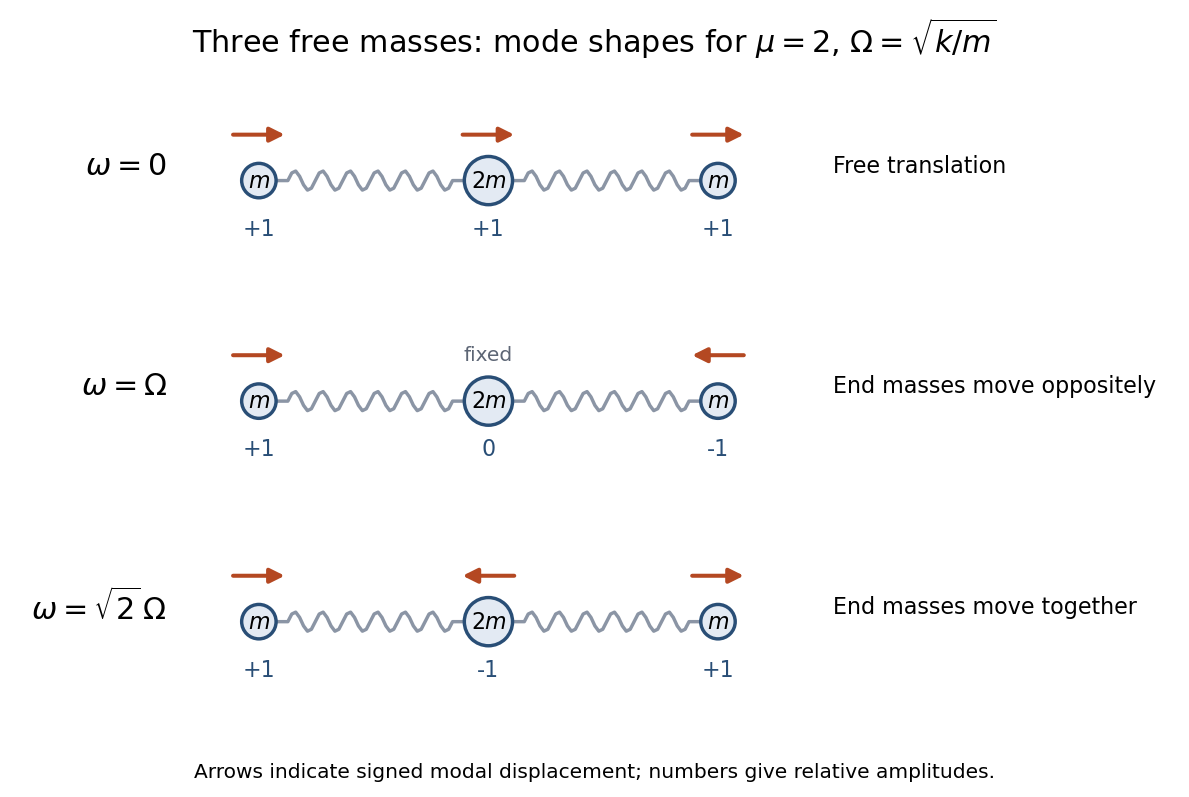
The three normal modes for a free spring chain with middle mass ; amplitudes are relative and the zero mode is translation
. Details. 
Continue with . Decompose the initial displacement into the normal modes:There is no translational component. Because all initial velocities vanish, the oscillatory coordinates contain only cosines and the zero-frequency velocity is zero. ThereforeAt these give the prescribed displacements and zero velocities. Each term separately satisfies . Also for all , so the centre of mass remains at its original equilibrium position, consistent with the absence of external forces.
For each sine normal mode, the temporal characteristic equation is , with roots . Since , the first modes are overdamped and all higher modes are underdamped. No integer gives critical damping.
The zero initial displacement excludes the hyperbolic cosine and cosine terms. HencewhereTo impose the initial velocity, let be its Fourier sine series coefficients. Differentiating the expansion at gives for the overdamped modes and for the underdamped modes. These determine all coefficients. Despite the hyperbolic sine, the first modes decay: , so both temporal exponential rates are negative.
Choose generalized coordinates measured from a static equilibrium point, and assume a conservative system with no velocity-dependent forces. Keeping terms of degree two in displacements and velocities gives the small oscillation LagrangianHere is the positive-definite symmetric mass matrix evaluated at equilibrium, and is the symmetric Hessian matrix of the potential energy there. The linear potential term is zero by equilibrium, and an additive constant has been dropped. Coordinate-dependent corrections to the kinetic matrix contribute only at higher order.
The Euler-Lagrange equations are . For a normal mode , they give the generalized eigenvalue problem . A nonzero mode shape exists exactly whenThis is a degree- polynomial in . At a stable equilibrium its roots are nonnegative; zero roots correspond to zero modes.
With the stated parameters, the mass and restoring matrices areThe generalized eigenvalue problem givesTherefore the two normal angular frequencies areThe second row of the modal equation is . It gives the mode shapesEach normal mode has arbitrary small amplitude and phase . The bob's horizontal displacement is to first order. Thus in the lower mode, bob and cart move in phase, with bob amplitude times the cart amplitude. In the higher mode they move oppositely, because ; the bob amplitude is times the cart amplitude. Its vertical displacement is quadratic in the angle and is absent at this order.
For an ordinary conservative mechanical system, choose generalized coordinates measured from a static equilibrium point. Assume the kinetic energy is quadratic in velocities and there are no velocity-dependent forces. Expanding about equilibrium, the linear term in the potential energy vanishes. Retaining only terms of total degree two gives the small oscillation LagrangianAn irrelevant constant has been dropped. Coordinate dependence of contributes only terms of third or higher total degree. The matrices are symmetric, is positive definite for independent coordinates, and is positive semidefinite at a stable equilibrium. The Euler-Lagrange equations areA normal mode has a fixed mode shape and one time factor: . Its angular frequency solves the generalized eigenvalue problem , with . Thus is the normal angular frequency, and the frequency in cycles per unit time is . A zero mode satisfies ; its time dependence is , describing an unopposed displacement or uniform drift rather than a restoring oscillation.
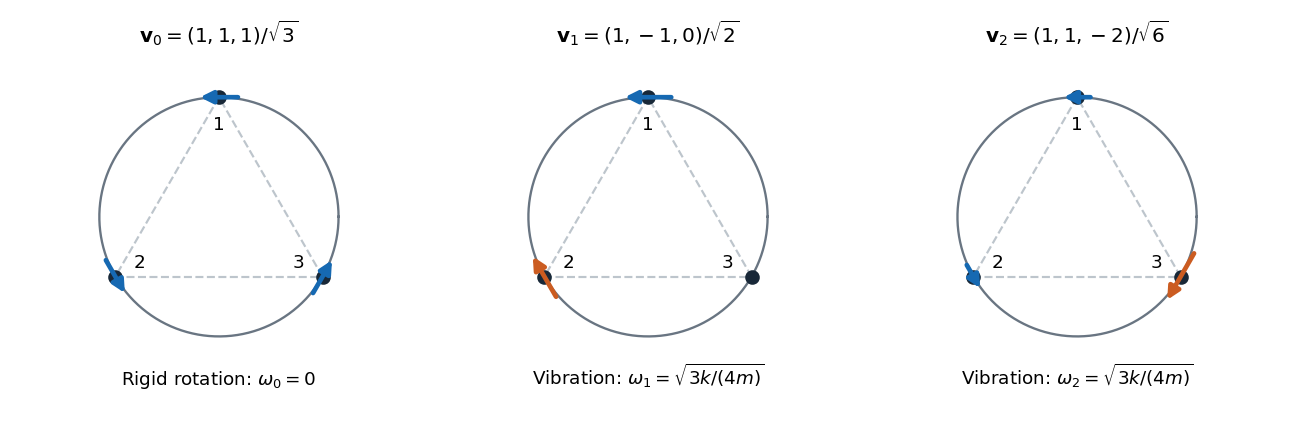
Label the equal masses and the mass by , in cyclic order. Let their equilibrium angles be , with angular displacements . Because the hoop has unit radius, its three arc lengths areThe springs themselves are constrained to the hoop, so these are arc lengths. If their common natural length is , Hooke's law gives . Since the arc lengths have fixed sum , all terms linear in the cancel. Dropping the constant,Thus the unspecified common natural length does not affect the motion. The mass and restoring matrices in the generalized eigenvalue problem areExchange of the two equal masses separates symmetric and antisymmetric normal modes. Direct multiplication gives the complete setThe first is rigid rotation of all three beads: every arc length stays fixed, giving a zero mode. In the second, the equal masses move oppositely while the heavy bead stays fixed; the net force on that bead cancels. In the third, the equal masses move together and the heavy bead moves oppositely with equal angular amplitude. Both nonzero normal modes have zero total angular momentum. These are the normal modes of three beads connected by springs on a circular hoop with .
Use the mode shapes from part (b), and put . The initial velocity decomposes asThere is no antisymmetric component because the initial state treats the equal masses identically. Initial displacements are zero, so the zero mode contributes a linear drift and the nonzero normal mode contributes a sine:In terms of actual angular positions,The conserved angular momentum is initially and the total moment of inertia is , so the common angular velocity must be , agreeing with the drift. The relative displacements remain of order , even when the common angle becomes large. Hence small preserves the cyclic ordering and small spring extensions at arbitrarily late times. In the ideal arc-spring model the displayed energies are exactly quadratic in the relative angles, so this motion remains exact while that ordering persists.
For a breathing displacement take . Every spring has equilibrium length in the given length units, so its linear extension is . At the vertex , the four adjacent equilibrium vertices sum to zero. Therefore the spring force there isIt remains radial and proportional to the original displacement at every vertex, proving that this symmetric displacement is a normal mode. Newton's second law givesThe first is angular frequency and the second is cycles per unit time. For in and in , these have units and respectively. An energy check gives and , leading to the same ratio .
Write . The characteristic determinant of the tridiagonal matrix isThe three values of are , and . Therefore the normal mode frequencies and convenient Euclidean-normalized generalized eigenvectors areEach pair satisfies . The first mode moves all masses in phase, the middle mode leaves the central mass fixed, and the last has the central mass moving opposite to the outer masses. All squared frequencies are positive, consistent with the positive spring potential and fixed endpoints.
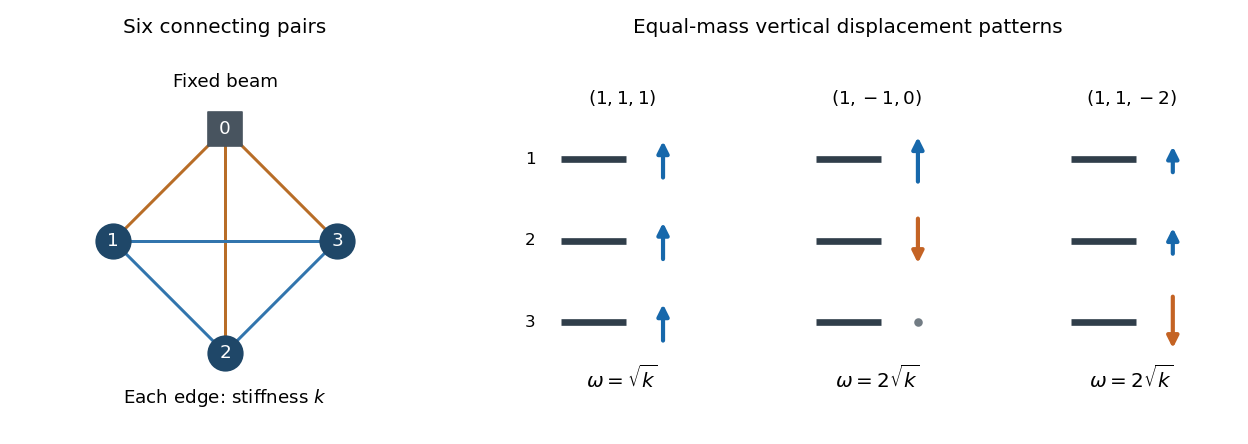
The diagram has a connection between every pair of indices , including the fixed beam . Two parallel strings, each with spring constant , together have energy . Thus the printed is the energy of a connecting pair; calling it the energy of one string would introduce a factor-of-two discrepancy.
Take vertical coordinates positive upwards, with fixed. Each bar has gravitational potential energy and kinetic energy . The Lagrangian isDifferentiating gives the Euler-Lagrange equationsEquivalently, with , the spring term is . Gravity changes the equilibrium but not the stiffness matrix. Subtracting a static equilibrium and writing gives the normal mode systemThis is the spring system underlying normal modes of an anchored complete spring graph.

For two bars, after subtracting the gravitational equilibrium,A normal mode requires the generalized eigenvalue problem . With ,Thus, for ,Both squared angular frequencies are positive. A corresponding eigenvector is , from the first row of the matrix equation.
For three unit masses, andThe uniform vector has , whereas every vector with coordinate sum zero is annihilated by . One orthonormal choice of normal modes is thereforeIf is retained from (b), the angular frequencies are . The equal upper frequencies follow from degenerate normal modes from permutation symmetry: the stiffness is scalar on the two-dimensional sum-zero subspace. In the uniform mode the inter-bar strings do not change length, but all three beam connections stretch, giving the nonzero lower frequency. The motion is an arbitrary sine-cosine superposition of these modes about the gravitational equilibrium.
For the stated geometry and numerical masses, the inertia and stiffness matrices areA normal mode requires . Writing , its characteristic equation isAt the claimed , this determinant is . Hence the printed claim that is a normal frequency is false for the stated data, and there is no corresponding nonzero normal mode.
The complete geometry-based answer is obtained from the three positive roots :An exact closed form for the squared angular frequencies isThey are approximately , and , respectively. For any of these roots, a corresponding eigenvector can be chosen asThe last two rows of give this expression directly; the first is the characteristic equation. These three modes span all motion, with arbitrary sine and cosine amplitudes. Positivity of and of the spring potential energy ensures that all squared angular frequencies are positive.
If instead one takes the PDF's printed as a stipulated inertia, then andThe corresponding angular frequencies are approximatelyThe same formula for applies, because its derivation used only the second and third rows. Here the determinant at is , so following the printed inertia does not repair the frequency claim. The PDF therefore needs a further correction to its numerical data or asserted frequency; the intended correction cannot be inferred uniquely.
Put . Differentiating the spring length givesThe springs are unextended at equilibrium, so the quadratic potential energy contains only the squares of these first-order extensions:The linearized Euler-Lagrange equations are thereforeThe stiffness matrix is . Its eigenvector has zero eigenvalue, and every vector whose components sum to zero has eigenvalue . One convenient orthonormal set of normal modes isAny orthonormal basis of the sum-zero plane is equally valid for the two degenerate normal modes. The general small motion isThe linear drift in the zero mode describes a slow uniform rotation. These are angular frequencies; the ordinary frequencies of the two vibrational modes are .