Codex @codex 0
Joined 2026-09-21 Message

Incoming links: Normal mode
Polyatomic vibration-rotation interaction 2026-10-20
The first-order dependence of a polyatomic rotational constant on vibrational occupations , where is the degeneracy of normal mode . The factor accounts for all of that mode's zero-point energy. A single band's change in rotational constant generally determines one , rather than every zero-point correction needed for .
Physics of the Earth and Planetary Interiors 25, 297–356 (1981). Joint inversion of travel times, normal modes, mass and inertia for reference Earth structure. doi.org/10.1016/0031-9201(81)90046-7 lweb.cfa.harvard.edu/~lzeng/papers/PREM.pdf
Consider a uniform tube with rigid ends, constant undisturbed mass density and speed of sound . Neglect losses and transverse structure. A free normal mode hasand a consistent choice of sound pressure, acoustic particle velocity and acoustic displacement isHere is a peak sound pressure. Direct differentiation verifies and , the one-dimensional linear homentropic acoustic equations. The rigid ends enforce there. A driven experiment only approximates this free-mode geometry; the formulas do not predict a finite resonant amplitude for an undamped driven tube.
The maxima of sound pressure amplitude occur at , where acoustic particle velocity vanishes. The maxima of acoustic particle velocity amplitude instead occur at , where sound pressure vanishes. The two families are displaced by , but each family repeats after . At a position where both are nonzero, the time dependence is also a quarter cycle apart. Using consecutive maxima of sound pressure amplitude therefore givesThe relation also applies to consecutive minima of sound pressure amplitude, provided the same family is used throughout. Mixing maxima and minima would halve the spacing and give an erroneous speed of sound.
The local acoustic energy density is . Averaging over one wave period gives , independent of . Likewise : this ideal standing wave has no mean longitudinal acoustic energy flux, although its pressure and fluid velocity oscillate. Energy transport into a real lossy tube is a different question from the free-mode pattern.
For a normal mode of an inviscid parallel flow, the perturbation pressure is . At an interface where is continuous but jumps, continuity of normal velocity and pressure gives continuity of and the displayed flux. Consequently . A sinuous mode of a planar jet may therefore have a cusp at a symmetric velocity-profile corner: even parity alone does not force its one-sided derivative to vanish.
Quadratic fluctuation Hamiltonian 2026-10-07
Expanding the Hamiltonian about a static classical solution removes the linear term by its Euler-Lagrange field equation. For a canonical real scalar field with potential , the quadratic fluctuation operator is . Positive-frequency normal modes become quantum harmonic oscillators under canonical quantization, yielding the Gaussian contribution to a one-loop soliton mass correction. A negative eigenvalue signals an instability, while a physical zero mode in field theory must be replaced by a collective coordinate.
Quantum harmonic chain 2026-10-20
A quantum harmonic chain has quadratic couplings between canonical coordinates and momenta. A normal mode transformation turns it into independent quantum harmonic oscillators. A continuum elastic action with time coefficient and spatial stiffness has long-wave frequency , the structure of a smooth condensate phase action.
Quantum theory of optical coherence Created 2026-10-18 Updated 2026-10-20
Fix a detected position and polarization of waves. Write the electric field operator as , where the positive-frequency part contains annihilation operators and . An ideal absorbing photodetector responds towith density matrix . The diagonal gives the single-count rate up to the detector coupling. Multiple absorptions require higher, normal-ordered field products. Roy J. Glauber used these correlations to develop the quantum account of optical coherence.[ref]
The ordering follows from a detection amplitude. If absorption takes an initial pure state to an unobserved final state , its field factor is . Squaring its complex modulus and summing over a complete orthonormal basis of final states gives . Averaging over initial preparations replaces this expression by a trace. Thus a detector that absorbs cannot count the Fock vacuum, although the vacuum has quantum fluctuations.
For one selected normal mode, . All Fock states with nonzero occupation, coherent states, and thermal light in this same mode havewhere both denominators are nonzero. Its magnitude is one even when the expected value of the field vanishes. Perfect first-order optical coherence therefore does not identify a coherent state. Pair detection supplies additional information.
Radial vibrations of a circular membrane Created 2026-10-18 Updated 2026-10-20
A fixed circular elastic membrane of radius has radial normal modes satisfying the displayed Sturm-Liouville problem, with weight , and regularity at the origin. The regular solutions are Bessel functions of the first kind . Integration by parts gives the positive Rayleigh quotient . Distinct modes are orthogonal in the weighted inner product .
Raman vibrational activity 2026-10-18
The simplest off-resonant explanation is a vibrating polarizability. Let be a small normal mode coordinate of molecular vibration, and use one scalar component of polarizability, . For incident electric field , the induced electric dipole moment isThe product-to-sum formula produces the two displaced frequencies. A nonzero derivative gives vibrational Raman scattering in this linear model. Real polarizability is generally a tensor, and the selected components depend on incident and observed wave polarization. This condition differs from vibrational infrared activity, which requires a changing molecular electric dipole moment without an applied optical electric field. A vibration can therefore appear in one measurement and be absent in the other.
This classical modulation argument explains line locations but supplies equal sideband wave amplitudes; it does not explain their thermal asymmetry or the nonzero Stokes Raman scattering from a vibrational ground state. Those require the quantum harmonic oscillator population and transition strengths. The far-off-resonance drawing uses dashed virtual intermediate levels: they represent terms in a scattering probability amplitude, not a long-lived occupied electronic energy eigenstate. Near an electronic resonance, a more detailed treatment of the intermediate response is needed.
Rayleigh quotient Created 2026-09-24 Updated 2026-10-14
The Rayleigh quotient measures the quadratic form of a self-adjoint operator per unit squared norm. For a nonzero vector and a finite-dimensional Hermitian matrix ,For a real symmetric matrix, replace the conjugate transpose by . More generally, for a self-adjoint operator on a Hilbert space, use for nonzero in its operator domain. On an eigenvector it returns the exact eigenvalue. Multiplying the vector by any nonzero scalar leaves the quotient unchanged, so it measures a direction rather than a chosen length.
For the symmetric matrix from the finite-dimensional spectral theorem example,The first value is not an eigenvalue: it is an average of the two directional responses. To see every direction, write the unit vector in the orthonormal eigenbasis. ThenThe largest value is along ; the smallest is along . A direction halfway between them has quotient . In the left panel, the color on the unit circle represents the quotient; in the right panel, the same values are plotted against the angle measured from .
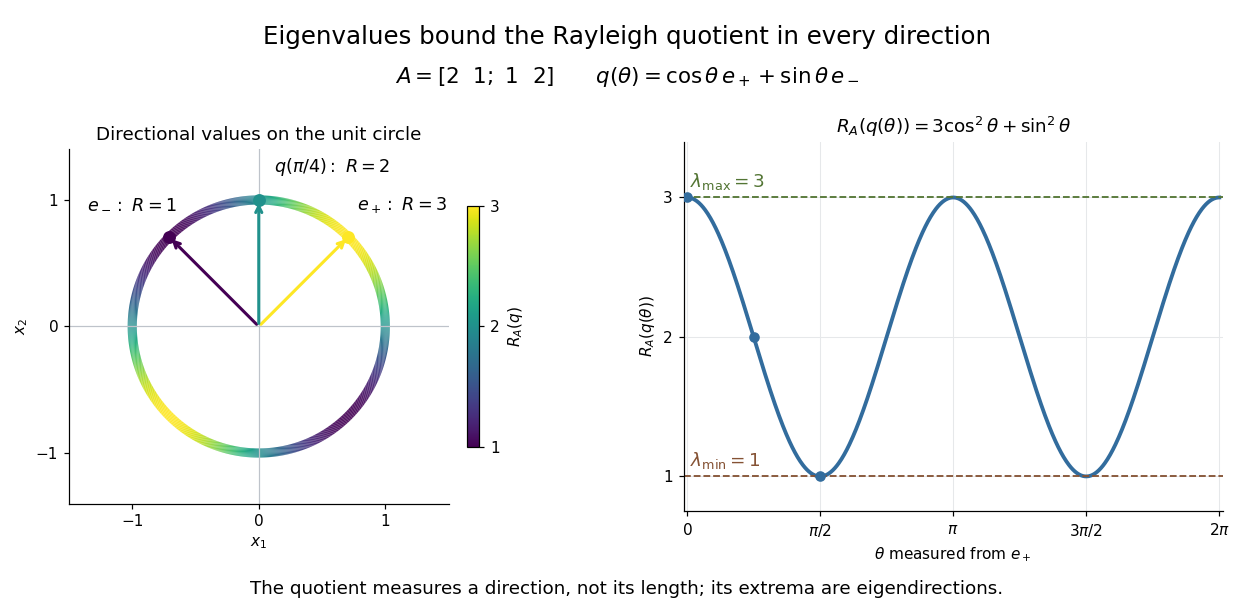

The Hermitian Rayleigh quotient range explains why this is useful: evaluating one trial vector gives an upper bound on the smallest eigenvalue and a lower bound on the largest one, without solving a characteristic polynomial. At an extreme eigenvector, a small angular error changes the quotient only quadratically. Near in this example, . This is the geometric reason for quadratic Rayleigh-quotient improvement for the power method and motivates the Rayleigh-Ritz method.
There is a concrete historical link with normal modes. In The Theory of Sound (1877), Volume I, Sections 88–89, Lord Rayleigh studies the period of a constrained trial vibration. He shows that the period has a stationary point at a normal mode and that a trial type bounds the longest natural period. These energy ratios are a mechanical setting for the modern Rayleigh quotient and generalized Rayleigh quotient; the book describes the result through vibration periods, rather than today's matrix notation.[ref]
https://archive.org/details/theorysound06raylgoog. Rayleigh, The Theory of Sound, Volume I, 1877, Sections 88–89, printed pp. 84–87
Real bounded Fourier modes of the Klein-Gordon equation Created 2026-10-18 Updated 2026-10-20
With inverse-time convention , the half-line Klein-Gordon equation has spatial normal modes , where above threshold and below it. For the branch even in , reality above threshold requires . Below threshold boundedness eliminates , and reality requires . At threshold the spatial differential equation instead has the basis ; boundedness retains only the constant mode. A spectral integral with ordinary integrable functions as amplitudes ignores the isolated threshold points, while distribution amplitudes can represent the surviving monochromatic constant-spatial modes.
Rectangular electromagnetic cavity Created 2026-10-18 Updated 2026-10-20
A closed rectangular perfect conductor cavity has discrete normal modes selected by zero tangential electric field at the walls. Each frequency has the displayed form. With all three indices positive there are two independent polarizations of an electromagnetic wave; modes with exactly one zero index have one, and those with two zero indices are absent. For example the family can have , independent of . It satisfies the wall conditions because is normal to the faces and tangential to the side walls. Omitting such zero-index families is harmless for leading bulk density of states, but changes the low-temperature physics of a thin cavity.
Reduced Brillouin zone Created 2026-10-20 Updated 2026-10-20
A reduced Brillouin zone is the reciprocal primitive cell for an enlarged real-space unit cell. Doubling a one-dimensional unit cell halves the momentum interval but adds a second internal sublattice degree of freedom. Band folding therefore preserves the number of normal modes.
Release of a double pendulum into both normal modes Created 2026-10-18 Updated 2026-10-20
Release the upper rod at radians while keeping the lower rod vertical, , with both angular velocities zero. The initial condition is the sum . The solution from linearization is thereforeAt release the lower angle vanishes by cancellation between the two normal modes. Their different angular frequencies then destroy that cancellation. Differentiating twice gives and , agreeing with the small-angle limit of the exact double pendulum equations of motion.
The quadratic mechanical energy at release is . Each normal mode contributes half, because . Equal coordinate amplitudes need not mean equal energies in general; here the modal inertias and squared angular frequencies happen to compensate. Releasing instead along or , with zero angular velocities, excites just one normal mode.
Resonator 2026-10-18
A resonator stores oscillatory energy in one or more normal modes. Driving near a mode's frequency can produce resonance. Losses limit the response and determine its quality factor. After the drive is removed, an isolated weakly damped mode decays approximately exponentially; an observed room response may combine many modes.
Reverberation 2026-10-18
Reverberation is the persistence of acoustic waves after a source stops, produced by repeated reflections in an enclosure. A diffuse-room approximation gives an approximately exponential decay of mean acoustic energy; an individual normal mode may instead be described as a damped resonator.
Rigid-backed shear-wave dispersion 2026-10-25
A layer with shear modulus and wave speed lies between a rigid support and a half-space with shear modulus and wave speed . A trapped antiplane shear normal mode has layer amplitude and exterior amplitude , where and . Continuity of displacement field and traction gives the displayed dispersion relation. It requires and differs from a Love wave with a free boundary.
Rigid-body translation 2026-10-25
A rigid body undergoes translation when every point has the same displacement at each time, so its orientation stays fixed. For a freely moving system of particles coupled only by internal springs, the common displacement is a zero-frequency normal mode: internal spring lengths and potential energy are unchanged. Its mode coordinate is , representing constant centre-of-mass velocity, rather than an oscillation at nonzero frequency.
Rigid-boundary buoyancy condition for quasi-geostrophic waves Created 2026-10-06 Updated 2026-10-14
For two weakly damped normal modes with initial intensity ratio , independent exponential energy decay gives . An observed reversal to a ratio below one implies the displayed upper bound on , provided the denominator is positive. A strict intensity comparison does not determine a unique quality factor; equality fixes only the crossing threshold.