By the spectral theorem for real symmetric matrices, choose an orthonormal eigenbasis with . If , thenThus every point of the ellipsoid has distance at least from the origin. Equality holds precisely whenBoth coefficients are strictly positive, so . The surface equation then gives . ThereforeExactly two points attain the minimum. The strict ordering makes the largest-eigenvalue eigenspace one-dimensional; this is the equality case in nearest points to the origin on a positive-definite ellipsoid.
A cyclic group is a group generated by a single element: there is such that every element is for some integer . For a finite group of prime order , choose . Its cyclic subgroup has order dividing by Lagrange's theorem, and its order is greater than one. Hence , and . Thus every group of prime order is cyclic.
A group homomorphism from is determined by , since . Its image generator must satisfy , so its order of a group element divides . As an element of its order also divides . These integers are coprime, so the only possible order is one. Thus , andThis map is indeed a group homomorphism, so there is exactly one, the trivial homomorphism.
Let . The time equations and the dot product differentiation rule give the local identityThe divergence of a cross product isCombining them yields . On a fixed bounded region with a boundary regular enough for the divergence theorem, differentiating under the integral and applying that theorem givesHere is the outward unit normal, so the sign expresses loss of the interior quadratic quantity by outward flux. No vanishing-boundary assumption is required.
For the unit-speed curve, the unit tangent vector, curvature of a space curve, principal normal vector and binormal vector areDifferentiating gives , so form a positively oriented orthonormal basis. The hypothesis makes the principal normal vector well-defined.
To determine the sign of the torsion of a space curve without relying on a pictorial handedness convention, take , , and use the unit-speed circular helixWriting , direct differentiation gives its Frenet frame:ConsequentlyAt the marked point is , with , , and . For , points opposite to and the torsion of a space curve is positive. Replacing by reflects the circular helix across the horizontal plane and makes the torsion of a space curve negative; then points in the same direction as . The direction of increasing is fixed in both panels.
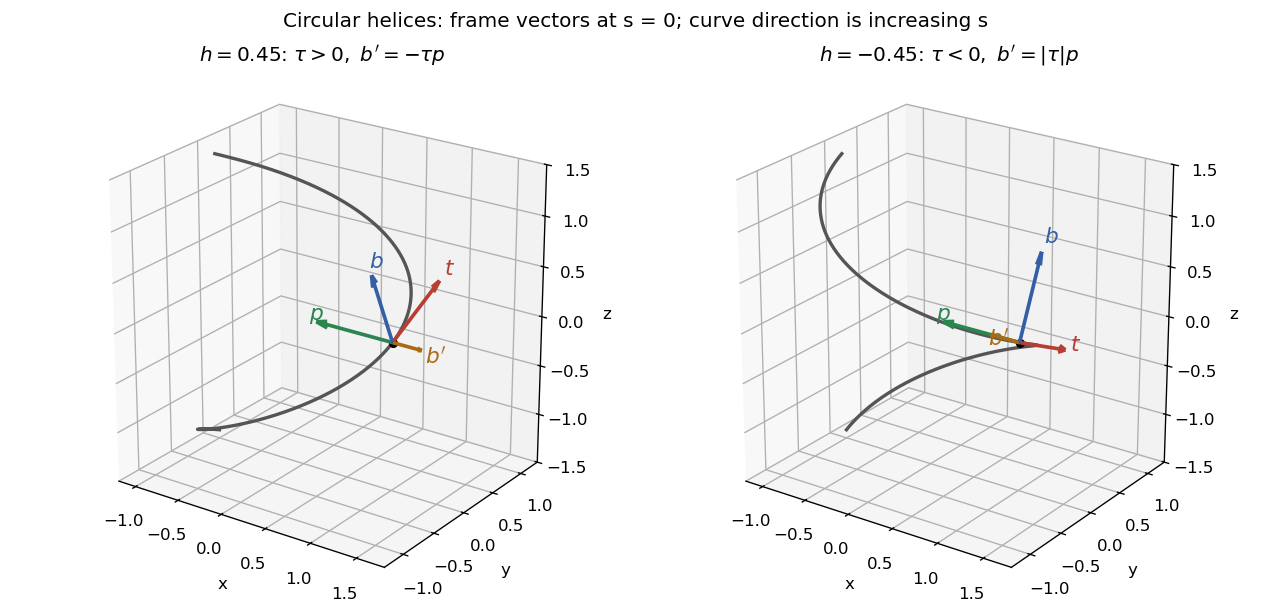
Unit-speed circular helices of opposite torsion, with tangent, principal normal, binormal and binormal derivative at the marked point
. Details. 
A group action is a map from to satisfying and . Define the orbit of a group action and the stabilizer subgroup . The latter is a subgroup: the identity fixes , products of elements fixing fix , and inverses do too.
For finite , the orbit-stabilizer theorem statesTo prove it, send a left coset to . If , then and . Conversely, equality of the two images implies , hence equality of the cosets. Every point of the orbit of a group action has such a preimage. This is therefore a bijection, and each coset has elements, proving the formula.
For the action on subgroups, conjugation maps a subgroup to a subgroup because it preserves products and inverses. Furthermore andThus this is the conjugation action. The stabilizer subgroup of is its normalizer , and since each conjugates onto itself. Hence the number of distinct conjugate subgroups isNow suppose is proper. Put and list the distinct conjugate subgroups as . Each has elements and all contain the same identity. Counting the identity just once, even if other elements overlap, givesThus some element of lies in no conjugate of . This proves conjugates of a proper subgroup do not cover a finite group by an explicit count; it does not require the conjugates to intersect only at the identity.
Represent the Riemann sphere by the complex projective line, with finite represented by and infinity by . An invertible matrix acts by , giving the stated fractional map on finite points. Applying and then is exactly matrix multiplication , including at poles and infinity. Thereforeso is a group homomorphism from the special linear group to the Möbius group.
Every Möbius transformation has an invertible complex matrix representative . Choose with . Such a nonzero square root exists in , and has determinant one while representing the same projective map. This proves surjectivity. If the map is the identity, fixing zero and infinity forces , and fixing one forces . The determinant-one condition gives . Conversely both scalar matrices and act trivially. HenceFor the normal forms, use the fact that a complex matrix has a Jordan normal form: either it is diagonalizable or it has one nontrivial Jordan block. For a determinant-one representative, distinct eigenvalues are . Diagonalizing gives , whose projective action is . Distinctness means , so is neither zero nor one.
If the eigenvalue is repeated, the determinant condition gives . A diagonalizable representative would be and would give the identity, excluded here. A nontrivial Jordan block is similar to , giving . Any invertible conjugating matrix gives a Möbius transformation; rescaling it to determinant one does not change that map. Thus these matrix similarities are genuine conjugacies in the Möbius group, proving the requested Möbius conjugacy normal forms.
Conjugacy preserves fixed points bijectively. A nonidentity scaling has exactly the two fixed points zero and infinity, while either translation has exactly one, infinity. The identity fixes every point. This proves all three possibilities and excludes any further finite number of fixed points.
Finally, suppose , with and . Then for every finite in the topology of the Riemann sphere; infinity remains infinity. Since is continuous on that sphere,This is iteration of a one-fixed-point Möbius transformation. The limiting statement includes the unique fixed point itself and uses spherical convergence, which also handles intermediate iterates equal to infinity.
The identity belongs to the center of a group. If are central, then for every ,so the center is a subgroup. For a central , for every , giving . Thus the center is a normal subgroup.
Write a matrix of the Heisenberg group as . Direct matrix multiplication and inversion giveThe identity is and each matrix has determinant one, so these formulas show closure under products and inverses inside . Hence is a subgroup.
The two products and differ only in their upper-right entries, by . Commutation with every therefore requires for all real . Setting forces ; setting forces . These conditions are also sufficient. ThusDefine the surjective group homomorphism by . The multiplication formula gives , and its kernel of a group homomorphism is precisely . The first isomorphism theorem yieldsThis center quotient of the real Heisenberg group can also be checked directly: two elements have the same coordinates exactly when they differ by multiplication by a central element, and quotient multiplication adds these coordinates.
First is a linear subspace. To prove it is nonzero, use orthogonality and :Hence . If then also implies . For ,so is invariant. If had dimension two, its one-dimensional orthogonal complement would be invariant and would act there as a scalar . The determinant would be , so , forcing . Dimension three also forces . Both contradict the hypothesis. ConsequentlyChoose an orthonormal basis beginning with a unit vector in and followed by a basis of . In this basis the orthogonal matrix has block formThe first column of is some . Its perpendicular unit second column with positive orientation must be . Thus the restriction is the plane rotationTrace invariance gives , provingA Euclidean reflection in fixes that plane pointwise and reverses , so it occurs exactly when . This is equivalent to , hence exactly to . Finally,This exhibits the three-dimensional improper orthogonal transformation as a rotation about the axis composed with Euclidean reflection in .
Assume sufficient smoothness and a regular boundary for the integrations below, with outward. Put , so on . Expanding the Dirichlet energy givesBy Green's first identity, the middle integral isThus the Dirichlet principle follows with an explicit remainder:Equality means is constant on each connected component; its zero boundary value forces that constant to be zero.
Now let solve the heat equation and set . Differentiation followed by Green's first identity givesUnder time-independent Dirichlet boundary conditions, on , while in . ThereforeIf equality holds at a particular time, continuity makes throughout at that time. Its boundary values are still , so uniqueness of the Dirichlet problem implies . Conversely has and gives equality. This proves the full equality criterion for Dirichlet energy dissipation for the heat equation.
For the dynamic boundary condition for the heat equation, substitute directly into the boundary term. The interior equation is unchanged, soThis is Dirichlet energy dissipation with a dynamic heat boundary condition. It remains valid when vanishes, because no division by is used. The last part preserves energy monotonicity; its stationary states need not have the earlier prescribed Dirichlet data. For example, with strictly positive on a connected boundary, a stationary harmonic state has zero outward normal derivative and is constant, as follows by applying Green's first identity to that state itself.
For an oriented piecewise smooth surface and a continuously differentiable vector field, Stokes theorem stateswhere the boundary orientation is induced by through the right-hand rule. Choose the upward orientation of the elliptic paraboloid. Its band has cylindrical radius , and a parametrization isIts oriented surface element and scalar area element areThe requested sketch shows the open band, not a capped solid.
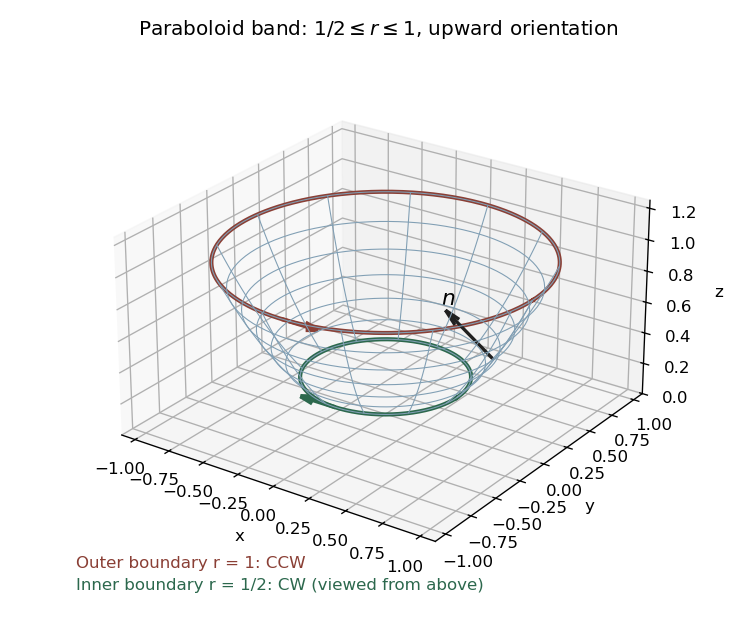
Upward-oriented annular paraboloid band, with counterclockwise outer boundary and clockwise inner boundary
. Details. 
For the specified vector field, direct differentiation gives . HenceTo check this by Stokes theorem, parametrize a counterclockwise circle of radius at height by . Along it , andUsing gives . The induced outer circle is counterclockwise as viewed from above, and the inner circle is clockwise. ThereforeThis verifies the direct surface integral and the Stokes flux through an annular paraboloid. Reversing the chosen surface orientation reverses the final sign.
At a critical point of a twice continuously differentiable real function, and the Taylor expansion isThe real symmetric Hessian matrix has an orthonormal eigenbasis, so writing gives . If every eigenvalue is positive, this quadratic form is at least , and the remainder cannot change its sign for sufficiently small nonzero . Thus is a strict local minimum. If every eigenvalue is negative, the analogous argument gives a strict local maximum. If positive and negative eigenvalues both occur, displacement along the corresponding eigenvectors gives values above and below , so is a saddle point of a scalar function.
The second-derivative test can be inconclusive when the Hessian matrix is singular and semidefinite: higher-order terms along directions in the kernel of a linear map matter. For example and have the same Hessian at zero, but the first has a strict minimum and the second a saddle point of a scalar function. A zero eigenvalue does not prevent a saddle conclusion if other eigenvalues already have both signs.
For the given function write . Its first derivatives areThe origin is a critical point for every real , withIts eigenvalues are , so it is always a saddle point of a scalar function. If one coordinate at a critical point is zero, the other must also be zero. If both are nonzero, the derivative equations force , possible only for . Hence for the origin is the only critical point.
For there are four additional critical points,At such a point,Thus the two equal-sign points are strict maxima, and the two opposite-sign points are strict minima. They are global: implieswhere the last maximum occurs at and equality also requires .
As , the four nonzero critical points have distance from the origin and escape to infinity, rather than merging with the origin. Their values diverge as . As from below there are no extra critical points, while the origin stays a saddle throughout. This is critical points escaping to infinity in a Gaussian-weighted bilinear function.
The substitution is nonsingular in the interior , , . Its inverse isThus is equivalent to , while is equivalent to . Positivity gives the full transformed domainThe forward Jacobian determinant isTherefore . The boundary faces where the formula fails have measure zero. The change of variables formula givesThe integrand is nonnegative, so Tonelli's theorem permits reordering the integration even before convergence has been established. Integrating first in , then in , givesThe assumptions make all three integrals of exponential functions converge. Equivalently, the ordered-cone substitution by products and ratios can be followed by the increment variables , , , all independently positive and with Jacobian determinant one; the exponent then separates into three linear terms with coefficients , and .
Articles by others on the same topic
There are currently no matching articles.