For a finite group and a subgroup , Lagrange's theorem statesIn particular divides : the left cosets partition , and multiplication by a representative is a bijection from to each coset. Apply this to the cyclic subgroup . Its size is the order of a group element , so every element order divides .
Under the square condition, every group element is its own inverse element. Consequentlyfor all . This proves that a group of exponent two is abelian, including the trivial group.
For the fourth-power condition a counterexample to commutativity is the quaternion groupHere and . Thus its six elements outside have order of a group element four, while and have orders one and two. All fourth powers are the identity, yet .
A permutation cycle sends to , each successive listed point to the next, and to , fixing every unlisted point. Its length is . For any permutation ,Thus conjugate group elements in the symmetric group have the same cycle length. Conversely, two cycles of the same length are conjugate: send their entries, in cyclic order, to one another and extend this bijection arbitrarily to the unused points. Length-one cycles represent the identity and cause no exception to this conclusion.
An odd-length permutation cycle is an even permutation, since its sign is . Let be such cycles on points and choose with . If is odd, let be the transposition of the two points unused by the listed cycle . Then , and is even withHence all the -cycles are conjugate within . The two spare letters supply the parity correction; they are the reason the same argument need not work with only one spare letter.
In the answer is no. For example, and are conjugated by the odd transposition in . The centralizer of in is exactly its order-three cyclic subgroup: a commuting permutation fixes the unique fixed point and acts as a power of the cycle on the other three points. All these centralizing elements are even. Every other conjugating element differs from by a centralizing element, so it is also odd. There is no conjugator in . Equivalently, the eight three-cycles split into two conjugacy classes of size , illustrating the alternating conjugacy class splitting criterion.
A differential one-form is an exact differential if there is a differentiable function with and , so the form equals . For continuously differentiable , equality of mixed partial derivatives gives the necessary conditionA local differential condition need not by itself give a global potential on a domain with holes; no such issue arises for the explicit primitives here.
For the first form, and direct differentiation givesFor the second, but . These are not equal on any nonempty open subset of the plane, so that form is not an exact differential. Nevertheless,Thus one suitable pair is , . This factorization is smooth even at . On regions where , its reciprocal factor is an integrating factor which turns the original form into .
A Cartesian second-rank tensor is an isotropic tensor if its components are unchanged under every proper rotation matrix :The Kronecker delta is isotropic because , the orthogonality relation .
No symmetry of needs to be assumed. A half-turn about the first axis has matrix ; invariance under it forces to vanish. A half-turn about the second axis additionally kills and . Thus . Each half-turn is the square of an allowed quarter-turn. A quarter-turn about the third axis interchanges , so they are equal. A quarter-turn about the second axis interchanges , so all three are equal. Consequently the complete family of isotropic second-rank tensors isConversely, every member of this family is invariant because .
For a group action of on , let be the stabilizer subgroup of , and its group orbit. The orbit-stabilizer theorem is the bijectionIt is well defined because elements in the same left coset differ by an element fixing . Conversely, implies , so the cosets coincide. Surjectivity is the definition of the group orbit. For a finite group, counting the cosets givesTo obtain Cayley theorem, let act on its own underlying set by left multiplication. The map is a permutation, with inverse , and . If is the identity permutation, evaluating at the identity element gives . Thus is an injective group homomorphism. When , labeling this set by letters identifies its image with a subgroup of . Every finite group embeds in the symmetric group on its own elements.
Choose with stabilizer subgroup . Transitivity means that every point is for some . Its stabilizer subgroup issince exactly when . The kernel of a group homomorphism arising from the group action is the set of elements fixing every point, henceThis is the subgroup core. A group homomorphism is injective precisely when its kernel is trivial. The desired equivalence is therefore exactly the equivalence between a trivial subgroup core and a faithful group action. No finiteness assumption is required in this part.
Every nontrivial subgroup of the quaternion group contains . Indeed, it either contains directly, or contains one of , whose square is .
Suppose acts on an -point set with . Every group orbit has size at most . By the orbit-stabilizer theorem, each point's stabilizer subgroup has order , so it contains . Consequently fixes every point, and the group action is not faithful. An embedding in would give a faithful group action on letters, which is impossible. ThusThe left-regular group action on eight points is faithful by Cayley theorem, so the minimal faithful permutation degree of the quaternion group is exactly eight. The proof allows multiple group orbits; restricting only to transitive actions would not suffice.
Write a member of the special linear group as with . Its Möbius transformation is , with the usual values at a pole and at infinity. For nonreal ,This follows by multiplying numerator and denominator by . Thus the sign of the imaginary part is preserved, while the extended real line is preserved as a set.
Fixing zero requires . Therefore its stabilizer subgroup and group orbit areTranslations send zero to each finite real point, and sends it to infinity.
For , comparing real and imaginary parts gives and , with . Exactly the same conditions follow from . HenceFor any and , the upper triangular matrixsends to and to . Therefore the two group orbits are the open complex upper half-plane and the open lower half-plane respectively. Along with the extended real line they exhaust the Riemann sphere, so there are exactly three orbits, the real determinant-one Möbius orbits.
Every has the form and acts by . Thus is the entire complex upper half-plane, by the same explicit matrices . Given , choose such that . Then fixes , so and . This proves the triangular-rotation factorization of real determinant-one matrices.
For uniqueness, if , then . An upper triangular rotation matrix must have , soThere are consequently exactly two matrix factorizations, and . Restricting the first diagonal entry of to be positive makes the factorization unique. For example, if and , that unique branch isAngles are understood modulo when counting matrices; allowing unrestricted real angle representatives gives infinitely many labels for those same two factorizations.
Use the standard implicit assumption that is prime, so is a finite field. The matrices in question form , the general linear group over a finite field. Products stay in the set because determinants multiply, the identity has determinant one, andhas entries in the finite field and nonzero determinant. Together with associativity this verifies the group axioms. The multiplication of matrices with column vectors is a group action because and .
Let be the order- cyclic subgroup. By the orbit-stabilizer theorem, its group orbits on have size either one or . If is the number of fixed vectors, counting all vectors gives . Since the zero vector is fixed, and hence . There is a nonzero fixed vector .
Extend to a basis . In this basis has matrix . From we get ; in the prime finite field, , so . Since has order , it is not the identity, and . Replace by . Then , and in the new basisThus all the order-p matrices in GL2 over the prime field form one conjugacy class. This proof also works at . Primality is essential to the first assertion: for modulus four, has nonzero determinant but no inverse, so the set defined using merely nonzero determinants would not be a group.
Work with modulo and modulo . By Fermat's little theorem, in , so the factor is independent of the chosen representative of . The proposed multiplication is therefore well defined on the stated Cartesian product. Its two associative bracketings have the same second component:and both have first component . The identity element is , and the two-sided inverse element isThus the multiplication defines the twisted cyclic pair group, of order .
If , multiplication is coordinatewise addition, so the group is abelian. If , then and both and are available; their products in opposite orders are and . They differ. HenceBoth and contain the identity element and are closed under the multiplication and inverses: they are the cyclic groups of orders and respectively. Conjugation gives, with all coordinates reduced in the appropriate modulus,so is a normal subgroup. For , the corresponding calculation isWhen this lies in . Conversely, for , take , , : the second coordinate is , so is not normal. Thus is normal precisely when .
Finally, the projectionis a surjective group homomorphism because the first coordinates add. Its kernel of a group homomorphism is exactly . At , is the only possibility and the first factor is trivial, consistent with every conclusion. No assumption that generates the multiplicative group of the finite field is needed.
For an oriented smooth surface with piecewise smooth, consistently oriented boundary, Stokes theorem givesfor a continuously differentiable vector field defined on a neighborhood of . Choose the upward normal vector here. The surface is an annular band of an elliptic paraboloid, parametrized byUsing as the oriented vector area element givesThe sketch below shows the open band, not a capped solid. Its upper circle has radius one and its lower circle radius one third.
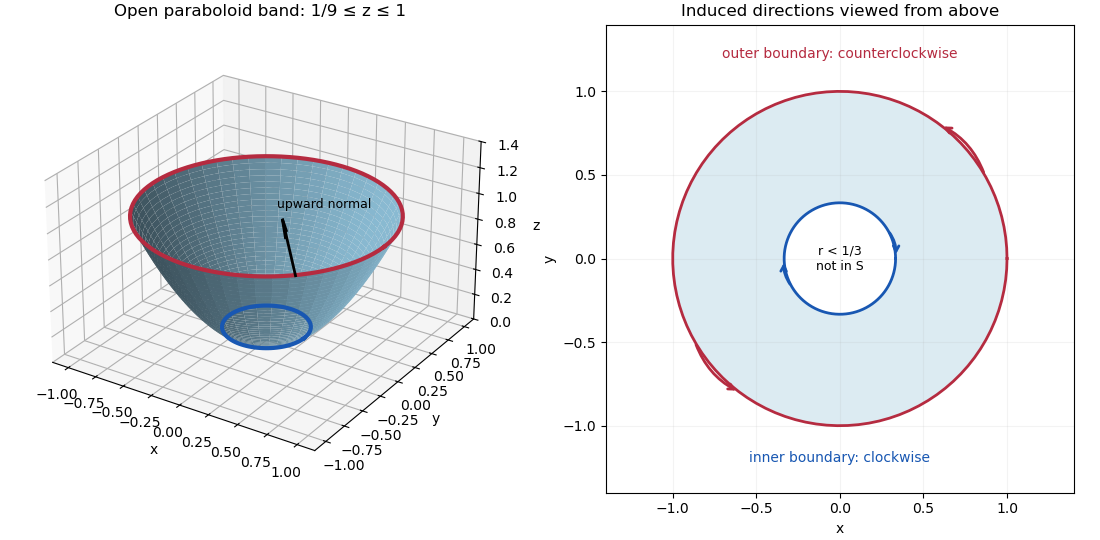
Annular paraboloid with upward normal and opposite induced orientations on the outer and inner boundary circles
. Differentiating the given vector field yieldsThe surface integral is thereforeFor the boundary line integral, the upward normal vector induces counterclockwise traversal of the outer circle and clockwise traversal of the inner circle, as viewed from above. On a circle of radius , parametrized counterclockwise, is constant andSince each fourth power integrates to , the two-circle line integral isconfirming Stokes theorem and the Stokes flux through an annular paraboloid. Reversing the chosen orientation changes both integrals to .
For fixed , andAs runs from zero to one, decreases continuously from one to zero. Thus the map is onto the open unit square and is one-to-one, with smooth inverseIts denominator is positive in the open square. This is a rational square diffeomorphism. Its Jacobian determinant isWriting , the inverse relation gives . ConsequentlyThe second transformation also maps the open unit square bijectively onto the open unit square: for fixed , decreases strictly from one to zero as goes from zero to one, while independently spans . Its positive Jacobian determinant isTo express this in , the composite transformation gives and . Put . Solving these relations givesThe chain rule for Jacobian determinants therefore givesThe requested integrand is exactly the reciprocal of this positive determinant. Apply the change of variables formula using the composite diffeomorphism:Possible singular behavior at the square's boundary does not invalidate the calculation: first integrate over the images of compact interior squares, where all transformations are smooth with nonzero Jacobian determinant, and then increase these domains to the full square. Positivity and monotone convergence theorem justify this limit.
Use the Einstein summation convention and the contraction of two Levi-Civita symbols. For the first cross product term,The last term cancels . Interchanging gives the analogous cancellation with . The surviving terms are by the product rule. This proves the dot-product gradient identityThe proof only requires continuously differentiable vector fields; neither field needs to be an irrotational vector field.
Assume the continuously differentiable irrotational vector field is defined on all of , as in this vector calculus setting. A constructive vector-field potential with the requested negative-gradient convention isSince zero curl means , differentiation under the integral givesThus . This is the Poincare lemma in its straight-line form, and works on any star-shaped set about the integration base point. Zero curl on a domain with holes would not by itself guarantee a global vector-field potential; the full-space hypothesis matters.
For the given field, the second component requires . Integration in gives . Its derivative is , and its derivative is . Comparison with the other two components forces . HenceIts negative gradient is exactly the given field. Because this vector-field potential is smooth everywhere, commutation of mixed partial derivatives gives , verifying irrotationality. All such vector-field potentials differ by a constant on the connected domain.
For two solutions of the Poisson equation with the same Dirichlet boundary condition, let . Then in and on its boundary. By Green's first identity,Thus is constant on each connected component, and the zero boundary values make each constant zero. The Dirichlet solution is unique whenever it exists. This argument requires the regularity needed for the displayed integration by parts; it does not assert existence for arbitrary rough data.
With a Neumann boundary condition, integrating the Poisson equation and using the divergence theorem instead gives the necessary compatibility conditionOn a disconnected region this condition must hold on each connected component separately. If two solutions have the same normal derivative, their difference is harmonic with . The same Green's first identity again forces . Thus Neumann solutions are unique only up to an additive constant on each connected component. Adding a constant preserves both the equation and normal derivative, so uniqueness without a normalization cannot hold. On a connected region, prescribing the mean value removes this one-dimensional freedom.
For a spherically symmetric function in three dimensions, the radial Laplacian is . On , integrate twice to obtainThe region includes the origin. A classical solution must be regular there, so : the term is singular and is not a solution of the stated full-ball problem. Hence the complete family on the ball isThe boundary cases below use this regular family. Allowing punctured-ball solutions would change the problem and the compatibility calculation.
The Dirichlet boundary condition gives , so the unique radial solution isIts radial Laplacian is one, it is smooth at the origin, and its boundary value is zero. The uniqueness result in part (i) shows that this is also the only solution among all classical functions on the ball, not merely among spherically symmetric ones.
Every regular radial solution has outward normal derivative , which is nonzero since . Therefore there is no solution with the stated homogeneous Neumann boundary condition. This also follows without imposing spherical symmetry: the compatibility condition from part (i) would requirewhich is impossible. Thus the full-ball Poisson equation has no classical solution for these boundary data, radial or otherwise. A singular term could formally cancel the derivative at , but would introduce a source at the origin and violate the problem's equation there.
Articles by others on the same topic
There are currently no matching articles.