Source paper: www.whatdotheyknow.com/request/physics_preliminary_examinations/response/1162943/attach/3/Twain.7z?cookie_passthrough=1
The cover dates this paper to 8 September 2014. The held PDF and transcription have legacy filenames ending in
2014, but this is the resit. All questions in both sections are covered. Unlettered marked blocks use editorial lettered scopes; the two separately marked blocks within 8(a) use editorial Roman scopes.The parallel axis theorem relates the moment of inertia about an axis through the centre of mass to that about a parallel axis displaced by perpendicular distance :The reference axis must pass through the centre of mass. To see why, write the displacement from it as in the plane perpendicular to the axes. Expanding gives because .
For a thin planar mass distribution, let be perpendicular axes in its plane and the normal axis through their same intersection. The perpendicular axis theorem statesIndeed, , while and . Their common intersection need not be the centre of mass, but an arbitrary three-dimensional body does not satisfy the planar equality.
Take the square to have uniform surface mass density , and put its centre at . For an in-plane axis through the centre parallel to a side, direct integration givesThe same holds for , and the mixed integral vanishes by reflection symmetry. The squared perpendicular distance to an axis making angle with the axis is . Its integral therefore givesThus a diagonal through opposite corners and its perpendicular through the centre haveThis is the in-plane inertia isotropy of a square plate.
Axis-location qualification: perpendicularity fixes a direction, not a line's position. If the second axis is instead shifted by distance from the centre, the parallel axis theorem gives . A perpendicular through a corner on that diagonal has and hence , a concrete different value satisfying the stated directional description. If “through the corners” means an edge rather than a diagonal, that edge has ; two adjacent edges both have that value. The general displaced-axis formula and these choices make the location convention explicit rather than silently assigning a unique value to an unspecified second axis.
Use two central perpendicular axes in the plate. The perpendicular axis theorem and the preceding moments of inertia giveAlternatively, axes along adjacent edges have moments of inertia each. The normal axis through their shared corner therefore has . It lies a distance from the parallel normal axis through the centre, so the parallel axis theorem yields . This normal central result is independent of the in-plane axis-location ambiguity.
For the attractive central force , with , the potential energy is up to an additive constant. Conservation of angular momentum confines the motion to a plane; writing its magnitude as , the kinetic energy isAt fixed , the radial energy equation becomes , whereThe effective potential combines the true potential energy with the angular-motion contribution. Its negative derivative gives the radial equation ; the first term is the centrifugal contribution arising from elimination of the angular coordinate.
A circular orbit is a fixed radial position at a stationary point:For , , so this is a stable minimum. Small radial disturbances have angular frequency . For , there is no nonzero-radius circular orbit.
In the centre-of-mass frame, the two equal incoming rest masses have opposite momenta and total energy . The squared total four-momentum fixes the composite invariant mass :A change of inertial frame, including going to either particle's rest frame, cannot change this invariant mass. It includes the internal kinetic energy and is generally larger than .
There is a terminology convention worth making explicit. The older “relativistic mass” means frame-dependent total energy divided by . To stop particle 1 requires a boost with Lorentz factor , so the system has total energy in that frame. Under that alternative convention, its relativistic mass would be . This is not its invariant mass; both quantities coincide only when and the incoming particles already have zero relative motion.
Four-momentum conservation fixes the outgoing system's invariant mass to the same . In the rest frame of particle 3, let particle 4 have energy and momentum . Each outgoing particle has rest mass , soConsequentlyHere is the total energy, including rest energy. At the production threshold , it reduces to , as it should. Production is kinematically possible only for . The initial rest mass drops out because the conserved total centre-of-mass energy, rather than the identity of the incoming particles, determines this outgoing relative motion.
Let the source's proper emission period be , and let it approach a stationary observer directly with speed . In the observer's inertial frame, consecutive emissions are separated by through time dilation. The second crest starts nearer the observer, reducing the arrival interval toSince light travels at in each inertial frame, the longitudinal relativistic Doppler effect isRecession reverses the sign of . More generally, if is the angle between the source velocity and the photon propagation direction in the observer's frame, a Lorentz transformation of the photon four-momentum gives .
The common Doppler scaling of spectral-line separations follows because every line receives the same wavelength factor . The supplied wavelengths have rest separation ; the measured separation gives . Defining for recession, inversion givesSource contradiction: a strictly approaching source has and must reduce the wavelength separation below , so no positive approach speed satisfies the stated . For example, approach at gives a separation of . The speed inferred from the numerical data is therefore about receding; retaining the word “approaching” would require a negative signed approach velocity. The two observed wavelengths consistent with the given separation are and .
Measure the vertical displacement downward from the spring's unstretched position. The kinetic energy is , while the spring and gravitational potential energies are and . Thus the Lagrangian isApplying the Euler-Lagrange equation, , givesGravity shifts the equilibrium to . For displacement from that equilibrium, the equation of motion becomes , giving simple harmonic motion with angular frequency . Choosing an upward coordinate instead reverses the gravitational term, but leaves the equilibrium-relative angular frequency unchanged.
Let the initial velocity be and the two final velocities be . In the stated nonrelativistic elastic collision, conservation of momentum and conservation of energy giveSquaring the first equation and comparing it with the second yieldsIf both final velocities are nonzero, their directions are perpendicular. If one is zero, the moving particle retains the initial velocity and a scattering angle for the stationary particle is undefined. This includes the zero-deflection and head-on exchange limits rather than incorrectly assigning a direction to a zero vector. Equal masses and a stationary initial target are essential to the dot-product cancellation.
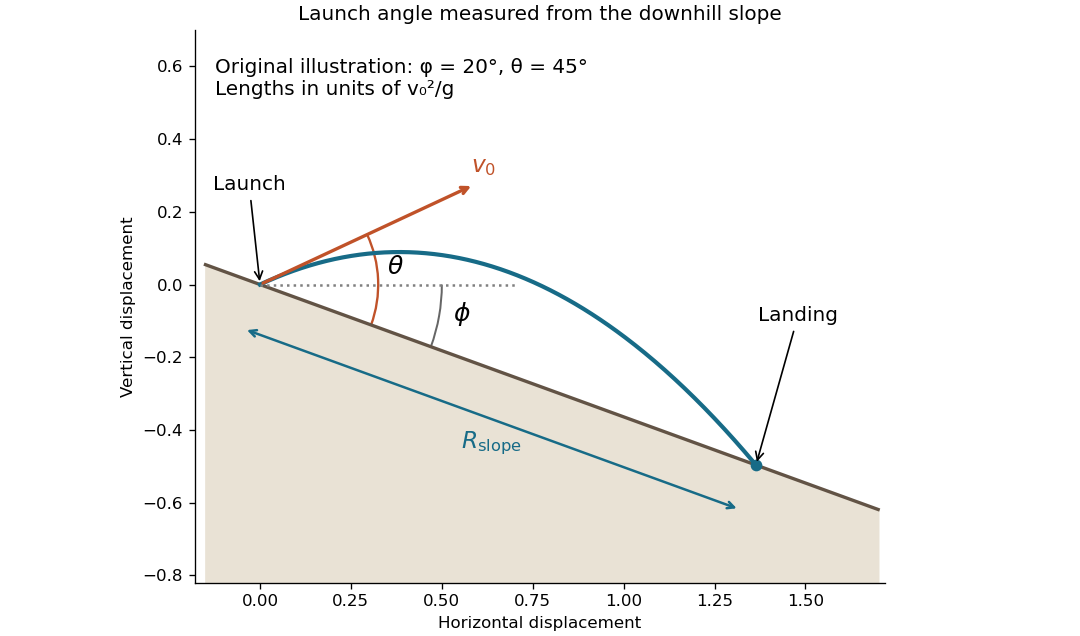
Use coordinates down the inclined plane and along its upward normal, with the launch point as origin. Gravity has components and . For launch angle above the downhill direction,The nonzero root of is . Substituting into and combining the two trigonometric terms gives the distance along the slope:This assumes , , and a downhill landing with , as well as the neglected air resistance. It reduces to the horizontal projectile range at . The angle relative to the horizontal is , which explains the shifted cosine. The original diagram uses stipulated illustrative angles; no examination figure is being reconstructed.

Take from the downward vertical. Under the conventional light-rod idealization, only the endpoint point mass contributes appreciably. Its speed is , and its gravitational potential energy is . ThereforeAn additive constant in the potential energy has no effect on the Euler-Lagrange equation.
Rod-mass qualification: “thin” and “uniform” do not imply negligible mass. If the uniform rod has a finite unspecified mass , its pivot moment of inertia is and its centre of mass lies from the pivot. For a pendulum with a uniform rod and an endpoint mass, the general answer isThis formula covers either convention without inventing a rod mass. A result involving only the specified uses unless an additional relation for is stated.
For the general Lagrangian just obtained, the Euler-Lagrange equation givesUsing the small-angle approximation , this is simple harmonic motion with . ThusThe endpoint mass cancels in the light-rod limit. A concrete comparison shows why the finite rod cannot silently be included: the same specified endpoint with gives , distinct from the negligible-rod result. This is a physical pendulum when the rod contributes, and a simple pendulum in the light-rod limit. Both expressions require small oscillation amplitude; the full sine equation remains nonlinear.
Allowing azimuthal motion makes the endpoint speed satisfy . The light-rod spherical pendulum therefore hasThe azimuth is a cyclic coordinate, since the Lagrangian is independent of it. Its conjugate canonical momentum is the conserved vertical angular momentum:For a finite uniform rod, replace by and by from i. The same azimuthal symmetry then gives .
The Hamiltonian is the Legendre transform of this Lagrangian. With ,There is no explicit time dependence, so . Here also equals the total mechanical energy: the constraint is stationary, the kinetic energy is quadratic in generalized velocities, and gravity is conservative. The apparent singularity of the momentum expression at is a spherical-coordinate singularity; trajectories reaching a pole must be described consistently, and nonzero prevents reaching it at finite energy.
Let denote the proton rest energy and the desired particle's rest energy. For an antiproton of total energy striking a stationary proton, the incoming squared centre-of-mass energy isFor production of the stated single particle, four-momentum conservation requires . ThusThe numerical value uses . It is a total incident energy; the corresponding kinetic energy is . Much of the laboratory energy supplies motion of the outgoing system rather than its invariant mass.
For equal and opposite beam momenta, the laboratory is the centre-of-mass frame. Each beam has the same total energy and their sum is , givingThese are the fixed-target production threshold and collider kinematic comparison for the specified final state. Extra final particles or restrictions from conserved quantum numbers would require a separately specified reaction.
In the parent's rest frame, the identical daughters have equal and opposite momenta, and each has total energy . With daughter rest energy , each speed in this frame isTransform to the rest frame of one daughter using the collinear relativistic velocity addition law. The other daughter then has speedAn independent invariant mass check is useful. In the rest frame of one daughter the other's total energy satisfies , so and the relative Lorentz factor is . Hence , the same result.
The answer is unchanged if the parent is produced by a fixed-target collision. Its laboratory velocity then differs, but its rest mass and two-body decay kinematics do not. The scalar product of the daughters' four-momenta, equivalently their relative Lorentz factor, depends only on and . A common boost cannot change the speed of one measured in the rest frame of the other.[ref]
Relative speed from four-velocity contraction. Invariant relative Lorentz factor and associated relative speed
Conservation of angular momentum means that the total angular momentum of a system about a chosen fixed origin in an inertial frame stays constant. Its dynamical condition isInternal torques cancel for the complete isolated mechanical system. If only the component of external torque about an axis vanishes, only that angular momentum component is necessarily conserved. The skater's upright spin uses this axial statement: vertical weight and support provide negligible vertical-axis torque, and frictional torque is neglected. The skater need not conserve rotational kinetic energy while changing the internal configuration.
The uniform cylindrical torso contributes . Adding both arm point masses about the same vertical axis givesWith initial angular frequency , conservation of angular momentum gives . ThereforeThis corresponds to rotations per second; it is important not to confuse that frequency with the requested angular frequency.
Using rotational kinetic energy at the two steady endpoint configurations,At fixed angular momentum , increases when the moment of inertia decreases. The skater supplies work by pulling the arms inward; chemical energy in the muscles is converted into additional rotational kinetic energy, with possible extra dissipation in a real skater. This does not require an external axial torque.
For the ideal rotating point masses, an inward radial force supplies the required centripetal acceleration. During contraction both that inward force and the radial displacement point inward, so their scalar product gives positive work. At the initial and final steady configurations radial motion has ceased; any transient radial kinetic energy must also be included in a full intermediate-time balance. The quoted difference compares the rotational endpoint energies only.
The first term, , is radial kinetic energy. The second, , is tangential kinetic energy, since conservation of angular momentum gives . The final term, , is the gravitational potential energy, with zero at infinite separation. ThusThe second and third terms together form the radial effective potential for a Kepler orbit. At an apsis the radial velocity vanishes, so ; for a bound noncircular orbit the two accessible roots give the nearest and furthest radii.
Write the lost mass fraction as , with , and let . Initially the circular orbit has , zero radial velocity, and specific angular momentum . The stipulated rapid symmetric loss leaves the satellite's instantaneous position and velocity unchanged, but reduces the gravitational parameter to . There is no impulsive kick from contact with ejecta in this model.
The new specific orbital energy isand remains unchanged because the post-loss force is still central. At a radial turning point,Inserting the known constants and factoring yieldsFor the two radii are and . The initial radius is the pericentre: immediately after the loss, , so the satellite begins moving outward. ThereforeEquivalently, the new semi-major axis is and the orbital eccentricity is . These values also satisfy and . For loss of half the original mass the ideal trajectory becomes parabolic, and larger loss makes it unbound. Slow adiabatic loss would give a different, nearly circular expansion; it is not the instantaneous limit stipulated here.
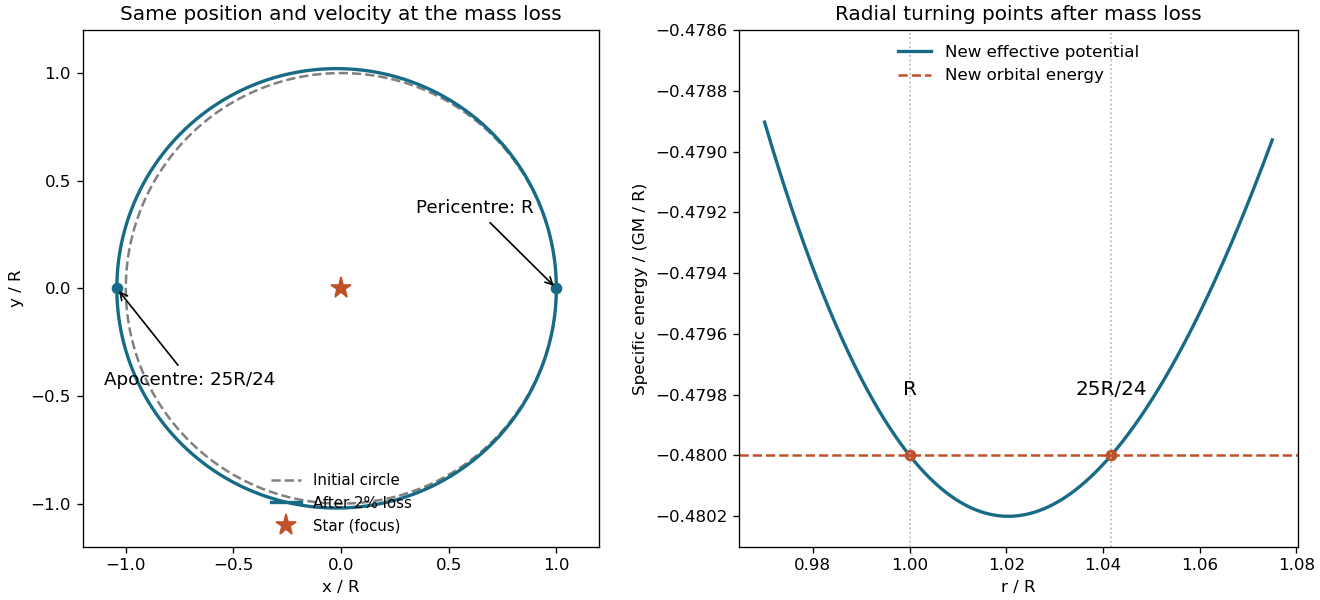
Original effective potential comparison and turning radii after an instantaneous two-percent central mass loss
. Details. 
The figure retains the same angular momentum before and after the change. Once the expelled material is far away, a spherically symmetric outer shell exerts no interior gravitational force by the shell theorem; direct ejecta interaction and the shell's finite transit time are neglected as in the source idealization.
Articles by others on the same topic
There are currently no matching articles.