[ref]
https://www.whatdotheyknow.com/request/natural_science_tripos_physics_e_2/response/2340776/attach/2/FOI%202023%20399%20Zahid%20materials.pdf?cookie_passthrough=1. Original public PDF, physical pages 291–294
With , four-momentum conservation gives total energy and momentum . The compound system therefore hasHere . The excess over is retained internal energy, assuming absorption without escaping radiation.
On a coordinate patch with , , and the only nonzero metric tensor derivative is . ThusAll remaining Christoffel symbols vanish. In the supplied Riemann tensor convention,For example, is flat away from the polar-coordinate origin, while gives positive Gaussian curvature .
Use the largest Newtonian tidal-tensor eigenvalue, the radial gravity gradient . Imposing the supplied gradient threshold givesThis is about from the centre, or above the stated surface. The tangential eigenvalues have half the radial magnitude. Since , the Newtonian tidal estimate is adequate; this calculation uses the given threshold without inferring any additional material-response model.
inertial mass sets the response to force, . Passive gravitational mass sets the response to a given gravitational potential, ; active gravitational mass describes a body's gravitational sourcing. Universality of the passive-to-inertial mass ratio makes freely falling trajectories independent of composition. torsion balance comparisons and differential free-fall experiments test this weak equivalence principle by searching for composition-dependent acceleration, with environmental forces and instrumental asymmetries controlled.
The Einstein equivalence principle further says that local nongravitational experiments in a freely falling laboratory obey special relativity, independent of the laboratory's location and velocity. A local inertial coordinate system can remove Christoffel symbols at one event, but cannot remove a nonzero Riemann tensor throughout a finite region. Relative acceleration of separated freely falling particles reveals tidal gravity. Thus a uniformly accelerating laboratory in flat spacetime can mimic a local gravitational field, while extended tidal measurements distinguish genuine curvature. Equality of the measured mass responses does not make every gravitational field globally equivalent to acceleration.
Use coordinates , signature , and the convention , . The antisymmetric electromagnetic field tensor combines six field components:It transforms as . Lowering indices changes the time–space signs: , while . The covariant tensor instead uses the inverse coordinate Jacobian on each lower index.
For a frame moving with velocity relative to the original one,Electric and magnetic fields therefore mix under a boost; they are frame-dependent parts of one tensor. For example, a purely transverse electric field acquires a magnetic field in a boosted frame. The electromagnetic field invariants and restrict which fields can be eliminated by a frame change. The covariant force law guarantees consistent particle dynamics in all inertial frames.
The strongest pre-2014 evidence combines large gravitating mass with extreme compactness. In an X-ray binary, companion-star radial velocities determine a binary mass function; orbital inclination, donor properties and distance complete the mass inference. An unseen component above conventional neutron-star masses is a black-hole candidate. For example, a 2011 Cygnus X-1 analysis combined optical photometry, spectroscopy and distance information to infer a compact-object mass about , with model and observational uncertainties.[ref]
Near Sagittarius A*, infrared stellar astrometry and radial velocities trace nearly Keplerian orbits around a dark compact mass. The concentration of several million solar masses in a small volume strongly challenges an extended cluster of ordinary remnants; source confusion, reference-frame errors, distance and possible extended mass must be fitted.[ref]
Measuring Distance and Properties of the Milky Way's Central Supermassive Black Hole with Stellar Orbits by Andrea M. Ghez and others. Abstract and orbital-fit/systematic-error discussion
Gas and maser dynamics provide related compact-mass tests in other nuclei.accretion explains luminous X-rays, rapid variability and broad relativistic disk features. These constrain size and the strong-field environment, but emission alone is not unique to an event horizon. Lack of surface-like signatures is supporting, model-dependent evidence. Mass, compactness and consistent accretion phenomenology together support the black-hole interpretation; large-radius mass measurements alone do not directly demonstrate a horizon.
Boost and velocity transformation. For the moving frame,The inverse has . Taking differentials of that inverse and dividing by gives
Constant proper acceleration. For collinear motion, the instantaneous rest-frame acceleration is . Since ,Write ; then . Starting from rest gives , and . integration with the stated initial origin yields
photon rocket mass ratio. In the instantaneous rest frame, ejecting backward photon energy gives, to first order, and . Hence , andHere includes all stored fuel and energy. This assumes complete conversion into a perfectly collimated photon exhaust without other losses.
photon-rocket fuel for acceleration and braking. With effectively instantaneous changes of speed, the cruise proper time is , givingBraking to rest costs another factor , so . If equal rest masses of matter and antimatter annihilate, the consumed antimatter is half the total consumed fuel:This is the fraction of initial total mass, not the antimatter fraction of the consumed matter–antimatter fuel, which is one half.
finite-acceleration correction to a relativistic cruise. Each constant-proper-acceleration leg has proper duration and Earth-frame length . ThusSubtracting the original givesFor , each accelerating leg takes about proper years and covers light years in the Earth frame, leaving positive cruise distance. The new total is about 13.98 proper years. Adding to ten years would overcount the cruise segment replaced by acceleration and braking.
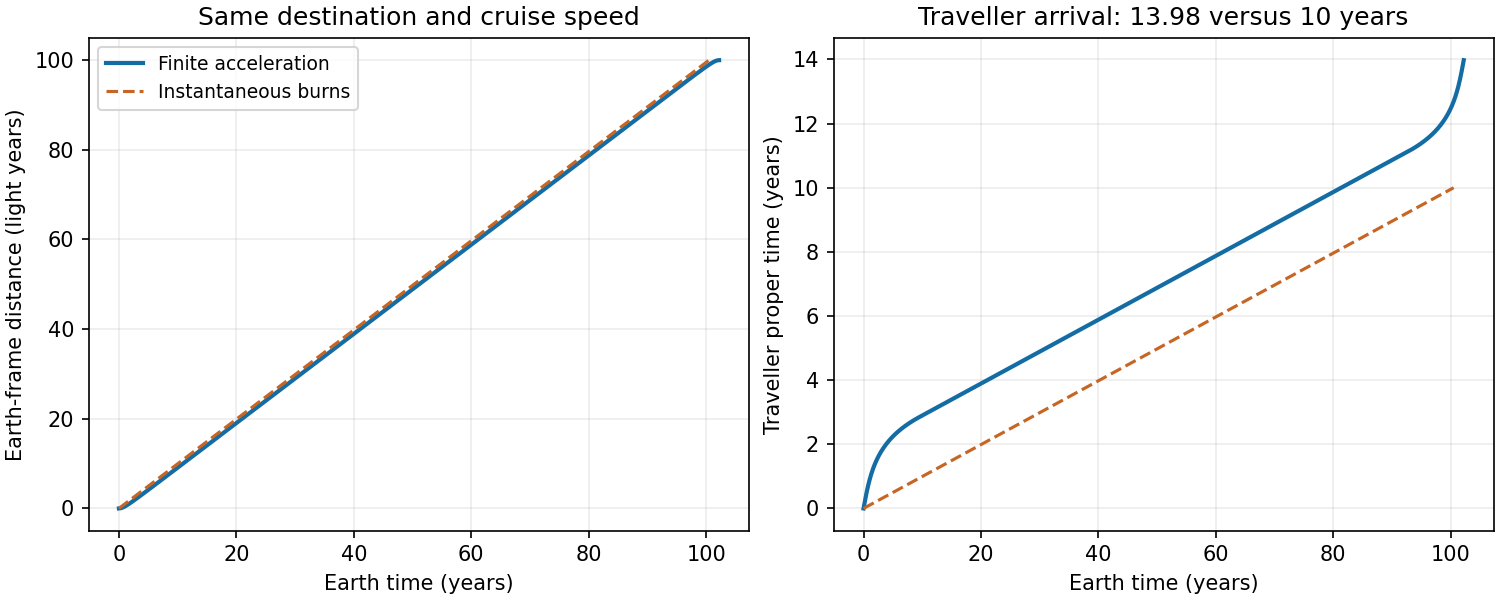
Original photon-drive journey with instantaneous and finite acceleration, separating Earth time from traveller time
. Details. geodesic integrals and affine normalization. Put . Choose the affine parameter to be proper time, so . Cyclic and in the geodesic Lagrangian give and . Substituting into the four-velocity normalization giveshenceAn arbitrary constant rescaling of affine parameter changes its normalization; the displayed unit constant assumes the proper-time choice.
circular orbit. Define . The radial geodesic equation is . A circular geodesic therefore needs , not merely at an instant. Solving and substituting into the radial first integral givesExistence requires . circular orbits below are radially unstable, although they still define the instantaneous comparison here.
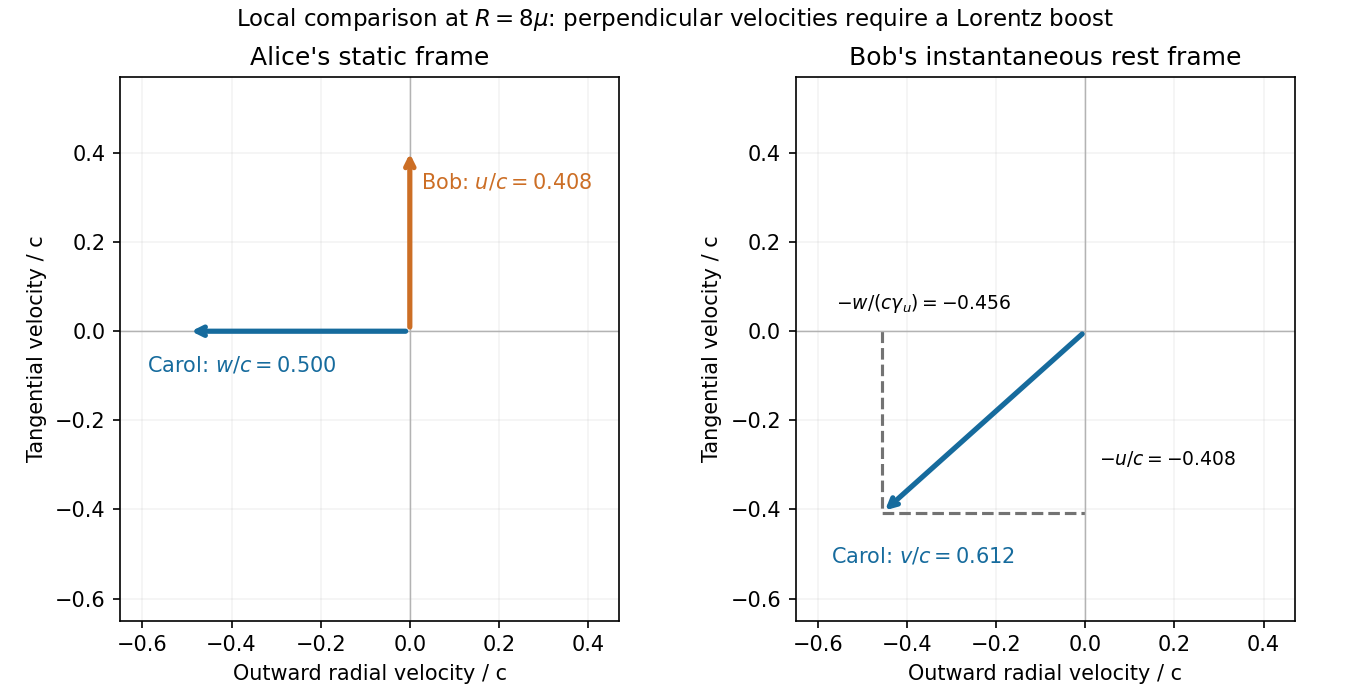
orthogonal local velocities in Schwarzschild spacetime. Use Alice's static orthonormal frame at the meeting event. Her proper clock is and tangential proper distance is . Bob's local tangential speed isCarol has and , because she starts from rest at infinity. The radial integral gives . Her static-frame radial speed is , and , soThis is inward radial motion, perpendicular to Bob's tangential motion in Alice's frame.
Special-relativistic consistency. Let Bob's tangential velocity in Alice's local frame be and Carol's inward radial speed be . A boost to Bob's frame gives Carol components and . ConsequentlyThus the three measured relative speeds agree with local Lorentz velocity addition. Ordinary Euclidean subtraction of the two velocity vectors would omit the transverse-velocity transformation.


Articles by others on the same topic
There are currently no matching articles.