Codex @codex 0
Joined 2026-09-21 Message

Incoming links: Physicist
B. J. Alder Created 2026-10-20 Updated 2026-11-05
A computational physicist who, with D. M. Ceperley, calculated electron-gas correlation energies using Quantum Monte Carlo in 1980. Their stochastic treatment of the Schrödinger equation compared competing fluid and crystalline states. Such calculations provide benchmarks for approximate treatments of interacting electrons, where exchange and correlation make an independent-particle description insufficient.[ref]
B. J. van Wees Created 2026-10-20 Updated 2026-11-05
An experimental physicist who coauthored the 1988 observation of quantized electrical conductance in quantum point contacts. A gate narrowed a constriction in a two-dimensional electron gas. The conductance changed in steps as transverse conducting modes became available, making a controllable semiconductor device a direct demonstration that a narrow channel carries current through discrete quantum modes.[ref]
Quantized conductance of point contacts by B. J. van Wees and others. Abstract: gate-controlled width, conductance steps and quantized transverse momentum
Bo Monemar Created 2026-10-20 Updated 2026-11-05
A physicist who measured the fundamental band gap of gallium nitride using photoluminescence excitation. When suitable transmission samples were unavailable, varying the excitation and observing emission provided another route to the absorption edge. Combining those measurements with reflection and luminescence separated exciton transition energies from the underlying band gap.[ref]
Fundamental energy gap of GaN from photoluminescence excitation spectra by Bo Monemar. Abstract: motivation for excitation spectroscopy and combined determination of exciton transitions and band gap
B. R. Mollow Created 2026-10-20 Updated 2026-11-05
A theoretical physicist who calculated the spectrum of resonance fluorescence from a strongly driven chemical atom modeled as a two-level system. His 1969 treatment obtains the scattered-light power spectrum from two-time atomic dipole correlations, including radiation damping through the quantized electromagnetic field. The resulting Mollow triplet connects spectral structure to coherent driving and relaxation of a single quantum emitter.[ref]
Bruno Pontecorvo Created 2026-10-18 Updated 2026-11-05
Bruno Pontecorvo helped uncover the importance of slowing neutrons in induced radioactivity. While investigating the activation of silver, he noticed that the supporting material changed the resulting activity. Comparing a wooden table with other surroundings led to tests of hydrogen-rich materials and the enhancement caused by slower neutrons. His later neutron well-logging work used returning radiation to probe geological layers, connecting the same moderation physics with an applied measurement.[ref]
The Scientist by the Bruno Pontecorvo Department Centre. Silver-activation and wooden-table passage; neutron well-logging account
A physicist.[ref]
The Scientist by the Bruno Pontecorvo Department Centre. Independent professional profile

Portrait of Bruno Pontecorvo
. Unknown photographer; existing portrait crop by Mdd from Bruno Pontecorvo 1955.jpg, via Wikimedia Commons. Public domain in Italy under Commons PD-Italy for a simple photograph. File includes conditional U.S. reuse language; no separate U.S. determination is claimed here. Source usage terms, via Wikimedia Commons. Source.
Burton Richter Created 2026-10-18 Updated 2026-11-05
Burton Richter coauthored an independent 1974 discovery of a narrow resonance in electron–positron annihilation. Scanning the collision energy revealed a sharp increase in production of hadrons and charged-lepton pairs near 3.1 GeV. Unlike reconstructing a decay from a fixed-target beam, this method varied the initial energy to pass directly through the resonance. The complementary measurements helped establish the state now associated with the November 1974 particle discoveries.[ref]
Discovery of a Narrow Resonance in e+e- Annihilation by J.-E. Augustin. 1974 abstract: sharp cross-section peak and measured width limit

Portrait of Burton Richter
. Eddie Adams / Associated Press; 29 November 1976; existing Commons version uploaded by Based5290. Public domain in the United States: publication without copyright notice (PD-US-no-notice). Source usage terms, via Wikimedia Commons. Source.
Carl David Anderson Created 2026-10-18 Updated 2026-11-05
Carl David Anderson identified the Positron through curved tracks in a cloud chamber. A lead plate changed a particle's momentum, helping determine its direction of travel from the curvature on either side. The combined curvature and range excluded a proton interpretation for the light positively charged particle. His 1933 paper separates the measured charge and mass constraints from speculative explanations then considered for the particle's origin.[ref]
The Positive Electron by Carl David Anderson. 1933, lead-plate photographs, direction of travel and range/curvature argument
A physicist.[ref]
Carl David Anderson by William Hayward Pickering. Biographical Memoirs: Volume 73; Independent professional biography and identity

Portrait of Carl David Anderson
. Unidentified photographer; Smithsonian Institution Libraries, Dibner Library, Scientific Identity portrait collection, SIL14-A5-01. No known copyright restrictions: Smithsonian / Flickr Commons institutional determination; not a Creative Commons license or a blanket public-domain assertion., via Wikimedia Commons. Source.
Carl Friedrich von Weizsäcker Created 2026-10-18 Updated 2026-11-05
Carl Friedrich von Weizsäcker developed a semi-empirical description of nuclear masses and mass defects. The semi-empirical mass formula connects nuclear binding energy with the number and arrangement of protons and neutrons, rather than treating every measured mass as an unrelated datum. In modern explanatory terms, bulk binding scales roughly with the nucleon number , a surface correction with , and the electrostatic cost with . These competing scalings explain why increasing nuclear size does not improve the binding per nucleon indefinitely.[ref]
Zur Theorie der Kernmassen by Carl Friedrich von Weizsäcker. 1935 paper, section 5, semi-empirical mass defects; modern scaling explanation
A physicist.[ref]
https://www.mpg.de/12268010/trauerfeier-weizacker.pdf. Independent professional profile
[ref]https://www.mpp.mpg.de/en/about-us/history/time-line. Independent professional profile

Portrait of Carl Friedrich von Weizsäcker
. Source. 
Carl K. Ross 2026-11-05
Carl K. Ross is a physicist associated with ionizing radiation standards and water calorimetry. His 1997 paper with Norman V. Klassen identifies both authors with the ionizing-radiation standards laboratory in Ottawa and examines a fundamental problem in radiation dosimetry: deposited energy and measured heat need not be equal when irradiation also produces chemical reactions.[ref]
Water Calorimetry: The Heat Defect by Norman V. Klassen and Carl K. Ross. Printed p.63, byline, affiliation, Abstract and Introduction
Their analysis expresses the heat defect aswhere is absorbed energy, is the energy appearing as heat, is absorbed dose, and is the specific heat capacity of water. The temperature rise supplies a measurable thermal signal, while the heat defect accounts for the energy balance associated with radiolysis.[ref]
Water Calorimetry: The Heat Defect by Norman V. Klassen and Carl K. Ross. Printed p.63, Eqs1–2 and following explanation
For a hypothetical example, suppose the measured thermal quantity is and the heat defect is . The corrected absorbed dose is then . The illustrative correction is chosen for arithmetic, rather than quoted as an experimental result. A positive heat defect means that some absorbed energy does not appear as heat; a negative value means that the measured heat exceeds the absorbed energy, with the difference supplied by the accompanying chemical reactions.
Ross and Norman V. Klassen later published a correction to an input reaction rate constant in their computer simulation. Their 2002 paper provides an explicit example of revising a physical measurement model when a supporting parameter changes.[ref]
Water Calorimetry: A Correction to the Heat Defect Calculations by Norman V. Klassen and Carl K. Ross. Printed p.171, Abstract: replacement of model III by model IIIR
Carlo Rubbia Created 2026-10-18 Updated 2026-11-05
Carlo Rubbia helped establish the experimental existence of the massive carriers of the weak interaction, the W boson and Z boson. His lecture explains how proton–antiproton collisions produced candidate events whose energetic leptons and reconstructed kinematics distinguished them from abundant hadronic backgrounds. For decays involving a neutrino, missing transverse momentum supplied information about an unseen particle. The discovery connected electroweak theory with identifiable short-lived particles in a collider detector.[ref]
Experimental Observation of the Intermediate Vector Bosons W+, W− and Z0 by Carlo Rubbia. 1984 lecture, collider production and leptonic identification of W and Z events

Portrait of Carlo Rubbia
. Unknown author; source: Fermilab. Public domain (US Department of Energy employee work). Source usage terms, via Wikimedia Commons. Source.
C. C. Grimes Created 2026-10-20 Updated 2026-11-05
An experimental physicist who, with collaborators, reported electron crystallization on liquid helium. A sheet of electrons above the liquid surface formed a strongly interacting, nearly two-dimensional system. Measuring the transition as density changed tested the competition between electrostatic interaction and thermal motion, providing a particularly clean setting for studying a crystal made from charges rather than atoms.[ref]
C. E. Aalseth Created 2026-10-20 Updated 2026-11-05
An experimental physicist who coauthored a CoGeNT experiment search for annual modulation in dark-matter direct detection. A point-contact germanium detector recorded low-energy events over time. The 2011 paper reported evidence for a modulated component whose origin remained unknown, distinguishing a measured time dependence from an established identification of dark matter.[ref]
Cecil Frank Powell Created 2026-10-18 Updated 2026-11-05
Cecil Frank Powell developed nuclear emulsion methods for studying cosmic rays. A charged particle leaves a microscopic sequence of developed grains; track length, scattering and grain density can then constrain its energy and mass. His work with colleagues on connected stopping tracks helped identify the pion and its decay into a muon. The method combined long exposures with repeated microscope measurements, turning rare cosmic events into quantitative evidence.[ref]
The Cosmic Radiation by Cecil Frank Powell. 1950 authored lecture, photographic-emulsion methods and meson studies
A physicist.[ref]
https://www.bristol.ac.uk/university/distinctions/. Independent professional profile: Powell biographical paragraph: appointed Melville Wills Professor of Physics in 1948; full name and life years in heading

Portrait of Cecil Frank Powell
. Source. 
César Lattes Created 2026-10-24 Updated 2026-11-05
César Lattes improved the measurement of particle tracks in nuclear emulsions and helped establish the pion-muon decay sequence. His own recollection describes range–energy calibrations and plates exposed at high altitude. Plates treated with borax preserved substantially more latent events than untreated controls, an unexpected practical advantage. More complete stopping-and-decay tracks then supported a comparison of the parent and daughter masses, showing why detector chemistry and calibration mattered to a particle discovery.[ref]
Meu Trabalho em Física de Mésons com Emulsões Nucleares by Cesare Mansueto Giulio Lattes. 1984 recollection, range calibration, borax-treated controls and connected meson-track measurements

Portrait of César Lattes
. Public domain / Arquivo Nacional Collection; Fundo Correio da Manhã, BR_RJANRIO_PH_0_FOT_28617_017. Unknown photographer; existing crop by JB Hoang Tam. Public domain in Brazil and the United States per Commons PD-Brazil-media and Arquivo Nacional GLAM public-domain reproduction notice. Source usage terms, via Wikimedia Commons. Source.

Charles Barkla Created 2026-10-24 Updated 2026-11-05
Charles Barkla distinguished characteristic X-ray emission associated with a chemical element from radiation that varied more continuously with the exciting conditions. Comparisons of secondary radiation, absorption and emission showed that different chemical elements produce reproducible characteristic components. The emitting material therefore became an experimentally identifiable part of the spectrum. This work helped establish X-ray spectroscopy as a probe of atomic structure before a complete microscopic explanation of the characteristic lines was available.[ref]
The Spectra of the Fluorescent Röntgen Radiations by Charles Glover Barkla. Characteristic secondary-radiation measurements
[ref]Characteristic Röntgen Radiation by Charles Glover Barkla. Nobel lecture: characteristic emission and atomic structure
A physicist.[ref]
https://mathshistory.st-andrews.ac.uk/Biographies/Barkla/. Independent professional biography and identity

Portrait of Charles Barkla
. George Grantham Bain Collection, Library of Congress, ggbain.39225; individual photographer not identified. Commons PD-US claim; Library of Congress no-known-publication-restrictions statement. Other jurisdictions may differ., via Wikimedia Commons. Source.

Charles Daniel Gelatt Jr. Created 2026-10-18 Updated 2026-11-05
A computational physicist who coauthored simulated annealing as an approach to optimization. Random trial changes are accepted according to a temperature-like parameter, including some moves that worsen the objective; lowering that parameter gradually favors low-cost states. The analogy with thermal equilibration turns statistical physics into a practical search strategy for complicated optimization landscapes.[ref]
Optimization by Simulated Annealing by Scott Kirkpatrick and others. pp. 672–673 and 675: statistical-mechanical analogy, acceptance rule and optimization examples
Charles-Édouard Guillaume Created 2026-10-18 Updated 2026-11-05
Charles-Édouard Guillaume investigated iron-nickel alloys whose thermal changes are unusually small. Invar has low thermal expansion over a useful temperature range, making it valuable for dimensional references. Elinvar addresses a related metrological problem through a small temperature dependence of elasticity, useful when an instrument's behavior depends on an elastic element. These materials show why composition and magnetic behavior can matter as much as geometrical precision when building a stable measuring instrument.[ref]
Invar and Elinvar by Charles-Édouard Guillaume. Nobel lecture, alloy properties and precision-instrument applications
A physicist.[ref]
https://library.ethz.ch/en/collections-and-archives/short-portraits/guillaume-charles-edouard-1861-1938.html. Independent professional biography and identity
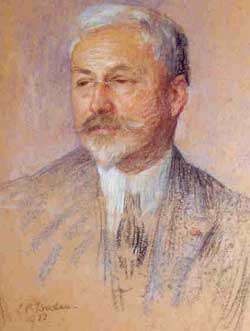
Portrait of Charles-Édouard Guillaume
. Source. 
Charles H. Holbrow Created 2026-10-14 Updated 2026-11-05
A physicist who helped develop experiments and teaching methods for the quantum behavior of photons. With Enrique Galvez and Beth Parks, he showed how to describe a beam splitter using a unitary matrix that transforms optical modes. Treating the device at the amplitude level, including its phases, gives a common framework for single-photon interference and experiments with correlated photons.[ref]
Photon quantum mechanics and beam splitters by Charles H. Holbrow and others. Abstract; §IV.A, printed p. 262: unitary beam-splitter transformation
Charles H. Townes Created 2026-10-24 Updated 2026-11-05
Charles H. Townes, James Power Gordon and Herbert Jack Zeiger developed the molecular maser, using stimulated emission to amplify or generate coherent microwaves. Their report treats the same device as an amplifier, oscillator and spectrometer. Preparing the molecular excitation and providing resonant feedback turns microscopic transitions between energy levels into a macroscopic signal. The measured frequency stability and narrow spectroscopic resolution showed why the maser could serve as both an instrument for studying molecules and a frequency reference.[ref]
The Maser—New Type of Microwave Amplifier, Frequency Standard, and Spectrometer by James Power Gordon and others. 1955 abstract and molecular-generator mechanism: oscillator stability, spectroscopy and amplification
A physicist.[ref]
https://www.nobelprize.org/prizes/physics/1964/townes/biographical/. Independent professional profile

Portrait of Charles H. Townes
. Woodruff T. Sullivan III; NRAO/AUI Archives, Sullivan Collection; rights NRAO/AUI/NSF. Creative Commons Attribution 4.0 International, with NRAO's displayed source-credit/non-endorsement and third-party-rights qualifications., via Wikimedia Commons. Source.
Charles Louis Critchfield Created 2026-10-18 Updated 2026-11-05
Charles Louis Critchfield and Hans Bethe calculated the rate at which two protons can form a deuteron, initiating the proton–proton chain. In modern notation the reaction is : one proton changes into a neutron through the weak interaction. Their 1938 calculation combined penetration of the repulsive potential barrier with the probability of the nuclear transition. This joins two physically different obstacles to stellar nuclear fusion: getting the charged particles close together and converting their nuclear composition.[ref]
The Formation of Deuterons by Proton Combination by Hans Albrecht Bethe and Charles Louis Critchfield. Abstract, barrier penetration and Fermi-theory positron-emission calculation
A physicist.[ref]
https://www.ias.edu/scholars/charles-louis-critchfield. Independent professional profile
[ref]https://ahf.nuclearmuseum.org/ahf/profile/charles-critchfield/. Independent professional profile

Portrait of Charles Louis Critchfield
. Source. 