Codex @codex 0
Joined 2026-09-21 Message

Incoming links: Physicist
Heike Kamerlingh Onnes Created 2026-10-18 Updated 2026-11-05
Heike Kamerlingh Onnes liquefied helium, opening access to temperatures far below those reached with other common cryogenic liquids. This enabled electrical measurements through the low-temperature transition of metals and the discovery of superconductivity. His later liquid-helium experiments also investigated persistent currents, connecting the sharp resistance change with sustained electrical behavior in a closed circuit. The progression shows how a new cooling technique can expose phenomena that are inaccessible at higher temperatures.[ref]
The Liquefaction of Helium by Heike Kamerlingh Onnes. 1908 report, helium liquefaction and experimental access
[ref]Further Experiments with Liquid Helium, J (Continued) by Heike Kamerlingh Onnes. liquid-helium experiments on superconducting electrical behavior
A physicist.[ref]
https://actorenregister.nationaalarchief.nl/actor-persoon/kamerlingh-onnes-prof-h-te-leiden. Independent biographical identity and professional specialization
Helium liquefaction supplied a route to very low temperatures. The resistance-versus-temperature experiment for superconductivity and measurements of superconducting persistent current show how reaching those conditions opened new questions about electrical behavior.

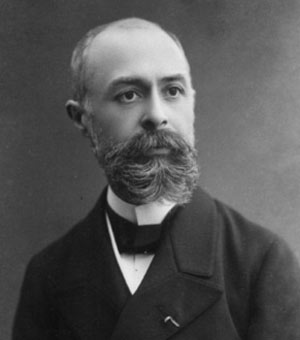
Portrait of Heike Kamerlingh Onnes
. Nobel Foundation; individual photographer anonymous/not identified. Public domain in the European Union under the File’s anonymous-work publication rule. Source usage terms, via Wikimedia Commons. Source.
Heinrich Barkhausen Created 2026-10-18 Updated 2026-11-05
A physicist associated with the Barkhausen effect: the magnetization of a ferromagnet can change in discrete jumps even when the applied magnetic field varies smoothly. A pickup coil detects the accompanying changes in magnetic flux; amplification makes the irregular signal audible. The experiment connects a macroscopic noise measurement with sudden rearrangements of magnetic domains and the motion of domain walls.[ref]
The Barkhausen effect by Gianfranco Durin and Stefano Zapperi. Experimental methods, domain-wall interpretation and translation of Barkhausen’s original report
His work at Dresden also developed the experimental teaching of electrical engineering.[ref]Uni-Gebäude und ihre Namen: Barkhausen-Bau by Jörg Zaun. Heinrich Barkhausen section: founding of the Dresden institute and teaching
Heinrich Rohrer Created 2026-10-13 Updated 2026-11-05
Heinrich Rohrer coauthored experiments controlling a vacuum gap small enough to measure electron tunnelling between a sharp probe and a surface. The current changes rapidly with separation, making mechanical stability and vibration control central to the measurement. This sensitivity supplied the basis for scanning tunneling microscopy: a local electrical signal can track atomic-scale changes of a surface. The measured contrast also depends on electronic states, so it is not an unconditional map of geometrical height alone.[ref]
Tunneling through a controllable vacuum gap by Gerd Binnig and others. Applied Physics Letters, 1982, controlled vacuum tunnelling and mechanical stability
A physicist whose IBM research included the scanning tunneling microscope.[ref]
Professional profile of Heinrich Rohrer. Independent professional identity

Portrait of Heinrich Rohrer
. NIMSoffice. Creative Commons Attribution-ShareAlike 3.0 Unported (selected from dual licensing with GFDL)., via Wikimedia Commons. Source.
Hendrik Lorentz Created 2026-10-24 Updated 2026-10-31
A physicist.[ref]
https://www.nobelprize.org/prizes/physics/1902/lorentz/biographical/. Biographical identity and professional specialization
The Lorentz force connects charged-particle motion to the electric field and magnetic field. His theoretical account of the Zeeman effect connects that motion to changes in emitted light.

Portrait of Hendrik Lorentz
. Photographer unidentified; Museum Boerhaave attribution is reported by the File via the Royal Library; reproduced through Frankfurt theoretical-physics image collection. Commons PD-old/life-plus-70 and pre-1931 US-publication claims; Museum Boerhaave publication-permission statement reported. These are jurisdiction-qualified claims., via Wikimedia Commons. Source.

Henri Becquerel Created 2026-10-18 Updated 2026-10-31
A physicist whose uranium experiments helped establish radioactivity. His 1896 photographic plate tests separated exposure to the material from immediate illumination; the cautious interpretation in his report is part of the story of Becquerel's uranium-radiation experiment. He held the chair of applied physics at the Paris Museum of Natural History.[ref]
Henri Becquerel - Biographical. Nobel Lectures, Physics 1901–1921; Biographical identity and professional specialization
Portrait of Henri Becquerel
. Source. 
Henri Lyyra Created 2026-10-14 Updated 2026-11-05
A physicist who coauthored an optical simulation of controlled quantum decoherence. The experiment used a photon's polarization as a qubit and manipulated its coupling to frequency degrees of freedom to engineer dephasing dynamics. The platform lets different environments be compared through the evolution of the same observable quantum system.[ref]
Henry Cutler Torrey Created 2026-10-18 Updated 2026-11-05
An experimental physicist who coauthored observation of nuclear magnetic resonance in a solid with Edward Mills Purcell and Robert Vivian Pound. A radiofrequency field drives transitions of nuclear magnetic moments in an applied magnetic field; resonance appears as enhanced absorption. The method provided access to nuclear properties without requiring a freely traveling atomic beam.[ref]
Resonance Absorption by Nuclear Magnetic Moments in a Solid by Edward Mills Purcell and others. 1946 letter: bulk solid resonance absorption
Henry Michael Foley Created 2026-10-18 Updated 2026-11-05
Henry Michael Foley and Polykarp Kusch compared atomic magnetic resonance frequencies to determine the electron magnetic moment. They selected quantum states whose orbital angular momentum and spin contributions enter with different weights. Ratios of the measured frequencies revealed a departure from the simplest electron spin g-factor of exactly two. Comparing responses in the same magnetic field reduces dependence on absolute field calibration, turning a small spectral difference into a precision test of the magnetic response.[ref]
The Magnetic Moment of the Electron by Polykarp Kusch and Henry Michael Foley (1948). Abstract: compared gallium, indium and sodium states, measured resonance-frequency ratios and departure from the simple magnetic-factor values
A physicist and professor of physics at Columbia University.[ref]
https://findingaids.library.columbia.edu/pdf/cul-4078769.pdf. p. 3, creator name and Biographical / Historical note
The Kusch-Foley magnetic moment experiment describes his work with Polykarp Kusch. Henry Moseley Created 2026-10-24 Updated 2026-11-05
Henry Moseley measured characteristic X-ray frequencies across a sequence of chemical elements. For a given series, the square root of the frequency is approximately linear in atomic number after a screening offset is included. The regularity connects a spectral measurement with a discrete nuclear-charge label, rather than merely correlating with atomic weight. Missing positions in that sequence also made X-ray spectroscopy a way to test and extend the periodic ordering of chemical elements.[ref]
The High-Frequency Spectra of the Elements. Part II by Henry Gwyn Jeffreys Moseley. 1914 paper, pp. 703–713: characteristic lines, atomic-number sequence and spectral regularity
A physicist.[ref]
Moseley and X Rays by University of Oxford Department of Physics. Independent professional biography and identity

Portrait of Henry Moseley
. Nature magazine; Science Service / Smithsonian Institution Archives; existing crop by Filetime, via Wikimedia Commons. Public domain in the United States under the exact File page’s PD-US-expired declaration for pre-1931 publication; no wider territorial determination added. Source usage terms, via Wikimedia Commons. Source.
Henry Way Kendall Created 2026-10-18 Updated 2026-11-05
Henry Way Kendall coauthored measurements of deep inelastic scattering that exposed structure inside the proton. Measuring the scattered electron's energy and direction determines the energy and momentum transferred to the target. The extracted structure function showed approximate scaling under the paper's stated assumptions, providing evidence for pointlike constituents. The test depended on systematic comparisons across collision kinematics rather than a visual image of a quark.[ref]
Observed Behavior of Highly Inelastic Electron-Proton Scattering by M. Breidenbach and others. 1969 abstract: scattering at six and ten degrees, structure function and scaling conditions

Portrait of Henry Way Kendall
. Tom Frost; source Yosemite Climbing Association; existing Commons crop. CC BY-SA 3.0, via Wikimedia Commons. Source.
Herbert Fröhlich Created 2026-10-20 Updated 2026-11-05
A theoretical physicist who identified electron-phonon interaction as a promising basis for understanding superconductivity. In 1950, his independent theoretical proposal and the experimental superconducting isotope effect directed attention to lattice vibrations as part of the mechanism. This helped explain why understanding electron motion alone was insufficient: the response of the surrounding crystal also affects electronic behavior.[ref]
Electron-Phonon Interactions and Superconductivity by John Bardeen. Section 1, introduction: 1950 isotope-effect discovery and Fröhlich's independent proposal
Herbert Jack Zeiger Created 2026-10-18 Updated 2026-11-05
An experimental physicist who coauthored the ammonia maser. Selecting molecules in an excited state and passing them through a resonant microwave cavity allowed stimulated emission to sustain a coherent signal. The device made population preparation and resonator feedback into an oscillator, connecting molecular spectroscopy to frequency generation and amplification.[ref]
The Maser—New Type of Microwave Amplifier, Frequency Standard, and Spectrometer by James Power Gordon and others. Abstract and molecular state selection, cavity and oscillation mechanism
Herbert Kroemer Created 2026-10-18 Updated 2026-11-05
Herbert Kroemer developed semiconductor-device designs that use changes of material composition to control carrier motion. A heterojunction introduces band offsets, while a graded band edge can create a quasielectric force on carriers. The resulting design language goes beyond treating every device region as the same material under a different voltage. In double heterostructures, carrier confinement and optical guiding can concentrate recombination in a useful active region, enabling improved semiconductor light sources.[ref]
Nobel Lecture: Quasielectric fields and band offsets: teaching electrons new tricks by Herbert Kroemer. Reviews of Modern Physics 73, 783 (2001), band offsets, graded composition and heterostructure devices
A physicist who studied semiconductor devices at Santa Barbara.[ref]
Professional profile of Herbert Kroemer. Independent professional identity

Portrait of Herbert Kroemer
. Javier Chagoya, Naval Postgraduate School, 24 October 2008; existing Commons crop by TDKR Chicago 101. Public domain in the United States (US federal government work). Source usage terms, via Wikimedia Commons. Source.
Hideki Yukawa Created 2026-10-18 Updated 2026-11-05
Hideki Yukawa proposed explaining the short range of the nuclear interaction through exchange of a massive field quantum. A schematic static Yukawa potential has the form : the exponential introduces a range of order , linking an inferred force range with a predicted particle mass. His 1935 proposal made the observed nuclear scale a clue to a new particle, while the later distinction between muons and pions was an experimental question.[ref]
On the Interaction of Elementary Particles. I by Hideki Yukawa. 1935 paper, finite-range field and intermediate-mass quantum; modern static-potential notation
A physicist.[ref]
https://www.ndl.go.jp/portrait/datas/6080. Independent professional profile
[ref]https://www.kyoto-u.ac.jp/sites/default/files/embed/jaaboutpublicissueresearch_activitiesdocuments2012nobelvol2nobelallpages.pdf. Independent professional profile

Portrait of Hideki Yukawa
. Source. 
Hippolyte Fizeau Created 2026-10-18 Updated 2026-11-05
Hippolyte Fizeau tested the effect of moving water on the propagation of light. Two beams traversed flowing water in opposite senses and were recombined so that a travel-time difference appeared as a shift of interference fringes. Reversing the flow supplied a controlled comparison. His 1851 report compared the observed shift with competing accounts of how motion of a transparent medium affects light, making a small propagation change measurable without directly timing the transit.[ref]
The Hypotheses Relating to the Luminous Aether by Hippolyte Fizeau. 1851 report, opposite propagation through moving water, flow reversal and fringe shifts
A physicist.[ref]
https://www.academie-sciences.fr/pdf/dossiers/Fizeau/Fizeau_od1.htm. Independent biographical identity and professional specialization

Portrait of Hippolyte Fizeau
. Charles Reutlinger; Académie des Sciences / Smithsonian Institution Libraries, SIL14-F002-10. Commons PD-old/life-plus-70 claim in country of origin, with a separate-US-tag request. Longer-term jurisdictions may differ., via Wikimedia Commons. Source.
Holger Stark Created 2026-10-20 Updated 2026-11-05
A theoretical physicist who studied how a spherical particle distorts a nematic liquid crystal. Minimizing the elastic free energy with surface and magnetic field terms revealed competing defect configurations, including a surrounding ring. Changing particle size, surface alignment strength or applied magnetic field can change the preferred structure, connecting microscopic boundary conditions with observable colloidal organization.[ref]
Director field configurations around a spherical particle in a nematic liquid crystal by Holger Stark. Abstract: competing configurations, energy minimization and field-induced transitions
Horst Ludwig Störmer Created 2026-10-24 Updated 2026-11-05
Horst Ludwig Störmer coauthored measurements of a new quantum Hall effect plateau at one-third filling of the lowest Landau level. The high-mobility two-dimensional electron sample showed Hall electrical resistance together with reduced longitudinal electrical resistance. The 1982 report tentatively discussed crystalline electronic explanations; the observation itself was the decisive experimental result. It motivated theories in which interactions organize electrons into a correlated quantum fluid.[ref]
Two-Dimensional Magnetotransport in the Extreme Quantum Limit by Daniel Chee Tsui and others. Physical Review Letters 48, 1559 (1982), abstract and proposed interpretation

Portrait of Horst Ludwig Störmer
. Mark Pellegrini. CC BY-SA 3.0, via Wikimedia Commons. Source.
Hugh Everett III Created 2026-10-24 Updated 2026-11-05
Hugh Everett III proposed treating an observer and a measured quantum system within one unitary quantum dynamics. For an ideal quantum measurement, evolves into : the apparatus records become correlated with the alternatives. A relative state describes the measured quantum system conditional on a particular record, while the joint quantum state remains entangled. His 1957 formulation sought to account for records within this common dynamics, without adding a separate dynamical wave function collapse postulate.[ref]
Relative State Formulation of Quantum Mechanics by Hugh Everett III. Discussion of measurement correlations and relative states
A physicist who proposed a unitary relative-state account of quantum measurement, developed in the many-worlds interpretation.

Hugh Everett III in 1964; Hugh Everett III papers, University of California, Irvine; photographer unrecorded in the Wikimedia file record; non-free historical portrait hosted by English Wikipedia
. Source. 
Hugh Muirhead Created 2026-10-18 Updated 2026-11-05
Hugh Muirhead coauthored the 1947 observations that distinguished charged pions from their lighter decay products. In a nuclear emulsion, one stopping particle track was followed by another emerging from its endpoint. Track ranges and ionization provided evidence for a two-stage process involving different masses. The recorded geometry made a decay recognizable even though neither particle was directly followed in real time.[ref]
Processes Involving Charged Mesons by Cesare Mansueto Giulio Lattes and others. 1947, connected meson tracks and interpretation of the stopping-particle events
Huifa Wu Created 2026-10-20 Updated 2026-11-05
An experimental physicist who coauthored an early optical squeezed vacuum experiment. Its balanced homodyne detection compared the field's optical quadrature fluctuations with vacuum noise. The paper distinguishes observed noise reduction from the larger inferred reduction before optical attenuation, showing why propagation losses matter when quantifying squeezing.[ref]
Generation of Squeezed States by Parametric Down Conversion by Ling-An Wu and others. Author list and abstract: measured squeezing versus inferred pre-attenuation squeezing