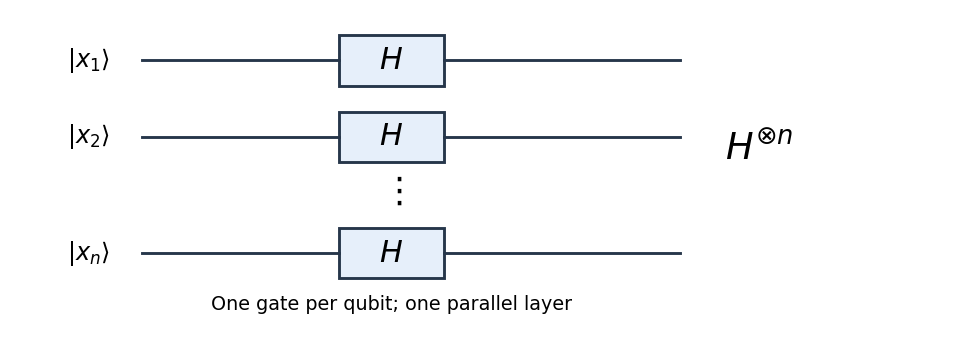
Apply one Hadamard gate to each of the qubits, with all gates acting in parallel. This quantum circuit implements the tensor product ; it needs single-qubit gates and one layer. For one qubit,
Taking the tensor product of these expressions multiplies the probability amplitudes and adds their exponents, giving
Here the dot product is evaluated using modular arithmetic modulo two.
Figure 1.
The Hadamard transform applies one Hadamard gate to each qubit in a parallel layer
. Details.
In particular, an initially zero quantum register becomes the uniform quantum superposition
This is useful at the start of a quantum algorithm because a subsequent quantum oracle acts on all these components coherently. Later quantum interference can reveal a global property of the function. Measuring immediately would merely produce a uniformly random binary string; the useful resource is the preserved quantum coherence, rather than the ability to read every function value in one run.
Write for bitwise exclusive or. Both quantum registers begin in . After the first Hadamard transform their joint quantum state is
The quantum oracle maps each component to . By linearity, the required quantum state is therefore
The different first-register computational-basis states are orthogonal, so there are orthogonal joint components of squared probability amplitude , even though some second-register values coincide. Thus the displayed quantum state is normalized.
Apply the Hadamard transform to the conditional quantum state from c. Since modulo two, its output is
If , the two probability amplitudes cancel by destructive quantum interference. If , they add, giving
Thus every observed string obeys . This Simon Fourier sampling is uniform on the -dimensional vector subspace over the two-element field. Indeed, the nonzero linear functional has a kernel of dimension by the rank-nullity theorem. The distribution does not depend on , so measuring or discarding the second quantum register gives the same statistics for the first.
Represent the single-photon state by its two path probability amplitudes. The first Hadamard gate sends to . With for the lower-arm phase shifter, the complete Mach-Zehnder interferometer gives
The global phase has no effect on detection. By the Born rule,
They sum to one. At , port 1 is a dark port; at , the roles reverse. The result uses coherent addition of the path amplitudes, rather than addition of separate path probabilities.
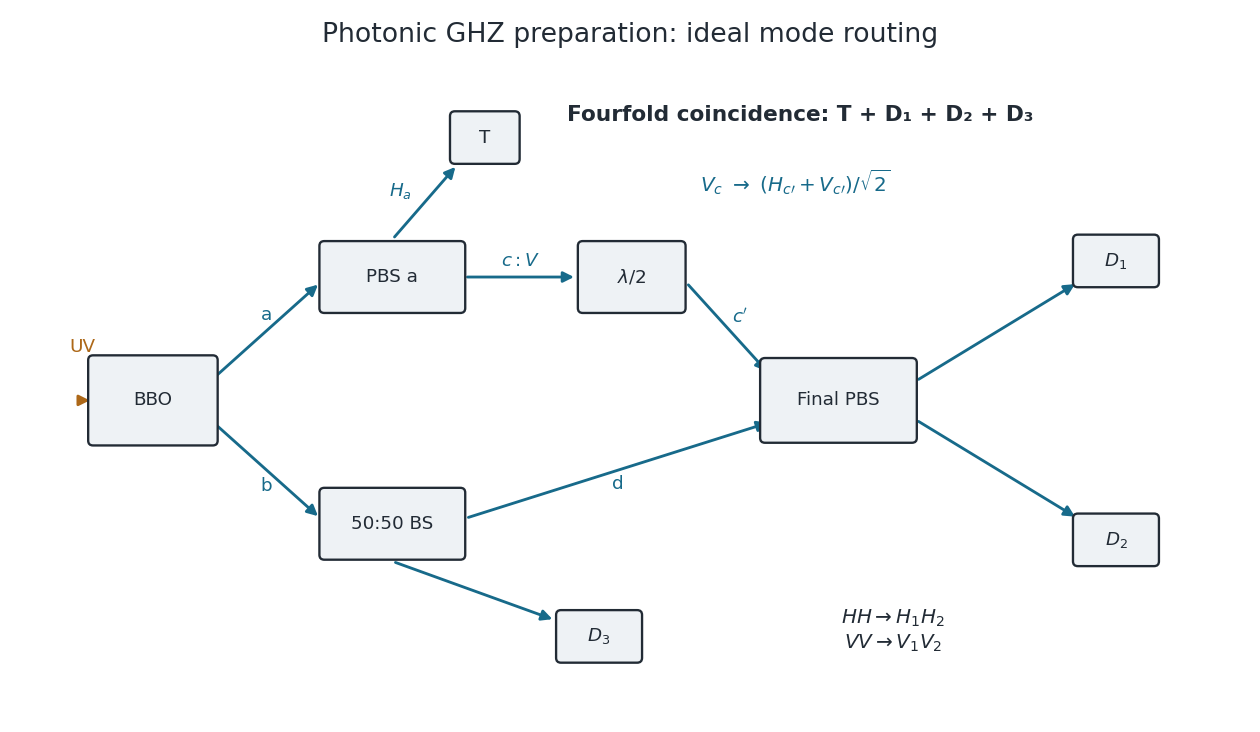
The beta barium borate crystal supplies spontaneous parametric down-conversion: a weak ultraviolet pump can produce a pair of lower-frequency photons, with their frequencies and wavevectors selected by conservation of energy and phase matching. A suitably aligned and compensated source makes the two polarization alternatives coherent, giving the stated Bell state. The crystal alone does not guarantee that every collected pair has that state.
The two polarizing beam splitters route horizontal polarization and vertical polarization to different ports. Take from arm to the trigger and to arm . The ordinary beam splitter in arm is a lossless, polarization-independent 50:50 splitter, with the unused input in the vacuum state. It splits probability amplitudes, rather than measuring which output a photon takes. The half-wave plate changes the relative phase of its principal polarizations by ; orient it so that a photon in becomes in , up to a common phase. Finally, photodetectors absorb arriving photons and supply electrical clicks. They need not resolve photon number for the ideal four-photon, fourfold-coincidence calculation: a click at every detector already requires one photon at each.
Figure 1.
Original mode diagram for photonic GHZ preparation by fourfold coincidence
. The paths and polarization conventions used in the calculation. PBS denotes a polarizing beam splitter; BS is a polarization-independent 50:50 beam splitter. A trigger click alone does not guarantee the required one-photon occupation of all three other outputs. Details.
Choose the relative wave phases so that the final polarizing beam splitter sends to , to , to and to . Such phase conventions must be used consistently: an uncompensated relative phase would give a phase-shifted GHZ state.
Use the resonant interaction picture and define by the one-atom Jaynes-Cummings model in part (a). Equal coupling to both atoms gives the Tavis-Cummings model
The initial state has two excitations and is symmetric under atom exchange. Excitation conservation and this symmetry confine the evolution to
The antisymmetric atomic spin singlet state is uncoupled and unpopulated. Applying the annihilation operator and creation operator gives
The first off-diagonal entry combines two indistinguishable atomic emission paths; the second also includes the enhancement for creating the second photon. Its eigenvalues are . Put and , so . Its exponential is
Applying this to yields
All three states have the same bare energy on resonance, so restoring the free Schrödinger-picture evolution adds only a common global phase. The expression starts at , has initial derivative , and its three squared probability amplitudes sum to one.
Suppose the conditional atomic pure state were a product state
Comparing its four probability amplitudes with gives
The last two equations make all four factors nonzero, contradicting either of the first two. Equivalently, the coefficient matrix has determinant , while a product state has a rank-one coefficient matrix and zero determinant. Thus the atoms are entangled; indeed each reduced density matrix is , making the conditional state maximally entangled.
Set and . Their commutator is
It commutes with both operators, so the stated Baker--Campbell--Hausdorff formula terminates:
In particular . Expanding the remaining exponential and using gives the number state expansion
The orthonormality of the number states gives
This is a Poisson distribution with parameter . Its probabilities sum to . The phase of affects the coherent state's relative probability amplitudes but not its photon number probabilities. At the distribution is concentrated at .
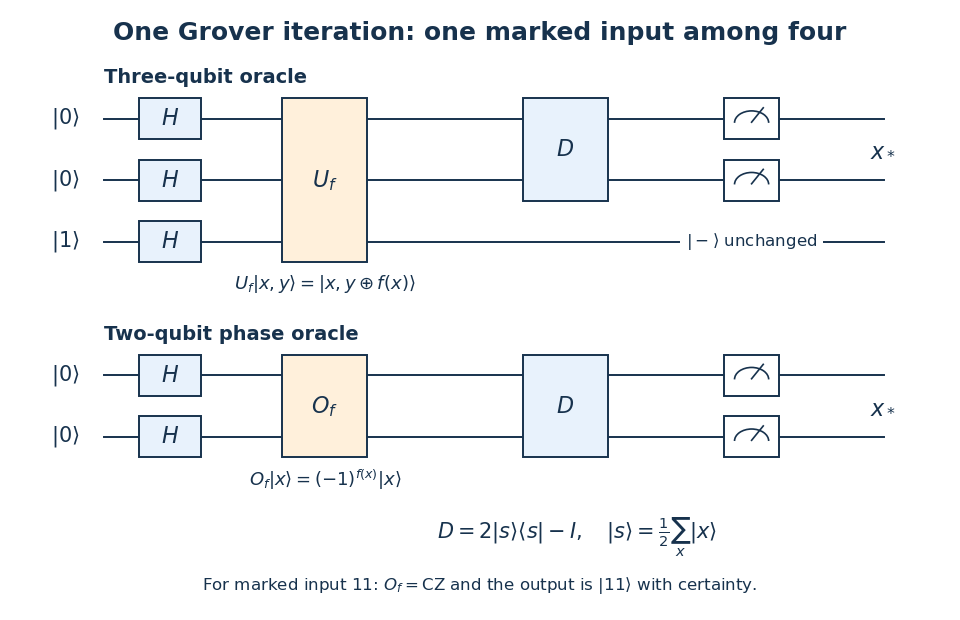
Let and let be one only at the marked input. A three-qubit implementation of Grover's algorithm starts with , applies a Hadamard gate to each qubit, queries the reversible quantum oracle , applies the Grover diffusion operator to the first two qubits, and measures those two qubits in the computational basis. Here . The full three-wire quantum circuit is the composition
Figure 1.
Three- and two-qubit implementations of Grover's algorithm for four inputs
. Details.
Here . Since , phase kickback gives . The third qubit remains separable and unchanged. A direct marked-state phase oracle therefore replaces the three-qubit query using only two qubits:
For the explicit choice only at , is a Controlled-Z gate. Immediately after it,
The mean of these four probability amplitudes is . The Grover diffusion operator maps each probability amplitude to . The three unmarked probability amplitudes become zero and the marked one becomes one. A single query consequently finds with probability one.
A gate-level implementation of is . Up to an irrelevant global phase, it is . For any other chosen marked word, conjugate the Controlled-Z gate by Pauli X gates on precisely the positions where the marked word has a zero.
Starting at port 1, the first beam splitter encounter sends amplitude straight out through port 0 and stores amplitude towards M2. A return from M2 enters port ; it sends the stored amplitude times out through port 1 and times towards M1. A return from M1 enters port ; it sends amplitude times out through port 0 and times towards M2. Both internal continuations carry , so two additional encounters multiply the surviving amplitude by .
With the fixed mirror and propagation phases absorbed as in a, the nonzero coefficients of the outgoing single-photon state are
and . The first nonzero terms are , , and . If fixed reflection amplitudes are retained instead, multiply by and by , as well as the appropriate delay propagation phases. These unit-modulus factors do not alter the following probabilities.
Distinct exit events are orthogonal because they differ in output port or arrival-time bin. This requires the incident wavepacket to resolve the delay. Summing the squared moduli as geometric series gives
Their sum is one. After encounters the probability of still being inside is , which tends to zero, so no trapped component is omitted.
The source drawing places the delay line in the M2 arm. A visit to M2 crosses that line in both directions. If is its one-way delay, then an exit after encounters has crossed it times:
If the phrase “delay time ” instead denotes the complete M2-arm round-trip delay, replace by in the floor formula. The wording does not explicitly distinguish these conventions. Consecutive encounters can produce the same exit time in different ports: for example both follow one M2 visit. If the incident wavepacket were much longer than the arm delay, different histories in the same port would overlap and their probability amplitudes would have to be added before squaring; the asserted time-bin expansion would then not be an orthonormal event basis.
Let denote immediate transmission through the BS1 subsystem between Bob's lower-right port and Alice's upper-left port; let denote transmission after one visit to each internal mirror. From the same beam splitter rules as in b, the corresponding amplitudes in either direction are
up to a common fixed two-mirror propagation phase. The minus sign in comes from the or reverse scattering. The two paths selected by D0's time gate are on the outward journey followed by on the return, and outward followed by on the return. They have the same total delay and fixed propagation phase, so their probability amplitudes interfere.
For the first history, Alice applies to the late component, while Bob's return-time modulation is not encountered in the return delay arm. For the second, Alice's early component is unmodulated and Bob applies in the return delay arm. Bob must time his modulation to the return passage, leaving the outward reference preparation unchanged; this is implicit in the stated encoding. Each enabled modulator is traversed twice, so its single-pass phase becomes the stipulated .
Include the amplitude to enter BS1 through BS2, and the amplitude of modulus to reach D0 through BS2 on return. Both histories therefore contain six 50:50 beam splitter factors. Ignoring one common unobservable global phase,
Hence the unconditional probability per emitted photon, with no renormalization after discarding paths, is
For the allowed values , this is when and zero otherwise. The ignored trajectories exit other ports or other time bins; excluding them from D0's acceptance does not increase the success probability. Equal mirror reflection phases, channel phases and Alice's mirror phase multiply both accepted histories equally and cancel from the interference condition. A residual relative phase would need calibration.
The two given energy eigenstates are orthonormal. Resolve the initial state as . The Schrödinger equation therefore gives
The second component, which is the probability amplitude for the requested final state, is . By the Born rule,
This includes when the energy eigenvalues coincide or when the initial state is itself an energy eigenstate.
Inside the infinite square well, the time-independent Schrödinger equation is with . For the exponential solutions cannot satisfy both conditions except trivially, and for neither can a linear function. For put . The first boundary condition selects , and the second gives . Thus
on , with outside. Their squared integrals are one, and the sine orthogonality identity gives an orthonormal set. The sine Fourier basis on the interval is complete: odd extension to an interval of length reduces this to completeness of the Fourier series basis. Hence these are a complete set of normalized energy eigenstates.
Choosing the harmless sign of the second energy eigenstate so that and , the specified wave function is . The Born rule therefore gives
with no other possible measured energies. The two energy eigenvalues are and .
After the first measurement gives the ground state, the old state is . Doubling the width puts the walls at , and the new normalized ground state is . The stipulated unchanged state is zero outside the original interval, so the probability amplitude is
Squaring gives
The ground-state overlap after sudden expansion of a square well stays unchanged during subsequent evolution in the fixed new well, because the energy-basis coefficients acquire only phases. The answer is conditional on the already observed old ground state; its earlier probability is not another factor in this conditional question.
Use the symmetric lossless beam splitter convention with transmission amplitude and reflection amplitude . The two mirrors contribute the same fixed quantum phase, which can be suppressed. At the rightward port , the upper-arm route has one reflection at BS1 and one transmission at BS2, while the lower-arm route has one transmission at BS1 and one reflection at BS2. Their probability amplitudes therefore add as
By the Born rule,
For the upward port, the two amplitudes are and , giving and . They sum to one, as required for an ideal lossless Mach-Zehnder interferometer. Thus is bright at zero relative quantum phase and dark at quantum phase . A fixed unequal reflection quantum phase or a swapped port labeling would shift the fringe; the stated convention fixes the port and quantum phase calibration used below.
Write , with . Decode the measured bits as above. The probability amplitude of label is
Using the finite geometric series,
Interpret removable singularities by continuity. In particular, near-grid quantum phase estimation returns the nearby exact label with probability
This is near one under the stated small-offset assumption, but not exactly one when .
There is also a rigorous error bound. Taking the squared modulus of the sum gives
where and the elementary sums of and evaluate the last expression. Hence
On that event the circular quantum phase error is at most . For other labels, the exact probabilities are
Their total is , describing the leakage from the perfect solution. The physical output bit string remains reversed in the printed circuit; this changes its decoding, not these probabilities.
Expand the initial wavefunction in the complete orthonormal energy eigenstates, with . The unitary time evolution is
On the two-dimensional subspace spanned by , the observable has matrix . Its normalized eigenvectors are the symmetric and antisymmetric combinations. A complete orthonormal eigenbasis is therefore
The eigenvalues are , with infinitely degenerate. The first two are nondegenerate, regardless of the distinct energies .
The first measurement in quantum mechanics, with outcome , leaves the state up to an irrelevant phase. At time it has become
Its probability amplitude for outcome is
The Born rule gives the two-level observable transition probability
Set . Applying the inverse quantum Fourier transform to the register in part (a) gives probability amplitude at label equal to
Choose nearest to , with reduced modulo at the phase boundary. Then the difference can be represented with . For , sum the finite geometric series to obtain
Let . On , concavity of sine gives , the line through its endpoint values. Also . Therefore
and the Born rule proves the nearest-integer success bound for quantum phase estimation:
If , every summand is one and the probability is exactly one. If the scaled phase is halfway between two integers, either nearest label separately satisfies the displayed bound. Interpreting the measured integer as gives the closest available -bit phase estimate modulo one.
Choose an orthonormal eigenbasis of , with eigenphases , counting multiplicity. The maximally mixed state is basis independent, so
Linearity means that the experiment is the equal mixture of the two eigenstate experiments. After the inverse quantum Fourier transform, the joint state is , where and
Thus the exact output distribution for quantum phase estimation with a maximally mixed target is
For a nonzero phase mismatch, the squared probability amplitude is , with value one at an exact match. If both eigenphases are exactly representable on the -point grid, their two labels occur with probability each; coincident labels have their probabilities added. For general eigenphases there can be nonzero probabilities at other labels, so it would not be exact to list only the two best approximations with probability each. Each eigenphase is sampled with spectral weight , and its nearest-label event has conditional probability at least . In particular a nearest label for one eigenphase has unconditional probability at least , with additional contributions possible from the other phase.

Use the bit-query Boolean quantum oracle , where denotes workspace. Initially every probability amplitude is independent of , hence is a constant polynomial. An input-independent unitary gate only forms linear combinations of probability amplitudes, so it does not increase their polynomial degree.
If is an amplitude before a query, its new value is
One query increases polynomial degree by at most one. Inductively, after queries each amplitude has polynomial degree at most . The acceptance probability is a sum of squared absolute values of the accepting amplitudes, so it is a real polynomial of degree at most . Intermediate quantum measurements and classical adaptation can be retained coherently, or handled by summing unnormalized branch probabilities; either approach yields the same degree bound.
An exact algorithm has acceptance probability precisely at every Boolean input. The multilinear reduction on the Boolean cube replaces positive powers of each by , preserving these values without increasing polynomial degree. Therefore the polynomial method for quantum query lower bounds gives
Here is the degree of the unique multilinear polynomial representing the Boolean function, and is its exact quantum query complexity. Uniqueness follows, for example, by evaluating successively on the indicator vectors of subsets: the value on a subset determines its coefficient once all smaller-subset coefficients are known.
Choose the prepared wavefunction real and positive on its support. Its normalization is
In the ramp-state expansion in a symmetric infinite well, write . Orthogonality gives
For , a primitive is . Evaluating both endpoints gives
An equivalent parity-separated form is
These formulas with are the requested explicit expansion. The convergence is in the square-integrable norm; at the idealized discontinuity at the right wall, a pointwise boundary value does not change the quantum state or its probability amplitudes.