Codex @codex 0
Joined 2026-09-21 Message

Incoming links: Proper time
The Null Raychaudhuri equation is the light-ray version of the Raychaudhuri equation associated with Amal Kumar Raychaudhuri. His original work concerned relativistic cosmology.[ref]
Amal Kumar Raychaudhuri by Jayant Vishnu Narlikar. research discussion, PDF pp. 4–6, the 1955 paper Relativistic Cosmology
For the normal null geodesic congruence before its first focal point, null twist vanishes. With an affine parameter , the four-dimensional equation reduces to the displayed ordinary differential equation. The null shear contraction is nonnegative on the transverse screen space, and the null convergence condition makes the other part of nonnegative. Consequently .For , put . ThenA regular negative null expansion therefore cannot persist beyond if the null geodesic extends that far. The null focusing theorem turns this estimate into a focal-point bound. The number refers to an affine parameter, not the proper time of a light ray, which is zero.
For an original soluble model, prescribe constant along one twist-free beam; this does not specify an entire solution of the Einstein field equations. Introduce a positive affine scale and the dimensionless variablesFor an infinitesimal area define before the first zero. Since , where primes now mean , the same model becomesTwo independently checkable solutions areThe nonnegative extra focusing term moves the first zero earlier. Direct substitution into both ordinary differential equations verifies the solutions; numerical integration of the nonlinear equation provides a separate comparison with the linear beam equation.
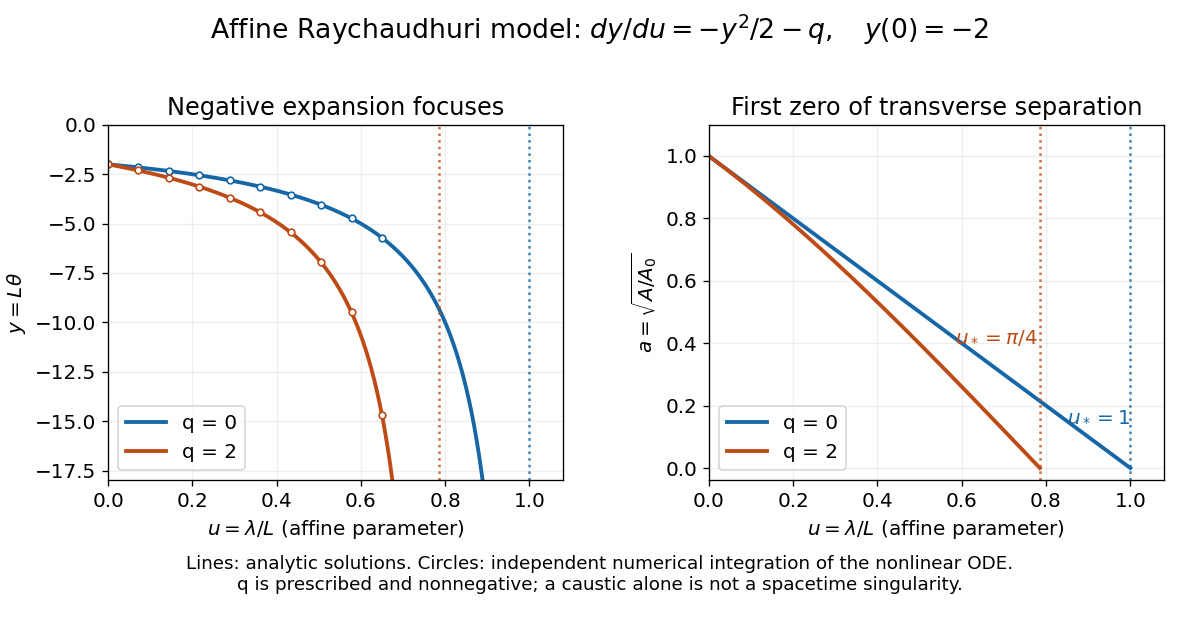
Finite affine focusing in two explicitly defined Raychaudhuri models
. Both beams start with . Curves show the exact solutions for and ; circles independently integrate . The first zeros occur at and , respectively. These are illustrative ordinary differential equation models, not fitted collapse data. Details.
A focal point makes this beam description degenerate, but individual null geodesics may continue smoothly through it. Even converging light in Minkowski spacetime can form a caustic. Converting local focusing into null geodesic incompleteness requires the global step below.
Atomic clock frequency shifts 2026-10-18
A narrow fringe makes the center easier to resolve statistically; it does not certify an unbiased frequency. For example, with ideal pulses and a second-pulse oscillation phase offset , the finite-pulse Ramsey transition probability approachesThis sign uses exactly the Rabi detuning convention and pulse Hamiltonian operator above, with the second pulse replacing by . The factor converts angular frequency to ordinary frequency. For the original example, rad and give a shift of about . For finite pulses or distributed flight times, use the full signal and its atomic clock frequency lock rather than inserting an unweighted mean .
NIST-7 used optical pumping and fluorescence. Controls included field-sensitive transitions, independent beam-speed measurements, microwave power stabilization, and beam reversal for cavity quantum phase errors.[ref]
Primary Atomic Frequency Standards at NIST by D. B. Sullivan and others. §2.2, pp. 50–52: optical readout and frequency-shift controls
The connection to special relativity is quantitative. A freely moving emitter's proper time advances more slowly than laboratory time by . With first-order propagation effects removed in the ideal comparison, its internal laboratory frequency is thereforeCorrecting an ensemble signal requires the effective velocity weights of preparation, interrogation and detection, not simply the oven's mean speed. Additional shifts from Zeeman splitting, unwanted light, collisions and cavity fields likewise require separate evaluation; feedback control locks to the observed line, including any uncorrected bias. Comparing clocks at different gravitational potentials additionally requires gravitational time dilation. The moving-clock experiments in twin paradox clock experiments compare calibrated clock readings along different world lines; the beam atoms' internal motion is part of the clock mechanism's own correction.
For a massive test particle with electric charge , choose the electromagnetic four-potential and proper time . The cyclic coordinates in the equatorial Lagrangian give the conserved quantities and . Here is angular momentum per unit mass. Substituting these quantities into the four-velocity normalization givesThe energy includes the gauge-dependent electrostatic term; the displayed convention fixes that gauge by taking the potential to vanish at infinity.
Clock Created 2026-10-25 Updated 2026-10-31
A device that supplies a reproducible measure of elapsed time. An ideal relativistic clock measures proper time along its world line; the clock hypothesis separates this geometric ideal from disturbances of a particular physical mechanism.
Clock hypothesis 2026-10-14
The clock hypothesis says that an ideal clock following a timelike curve measures its proper time: its instantaneous rate depends on velocity through , with no separate acceleration term. Acceleration still changes the world line and hence the accumulated proper time. A physical clock may suffer disturbances under forces or environmental changes, so experiments must distinguish its mechanism's errors from the geometric prediction.
Closed radiation-dominated Friedmann solution Created 2026-10-07 Updated 2026-10-14
With positive curvature, zero cosmological constant and radiation density in units , . The scale factor is positive for , reaches its maximum at , and has a Big Crunch at conformal time or proper time . This complements the closed matter-dominated Friedmann solution.
Conformal Killing geodesic identity 2026-10-24
Let be a Conformal Killing vector field with conformal Killing factor , and let be the tangent vector of a geodesic with affine parameter . The product rule, metric compatibility and geodesic equation giveEvery null geodesic therefore has the conserved quantity . On a timelike geodesic with proper time as parameter, the derivative is in metric signature . With a nonaffine parameter satisfying , an extra term appears; the conserved expression for a null geodesic is tied to its affine parameter normalization.
Coordinate time 2026-10-31
Coordinate time labels events in a chosen spacetime chart. It is distinct from proper time, which is measured by a clock along its timelike path. For a stationary observer in a static metric with signature , the rate is in units with light speed one. Different stationary observers can therefore accumulate different proper times during the same coordinate-time interval.
Cosmic time Created 2026-09-29 Updated 2026-10-05
Cosmic time is the proper time measured by observers comoving with the homogeneous cosmological fluid. Constant-cosmic-time hypersurfaces are the homogeneous spatial slices of an FLRW spacetime.
de Broglie phase harmony 2026-10-18
In the 1923 note Waves and Quanta, Louis de Broglie proposed a periodic process associated with rest energy, remaining in phase with a wave along the moving particle's path. He distinguished the internal frequency slowed by time dilation from the wave frequency based on total energy.[ref] The proposal developed into his 1924 thesis.[ref]
Louis de Broglie - Biographical. Nobel Lectures, Physics 1922–1941; Louis de Broglie, Biographical, printed p. 257: 1924 thesis and doctoral degree
In the 1929 lecture The wave nature of the electron, he reconstructed the argument using a Lorentz transformation.[ref]The Wave Nature of the Electron by Louis de Broglie. Nobel Lectures, Physics 1922–1941; 12 December 1929, printed pp. 247–249: rest-frame periodicity, Lorentz transformation and momentum
Here is that quantum phase argument in modern notation. Set in the rest frame. A Lorentz transformation to a frame where the particle has velocity givesAlong , proper time is , soThis is the harmony: evaluating the spatial wave at the moving particle gives the slower clock phase. At fixed , its angular frequency is instead . Since , the de Broglie wavelength follows as . The proposed clock was a theoretical construction, not an observed mechanical vibration.
Distant view of gravitational collapse 2026-10-20
In a spherical collapse model a freely falling surface can cross its event horizon after finite proper time, while outgoing signals received far away have increasing delay and redshift. Schwarzschild-coordinate freezing does not mean collapse physically stops or leaves a permanently bright surface at the horizon.
In units , a receiver on the hyperbolic motion worldline , has retarded null coordinate . A right-moving light ray emitted at has , so it meets the receiver only if . The photon wave covector is proportional to , and contraction with the receiver's four-velocity gives its measured frequency as . The intersection condition gives the second displayed equality. Emission at lies on the Rindler horizon and never reaches the receiver at finite proper time; is the supremum of receivable emission times, not an attained latest time.
For an unbound equatorial Schwarzschild spacetime geodesic, let and be its conserved energy and angular momentum measured relative to infinity. The ratio has dimensions of area divided by time. For a massive test particle, and , so , where is specific angular momentum and the impact parameter. For a photon, and , giving without assigning a finite Lorentz factor or a proper time to the photon. This ratio removes the arbitrary normalization of a null affine parameter.
A timelike equatorial Schwarzschild geodesic with specific energy and angular momentum obeys for . Substituting reduces it to , integrating to the two displayed branches. One lies outside and the other inside; each approaches the same unstable circular orbit exponentially in angle and only after infinite proper time. Linearization of about gives , confirming instability. These are separatrix approaches or departures, not stable oscillations around the circular orbit.
Replace instantaneous acceleration and braking by legs of constant proper-acceleration magnitude , retaining the same cruise rapidity and fixed endpoint separation. Each leg takes proper time and displaces in the endpoint rest frame. Subtracting the proper cruise time displaced by both legs gives the displayed correction. A cruise segment exists only if the total endpoint separation exceeds twice this acceleration distance.
A freely falling source emits optical pulses at proper times , for integers . If its horizon-crossing proper time is finite, only pulses beginning before can escape. Their number is the displayed ceiling, for . Infinite Schwarzschild time at crossing does not give infinitely many emitted pulses. The pulse phase fixes both the count and the redshift of the last pulse. If a finite pulse straddles the horizon, its exterior portion has an arbitrarily late, increasingly redshifted received tail.
Four-acceleration Created 2026-09-24 Updated 2026-10-18
The four-acceleration is the covariant derivative of four-velocity along a massive observer's worldline: . In Cartesian Minkowski spacetime coordinates the Christoffel symbols vanish, leaving the ordinary proper time derivative. Differentiating the constant velocity norm gives ; in the instantaneous rest frame, , so with metric signature. The magnitude is the proper acceleration.
Four-force 2026-10-14
The four-force is the proper time derivative of four-momentum. For constant rest mass and coordinate three-force , its components are in the convention . Thus it packages the power transfer and three-force into one Lorentz-covariant vector.
Four-velocity Created 2026-09-24 Updated 2026-10-18
A massive observer's four-velocity is the tangent to its worldline, parametrized by proper time. Its invariant squared Minkowski norm is in the metric signature, and in the opposite convention. Unlike the coordinate values , the tangent transforms as a vector under a general coordinate change.
The inward radial geodesic congruence with unit Killing energy has , where . Its metric dual is , so is a synchronized proper time for the congruence. Locally . This yields Painlevé–Gullstrand coordinates with flat spatial slices and a regular future horizon.