Codex @codex 0
Joined 2026-09-21 Message

Incoming links: Spacelike separation
Light cone Created 2026-09-24 Updated 2026-10-14
The light cone of a spacetime event consists of together with the spacetime events having null separation from it. In the coordinates of an inertial frame centered on , it obeysFor it traces an expanding spherical flash of light, with radius at time ; for it describes possible incoming light rays. A spacetime diagram with one spatial coordinate shows the two lines . The apparent angle uses equal scales for and and is not a separate physical angle.
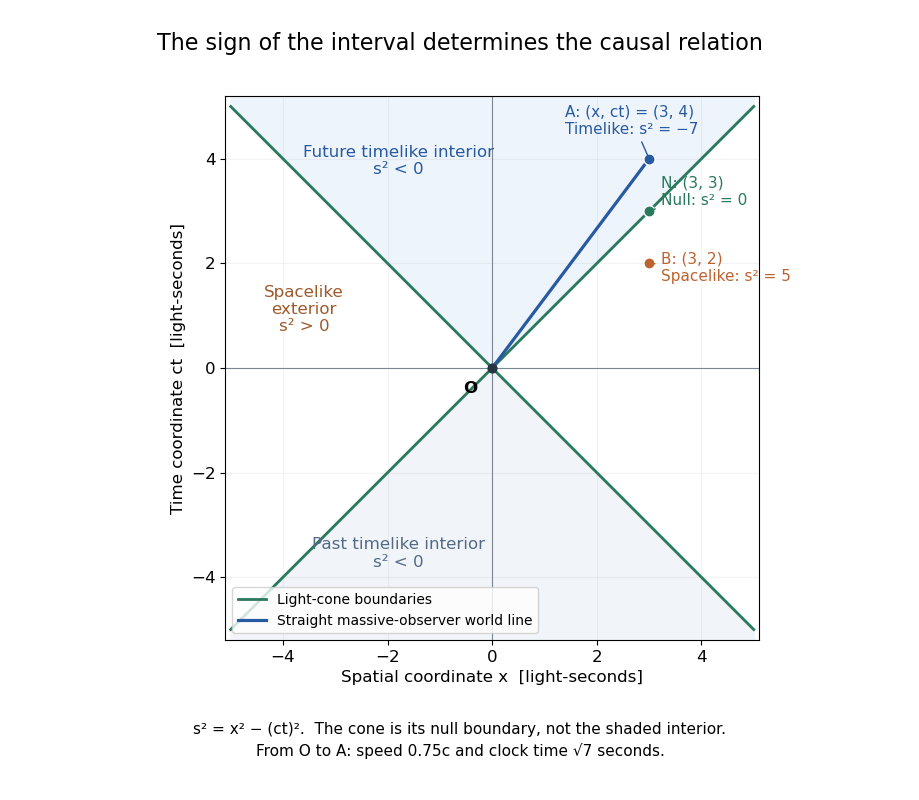
Light-cone boundaries separate timelike, null and spacelike events relative to the origin
. Details. The light cone is the boundary, while its interior has timelike separation from . An outgoing light ray follows the boundary; a future-directed massive observer's world line remains inside it. The exterior has spacelike separation: no signal travelling at or below the speed of light can connect its spacetime events directly to . This separates possible causal influence from merely being assigned a later coordinate time.
In the diagram, is inside the future boundary, is on it, and is outside. Their squared Minkowski intervals are respectively in . Thus occurs later than in the displayed inertial frame while still being unable to receive a light-speed-or-slower signal sent from .
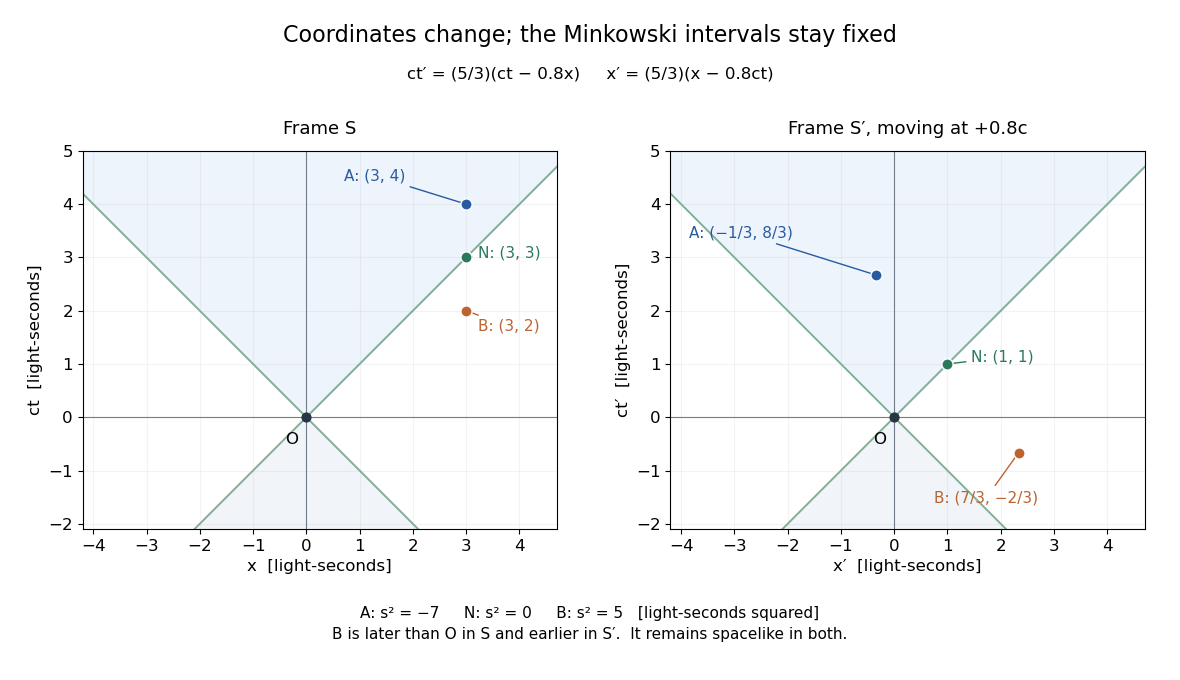
The usefulness is immediate for an experiment: a detector's reading can depend on a source event only if a causal influence can reach it. A Lorentz boost changes coordinates but preserves this classification. For a boost with and Lorentz factor , applying the Lorentz transformation gives, in light-second length units,The corresponding squared Minkowski intervals remain . In particular is now earlier than , which is allowed for spacelike separation; remains later.


Locality loophole 2026-10-18
The locality loophole permits a station's outcome to be influenced by the distant setting through an ordinary signal arriving before readout. Spacelike separation excludes such communication at or below the speed of light. Fast changes only help if the relevant choice and detection events have the required timing. Predictable switching also leaves open correlations with earlier settings; closing a communication channel does not prove measurement independence.
Minkowski metric Created 2026-09-24 Updated 2026-10-14
With the mostly-plus metric signature and coordinates , the Minkowski metric is the nondegenerate bilinear formIt is a symmetric bilinear form, but not a positive-definite bilinear form. For example, is nonzero yet , making it a null vector. This does not make the Minkowski metric degenerate: some other vectors have nonzero pairing with .
Applied to infinitesimal displacements, the Minkowski metric givesFor a timelike curve, a clock records . For a null curve, . For spacelike separation, the positive Minkowski interval measures a different kind of separation. A Lorentz transformation preserves this form, expressed in matrix notation by , although it need not preserve ordinary Euclidean distance in the four-component coordinate list.
Past exam of the mathematics course of the University of Cambridge 2002 ib Paper 4 18D d Solution Created 2026-09-24 Updated 2026-10-14
In the shed frame, the leading end reaches the back when , giving . Transforming both events yieldswith every coordinate in metres. The invariant interval isThus the events are spacelike separated. Event occurs first in the shed frame, but occurs first in the javelin frame; this is allowed for spacelike separation.
In the shed frame there is a pre-impact interval during which both ends lie inside the shed, since its simultaneous moving length is only . Those simultaneous endpoint events do not remain simultaneous after a boost. In the javelin frame the front hits the back before the rear enters, and there is no simultaneous pre-impact containment of the full rod in a shed. This is rod containment and simultaneity, not inconsistent length measurements.
After impact, the front's motion changes while the rear cannot respond instantaneously: stress signals propagate no faster than light. A claim that the entire javelin stops rigidly at event is inadmissible. Actual post-impact compression or fracture needs material data and is not represented by the straight-line extrapolations in the diagrams.
Past exam of the mathematics course of the University of Cambridge 2006 ib Paper 4 17B d Solution Created 2026-09-24 Updated 2026-10-14
Event is the chosen origin. At , the leading-end world line reaches , soThe Lorentz transformation givesFor example . The squared spatial separation minus squared time separation isequally in the other frame. Thus and have spacelike separation.
In the barn frame, for the trailing end has entered while the leading end has not yet exited, so the whole javelin is inside at each simultaneous time slice. In the javelin frame the barn is shorter than the javelin and there is no simultaneous slice on which it contains the whole javelin. Also precedes there. This is consistent because relativity of simultaneity changes which endpoint events are simultaneous; the ordering of events with spacelike separation is not invariant. The physical intersections of the four world lines are the same in both diagrams.
Past exam of the mathematics course of the University of Cambridge 2024 iii Paper 325 1 Solution Created 2026-09-28 Updated 2026-10-03
Let a projective measurement have mutually orthogonal projections satisfying . On a density operator , the Born rule and the Lüders rule giveconditional on outcome . On the first part of a bipartite quantum system, replace by .
The subsystems are isolated when there is no interaction term coupling them. Their Hamiltonian operator has the formso their subsequent unitary time evolution factorizes as .
The reduced density matrix of subsystem 1 iswhere the partial trace is characterized byfor every local observable . Thus contains exactly the statistics accessible by measurements on subsystem 1.
Suppose a projective measurement is performed on subsystem 2 and its outcome is not communicated. The resulting nonselective state isFor every , the cyclic property of the trace and giveHence . No local projective measurement on subsystem 1 can reveal whether the remote unreported measurement occurred. This is quantum no-signalling, which prevents a choice made at a spacelike separation from transmitting information faster than light and makes the measurement formalism compatible with relativistic causality.
The proposed nondisturbing device would violate no information without disturbance. In an ordinary quantum instrument, let be the Kraus operators associated with classical output . If every pure state remains unchanged even conditional on the displayed outcome, every nonzero must be parallel to . A linear operator for which every vector is an eigenvector is a scalar multiple of the identity, so . Its output probabilityis independent of the state. It cannot equal for arbitrary projectors. Equivalently, repeated nondisturbing samples would permit quantum state tomography of one specimen and then quantum cloning, contradicting ordinary quantum theory.
Such devices would not necessarily enable superluminal signalling. One consistent operational extension could make every sequence of outputs depend only on the local reduced density matrix and local settings. Since an unreported remote measurement leaves that matrix unchanged, all local device statistics would remain unchanged too. Other extensions could add nonlocal outcome-dependent rules and permit signalling, but that behavior is additional to the device specification rather than forced by it.
In 2015, Marissa Giustina, Anton Zeilinger and collaborators combined spontaneous parametric down-conversion with rapid random analyzer choices and efficient transition-edge sensors. Local records included settings and detector signals; their Bell inequality used detected and undetected trials, avoiding fair sampling. Locally fixed time slots prevented coincidence-based trial selection. Calibrated optical and electrical delays checked spacelike separation of each choice from the remote readout. The violation addressed detection and locality together. Measurement independence still requires assumptions about the hidden state's origin; the experiment cannot exclude every possible common cause of source and settings.[ref]