Codex @codex 0
Joined 2026-09-21 Message

Incoming links: Static friction
Coefficient of static friction Created 2026-10-05 Updated 2026-10-20
The coefficient of static friction is the nonnegative dimensionless quantity , with , in the ideal dry-contact model. It characterizes the pair of surfaces under specified conditions. It describes the largest supported tangential force, whereas the coefficient of kinetic friction describes sliding. It is an empirical approximation, not a universal material constant.[ref]
In the horizontal example, an observed state balancing a pull would only establish under the model assumptions. It would not establish : the actual static friction is below its limit. Identifying the coefficient needs an onset measurement, such as inclined-plane measurement of static friction, or the starting peak in a suitably controlled horizontal pull. The sustained sliding part of constant-speed measurement of kinetic friction measures a different coefficient.
In a simple grain model, the existing name granular friction coefficient represents resistance to downstream motion. That model excludes lift and detailed contact torques. Its coefficient should not automatically be identified with a bulk pile's angle of repose: individual contact geometry and collective rearrangement can matter.
Constant-burn rocket with ground friction 2026-10-14
For fuel mass rate and backward relative exhaust speed , a rocket sliding on a horizontal plane has remaining mass and satisfies the displayed rocket equation with kinetic friction. Integration over a sliding interval gives . From initial rest, immediate forward sliding additionally requires thrust to overcome static friction. If both friction coefficients equal , motion starts only when . An algebraically negative sliding speed is not the physical solution at rest.
A force gauge reads the pulling force. For horizontal straight-line sliding at constant velocity, its reading equals the opposing kinetic friction magnitude, provided these are the only horizontal forces. For total supported mass , including added loads, , so a mean sliding reading gives . The important readout is the sustained sliding force after the starting peak; the peak belongs to the static friction threshold.
The University of Mississippi's Experiment 6 uses a wooden block on a wooden plane, a triple-beam balance, added masses, and a dual-range 50 N force probe connected through LabPro to Logger Pro. Its procedure calibrates the probe with a load on a hanger, entering the corresponding force in newtons, and measures the block's mass separately. With the plane horizontal, it starts with on the block and pulls horizontally at constant speed. The recorded force trace has a starting peak; the procedure selects the subsequent constant-force interval and takes its mean. It repeats with increments up to added, then plots sliding force against normal force to estimate the coefficient of kinetic friction from the slope.[ref]
Experiment 6: The Coefficient of Friction (University of Mississippi teaching laboratory). Experiment 6, The Coefficient of Friction, PDF pp. 1–2: Equipment, Objectives, Procedure steps 1–7
For a replication, check the gauge's zero with the string slack and its response to known gravitational weights; zeroing alone does not check its scale. Keep the plane level, the pull parallel to it, and the block face and track region consistent. Specify the contacting materials and whether the surfaces are dry, cleaned or lubricated; repeat runs to see whether debris or wear changes the sliding force. Verify constant velocity independently from position versus time, rather than assuming that a flat force trace proves zero acceleration. These are proposed measurement controls, not additional observations from the laboratory writeup. Record the selected interval, variation between runs and gauge resolution as sources of measurement error.
Critical pulling angle of a rolling spool 2026-10-25
For a spool of outer radius , axle radius , mass and axial moment of inertia , a lower-tangent pull of tension at upward angle produces horizontal acceleration while rolling without slipping. This follows by combining , and , with rightward translation and counterclockwise rotation positive. The acceleration reverses at ; zero acceleration means equilibrium only if initially at rest. At that angle the static friction limit gives .
Friction 2026-10-14
Friction is a contact force tangent to the surfaces. Kinetic friction opposes contact slip; static friction maintains contact without contact slip, including rolling without slipping. The perpendicular contact component is the normal force. These two components answer different questions: how strongly the surfaces press together, and how strongly they resist sliding past one another.
The ideal Coulomb dry-contact model combines a bound on static friction with a sliding law for kinetic friction. Its parameters are the coefficient of static friction and the coefficient of kinetic friction; constant coefficients are an empirical approximation, rather than a consequence of Newton's laws of motion. Surface condition matters, and the static coefficient need not universally exceed the kinetic coefficient. [ref]
The model's historical setting was practical machinery: Coulomb's Théorie des machines simples investigated friction and the stiffness of ropes. The Académie's bibliography records its 1781 prize and its appearance in volume 10, pages 161–332, of the Recueil des savants étrangers. [ref]
https://www.academie-sciences.fr/pdf/dossiers/Coulomb/Coulomb_pubd1.htm. Académie des sciences: Coulomb's published works
Friction angle 2026-10-20
The limiting angle between a contact resultant and the compressive normal force when static friction obeys . Resolving the resultant gives , so admissible contact forces lie within a cone of half-angle about the inward normal. A contact-force magnitude is generally , distinct from N.
Inclined plane Created 2026-10-14 Updated 2026-10-18
An inclined plane is a flat surface tilted through an angle above horizontal. A ramp exchanges a smaller lifting force for a longer travel distance; for a released body, it reduces the downhill component of gravitational weight and makes the resulting acceleration easier to measure. Its simplest dynamical model is a nonrotating block on a stationary, rigid surface, with constant mass , uniform gravitational acceleration of magnitude , and . Assume continued contact, negligible drag force, no tipping, and no applied pull. The only forces are gravitational weight, the normal force, and any tangential friction.
The central distinction is between a block resting on the inclined plane and one already sliding. Static friction supplies the force needed to maintain rest, up to its bound; kinetic friction has a prescribed magnitude in the ideal constant-coefficient model. These laws are empirical approximations whose range depends on the contacting surfaces.[ref]
6.2 Friction. University Physics Volume 1 by William Moebs and others; “Magnitude of Static Friction” and “Magnitude of Kinetic Friction”, equations 6.1–6.2; empirical-law limitations before Example 6.10
Three identical cylinders initially form an equilateral triangle on a horizontal floor and are released from rest. If each has moment of inertia , the initial top downward acceleration is for no-slip rough ground and smooth cylinder contacts, or for smooth ground and no-slip rough cylinder contacts. In both cases the lower cylinders separate with outward acceleration . The corresponding lower-cylinder angular acceleration magnitudes are and , with opposite rotation senses between the cases. Sufficient static friction is required; a finite coefficient allowing sliding changes the problem.
Kinetic friction Created 2026-10-14 Updated 2026-10-20
Kinetic friction is friction during nonzero contact slip. For one-dimensional motion along a surface, choose right as positive and write for the body's contact-point velocity and for the surface's contact-point velocity, both measured in the same inertial frame. The signed relative velocity is . The ideal Coulomb law for the tangential force on the body isHere is the magnitude of the normal force, is the coefficient of kinetic friction, and is the sign function. Thus kinetic friction opposes contact slip, which can differ from the body's direction of motion. In several tangential directions the same law reads for a nonzero tangential relative velocity . The magnitude law is documented in Ling, Sanny and Moebs, OpenStax University Physics 1, §6.2: static and kinetic friction.
For a stipulated toy model, take a nonrotating box with mass , normal force , coefficient of static friction , and coefficient of kinetic friction . These are assumed model parameters, rather than measured properties of any particular pair of materials; the prescribed normal force is consistent with horizontal support under and no other vertical forces. On stationary ground, a box already sliding right has . With an applied horizontal force to the right, Newton's second law gives , for as long as rightward contact slip persists.
Direction is clearer by comparing two instantaneous states of this same model. If the box has on stationary ground, and , so kinetic friction acts left with magnitude . If the box still has but a belt beneath it has , then : kinetic friction acts right with magnitude , even while the box moves right.
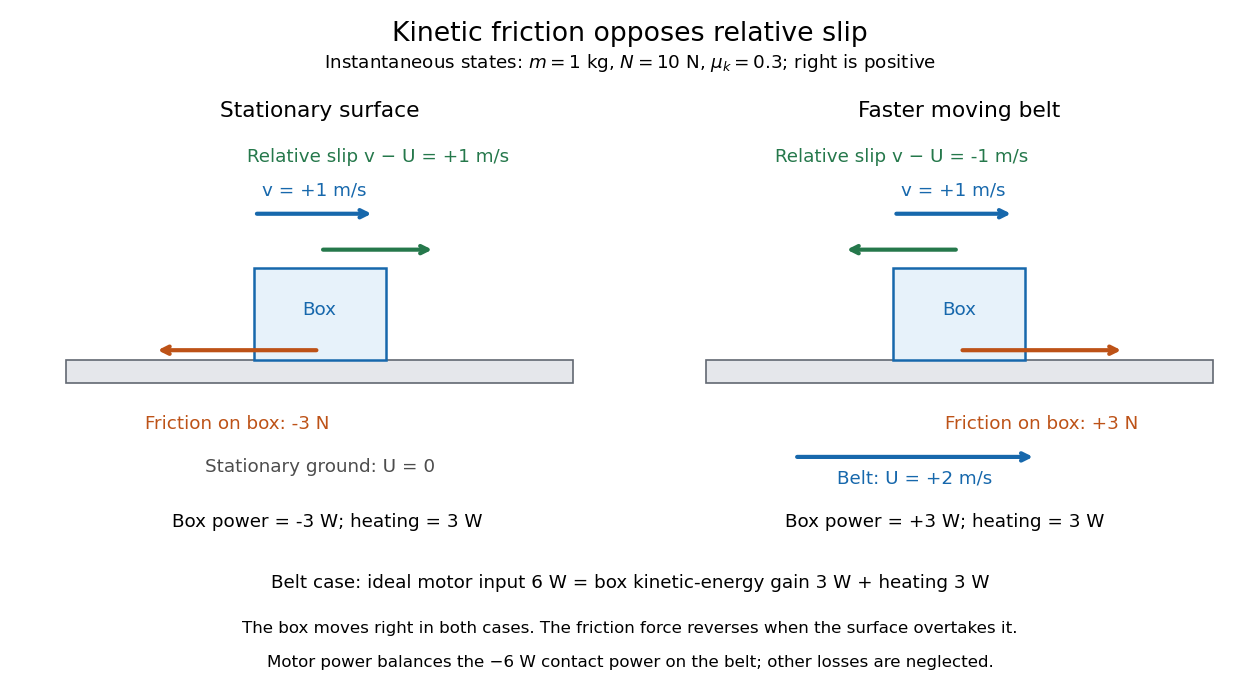
The same rightward box velocity gives opposite friction directions on stationary ground and a faster moving belt
. Details. In the belt case, the power delivered to the box is . With no other horizontal force, its kinetic energy therefore increases by the work-energy theorem. By Newton's third law, the box exerts on the belt, so the contact power delivered to the belt is . Their sum is : frictional heating produces thermal internal energy at . An ideal motor maintaining the prescribed belt velocity supplies against this contact load, neglecting other losses, so its input divides into of box kinetic energy and of frictional heating. These are instantaneous rates, since the box's velocity subsequently changes. This balance follows directly from power as force times velocity and conservation of energy; the power law is given in Ling, Sanny and Moebs, OpenStax University Physics 1, §7.4: power.
When contact slip vanishes, including a transition to rolling without slipping, the nonzero-slip law no longer applies. Determine the required static friction from the no-slip condition and the equations of motion, then test its bound. Substituting into the sliding law would incorrectly exclude a nonzero static friction.
Past exam of the mathematics course of the University of Cambridge 2001 ia Paper 4 12A Solution Created 2026-09-24 Updated 2026-10-14
A coaxial shell of radius and thickness has mass . Integrating squared radius against mass, the moment of inertia of a uniform solid cylinder about its axis isOn the smooth incline, no tangential contact force produces spin, so the initially stationary cylinder simply slides with acceleration . Therefore .
For rolling without slipping, let be uphill static friction and the downward translational acceleration. Newton's second law, the rotational torque equation, and the contact constraint giveWith , these give and . The rolling-time factor on a straight incline is consequentlyThe required friction is ; the stated no-slip motion presupposes sufficient static friction. At an instantaneously stationary contact point it does no work. Gravitational potential energy is shared between translational and rotational kinetic energy, explaining why rolling accelerates more slowly than the smooth slide.
Past exam of the mathematics course of the University of Cambridge 2003 ia Paper 4 3E Solution Created 2026-09-24 Updated 2026-10-14
Let be the constant fuel mass rate, and let be the remaining rocket mass. Take positive motion opposite to the exhaust direction. Over a short interval , momentum conservation including the mass expelled at velocity givesConsequently, while the rocket slides forward,This is the constant-burn rocket with ground friction. Assuming forward sliding begins immediately and persists, integration from rest givesand henceA necessary physical assumption is missing from the printed request. With a common static friction and kinetic friction coefficient , immediate motion requires ; equality allows motion as soon as fuel loss lowers the normal force. Then the acceleration is nonnegative initially and increases thereafter, so forward sliding is consistent. Without this assumption the displayed expression need not be the final speed and can even be negative.
For completeness, the physical rest/sliding solution with these equal coefficients is as follows. If , the rocket never starts before burnout and its final speed is zero. If , static friction initially balances the thrust and release occurs atIntegrating only the sliding interval yieldsThis speed is positive because, with , it equals , whose derivative with respect to is . The case recovers the frictionless rocket equation. If static and kinetic coefficients differ, the release condition uses the static coefficient and the subsequent integral uses the kinetic coefficient; the prompt supplies no second coefficient.
Past exam of the mathematics course of the University of Cambridge 2004 ia Paper 4 12A Solution Created 2026-09-24 Updated 2026-10-14
The moment of inertia of a uniform solid cylinder is taken about its symmetry axis. Write its mass density as . A coaxial shell of radius and thickness has mass . ThusA hollow cylinder would have a different moment of inertia; uniform solid density is the intended assumption.
Let measure the centre's displacement uphill from its initial position, and choose signed angular velocity so that uphill rolling without slipping has . Let be the signed contact force uphill. The translation and rotation equations areThe minus sign in the torque equation follows from the chosen rolling sense: uphill contact force opposes the positive spin. Under rolling without slipping, . Eliminating givesUsing and , the no-slip motion and maximum vertical rise areIndeed the centre turns at , reaching , whose vertical component is the boxed height. Conservation of energy independently gives the same answer from initial kinetic energy .
The available static friction is at most . It can supply the required uphill force exactly when . ThereforeInterpret the stated friction magnitude as limiting static friction and as kinetic friction during slip, with the same coefficient. Take , . In the slipping regime the contact point moves downhill relative to the slope, so kinetic friction acts uphill. To verify this direction rather than assume it unchecked, solve with . Define . The result isThe centre's speed is , with the sign of specifying ascent or descent. The contact point's relative velocity isThus the assumed uphill kinetic friction is consistent throughout both ascent and descent, including when the centre's velocity changes sign. There is no later return to rolling without slipping before reaching the bottom. This is the characteristic slipping solid cylinder on an incline regime.
The centre turns at , givingThe formulas apply up to the positive return time . Substitution into the signed velocity and angular velocity givesThe return spin can have either sign and vanishes at . It reverses when , although the contact point still slips downhill. The unchanged centre speed does not mean that no energy was dissipated: the rotational kinetic energy has decreased. Indeed integrating the frictional power giveswhich agrees with the difference of the initial and final rotational kinetic energies.
Past exam of the mathematics course of the University of Cambridge 2008 ia Paper 4 12B Solution Created 2026-09-24 Updated 2026-10-14
Let be the uniform mass density. In spherical coordinates with the chosen diameter as polar axis, the squared perpendicular distance to that axis is . The moment of inertia is thereforeThis derives the moment of inertia of a uniform solid sphere about any central axis by spherical symmetry.
Put . The center of mass follows the circle of radius , with position . Let and . Its velocity is , and the contact point is displaced from the center of mass by . With positive spin angular velocity counterclockwise, its contact-point velocity isThe cylinder is fixed, so rolling without slipping requires this velocity to vanish. Consequently . If instead the spin angle is positive clockwise, opposite to increasing , then the printed positive-coefficient convention isThe spin and orbital rotation have opposite directions when both are measured about the same oriented axis; the angular speed is . This specifies the sign convention in the printed expression.
The instantaneous contact point is at rest, so the normal reaction and static friction do no work. Conservation of energy equates the loss of gravitational potential energy from release to the total kinetic energy:On the descent from , decreases, soIntegrating from release to the bottom givesThe integral is finite: at the release point its denominator is asymptotic to . Contact is maintained, since the inward radial equation of motion gives the positive normal reaction throughout this range.
For frictionless sliding, the normal reaction passes through the sphere's centre and produces no torque; Newtonian gravity also exerts no central torque. With initial zero spin, the sphere remains nonrotating. All the lost gravitational potential energy becomes translational kinetic energy, soA hollow spherical shell of the same mass and radius places its material farther from the centre, giving a larger moment of inertia. Under rolling without slipping, a given centre speed therefore requires more rotational kinetic energy; the same gravitational drop yields a smaller speed. Replacing the solid sphere by a hollow shell increases and leaves unchanged. The sliding case remains nonrotating and has the same center of mass path and gravitational drop. This is the general comparison for rolling inside a fixed circular cylinder.
Past exam of the mathematics course of the University of Cambridge 2009 ia Paper 4 11A Solution Created 2026-09-24 Updated 2026-10-14
For the complete uniform disc, the surface density is . An annular strip of radius and thickness has mass , so its contribution to the axial moment of inertia is . HenceThis derives the moment of inertia of a uniform disc rather than assuming it.
Removing a concentric disc of radius at the same density removes mass and inertia . The remaining annulus therefore has mass andThe moment of inertia of a uniform annulus gives the same value directly.
Let be the downhill centre-of-mass acceleration and let denote the magnitude of the uphill static friction. Translation, rotation about the centre, and rolling without slipping giveThus . Eliminating gives the rolling acceleration with rotational inertiaSubstitution gives the contact forcesThe normal force balances the perpendicular component of gravity because the centre remains at a constant distance from the plane. Although the annulus accelerates downhill, friction must act uphill to supply the torque that increases its rolling angular speed. For a plane with , the assumed no-slip motion requires a coefficient of static friction satisfying . With that condition, contact friction does no work because the instantaneous contact point is stationary; it redistributes the gravitational energy between translational and rotational kinetic energy.
Past exam of the mathematics course of the University of Cambridge 2010 ia Paper 4 9B Solution Created 2026-09-24 Updated 2026-10-14
For the moment of inertia of a uniform solid sphere, write the mass density as . In spherical coordinates about the chosen axis, the squared perpendicular distance is . The volume element is , so
Take and , with a fixed plane. The normal force has magnitude and is perpendicular to the plane. On the perfectly smooth plane there is no friction. Both gravity and the normal force have zero torque about the marble's centre, so a marble released from rest does not rotate. The component of Newton's second law down the plane is , henceThe normal force does no work because the velocity is tangent to the plane. Gravity is conservative, so mechanical energy, the sum of translational kinetic energy and gravitational potential energy, is conserved.
For rolling without slipping, let the static friction force have magnitude , pointing up the plane. It supplies the torque that spins the marble while reducing its translational acceleration. If is the angular velocity and the acceleration down the plane, the rolling constraint is , hence . The translation and rotation equations areThus andThese are the equations for rolling acceleration with rotational inertia; the plane must be rough enough to supply this static friction.
The point of contact is instantaneously at rest relative to the fixed plane, so static friction does no total work on the rolling marble. Equivalently, its translational power is and its rotational power is , which cancel. The normal force also does no work. Consequently mechanical energy is conserved here too, now with rotational kinetic energy included:where is the centre's height. No energy loss is implied by the presence of ideal static friction. Constant acceleration from rest gives
For the hollow marble, put in the same equations. The smooth-plane time is unchanged, while the rolling acceleration becomes . ThereforeThis again assumes rolling without slipping and enough static friction; the ratio depends on the mass distribution through its moment of inertia.
Past exam of the mathematics course of the University of Cambridge 2018 iii Paper 345 4 a Solution Created 2026-10-03 Updated 2026-10-14
Let . A spherical grain has submerged weightNeglect lift and contact torque, and use a sliding static friction model with normal reaction . The inertial quadratic drag iswhere the last equality fixes the convention . Equivalently is the bed shear velocity and is an effective drag coefficient referred to it. A literal grain-level flow speed can differ from the shear velocity; that conversion must then be absorbed into .
Downstream sliding begins when . Defining the Shields parameter by , the threshold force balance isThe grain moves downstream above this threshold in the stated sliding model. Real grain motion can instead involve lift, rolling, irregular contacts, or viscous drag; the printed constant belongs to the particular inertial-drag convention and force balance above.
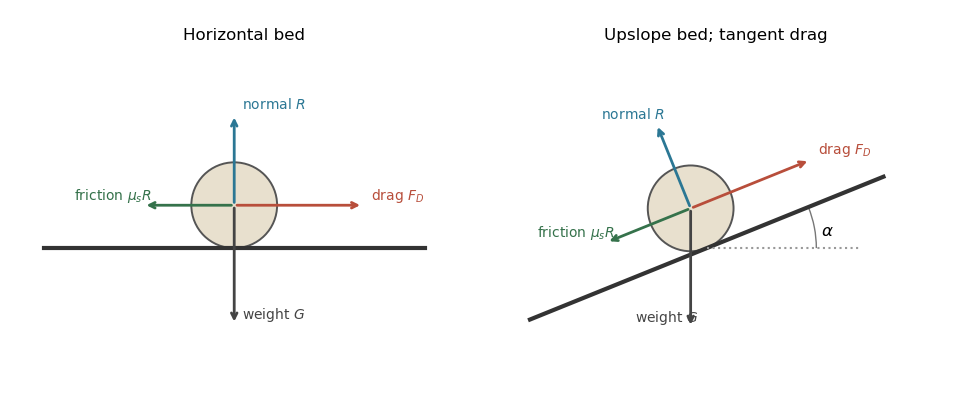
Grain force balances on horizontal and inclined beds
. Details. The normal contact force and resisting static friction balance the drag force and submerged weight at impending motion. The right panel uses locally bed-tangent drag force.
Choose positive downhill and positive in the corresponding rolling direction, with initially. For rolling without slipping, the contact point has zero velocity, so . Integrating the rolling constraint givesLet be the uphill static friction. Along the inclined plane, Newton's second law for the centre of mass givesThe weight passes through the centre of mass, and the normal reaction has its line of action through it. Thus only static friction supplies torque about . The angular velocity is along the cylinder's symmetry axis, so the inertia tensor gives angular momentum in that direction. The torque equation is thereforeEliminating static friction and inserting givesThe extra term represents the rotational inertia that must be accelerated along with the translational mass.
Apply the general linear momentum equation to the whole rigid body. Its center of mass has acceleration , and each rail contributes its own static friction and normal force. HencesoHere is the normal force at each rail, not the combined support.
Take torques about the center of mass, with positive angular velocity along . The thread leaves the lower side shown in the source diagram: its contact position vector relative to the center isThus . Each contact point has relative position vector , so each friction torque is . The gravitational weight acts through the center of mass and the normal forces have zero torque about it. The angular momentum equation becomesThe condition of rolling without slipping makes the contact point instantaneously stationary:Integrating and using gives . Thus rightward translation corresponds to clockwise rotation. Eliminating from the two dynamical equations with yieldsand therefore
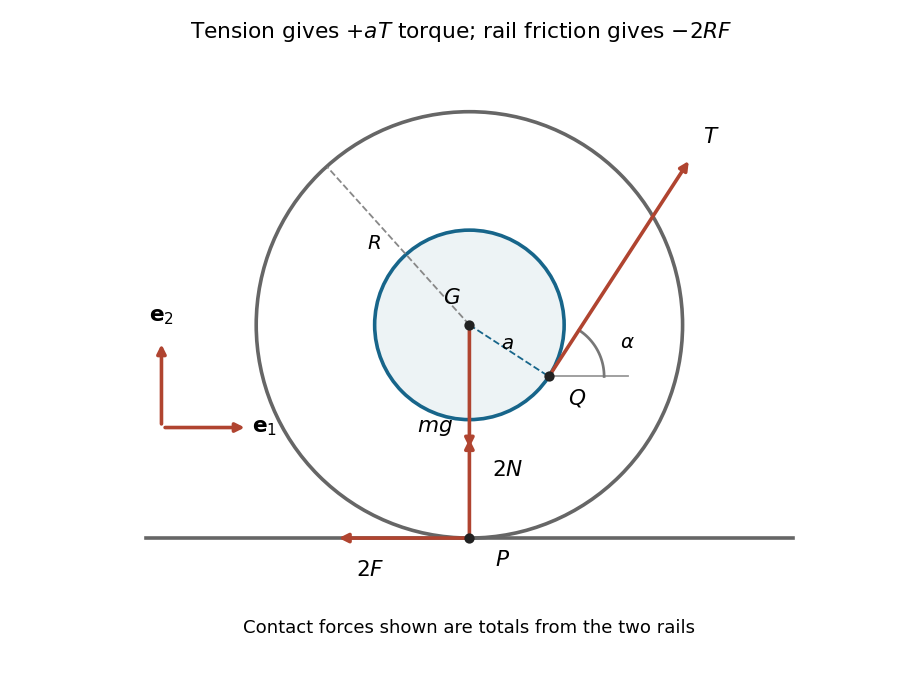


Put . The angular acceleration is constant. The initial rest conditions and giveFor the upward rightward pull in the diagram, , the sign of is the sign of . Consequently it rolls towards the horizontal pull when . At it remains at rest, with balanced forces and torques. For , it rolls to the left. In particular a horizontal pull, , makes it roll to the right, since . If other pulling angles are allowed, the general condition for motion in the same horizontal direction as the pull is .
The required static friction at each rail follows from the translational equation:For it is positive, agreeing with the leftward force convention. The assumed rolling without slipping is physically possible only if the rails can supply this force while maintaining contact. With coefficient of static friction , the necessary contact inequalities areFor the usual pulling range, these becomeIf either fails, the proposed motion requires lift-off or more static friction than the rails provide. Equality is also incompatible here: it gives but a nonzero required friction. The question supplies no coefficient of static friction, so it determines the required friction exactly but gives no numerical slip threshold. If is regarded as a prescribed force rather than an available contact response, it must equal for the rolling constraint to hold.
Assume the cylinders are released from rest. In each case, “there is friction” is interpreted as sufficient static friction for rolling without slipping at the rough contacts. Without a coefficient or a no-slip assumption, sliding cases would not have a unique specified acceleration. On release the two lower cylinders separate; their mutual contact must not be retained as a rigid constraint.
Let the top cylinder's initial downward acceleration be , and each lower cylinder's outward horizontal acceleration be . The top cylinder initially has no horizontal acceleration. Differentiating the fixed upper-to-lower centre separation twice at the initial zero velocity givesBy reflection symmetry the top cylinder has zero angular acceleration, while the lower cylinders rotate in opposite senses.