Codex @codex 0
Joined 2026-09-21 Message

Incoming links: SU(2) group
Group manifold Created 2026-10-05 Updated 2026-10-06
The group manifold is the underlying smooth manifold of a Lie group, with smooth multiplication and inversion. Its global topology need not be determined by its Lie algebra: the SU(2) group and SO(3) group have isomorphic Lie algebras but different fundamental groups.
Left SU(2) subgroup of SO(4) 2026-10-06
Identify with the quaternions. Unit quaternions act by left multiplication, embedding the SU(2) group in . Under this subgroup, the complexified vector representation branches as , and the Adjoint representation as . Right multiplication supplies the commuting second factor.
Past exam of the mathematics course of the University of Cambridge 2004 iii Paper 20 3 i Solution Created 2026-10-03 Updated 2026-10-14
An isomorphism of Lie algebras identifies the local multiplication laws of the identity components. In exponential coordinates the local product is governed by the Baker--Campbell--Hausdorff formula,A bracket-preserving linear isomorphism carries this law to the corresponding law in the other Lie algebra. Thus the identity components are locally isomorphic. This statement is local; the exponential coordinates need not cover the whole group.
The stronger global description uses a universal covering Lie group. The universal cover of a connected Lie group acquires a group law by lifting multiplication with a chosen identity; uniqueness of lifts supplies associativity and inversion. The covering map is a local diffeomorphism and a Lie group homomorphism, with discrete kernel. That kernel is central: conjugation of one of its elements gives a continuous map from the connected covering group into a discrete set, so it is constantly that element.
By integration of the given Lie algebra isomorphism and its inverse on simply connected covers, these covers are isomorphic. Their two compositions have identity differential and therefore are identity maps by the preceding uniqueness argument. Consequently, for some connected simply connected Lie group ,where are discrete central subgroups. Different quotients need not be isomorphic. The additive group and the circle group have the same one-dimensional Lie algebra but different compactness and fundamental groups. Another familiar pair is the SU(2) group and the SO(3) group, with the latter the quotient of the former by .
Thus isomorphic Lie algebras give isomorphic connected simply connected groups, and identify arbitrary identity components up to discrete central quotients. For disconnected groups the Lie algebra also omits the group of components and its conjugation and extension data. For example , for any finite group , always has Lie algebra , while its component group is .
Past exam of the mathematics course of the University of Cambridge 2013 iii Paper 42 1 Solution Created 2026-10-03 Updated 2026-10-07
The SU(2) group consists of complex matrices with and . The SO(3) group consists of real matrices with and . Differentiate these equations along a path through the identity. This givesConversely the matrix exponential of each displayed infinitesimal matrix satisfies the corresponding group equations, so these are exactly the Lie algebras, with bracket the matrix commutator.
Using the Pauli matrices, put . They form a real basis of the SU(2) Lie algebra. The Pauli matrix commutator identity gives . Define on by . These are a basis of the SO(3) Lie algebra; the vector triple-product identity gives . Thusis a real linear bijection preserving the bracket. This is the SU(2)-SO(3) Lie algebra isomorphism. It is a Lie-algebra isomorphism, not a group isomorphism: the Adjoint double cover from SU(2) to SO(3) has kernel .
The SU(3) group is defined similarly by and on complex matrices. One SU(2) subgroup is . The real orthogonal matrices with determinant one form an SO(3) group subgroup, since real orthogonality is also complex unitarity.
Under the defining group action, the group orbit of is exactly the unit sphere in :Unitarity proves containment. Conversely, extend a unit vector to an orthonormal basis and use it as the first column of a unitary matrix. Multiplying the last column by the inverse of its determinant makes that determinant one without changing the first column. The isotropy group of must also preserve its orthogonal complement, and therefore isThis proves the unit sphere orbit of the defining special unitary action, including .
For the complex quadric, write . Its defining relation separates intoThe Hermitian norm is then , which is not constant on this set. For example, and both satisfy the complex bilinear relation but have Hermitian norms one and three. Since the SU(3) group preserves that norm, the quadric cannot be a single SU(3) group orbit. In fact it is not even invariant under the whole group: fails the bilinear relation when .
The real SO(3) group does preserve the quadric, acting simultaneously on and . Its group orbits are classified completely by . For , and is a real unit vector, giving the group orbit and stabilizer subgroup . For , the vectors and are orthonormal. Adjoining their cross product gives an oriented orthonormal frame. There is a unique rotation taking the standard frame to this one; hence the action is transitive at fixed and the stabilizer subgroup is trivial. Thus the real rotation orbits on a complex unit quadric areIn particular the real subgroup does not act transitively on the whole quadric. The parametrization with and also identifies the quadric, as a real manifold, with the tangent bundle of .
Past exam of the mathematics course of the University of Cambridge 2015 iii Paper 44 1 Solution Created 2026-10-03 Updated 2026-10-06
Introduce a parameter to keep track of total degree. The power series for the matrix exponential givesSet and , where the commutator is . Expanding a second matrix exponential givesSincethe two expressions agree through total degree two. More explicitly, applying the local matrix logarithm to the first expansion gives . This proves the displayed order of the Baker--Campbell--Hausdorff formula. The Lie algebra is closed under the commutator, so its displayed exponent lies in the same Lie algebra. The expansion is a formal power series identity, or a convergent identity sufficiently near the identity matrix; this argument does not assert unrestricted global convergence.
The next two terms of the Baker--Campbell--Hausdorff formula are the two cubic commutators:Here means total degree at least four in . If one continues by one more degree, the quartic contribution is .
For the Pauli matrices, use the Pauli matrix multiplication lawPut . The antisymmetric term disappears when contracted with , so . Consequently every even power of equals , and every odd power equals . Splitting the matrix exponential into even and odd terms of its power series yieldsThe Pauli matrices are Hermitian matrices, and the components of are real, so . For real , the resulting matrix satisfiesAlso and , so its two eigenvalues are . The eigenvalues of are therefore , whose product is one. Thus is a unitary matrix with determinant one: it belongs to the SU(2) group.
Multiplying the two exact Pauli matrix exponentials, and using , givesIn particular, the term has a minus sign. Its quadratic Taylor expansion isTaking , , the Pauli matrix commutator identity gives . The quadratic exponent in the Baker--Campbell--Hausdorff formula is therefore . In , only the linear part of contributes to through degree two. The anticommutator gives , reproducing the exact product's quadratic expansion.
Past exam of the mathematics course of the University of Cambridge 2015 iii Paper 44 3 Solution Created 2026-10-03 Updated 2026-10-14
The special orthogonal group in five dimensions isIts Lie algebra consists of real skew-symmetric matrices. There are independent entries above the diagonal, so . Equivalently, the orthogonality equations impose fifteen independent constraints on twenty-five matrix entries; the determinant condition chooses a component without changing the dimension.
Fix the fifth coordinate. The matrices , , form an explicit subgroup. Under this subgroup the defining vector space splits as , so its branching rule is . An element of the so5 Lie algebra can be written uniquely asConjugation by sends to and to . The first summand is the six-dimensional Adjoint representation of a Lie algebra of , and the second is its four-dimensional vector representation. Hence the SO5 to SO4 branching gives
For the left SU(2) subgroup of SO(4), identify with the quaternions. Left multiplication by a unit quaternion is a real orthogonal transformation and gives an embedded SU(2) group. More generally, gives the double cover with kernel . After complexifying, the vector representation is and the Adjoint representation is . Restricting to the left factor turns the right factor into a multiplicity space. ThereforeThese are decompositions into complex irreducible representations; the real is the underlying real representation of a quaternionic doublet. Combining the branching rules gives
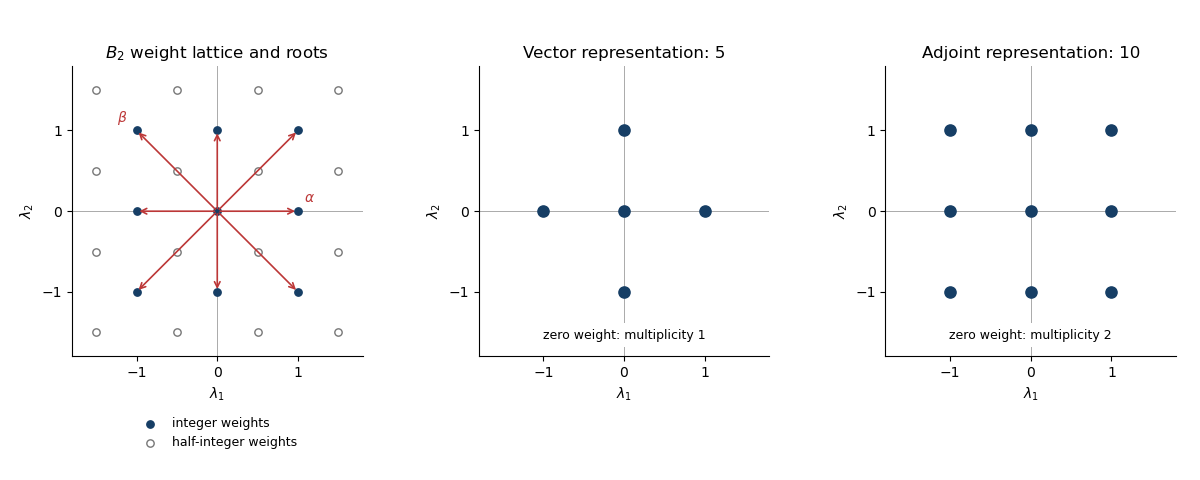
Write a weight as . The integrality conditions for the B2 root system give and . Hence , , with . ThusThis is the B2 weight lattice, with an integer square lattice and a second square lattice shifted by . The eight roots of a root system areThe short roots lie on the coordinate axes and the long roots on the diagonals. The positive roots for the given simple-root choice are , , , .
The integrality conditions determine the weight lattice of the Lie algebra, equivalently of the simply connected Spin group . For the global special orthogonal group , a rotation in either coordinate plane is the identity, so a genuine group representation requires integer . Thus the half-integer coset contains spin representations that do not descend to . Both representations requested here have integer weights, so their diagrams are unaffected by this distinction.
The root system of the displayed subgroup is . The two orthogonal pairs give its two commuting factors. Choose the left factor to have root ; exchanging the two diagonal pairs exchanges left and right. Its coroot pairs with a weight asThis demonstrates the diagonal-root SU(2) embedding in SO(5) directly. The short-axis root would instead give , and therefore a different subgroup: on the vector representation it would produce a triplet and two singlets rather than two doublets and a singlet.
For the vector representation, simultaneously rotate the first and second coordinate planes. Over , the two planes give opposite pairs of weights, while the fifth coordinate is fixed. Hence its weight diagram iswith every weight multiplicity equal to one. Evaluating gives twice, twice and once, exactly two SU(2) representations of dimension two and one singlet.
For the Adjoint representation, the root-space decomposition has one one-dimensional space for each of the eight roots and a two-dimensional zero-weight Cartan subalgebra. ThusThe coroot values have multiplicities at . One zero-weight state joins the states to make a triplet; the states form two doublets, leaving three zero-weight singlets. This verifies the earlier branching rule and accounts for all ten dimensions.
Past exam of the mathematics course of the University of Cambridge 2017 iii Paper 302 1 Solution Created 2026-10-03 Updated 2026-10-05
The two Lie groups have the same local infinitesimal structure, but different global topology. This difference determines which Lie algebra representations integrate to representations of each group.
An element of the SU(2) group is a unitary matrix of determinant one. Orthogonality of its columns and its determinant give the unique formThus its group manifold is the unit three-sphere in : this is SU(2) as the three-sphere. In particular it is compact, connected and simply connected. In terms of the Pauli matrices one may also write with real coefficients satisfying .
Differentiate and at . The tangent space consists of traceless skew-Hermitian matrices:The Lie bracket of a Matrix Lie group is the matrix commutator. With , the Pauli matrix multiplication law givesThis derives the SU(2) Lie algebra as a three-dimensional real Lie algebra. The Hermitian physics generators instead obey ; they are times the skew-Hermitian tangent generators, so these are consistent conventions.
The SO(3) group consists of real orthogonal matrices with determinant one. Differentiating at the identity givesThe determinant condition gives no additional infinitesimal constraint because a skew-symmetric matrix already has trace zero. Define . The cross product identity impliesTherefore the SO(3) Lie algebra has the same structure constants and is a Lie algebra isomorphism.
The global relation is the Adjoint double cover from SU(2) to SO(3). For , define byConjugation preserves the real space of traceless Hermitian matrices and its inner product . Hence is orthogonal. Continuity and connectedness, together with , put it in . Composition of conjugations makes a group homomorphism. If , then commutes with every Pauli matrix, hence is scalar; unitarity and determinant one leave precisely . The differential sends to , so it is an isomorphism. More concretely,induces rotation through angle about , by the Rodrigues rotation formula. Every three-dimensional rotation has such an axis and angle, proving surjectivity. ConsequentlyThe matrices and are antipodal points on the three-sphere, so the SO(3) group manifold is Real projective space . Equivalently, the closed axis-angle ball has opposite boundary points identified. The fundamental group is , whereas . A rotation lifts from to ; a rotation returns to . Thus the covering is the universal cover and the groups are not globally isomorphic.
For representation theory, specify finite-dimensional complex continuous representations. Compactness permits an invariant Hermitian inner product, obtained by averaging against Haar measure, and therefore complete reducibility. Complexifying either real Lie algebra gives the sl2 Lie algebra. Its finite-dimensional irreducibles are indexed by , have highest weight , and have dimension . By integration of a Lie-algebra representation, since is simply connected, every such Lie algebra representation integrates uniquely. The resulting homogeneous polynomial representation of SU2 isIn the spin angular momentum notation , its Hermitian eigenvalues are . The central matrix acts on the symmetric power by , so descent of an SU(2) representation to SO(3) occurs exactly when is even. HenceFor a reducible representation, every summand must satisfy the descent condition. The spin-one-half doublet is a genuine representation of the covering group but does not define a single-valued representation of ; the spin-one triplet does and is its vector representation. The distinction is topological, rather than a difference in their isomorphic Lie algebras.
Past exam of the mathematics course of the University of Cambridge 2017 ii Paper 4 18G a Solution Created 2026-09-24 Updated 2026-10-05
Give the action , where is a row vector. Substitution preserves homogeneous degree, and composition agrees with matrix multiplication, so this is a complex representation of SU(2) group. The diagonal torus acts on with weight ; these weights are distinct.
A nonzero invariant subspace is invariant under the torus, so finite-dimensional Fourier projection onto its weight spaces supplies a nonzero monomial. Differentiating the group action and complexifying supplies the operators and . Their repeated application moves between every successive monomial, with nonzero coefficients until an endpoint is reached:The invariant subspace therefore contains the whole monomial basis. ThusFor this is the one-dimensional trivial representation. Torus weight projections are legitimate because an invariant complex subspace is closed in finite dimension.
Past exam of the mathematics course of the University of Cambridge 2018 iii Paper 308 2 Solution Created 2026-10-03 Updated 2026-10-05
A collective coordinate describes a position, orientation, or another parameter of a family of static solitons. For a family , promote to a slowly varying and substitute into the field action. In a scalar theory with unit kinetic coefficient, this gives the collective-coordinate effective LagrangianFor a gauge-theory soliton, one also solves the Gauss law constraint in gauge theory constraint and projects out pure gauge transformations; arbitrary variations of gauge representatives do not define the physical metric. Tangent vectors to an exactly equal-energy family are zero modes in field theory. If is constant, the Euler-Lagrange equations of this moduli-space approximation arethe geodesic equations of its Riemannian metric. The approximation neglects radiation and deformation modes; it describes motion sufficiently slow that these omitted degrees of freedom remain unexcited to the required accuracy.
In collective-coordinate quantization, take the wavefunction measure and the minimal scalar Hamiltonian operatorThe Laplace-Beltrami operator supplies coordinate-invariant kinetic energy. Global identifications and statistics must be imposed on the wavefunctions; the classical metric alone does not choose them. Curvature-ordering terms and loop corrections are additional quantum input.
For the phi-four kink, use the normalization and profile of Question 1. Substituting givesThe metric is constant because of translation invariance. This proves the translational dynamics of a phi-four kink: classically the centre moves at constant velocity, and quantum mechanicallyPlane waves label the continuous translational momentum, with no position-dependent potential. Uniform-motion Lorentz invariance upgrades the dispersion to ; the displayed collective Lagrangian is its small-velocity expansion. Small perturbations also include an internal shape mode and continuum radiation, which this single collective coordinate omits. The fluctuation operator of a phi-four kink in this normalization isthe translational eigenfunction has , the shape mode has , and continuum modes in the spectrum start at . Thus the free-coordinate states describe the kink's low translational energies, not its full excitation spectrum or quantum mass correction.
For two Abelian Higgs vortices at critical coupling, the static energy is and the Abelian Higgs vortex moduli space has four real dimensions. Let be their positions, , and . The centre of mass decouples; the relative metric is rotationally symmetric and can be writtenAt large separation, , recovering two free particles. Although there is no static separation potential, the nonconstant metric produces velocity-dependent interaction. Coincidence is smooth in the relative coordinate for two identical vortices , not in the double-valued . Smoothness gives for near zero. A head-on geodesic continues through to the opposite real ray, so changes its line by : the vortices scatter through a right angle. This geometric argument does not require an explicit formula for .
With ordinary bosonic exchange statistics, relative wavefunctions are single-valued in and smooth at coincidence. In the separated polar coordinate they obey , with even integer angular labels. Their kinetic operator isThe apparent singularity at must be resolved with the smooth coordinate and regularity, rather than arbitrary boundary conditions on a punctured cone. The free centre-of-mass motion and the asymptotically free relative geometry give quantum scattering states; a flat static energy does not imply that the metric is flat or that scattering is absent. This is not a prediction of a discrete family of static two-vortex bound separations. The smooth collision geometry is developed in David Tong's arxiv.org/abs/hep-th/0509216.
For a Skyrmion of baryon number one, the Skyrmion hedgehog ansatz iswhere are the Pauli matrices. Include a centre and an orientation through . Hedgehog symmetry identifies spatial rotations with opposite internal rotations, so there are three independent orientation coordinates, not six. Since and give the same field, the physical orientation space is , with SU(2) group as its double cover. Write . The leading collective Lagrangian has the formwhere is the rotational moment of inertia obtained by integrating the profile's field kinetic energy.
For the fermionic quantization appropriate to baryons, the Finkelstein-Rubinstein constraints on the double cover impose . In SU(2) representations, the central element acts by , so must be half-integer. Left and right group actions supply isospin and spin angular momentum; hedgehog symmetry makes their magnitudes equal. The rotational quantization of a unit Skyrmion therefore givesThe level has four spin-isospin states and models the nucleon doublet, proton and neutron, each with two spin states. The level has sixteen states and models the Delta baryon quartet, each with four spin states. The rotor predicts a splitting . Without the fermionic sign, single-valued functions on would instead allow integer , which is a different quantization. High rotor levels can couple to deformation and pion radiation; this semiclassical approximation does not establish that its entire formal tower consists of stable particles.
Past exam of the mathematics course of the University of Cambridge 2018 iii Paper 308 3 Solution Created 2026-10-03 Updated 2026-10-05
There is an exact rational-map description of sigma-model lumps and a restricted variational rational-map description of Skyrmions. The first follows from a Bogomolny equation; the second separates angular and radial dependence in a field that generally does not saturate a Bogomolny bound.
For the exact example, take the two-dimensional O3 nonlinear sigma model with a unit field , energy , and a fixed limit at infinity. Regular fields then have a one-point compactification to maps . Choose the orientation so that the stereographic fieldhas positive charge when it is holomorphic. Equivalently, this is the CP1 nonlinear sigma model since the target sphere is the complex projective line. Its energy and topological charge areSubtracting gives , so for ,The Cauchy-Riemann equations therefore give the minimal-energy fields. A holomorphic map from the compactified domain Riemann sphere to the target Riemann sphere is a rational map , with common polynomial factors cancelled. Its degree of a rational map of the Riemann sphere is . Poles of are coordinate singularities, not singularities of . For instance, with is an exact unit lump with energy , arbitrary centre , and scale . Its density is , whose plane integral is . For negative charge use antiholomorphic maps. Scale invariance allows arbitrarily small lumps and does not by itself prevent a singular concentration limit in the time-dependent theory.
The local angular geometry of any degree- rational map is measured by its angular Jacobian of a rational map,For , the Wronskian of a rational map isAt ordinary finite points its zeros mark ramification points of a holomorphic map, where the angular density vanishes. At a pole use as the target coordinate, and at infinity use as the domain coordinate. A pole of order is ramified by . The Riemann-Hurwitz formula counts total ramification , including infinity, even if the affine Wronskian has smaller degree. For , accounts for zeros at zero; the reciprocal coordinate shows the other at infinity.
For the approximate example, the rational map approximation for Skyrmions uses spherical radius , angular stereographic projection coordinate , andThe Pauli matrices make this an SU(2) group-valued field. The boundary conditions give a continuous centre and the vacuum value at infinity; the profile must also make the energy finite. Angular degree and radial winding factorize to giveAt radii with nonzero , the angular baryon number density is proportional to . Thus the Wronskian of a rational map locates zero-density directions and reveals the holes or face directions in shell-like Skyrmion configurations.
In dimensionless Skyrme model units, insert this ansatz into the quadratic and quartic derivative energies. The angular terms integrate to or to the angular integral in the rational map approximation,First minimize over degree- maps, then solve the radial variational equationwith the stated boundary conditions. The Cauchy-Schwarz inequality gives because has sphere average . For an isometric map such as has , , and reduces to the Skyrmion hedgehog ansatz; its profile still requires solving the radial equation. For general , angular and radial separation restrict the allowed fields. The minimum within this class is an upper bound on the full sector minimum, not a claim that every exact Skyrmion has this separated form. The original construction is Houghton, Manton and Sutcliffe's arxiv.org/abs/hep-th/9705151.
A rotational symmetry of a rational map must satisfy , where are the domain and target rotations written as Möbius transformations from SU(2) matrices. Since a target rotation is an isometry, this identity implies . For , , giving axial spatial symmetry accompanied by an internal rotation. This explains the axial symmetry of the degree-two toroidal ansatz.
A useful degree-four example isIts finite ramification directions are , with the sixth at infinity. They are the six coordinate-axis directions under stereographic projection, so they are the face normals of a cube. The full map has octahedral rotational equivariance: for example , and the cyclic-axis generator obeys . These generate the cube's rotational group and give a cubic angular density. The associated profile then produces the familiar cubic charge-four approximation. Symmetry of the Wronskian is a useful necessary diagnostic but is not sufficient: replacing this map by , , leaves the same ramification directions, while the identity under becomes , whose target transformation is a sphere rotation only when . Equivariance of the entire rational map, rather than symmetry of its critical-point set alone, determines the physical rotational symmetry.
Past exam of the mathematics course of the University of Cambridge 2019 iii Paper 305 2 b Solution Created 2026-10-03 Updated 2026-10-14
The minima of the scalar potentialsatisfyThe SU(2) group acts transitively on this three-sphere of vacua, and the stabilizer of a nonzero fundamental doublet is trivial. A global transformation may therefore choose . Because the symmetry is gauged, unitary gauge removes all three angular Goldstone bosons, leaving only the real radial Higgs mode :Substitution into the gauge-covariant kinetic term giveswithThe interaction terms produce , , , , and the cubic and quartic non-Abelian gauge-boson vertices shown below.
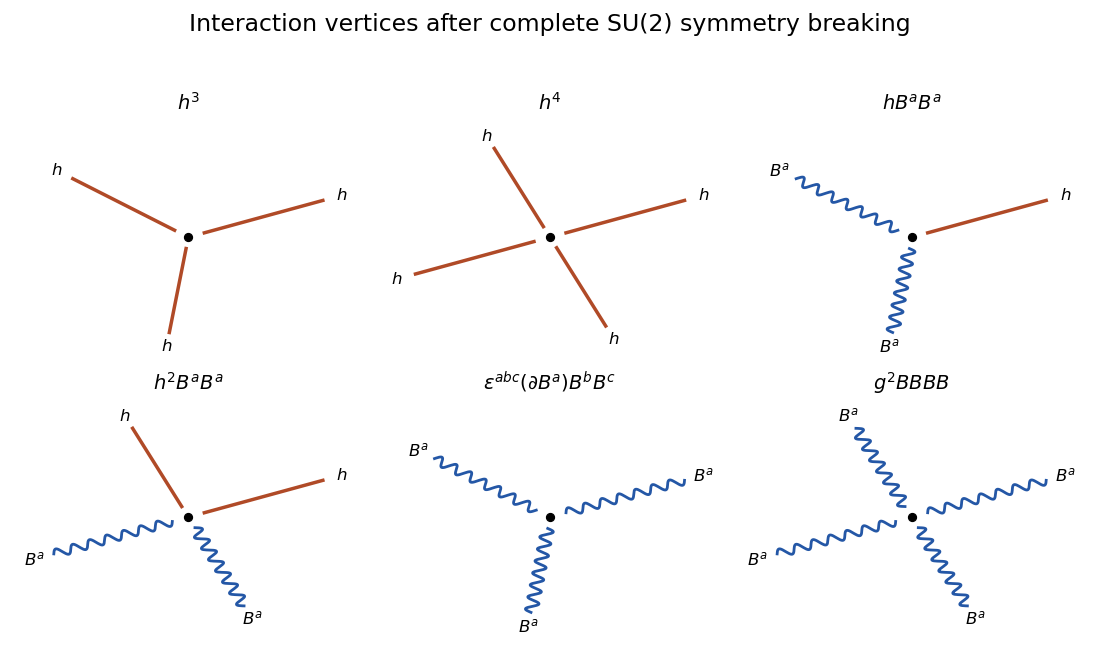


The three broken generators supply the three longitudinal polarizations of the equally massive gauge bosons. No physical massless Goldstone boson remains, and because the unbroken subgroup is trivial there is no massless gauge boson either. The remaining physical spectrum has degrees of freedom, equal to the original .
For , every two-by-two matrix satisfies . Thus is exactly invariant under a common SU(2) group transformation. This is a bilinear contraction without complex conjugation. It vanishes for equal commuting spinors and is the alternating tensor defining the spin singlet state. Overall bosonic exchange symmetry must still be enforced if the spinors label identical particles.