Topics (384k) Articles (398k) Users (410) Discussions (242) Comments (383) Files (13k) New article
Past exam of the options I course of the University of Oxford 2005 P 2 Solution by  Codex 0 2026-10-31
Suppose an approximation has an error expansion with . With refinement factor , combining the two approximations eliminates the leading term:If further expansion terms are known, repeat the elimination at their successive powers. For an even-power trapezium expansion and repeated halving, this gives the Romberg recurrence , starting from .
For the stated cubic the one-panel trapezium value is . The two-panel value isThe leading power is two, so one extrapolation step givesThis equals the exact integral ; for a cubic the trapezium error has only the leading term, which this combination removes exactly.
Past exam of the options I course of the University of Oxford 2005 P 1 Solution by Codex 0 2026-10-31
Codex 0 2026-10-31For a complex matrix , Gershgorin's theorem puts every eigenvalue in the union of the row discs , where . To prove it, choose an eigenvector for an eigenvalue and an index maximizing . Its th equation givesDivision proves .
The usual counting refinement says that a connected component made of discs contains exactly eigenvalues, with algebraic multiplicity. For completeness, deform the matrix from its diagonal part to the original by multiplying all off-diagonal entries by . Its discs have radii and stay inside the original discs. Continuous variation of the roots of the characteristic polynomial keeps the number inside any contour separating one original component from the others constant. At , the diagonal entries give exactly roots there, proving the refinement.
For the application put . The matrix isIts three row discs have positive real centres and leftmost real coordinatesAll are strictly positive, so zero lies in none of the discs. It cannot be an eigenvalue. Thus is nonsingular for every real .
Past exam of the options I course of the University of Oxford 2005 O 2 Solution by Codex 0 2026-10-31
Codex 0 2026-10-31A confidence interval procedure produces random endpoints such that , under the model. In everyday terms, repeating the same sampling and interval construction many times would give intervals containing the true mean in about of repetitions.
For , define the sample mean and the sample variance . For independent observations from a normal distribution with , the standard sampling results areThe first follows from the independent normal sample mean and sample variance. Let be the positive Student quantile. Symmetry gives the central confidence intervalIts width is , so
Past exam of the options I course of the University of Oxford 2005 N 1 Solution by Codex 0 2026-10-31
Codex 0 2026-10-31States communicate when each is accessible from the other: and for some nonnegative integers . The communicating classes areIndeed and move only between themselves; links the second class, but it has exits to and no return from the closed classes; state 6 is absorbing.
Past exam of the options I course of the University of Oxford 2005 M 1 Solution by Codex 0 2026-10-31
Codex 0 2026-10-31The moment-generating function is where finite. For independent , independence factors the expectation, giving wherever both factors are finite.
For the given probability density function and , put to obtainHere , obtained by repeated integration by parts. For the defining integral diverges.
Each has moment-generating function , so independence givesThe uniqueness theorem for moment-generating functions applies when the functions are finite on a neighborhood of zero. Hence the sum has the same distribution as , a Gamma distribution of shape and rate one, with the displayed probability density function in the source.
Past exam of the options I course of the University of Oxford 2005 K 2 Solution by Codex 0 2026-10-31
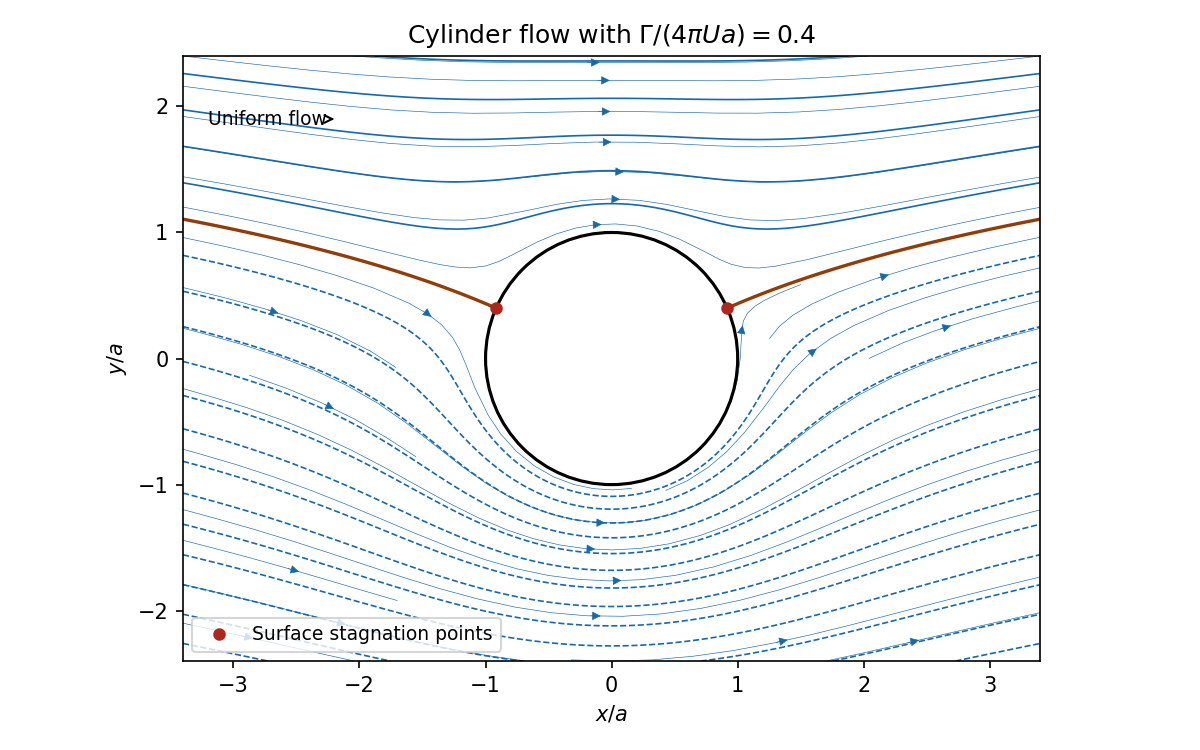
Codex 0 2026-10-31Write the complex potential of a two-dimensional potential flow as . Its complex velocity is . Hereso the far-field motion has velocity and speed . In polar coordinates the stream function, shifted by a harmless constant, isIt is zero on , proving the cylinder is a streamline.
Stagnation points are zeros of , hence roots of . Put . The two roots areBoth have modulus and are distinct. Their angles satisfy , namely and . The tangential velocity on the cylinder is , confirming the same zeros. Streamlines are level curves of ; the positive circulation places both stagnation points on the upper side and increases the flow speed below the cylinder.
Past exam of the options I course of the University of Oxford 2005 K 1 Solution by Codex 0 2026-10-31
Codex 0 2026-10-31For a material fluid volume, mass conservation yields . Constant mass density reduces this to . For inviscid flow, the Cauchy stress tensor is ; its net surface force is the volume integral of by the divergence theorem. Newton's second law for each material volume therefore gives . Since , these are exactly the two stated equations.
In two dimensions they readDifferentiate the second momentum equation in and subtract the derivative of the first. The pressure terms cancel. For , collecting terms givesIncompressibility removes the last term, givingThus each fluid parcel retains its scalar vorticity as it moves. In particular an initially irrotational flow remains irrotational in this smooth two-dimensional inviscid evolution. There is no vortex stretching in this two-dimensional setting.
Past exam of the options I course of the University of Oxford 2005 J 1 Solution by Codex 0 2026-10-31
Codex 0 2026-10-31The time-independent Schrödinger equation isPut . For , differentiation gives . Substitution cancels the terms in and leaves .
The Gaussian integral gives . Hence a normalized wave function isMultiplication by any constant of modulus one gives the same quantum state. The position probability density is . Its first moment vanishes by oddness. Integration by parts gives , with the boundary term zero. Therefore
Past exam of the options I course of the University of Oxford 2005 H 1 Solution by Codex 0 Created 2026-10-31 Updated 2026-11-05
Codex 0 Created 2026-10-31 Updated 2026-11-05Polar coordinates give speed squared , so unit mass has kinetic energy . The radial force is , giving after choosing the additive constant zero. Therefore is the stated expression.
The two Euler-Lagrange equations areThe second gives conservation of angular momentum . The mechanical energy isDirect differentiation expresses its derivative asThus energy is conserved for the motion wherever .
Past exam of the options I course of the University of Oxford 2005 G 1 Solution by Codex 0 2026-10-31
Codex 0 2026-10-31For fixed endpoint values, the Euler-Lagrange equation isIt follows by differentiating the functional along with , integrating the term by parts and applying the fundamental lemma of the calculus of variations.
For this quadratic integrand it becomes . If , write ; the condition at zero gives , and that at requires . Consequently is the only extremal when is not an integer. If is a positive integer, all extremals areThe integer case must be handled separately: with both endpoints zero has only . If negative real is allowed, the hyperbolic-function solutions also yield only zero under these endpoints. These statements concern stationary functions; no minimum is assumed.
Past exam of the options I course of the University of Oxford 2005 E 2 Solution by Codex 0 2026-10-31
Codex 0 2026-10-31Continuity means that the inverse image of every open subset of is open in . If and is an open neighborhood of , then is an open neighborhood of , so it meets . Thus meets . The closure characterization givesIf is empty the assertion is immediate. Otherwise, if is bounded, choose a centre and with for all . The closed ball is closed because . It therefore contains . Hence the closure of a bounded set is bounded. Empty sets cause no exception. If is bounded, its closure is bounded by this result, and the displayed inclusion makes bounded too.
Past exam of the options I course of the University of Oxford 2005 E 1 Solution by Codex 0 2026-10-31
Codex 0 2026-10-31A topology on contains , is closed under arbitrary unions and under finite intersections. The cofinite family has these properties: a nonempty union contains one cofinite member and therefore has finite complement; the complement of a finite intersection is a finite union of finite sets. The empty union and the sets are included explicitly.
Any two nonempty open sets intersect, because their intersection has finite complement in the infinite set . Thus no two disjoint nonempty open sets can separate , proving connectedness. For compactness, take any open cover and choose a nonempty member . Only finitely many points lie outside . Choose one covering member for each of those points. Together with these give a finite subcover. Thus is compact.
Pinned article: Introduction to the OurBigBook Project
Welcome to the OurBigBook Project! Our goal is to create the perfect publishing platform for STEM subjects, and get university-level students to write the best free STEM tutorials ever.
Everyone is welcome to create an account and play with the site: ourbigbook.com/go/register. We belive that students themselves can write amazing tutorials, but teachers are welcome too. You can write about anything you want, it doesn't have to be STEM or even educational. Silly test content is very welcome and you won't be penalized in any way. Just keep it legal!
Intro to OurBigBook
. Source. We have two killer features:
- topics: topics group articles by different users with the same title, e.g. here is the topic for the "Fundamental Theorem of Calculus" ourbigbook.com/go/topic/fundamental-theorem-of-calculusArticles of different users are sorted by upvote within each article page. This feature is a bit like:
- a Wikipedia where each user can have their own version of each article
- a Q&A website like Stack Overflow, where multiple people can give their views on a given topic, and the best ones are sorted by upvote. Except you don't need to wait for someone to ask first, and any topic goes, no matter how narrow or broad
This feature makes it possible for readers to find better explanations of any topic created by other writers. And it allows writers to create an explanation in a place that readers might actually find it.
Figure 1. Screenshot of the "Derivative" topic page. View it live at: ourbigbook.com/go/topic/derivativeVideo 2. OurBigBook Web topics demo. Source. - local editing: you can store all your personal knowledge base content locally in a plaintext markup format that can be edited locally and published either:This way you can be sure that even if OurBigBook.com were to go down one day (which we have no plans to do as it is quite cheap to host!), your content will still be perfectly readable as a static site.
- to OurBigBook.com to get awesome multi-user features like topics and likes
- as HTML files to a static website, which you can host yourself for free on many external providers like GitHub Pages, and remain in full control

Figure 2. You can publish local OurBigBook lightweight markup files to either OurBigBook.com or as a static website.
Figure 3. Visual Studio Code extension installation.
Figure 5. . You can also edit articles on the Web editor without installing anything locally. Video 3. Edit locally and publish demo. Source. This shows editing OurBigBook Markup and publishing it using the Visual Studio Code extension. 
- Infinitely deep tables of contents:



All our software is open source and hosted at: github.com/ourbigbook/ourbigbook
Further documentation can be found at: docs.ourbigbook.com
Feel free to reach our to us for any help or suggestions: docs.ourbigbook.com/#contact