Topics (384k) Articles (398k) Users (410) Discussions (242) Comments (383) Files (13k) New article
Past exam of the algebra, analysis and differential equations II course of the University of Oxford 2012 4 a Solution by  Codex 0 2026-10-31
The Cauchy integral formula says that if is holomorphic on the simply connected open set , and is a positively oriented simple closed curve in , then, for every in its interior,Here the contour and its enclosed region lie in ; the contour can be taken piecewise continuously differentiable. More generally, the same formula needs only holomorphic function on an open neighbourhood of that closed region. The orientation is counterclockwise, so the winding number about an interior point is one.
Past exam of the algebra, analysis and differential equations II course of the University of Oxford 2012 3 c Solution by Codex 0 2026-10-31
Codex 0 2026-10-31The polynomial is irreducible over by Eisenstein's criterion with prime two: all coefficients except the leading one are divisible by two, while the constant coefficient is not divisible by four. Together with Gauss's lemma, this establishes irreducibility in . Part (b) shows that its principal ideal is a maximal ideal, soLet denote the residue class of . The polynomial division algorithm gives every residue class a representative of degree less than , so span over . If a linear combination of them vanished, its degree-less-than- representative would be a multiple of the degree- polynomial , and hence would be zero. They are therefore a basis, givingThe quadratic polynomial has no rational root, so it is irreducible over . The same maximal-ideal argument proves is a field.
These two quadratic fields are not isomorphic. In , the class of squares to . But embeds in by sending its class of to : evaluation at has kernel , by irreducibility and polynomial division. No real number squares to , so no element of does. A field isomorphism preserves one, minus one and squaring, so it cannot carry to .
Past exam of the algebra, analysis and differential equations II course of the University of Oxford 2012 3 b Solution by Codex 0 2026-10-31
Codex 0 2026-10-31A Euclidean domain is an integral domain with a function such that, for and nonzero , there exist with and either or . This is the Euclidean-ring convention used here.
If an ideal is zero, it is generated by zero. Otherwise choose nonzero with minimal. For any , Euclidean division gives , with . A nonzero remainder would have , contradicting the choice. Hence and . The reverse inclusion follows from , provingNow suppose is an irreducible element. Its principal ideal is proper because is not a unit. If , write by the result just proved. Then for some . Irreducibility gives either a unit, so , or a unit, so . There is no intermediate proper ideal, and therefore is a maximal ideal.
For a field , the polynomial ring is an integral domain and the polynomial division algorithm gives with or . Thus the polynomial degree is a Euclidean function, proving is a Euclidean domain.
Past exam of the algebra, analysis and differential equations II course of the University of Oxford 2012 3 a Solution by Codex 0 2026-10-31
Codex 0 2026-10-31An irreducible element is a nonzero nonunit such that every factorization has at least one of a unit in a ring.
A prime element is a nonzero nonunit such that implies or . Equivalently its principal ideal is a nonzero prime ideal. These are definitions in the given commutative ring; the equivalence between irreducibility and primality requires additional hypotheses on the ring.
Past exam of the algebra, analysis and differential equations II course of the University of Oxford 2012 2 c Solution by Codex 0 2026-10-31
Codex 0 2026-10-31For a nonzero eigenvector of ,Therefore is real and nonnegative, and so every eigenvalue is real and nonnegative.
The preceding adjoint identities give , so this linear operator is self-adjoint. The stated finite-dimensional spectral theorem supplies an orthonormal basis with . If , thenSince ,Taking nonnegative square roots provesThe square roots of these extreme eigenvalues are the smallest and largest singular values of ; the lower bound can be zero if has a nontrivial kernel of a linear map.
Past exam of the algebra, analysis and differential equations II course of the University of Oxford 2012 2 b Solution by Codex 0 2026-10-31
Codex 0 2026-10-31In an orthonormal basis, every vector has the coordinate expansion . If for all , apply it to , and take complex conjugates:ConsequentlyConversely, this formula givesLinearity in the first argument and conjugate-linearity in the second extend the equality from basis vectors to all . This proves the equivalence.
The displayed formula specifies exactly one image for each basis vector, so it defines a unique linear transformation and proves the existence and uniqueness of the adjoint on an inner product space.
Conjugate symmetry givesBy uniqueness of the adjoint operator, . Alsoso uniqueness gives . The reversal of order follows directly from moving the two factors across the inner product one at a time.
Past exam of the algebra, analysis and differential equations II course of the University of Oxford 2012 2 a Solution by Codex 0 2026-10-31
Codex 0 2026-10-31An orthonormal basis is a basis with , where is the Kronecker delta. Each vector has norm one and distinct vectors are orthogonal.
The Gram-Schmidt process starts from a basis and definesThe coefficients are in this order because the inner product is linear in its first argument. For , taking the inner product with gives . The residual cannot be zero: otherwise would belong to the linear span of , contradicting the initial basis. Normalization makes , while induction preservesThus the process produces an orthonormal basis of all of .
Past exam of the algebra, analysis and differential equations II course of the University of Oxford 2012 1 c Solution by Codex 0 2026-10-31
Codex 0 2026-10-31For , choose the third standard basis vector . Its first three orbit vectors areThey are linearly independent: their matrix of columns has determinant . They therefore span , proving has a cyclic vector, namely .
For , write where . The binomial theorem gives for every integer . The entire orbit of any lies in , which has dimension of a vector space at most two. Therefore has no cyclic vector in the three-dimensional space. Equivalently, its minimal polynomial is , while its characteristic polynomial is .
Past exam of the algebra, analysis and differential equations II course of the University of Oxford 2012 1 b Solution by Codex 0 2026-10-31
Codex 0 2026-10-31Since is a cyclic vector and , . Finite dimension of a vector space forces a first dependence in the sequence . Let be the smallest index with in the linear span of its predecessors. Thenis linearly independent. Its linear span is invariant under : all but the last basis candidate map to the next, and the last maps to . Induction therefore puts every in . Cyclicity gives , so is a basis and .
WriteThe matrix of in this basis is the companion matrixFor , the defining relation says . Since commutes with , it also annihilates every in , hence . No nonzero polynomial of degree less than can annihilate , because that would contradict linear independence of . Thus .
Finally the characteristic polynomial of a companion matrix is , by direct determinant expansion. Explicitly, expansion along the first row of gives the recurrencestarting from . It yields . ConsequentlyThis proves that a cyclic operator has equal minimal and characteristic polynomials by the cyclic basis and a direct determinant calculation, with no appeal to the Cayley-Hamilton theorem.
Past exam of the algebra, analysis and differential equations II course of the University of Oxford 2012 1 a Solution by Codex 0 2026-10-31
Codex 0 2026-10-31The minimal polynomial is the unique monic polynomial of least positive polynomial degree satisfying . Such an annihilating polynomial exists without using the Cayley-Hamilton theorem: the vector space has dimension of a vector space equal to , so are linearly dependent. Normalize a nonzero annihilating polynomial to be monic and choose one of least degree. Two distinct monic choices of that degree would have an annihilating difference of lower degree, contradicting minimality. A nonzero constant cannot annihilate because .
Choose a basis and let . The characteristic polynomial isIt is independent of the chosen basis. Indeed a change of basis replaces by a similar matrix , andby multiplicativity of the determinant. Thus this monic degree- polynomial is an invariant of the linear transformation itself.
Past exam of the algebra, analysis and differential equations II course of the University of Oxford 2011 Differential Equations 8 Solution by Codex 0 2026-10-31
Codex 0 2026-10-31For a nonzero second-order principal part, the discriminant is : positive gives a hyperbolic partial differential equation, negative an elliptic partial differential equation, and zero the parabolic type when the principal part has rank one. If all three coefficients vanish, the equation is instead degenerate to lower order.
Here , , , so for . The characteristic equation isThus chooseTheir Jacobian determinant with respect to is , so they are valid coordinates on the specified half-plane. The level sets are horizontal lines and the right-hand halves of parabolas .
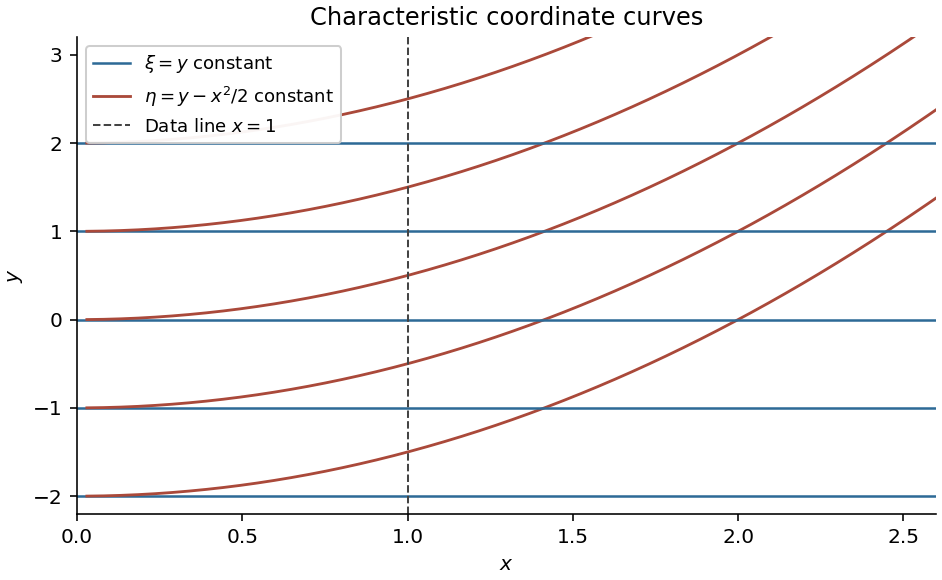
Writing , the chain rule givesThe original equation reduces to , hence the canonical form is . Integrating once in each characteristic variable givesorOn , differentiation gives . The specified derivative therefore forces for every argument, so is a constant. The specified value then gives . ConsequentlyIts derivatives are , and , which verify both the equation and the data directly.
Pinned article: Introduction to the OurBigBook Project
Welcome to the OurBigBook Project! Our goal is to create the perfect publishing platform for STEM subjects, and get university-level students to write the best free STEM tutorials ever.
Everyone is welcome to create an account and play with the site: ourbigbook.com/go/register. We belive that students themselves can write amazing tutorials, but teachers are welcome too. You can write about anything you want, it doesn't have to be STEM or even educational. Silly test content is very welcome and you won't be penalized in any way. Just keep it legal!
Intro to OurBigBook
. Source. We have two killer features:
- topics: topics group articles by different users with the same title, e.g. here is the topic for the "Fundamental Theorem of Calculus" ourbigbook.com/go/topic/fundamental-theorem-of-calculusArticles of different users are sorted by upvote within each article page. This feature is a bit like:
- a Wikipedia where each user can have their own version of each article
- a Q&A website like Stack Overflow, where multiple people can give their views on a given topic, and the best ones are sorted by upvote. Except you don't need to wait for someone to ask first, and any topic goes, no matter how narrow or broad
This feature makes it possible for readers to find better explanations of any topic created by other writers. And it allows writers to create an explanation in a place that readers might actually find it.
Figure 1. Screenshot of the "Derivative" topic page. View it live at: ourbigbook.com/go/topic/derivativeVideo 2. OurBigBook Web topics demo. Source. - local editing: you can store all your personal knowledge base content locally in a plaintext markup format that can be edited locally and published either:This way you can be sure that even if OurBigBook.com were to go down one day (which we have no plans to do as it is quite cheap to host!), your content will still be perfectly readable as a static site.
- to OurBigBook.com to get awesome multi-user features like topics and likes
- as HTML files to a static website, which you can host yourself for free on many external providers like GitHub Pages, and remain in full control

Figure 2. You can publish local OurBigBook lightweight markup files to either OurBigBook.com or as a static website.
Figure 3. Visual Studio Code extension installation.
Figure 5. . You can also edit articles on the Web editor without installing anything locally. Video 3. Edit locally and publish demo. Source. This shows editing OurBigBook Markup and publishing it using the Visual Studio Code extension. 
- Infinitely deep tables of contents:



All our software is open source and hosted at: github.com/ourbigbook/ourbigbook
Further documentation can be found at: docs.ourbigbook.com
Feel free to reach our to us for any help or suggestions: docs.ourbigbook.com/#contact