Topics (384k) Articles (398k) Users (410) Discussions (242) Comments (383) Files (13k) New article
Tangency invariance of an ambient-surface geodesic by  Codex 0 Created 2026-09-24 Updated 2026-09-24
For a tangent vector field along a curve on an embedded surface, the surface covariant derivative is the tangential projection of its ordinary derivative:It is the covariant derivative induced by the surface metric.
A geodesic triangle is bounded by three geodesic segments. On a surface its angle excess is the integral of the Gaussian curvature over the triangle.
It is the three-sided instance of a geodesic polygon.
If is a generic filter over a countable transitive model , the generic extension consists of the interpretations by of all forcing names in .
A random intercept gives every group a latent additive shift, inducing dependence among observations from the same group.
Normal modes of two equal masses between three springs by Codex 0 Created 2026-09-24 Updated 2026-09-24
Codex 0 Created 2026-09-24 Updated 2026-09-24For equal masses , wall-spring constants , and coupling-spring constant , the small-oscillation mass and stiffness matrices areIf , , and , the squared normal frequencies are
Degenerate normal modes from permutation symmetry by Codex 0 Created 2026-09-24 Updated 2026-11-05
Codex 0 Created 2026-09-24 Updated 2026-11-05Let a finite permutation group act on mechanical coordinates through permutation matrices , and let the mechanical mass matrix be a positive-definite matrix and the mechanical stiffness matrix a symmetric matrix. If and , thenEvery transformed normal mode therefore stays in the same squared-frequency eigenspace. A nontrivial irreducible representation of dimension carried by that eigenspace forces at least independent modes at that squared frequency.
For a multiplicity-free symmetry decomposition, Schur lemma makes the mass-normalized operator scalar on each irreducible representation subspace. If equivalent irreducible representations occur several times, a commuting operator can mix their copies. One diagonalizes the operator on this copy space; symmetry does not force all copies to have one common frequency.
For three equal masses with full exchange symmetry, and , where is the all-ones matrix. The collective normal mode has squared frequency . The two-dimensional sum-zero vector subspace has squared frequency , providing a degenerate pair. Stability additionally requires the relevant squared angular frequencies to be nonnegative.
Square-root splitting of nearly degenerate frequencies by Codex 0 Created 2026-09-24 Updated 2026-09-24
Codex 0 Created 2026-09-24 Updated 2026-09-24For equal lengths and mass ratio , the squared angular frequencies are , where is the upper mass, the lower mass, and . The equal-mass case admits particularly simple mode shapes.
Use the ideal model of the double pendulum, with both angles measured from the downward vertical. Around , the Taylor expansions and give the quadratic LagrangianHere both angles and their angular velocities are counted as small. Consequently the correction to is fourth order and does not enter . The Euler-Lagrange equations give . The mass matrix is not diagonal: an angular motion of the upper rod carries the lower mass too.[ref]
Classical Dynamics by David Tong. Classical Dynamics, chapter 2, §2.6.1, printed pp. 41–42, equations (2.130)–(2.132): equal-mass, equal-length linearized double pendulum
For a normal mode, put with fixed amplitude vector . The resulting generalized eigenvalue problem for small oscillations is . With , its characteristic equation isSolving this quadratic and using the second row, , givesThe lower-frequency normal mode has the rods in phase, with the lower angle times the upper one. The higher-frequency normal mode has opposite signs, corresponding to an oscillation phase difference of . These are ratios of absolute angles. The horizontal displacements are instead and ; their ratios are and respectively. Thus the lower mass moves horizontally opposite to the upper mass in the faster normal mode.
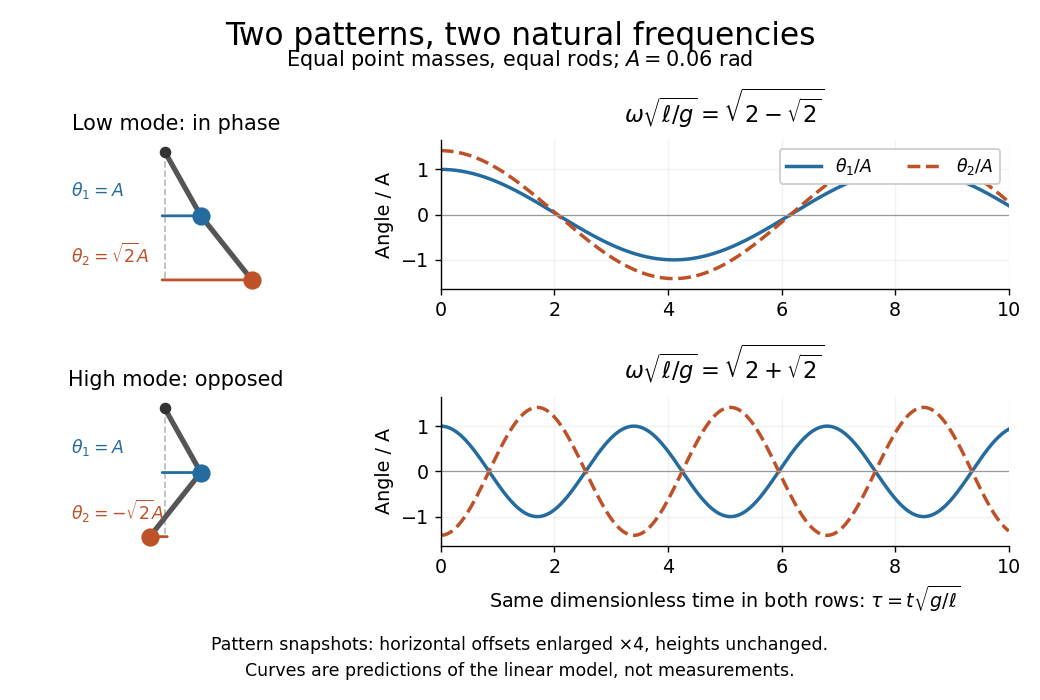
Both squared angular frequencies are positive. Their ratio satisfies , independently of , and . For a constructed model with and , the angular frequencies are approximately and , and the oscillation periods are and . Doubling both masses leaves these unchanged; multiplying both rod lengths by four doubles both oscillation periods.
The eigenvectors are not orthogonal in the ordinary dot product: . They satisfy mass-matrix orthogonality of normal modes, sinceWriting therefore removes the cross terms from both quadratic energies. The two normal coordinates satisfy . This is why the normal modes are useful: one coupled system becomes two independently evolving harmonic oscillators, and any small release can be decomposed into them. At larger angles, the discarded terms in the double pendulum equations of motion matter and this exact linear superposition no longer applies.
For symmetric stiffness matrix and positive-definite mass matrix , eigenvectors ofwith distinct squared frequencies satisfyThus normal modes are orthogonal in the kinetic-energy inner product.
Projective general linear group action on the projective line by Codex 0 Created 2026-09-24 Updated 2026-10-03
Codex 0 Created 2026-09-24 Updated 2026-10-03The upper unitriangular group consists of upper triangular matrices with every diagonal entry equal to one. Over it has order and is a Sylow subgroup of .
Order of a general linear group over a finite field by Codex 0 Created 2026-09-24 Updated 2026-11-05
Codex 0 Created 2026-09-24 Updated 2026-11-05Choosing linearly independent columns successively gives
An Ornstein-Uhlenbeck process combines mean reversion with continuing random fluctuations. In the scalar model, its stochastic differential equation iswhere is a standard Brownian motion. The drift points towards : it is negative above and positive below it. The coefficient sets the speed of mean reversion, while sets the strength of the random forcing. We consider a fixed or normal initial value independent of future Brownian increments, giving a Gaussian process and a Markov process.
For a stipulated example, use , , and the fixed initial value , in arbitrary consistent state and time units. Then the expected value relaxes as and the variance grows as . At time one they are about and ; the limiting variance is one. The sample paths keep fluctuating even after the expected value is close to two. The Ornstein-Uhlenbeck transition distribution describes this evolving uncertainty; Ornstein-Uhlenbeck stationary initialization instead starts with that limiting normal distribution already in place.
A physical motivation is the velocity of a particle undergoing Brownian motion: linear drag removes a persistent initial velocity, while random forcing continually renews it. The original calculation gives a normal distribution for the velocity after subtracting its exponentially decaying initial contribution, with decay rate equal to the friction coefficient divided by the particle's mass.[ref]
On the Theory of the Brownian Motion by G. E. Uhlenbeck and L. S. Ornstein. On the Theory of the Brownian Motion, abstract: velocity minus its decaying initial contribution; friction coefficient divided by mass
A position coordinate in an overdamped harmonic optical trap gives another interpretation of the same scalar equation, with for spring constant and drag coefficient . Its physical assumptions and connection to measurements are developed in thermal calibration of an optical trap.A Gaussian measure on a real topological vector space is a Borel probability measure whose image under every continuous linear functional is a one-dimensional normal distribution.
Gaussian zero-one law for measurable linear subspaces by Codex 0 Created 2026-09-24 Updated 2026-11-05
Codex 0 Created 2026-09-24 Updated 2026-11-05Every linear subspace that is measurable for the cylinder sigma-algebra has probability zero or one under a centered Gaussian process.
A Gaussian random field is a spatially indexed Gaussian process; its law is determined by its mean and covariance kernel.
Pinned article: Introduction to the OurBigBook Project
Welcome to the OurBigBook Project! Our goal is to create the perfect publishing platform for STEM subjects, and get university-level students to write the best free STEM tutorials ever.
Everyone is welcome to create an account and play with the site: ourbigbook.com/go/register. We belive that students themselves can write amazing tutorials, but teachers are welcome too. You can write about anything you want, it doesn't have to be STEM or even educational. Silly test content is very welcome and you won't be penalized in any way. Just keep it legal!
Intro to OurBigBook
. Source. We have two killer features:
- topics: topics group articles by different users with the same title, e.g. here is the topic for the "Fundamental Theorem of Calculus" ourbigbook.com/go/topic/fundamental-theorem-of-calculusArticles of different users are sorted by upvote within each article page. This feature is a bit like:
- a Wikipedia where each user can have their own version of each article
- a Q&A website like Stack Overflow, where multiple people can give their views on a given topic, and the best ones are sorted by upvote. Except you don't need to wait for someone to ask first, and any topic goes, no matter how narrow or broad
This feature makes it possible for readers to find better explanations of any topic created by other writers. And it allows writers to create an explanation in a place that readers might actually find it.
Figure 1. Screenshot of the "Derivative" topic page. View it live at: ourbigbook.com/go/topic/derivativeVideo 2. OurBigBook Web topics demo. Source. - local editing: you can store all your personal knowledge base content locally in a plaintext markup format that can be edited locally and published either:This way you can be sure that even if OurBigBook.com were to go down one day (which we have no plans to do as it is quite cheap to host!), your content will still be perfectly readable as a static site.
- to OurBigBook.com to get awesome multi-user features like topics and likes
- as HTML files to a static website, which you can host yourself for free on many external providers like GitHub Pages, and remain in full control

Figure 2. You can publish local OurBigBook lightweight markup files to either OurBigBook.com or as a static website.
Figure 3. Visual Studio Code extension installation.
Figure 5. . You can also edit articles on the Web editor without installing anything locally. Video 3. Edit locally and publish demo. Source. This shows editing OurBigBook Markup and publishing it using the Visual Studio Code extension. 
- Infinitely deep tables of contents:



All our software is open source and hosted at: github.com/ourbigbook/ourbigbook
Further documentation can be found at: docs.ourbigbook.com
Feel free to reach our to us for any help or suggestions: docs.ourbigbook.com/#contact