Topics (384k) Articles (398k) Users (410) Discussions (242) Comments (383) Files (13k) New article

For a circular cylinder translating parallel to a nearby wall at zero Reynolds number, leading lubrication shear and pressure recovery make the zero-torque condition force zero angular velocity.
The uniaxial extensional viscosity is the tensile normal-stress difference divided by the imposed extension rate.
The Oldroyd-B model combines a Newtonian solvent with infinitely extensible Hookean polymer dumbbells. It predicts constant shear viscosity, a positive first normal-stress difference, and an extensional catastrophe at a finite extension rate.
The conformation tensor describes the average stretch and orientation of polymer molecules. Its equilibrium value is the identity tensor under a common normalization.
A path has constant speed when the magnitude of its velocity does not vary with time. Its acceleration may still be nonzero: uniform circular motion has turning velocity and inward centripetal acceleration. Constant velocity is stronger, requiring unchanged direction as well as unchanged speed.
Acceleration is the time derivative of velocity, equivalently the second derivative of position:It is a vector with SI unit . A change in direction produces acceleration even if speed stays constant. For example, a car rounding a bend at steady speed needs an inward resultant force by Newton's second law. Thus acceleration does not mean only speeding up. When , the dot product gives : a perpendicular acceleration changes direction without changing speed at that instant.
Take counterclockwise circular motion about the origin with radius and constant angular speed . The position, velocity and acceleration areThe speed is throughout, while the inward centripetal acceleration has magnitude . At the four cardinal points, reached at , the velocities in are ; the accelerations in are . The vectors turn together, remaining perpendicular. [ref]
https://openstax.org/books/university-physics-volume-1/pages/4-4-uniform-and-nonuniform-circular-motion. Ling, Sanny and Moebs, section 4.4: uniform circular motion
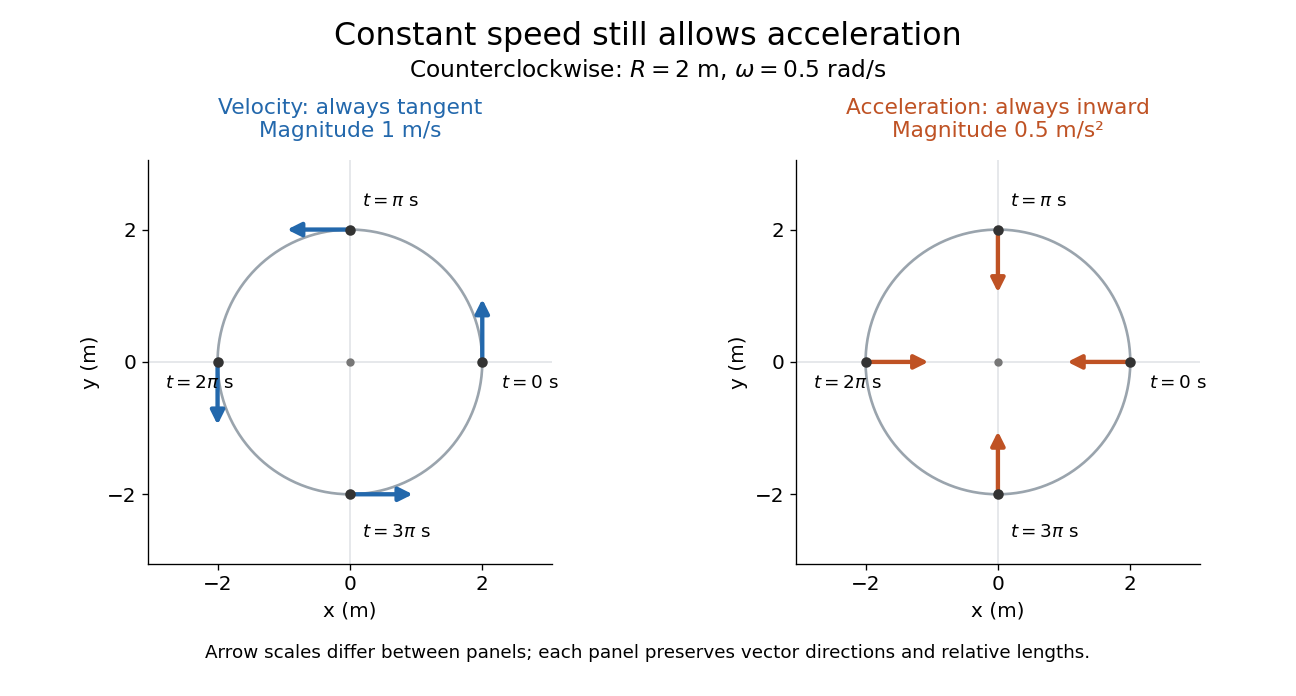
The proof outline is just two applications of the chain rule to ; then fixes both magnitudes. The usefulness is geometric: turning requires a force even when a speed reading remains steady, and doubling speed at fixed radius quadruples the required centripetal acceleration. The same mechanism appears in a circular orbit.
Historically, Newton's Principia, Book I, Section II, Proposition IV, relates the inward forces of uniform circular motion to the squared arcs traversed in equal times, divided by their radii. In modern notation, its dependence on speed and radius is ; Newton presents a geometric argument rather than the coordinate derivatives above. [ref]
https://en.wikisource.org/wiki/The_Mathematical_Principles_of_Natural_Philosophy_(1729)/Book_1/Section_2. Newton, Principia, Book I, Proposition IV; Motte's 1729 translation
Speed is the nonnegative magnitude of velocity, a scalar rather than a vector. In orthonormal Cartesian coordinates,Its SI unit is . In the reversal example under velocity, the endpoint velocities and both have speed , but the speed falls to zero between them. A speed reading alone therefore cannot tell which way the body is moving.
For a smooth path, the total distance traveled is its arc length, . Unlike the integral of a signed velocity component, this integral cannot cancel outward and return motion. The reversal example travels in , giving an average speed of , while its average velocity is zero. This makes speed useful for estimating travel duration or fuel use, while velocity also tracks progress toward a destination. [ref]
https://openstax.org/books/university-physics-volume-1/pages/3-2-instantaneous-velocity-and-speed. Ling, Sanny and Moebs, section 3.2: distance traveled versus displacement
A vector is an element of a vector space. Its defining operations are vector addition and scalar multiplication. An arrow in a Euclidean space is one example; a polynomial or a function can also be a vector when the chosen vector space uses the corresponding addition and scalar multiplication.
For instance, the polynomials and belong to the real vector space of polynomials of degree at most two. Their vector addition gives , and scalar multiplication gives . In the monomial basis these are the coordinate vectors , , and respectively. The vectors are the polynomials; these tuples are their representations in a chosen basis.
A general vector space does not itself prescribe lengths or angles. A norm supplies a size, while an inner product also supplies angle information and orthogonality. The familiar arrow geometry below belongs to Euclidean vectors, where this extra structure is available.
A basis is a linearly independent spanning set of vectors in a vector space. Every vector is a unique finite linear combination of basis vectors. Independence supplies uniqueness, and spanning supplies existence. An ordered basis turns the coefficients into a coordinate vector.
For , the matrix with these vectors as columns isHence the coordinate vector of is , and recovers the usual coordinates. The determinant is nonzero, so this recovery works for every vector in . A basis need not have perpendicular or unit-length vectors; an orthonormal basis adds those geometric conveniences when an inner product is available.
The point of changing basis is to simplify the operation being studied. Diagonalization uses an eigenbasis to turn a coupled linear map into independent scalings. In a space of polynomials, the basis makes differentiation easy to encode, while orthogonal polynomials can make approximation errors easier to measure. Gilbert Strang's MIT lecture on independence, basis and dimension develops this connection between attainable columns, redundant columns and coordinates.[ref]
https://ocw.mit.edu/courses/18-06sc-linear-algebra-fall-2011/. Strang, MIT 18.06SC, Independence, Basis and Dimension
In a vector space over a specified field , a finite family of vectors is linearly independent when, for coefficients ,Here the left-hand zero is the zero vector, while the right-hand zeros belong to the field . Thus linear independence excludes every nontrivial linear relation. For an infinite family, require this condition for every finite subfamily.[ref]
https://ocw.mit.edu/courses/18-06sc-linear-algebra-fall-2011/0bbc30e3f1d7933ea07a2d2e9ab050d9_MIT18_06SCF11_Ses1.9sum.pdf. MIT 18.06SC, Strang lecture summary 9, p. 1: linear independence
For and over the real numbers, the linear relation gives and . Adding and subtracting yields , hence . This verifies linear independence directly and explains why the linear combination giving has exactly the coefficients .
A linearly independent family cannot contain the zero vector: a coefficient of on that entry and on every other entry would be a nontrivial linear relation. The empty family is linearly independent, because its empty sum is the zero vector and there are no coefficients that could be nonzero. Linear independence identifies a collection without redundant vectors; combined with a spanning set, it gives a basis. The uniqueness of linear combination coefficients makes its representations unambiguous.
The direct sum of two vector spaces consists of pairs with componentwise operations. A vector space is an internal direct sum of subspaces and exactly when every vector has a unique expression with and .
Let be a vector space over a specified field , and let . A linear combination is a finite sumThe coefficients are scalars from that same field; each term uses scalar multiplication, and the terms are joined by vector addition. For coefficients in the real numbers, negative values reverse arrows and fractional values scale them by fractional amounts. The collection of attainable vectors is the linear span. The column picture in Strang's MIT notes interprets solving a linear system as choosing coefficients to reach a target vector.[ref]
https://ocw.mit.edu/courses/18-06sc-linear-algebra-fall-2011/6913aa2f37dada8fdda334168b30339b_MIT18_06SCF11_Ses1.1sum.pdf. MIT 18.06SC, Strang lecture summary 1, pp. 2–3: the column picture
For a concrete calculation over the real numbers, takeThen . More generally, solving and givesEvery vector in the Euclidean plane is therefore a linear combination of , so their linear span is all of . The target has coefficients ; the target has coefficients , since . The displayed formula also makes the coefficients unique. Consequently is an ordered basis, with coordinate vector .
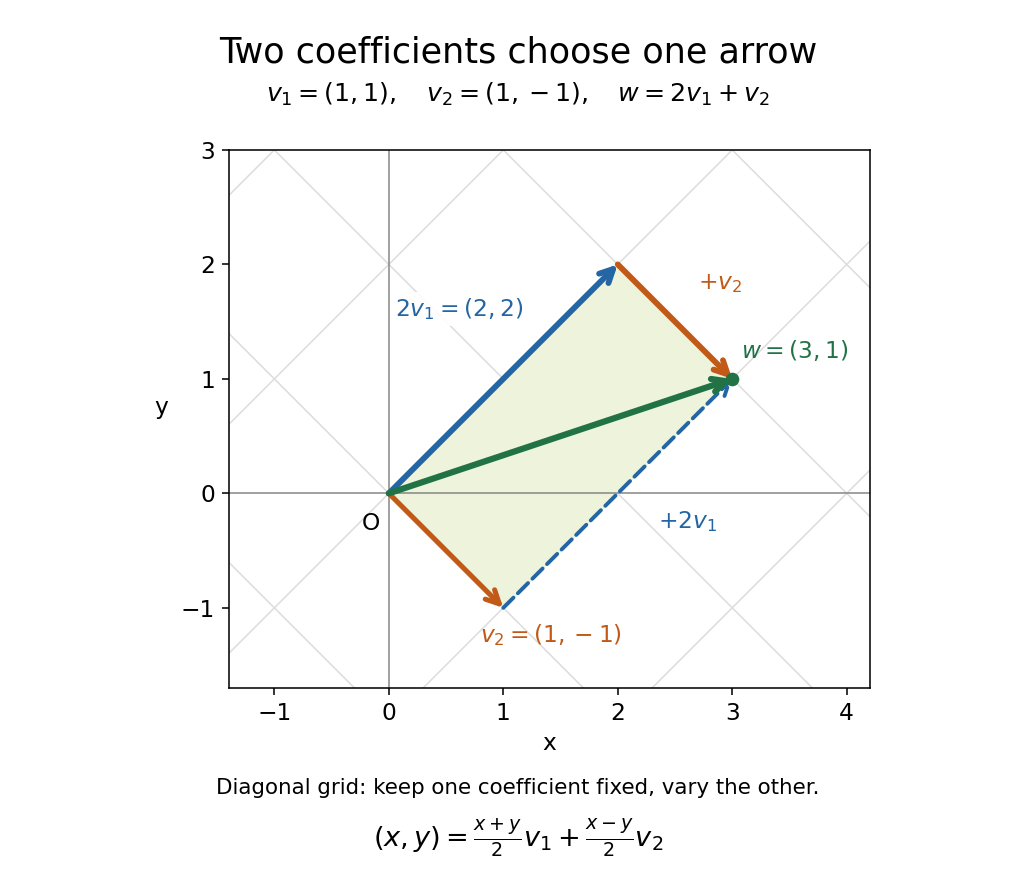
The payoff is a reusable language for synthesis: linear combinations build vectors from chosen ingredients, linear span decides which targets are reachable, and linear independence decides whether the coefficients are unique. The ingredients can also be polynomials or functions, as long as they belong to a vector space over the specified field.
A vector subspace is a nonempty subset of a vector space closed under vector addition and scalar multiplication, and is therefore itself a vector space. Equivalently, whenever belong to the subset, so does for all allowed scalars . In particular it contains the zero vector.
For example, the plane is a vector subspace, with basis . Indeed every element is . The parallel plane misses the zero vector and is an affine subspace instead. Homogeneous constraints produce vector subspaces: is the kernel of the linear map . This lets us describe all solutions of a homogeneous linear equation through a basis of its kernel.
The linear span of a subset of a vector space is the set of all finite linear combinations of elements of . It is the smallest vector subspace containing : every vector subspace containing the original vectors must contain their sums and scalar multiples.
In , the linear span of is a line, the linear span of is the plane , and adding gives all of . Adding to the first set changes none of its attainable vectors, because it is already a scalar multiple of . Thus a spanning set can contain redundant generators; linear independence identifies when this redundancy is absent. In an infinite-dimensional space, an algebraic linear span still uses finite sums; a closed linear span can also include limits in a specified norm.
If is a finite field, a vector space of finite dimension over has elements. Every infinite-dimensional vector space over is an infinite elementary abelian -group under addition.
Pinned article: Introduction to the OurBigBook Project
Welcome to the OurBigBook Project! Our goal is to create the perfect publishing platform for STEM subjects, and get university-level students to write the best free STEM tutorials ever.
Everyone is welcome to create an account and play with the site: ourbigbook.com/go/register. We belive that students themselves can write amazing tutorials, but teachers are welcome too. You can write about anything you want, it doesn't have to be STEM or even educational. Silly test content is very welcome and you won't be penalized in any way. Just keep it legal!
Intro to OurBigBook
. Source. We have two killer features:
- topics: topics group articles by different users with the same title, e.g. here is the topic for the "Fundamental Theorem of Calculus" ourbigbook.com/go/topic/fundamental-theorem-of-calculusArticles of different users are sorted by upvote within each article page. This feature is a bit like:
- a Wikipedia where each user can have their own version of each article
- a Q&A website like Stack Overflow, where multiple people can give their views on a given topic, and the best ones are sorted by upvote. Except you don't need to wait for someone to ask first, and any topic goes, no matter how narrow or broad
This feature makes it possible for readers to find better explanations of any topic created by other writers. And it allows writers to create an explanation in a place that readers might actually find it.
Figure 1. Screenshot of the "Derivative" topic page. View it live at: ourbigbook.com/go/topic/derivativeVideo 2. OurBigBook Web topics demo. Source. - local editing: you can store all your personal knowledge base content locally in a plaintext markup format that can be edited locally and published either:This way you can be sure that even if OurBigBook.com were to go down one day (which we have no plans to do as it is quite cheap to host!), your content will still be perfectly readable as a static site.
- to OurBigBook.com to get awesome multi-user features like topics and likes
- as HTML files to a static website, which you can host yourself for free on many external providers like GitHub Pages, and remain in full control

Figure 2. You can publish local OurBigBook lightweight markup files to either OurBigBook.com or as a static website.
Figure 3. Visual Studio Code extension installation.
Figure 5. . You can also edit articles on the Web editor without installing anything locally. Video 3. Edit locally and publish demo. Source. This shows editing OurBigBook Markup and publishing it using the Visual Studio Code extension. 
- Infinitely deep tables of contents:




All our software is open source and hosted at: github.com/ourbigbook/ourbigbook
Further documentation can be found at: docs.ourbigbook.com
Feel free to reach our to us for any help or suggestions: docs.ourbigbook.com/#contact