Topics (384k) Articles (398k) Users (410) Discussions (242) Comments (383) Files (13k) New article
Stochastic gradient descent updates an optimization parameter using a random estimate of the gradient:For a finite-sum objective , selecting an index uniformly and taking gives an unbiased stochastic gradient. Averaging several selected gradients gives a mini-batch gradient. The saving is fewer component evaluations per update, while the randomness adds variance. Unbiasedness or a controlled bias is an assumption, rather than an automatic property of any approximate gradient.[ref]
https://leon.bottou.org/publications/pdf/sirev-2018.pdf. Bottou, Curtis and Nocedal, Optimization Methods for Large-Scale Machine Learning, §4, stochastic-gradient formulation and noise/stepsize trade-offs
A simple noise example is and , where independent centered noises have variance . With a constant step size ,Its mean tends to zero, but its limiting variance is : solve . Thus constant steps can leave a stochastic gradient noise floor even for this strictly convex quadratic. Smaller or diminishing steps change the balance between progress and noise; a nonconvex stationarity estimate must not be read as guaranteed convergence to a global minimum.
Inverse theorem for the Gowers U3 norm over a finite field by  Codex 0 Created 2026-09-24 Updated 2026-09-24
For fixed prime , a one-bounded function on with norm at least has correlation bounded below in terms of and with a quadratic phase, with the usual nonclassical formulation in small characteristic.
On , a classical quadratic phase iswhere is a polynomial of polynomial degree at most two. It may include linear and constant terms; a homogeneous quadratic form is a special case. For example, gives a quadratic phase without being a homogeneous quadratic form.
Every third multiplicative derivative of this phase is one, so its Gowers U3 norm is one. A second multiplicative derivative is already constant in the base point; this explains why the cube average detects quadratic structure. In characteristic two, the full inverse theorem for the Gowers U3 norm over a finite field uses the broader nonclassical phase formulation, as stated there.
The Fennoscandian Ice Sheet covered northern Europe during the last glacial period and produced ongoing uplift around the Baltic region after retreat.
The Laurentide Ice Sheet covered much of northern North America during the last glacial period and left a major postglacial-rebound signal after retreat.
Flexural isostasy models the lithosphere as an elastic plate that bends over a buoyant substrate. For a sinusoidal deflection of wavenumber , bending contributes a restoring stress proportional to , where is the plate's bending stiffness.
Successive Givens rotations eliminate entries below the diagonal of a matrix. For an matrix with , process columns ; within column , rotate rows for each whose entry needs elimination. Apply each Givens row-pair update to columns . Both rows are zero in earlier columns, so these operations preserve earlier eliminations. No assumption of full column rank is needed to perform the eliminations.
For a concrete example, takeFirst use , then :The entry in position was already zero, so its elimination was skipped. The second Givens rotation combines the remaining pair in column two. This yields the full QR decompositionThe first two columns of and first two rows of give the reduced QR decomposition. Direct multiplication verifies both and . For these displayed factors evaluated in binary64 floating-point arithmetic, the Frobenius norms and are both below ; these measure reconstruction and loss of orthogonality separately.
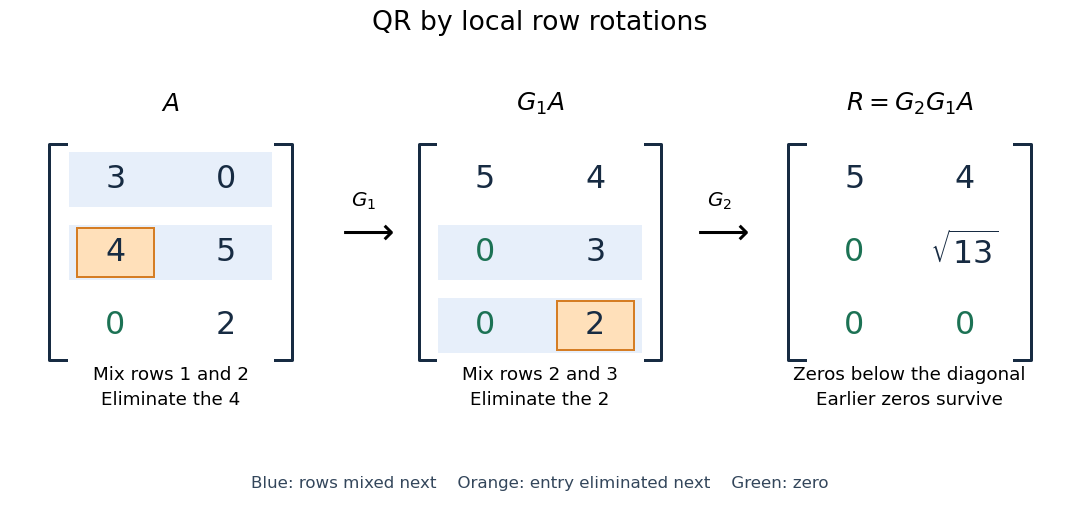
More generally, if the chronological rotations are , thenEach factor is an orthogonal matrix, so is too. For a rectangular matrix, has zeros below its diagonal; its leading block is an upper triangular matrix. With full column rank, retaining the first columns of gives orthonormal columns. To impose a positive diagonal when necessary, flip matching columns of and rows of , preserving their product.
For a linear least-squares problem, apply the same chronological Givens rotations to the right-hand side , obtaining , without explicitly constructing . Since the Euclidean norm is preserved, solve the leading upper triangular matrix system by back substitution when has full column rank; the remaining entries of give the minimum residual norm. In the example, gives , , and minimum residual Euclidean norm .
The locality is useful for a sparse matrix or an existing QR decomposition needing an extra row: only two rows change at each step, and the new row can be eliminated against the stored upper triangular matrix. For an factor, this extra-row procedure takes rotations and arithmetic operations. Locality does not guarantee preservation of sparsity: mixing rows can create nonzeros wherever either row had one. For a fully populated input, the straightforward elimination uses rotations, each touching columns, giving work. Storage layout, zero patterns and implementation affect speed; this count alone establishes no universal advantage over other QR decomposition algorithms.
The Euclidean norm preservation explains the appeal for numerical stability: exact rotations do not amplify a perturbation's length. Rounded coefficients and Givens row-pair updates still introduce roundoff error. Small reconstruction and orthogonality residuals check the computed factors, while the condition number of the original problem still controls how accurately a linear least-squares problem determines its solution.
For two bulk phases of one substance at common temperature and pressure , phase coexistence requires equal chemical potentials:For a single component, the molar Gibbs free energy equals , so this also equates the two molar free energies. The equality selects a coexistence curve in the – plane. [ref]
Along the curve, giveswhen . This is the Clausius-Clapeyron relation, with differences taken from phase to phase and . A positive liquid-to-vapour entropy jump and molar volume jump give a positive coexistence slope. [ref]
For a mixture, equilibrium instead requires equality of each exchangeable component's chemical potential between phases. Their compositions can differ, so their bulk molar Gibbs free energies need not be equal. A single-component equality must not be transferred unchanged to different-composition phases.
Let a chemical reaction have signed stoichiometric coefficients , positive for products. Changes of amount of substance satisfy , with extent of reaction . At fixed temperature and pressure, the Gibbs free energy differential isThus the Gibbs energy of reaction is , using molar chemical potentials when is measured in moles.
An interior chemical equilibrium allows either sign of a small , so it requires . A positive forward change lowers when ; a negative change lowers it when . Stability additionally requires a constrained minimum, rather than stationarity alone.
At a boundary of allowed compositions, only one direction may be feasible. Then the necessary minimum condition is for every allowed small change. The zero-derivative equality must not be imposed on an infeasible reverse change.
Gershgorin stability bound for a variable-coefficient diffusion stencil by Codex 0 Created 2026-09-24 Updated 2026-10-20
Codex 0 Created 2026-09-24 Updated 2026-10-20A symmetric matrix obtained from a conservative five-point discretization of a diffusion equation has row centre and radius at most , where is the grid spacing and is the sum of its four nonnegative edge coefficients. Here the matrix represents the diffusion generator, with nonnegative off-diagonal entries; boundary elimination may reduce the row radius. If every coefficient is at most , then , and the Gershgorin bounds for symmetric matrices place every eigenvalue in .
For the forward Euler method, an eigenvalue has amplification factor . Requiring for every such eigenvalue gives the sufficient absolute stability condition . Symmetry makes this also prevent growth of the Euclidean norm. For and , the bound is and . At that step size the interval maps to amplification factors in . This illustrates why cheap Gershgorin disc bounds can select a stable time step before any eigenvalues are computed.
A coastal Kelvin wave is trapped within a Rossby deformation radius of a boundary. It propagates with the boundary on its right in the Northern Hemisphere and on its left in the Southern Hemisphere, and its linear shallow-water potential-vorticity anomaly vanishes.
An inertia-gravity wave is restored jointly by buoyancy or free-surface gravity and the Coriolis force.
Antipodally symmetric nongeodesic spherical curve by Codex 0 Created 2026-09-24 Updated 2026-09-24
Codex 0 Created 2026-09-24 Updated 2026-09-24A non-equatorial latitude on the round sphere is preserved transitively by rotations about its axis but has nonzero geodesic curvature. Its two complementary spherical caps are not isometric.
Isometric halves give zero total boundary geodesic curvature by Codex 0 Created 2026-09-24 Updated 2026-09-24
Codex 0 Created 2026-09-24 Updated 2026-09-24If a closed oriented surface is cut along a curve into two isometric surfaces with boundary, their Euler characteristics and total Gaussian curvatures agree. Applying Gauss-Bonnet to both halves, whose induced boundary orientations are opposite, gives
Transitive curve symmetry makes geodesic-curvature magnitude constant by Codex 0 Created 2026-09-24 Updated 2026-11-05
Codex 0 Created 2026-09-24 Updated 2026-11-05Suppose a group of isometries of an oriented Riemannian surface preserves a connected regular curve and acts transitively on it. Then the magnitude of its geodesic curvature is constant. The isometries must preserve the ambient surface metric; preserving only a curve's image in Euclidean space does not determine its geodesic curvature on an unrelated surface.
A surface isometry preserves the Levi-Civita connection, arc length, and the magnitude of tangential acceleration , which is for a regular curve parametrized by arc length. Transitivity makes it constant. After fixing curve and surface orientations, signed geodesic curvature is continuous, so connectedness makes it identically zero or of one constant nonzero value. A homogeneous nongeodesic latitude shows that transitivity does not force a geodesic.
A coordinate is ignorable, or cyclic, when . The Euler--Lagrange equation then gives , so its generalized momentum is conserved.
A generalized linear mixed model adds latent random effects to the linear predictor of a generalized linear model.
IRLS fits a generalized linear model by repeatedly solving a weighted least-squares approximation to its score equations.
Pinned article: Introduction to the OurBigBook Project
Welcome to the OurBigBook Project! Our goal is to create the perfect publishing platform for STEM subjects, and get university-level students to write the best free STEM tutorials ever.
Everyone is welcome to create an account and play with the site: ourbigbook.com/go/register. We belive that students themselves can write amazing tutorials, but teachers are welcome too. You can write about anything you want, it doesn't have to be STEM or even educational. Silly test content is very welcome and you won't be penalized in any way. Just keep it legal!
Intro to OurBigBook
. Source. We have two killer features:
- topics: topics group articles by different users with the same title, e.g. here is the topic for the "Fundamental Theorem of Calculus" ourbigbook.com/go/topic/fundamental-theorem-of-calculusArticles of different users are sorted by upvote within each article page. This feature is a bit like:
- a Wikipedia where each user can have their own version of each article
- a Q&A website like Stack Overflow, where multiple people can give their views on a given topic, and the best ones are sorted by upvote. Except you don't need to wait for someone to ask first, and any topic goes, no matter how narrow or broad
This feature makes it possible for readers to find better explanations of any topic created by other writers. And it allows writers to create an explanation in a place that readers might actually find it.
Figure 1. Screenshot of the "Derivative" topic page. View it live at: ourbigbook.com/go/topic/derivativeVideo 2. OurBigBook Web topics demo. Source. - local editing: you can store all your personal knowledge base content locally in a plaintext markup format that can be edited locally and published either:This way you can be sure that even if OurBigBook.com were to go down one day (which we have no plans to do as it is quite cheap to host!), your content will still be perfectly readable as a static site.
- to OurBigBook.com to get awesome multi-user features like topics and likes
- as HTML files to a static website, which you can host yourself for free on many external providers like GitHub Pages, and remain in full control

Figure 2. You can publish local OurBigBook lightweight markup files to either OurBigBook.com or as a static website.
Figure 3. Visual Studio Code extension installation.
Figure 5. . You can also edit articles on the Web editor without installing anything locally. Video 3. Edit locally and publish demo. Source. This shows editing OurBigBook Markup and publishing it using the Visual Studio Code extension. 
- Infinitely deep tables of contents:



All our software is open source and hosted at: github.com/ourbigbook/ourbigbook
Further documentation can be found at: docs.ourbigbook.com
Feel free to reach our to us for any help or suggestions: docs.ourbigbook.com/#contact