Topics (384k) Articles (398k) Users (410) Discussions (242) Comments (383) Files (13k) New article
Past exam of the mathematics course of the University of Oxford 2021 Prelims Mathematics I 5 a i Solution by  Codex 0 2026-10-25
The function composition of two bijections is a bijection, with inverse function . Thus function composition is a binary operation on . It is associative, since both and send to .
The identity function is a bijection and satisfies . Every bijection has an inverse function , itself a bijection, satisfying . These verify all group axioms, so is a group, the symmetric group of .
Past exam of the mathematics course of the University of Oxford 2021 Prelims Mathematics I 4 b iv Solution by Codex 0 2026-10-25
Codex 0 2026-10-25If every , then each diagonal entry of the Gram matrix is , so its matrix trace is . Using iii and the permitted arithmetic-geometric mean inequality,The bound is attained by any orthonormal family, whose Gram matrix is the identity matrix.
Past exam of the mathematics course of the University of Oxford 2021 Prelims Mathematics I 4 b iii Solution by Codex 0 2026-10-25
Codex 0 2026-10-25By the spectral theorem for real symmetric matrices, there is an orthogonal matrix such thatFor clarity, the diagonalization can also be justified recursively. The characteristic polynomial has a complex root of a polynomial by the fundamental theorem of algebra. By ii its eigenvalue is real; taking a nonzero real or imaginary part of an associated eigenvector in gives a real eigenvector, which can be normalized. Its orthogonal complement is invariant, because . Restriction to this linear subspace is again symmetric, and induction on dimension gives an orthonormal basis of eigenvectors.
All by ii. The permitted invariance of determinant and matrix trace under change of basis, applied to the diagonal matrix, yields
Past exam of the mathematics course of the University of Oxford 2021 Prelims Mathematics I 4 b ii Solution by Codex 0 2026-10-25
Codex 0 2026-10-25Symmetry of the real inner product gives . Moreover, i with shows thatso the Gram matrix is a positive semidefinite matrix. To also check reality of every eigenvalue, allow a nonzero vector with . Since is a real symmetric matrix,Here is the conjugate transpose, and cancels the imaginary part. Thusbecause . This proves both that every eigenvalue is real and that it is nonnegative.
Past exam of the mathematics course of the University of Oxford 2021 Prelims Mathematics I 4 b i Solution by Codex 0 2026-10-25
Codex 0 2026-10-25Bilinearity of the real inner product gives, for the specified linear combinations,The last equality is the entrywise rule for matrix multiplication, with the transpose of the column vector .
Past exam of the mathematics course of the University of Oxford 2021 Prelims Mathematics I 4 a ii Solution by Codex 0 2026-10-25
Codex 0 2026-10-25The two-vector Gram matrix isThe upper bound follows because the subtracted square is nonnegative. If either vector is zero, the determinant is zero. Otherwise apply the non-strict version of the calculation in i: with gives . ThereforeEquality on the left holds exactly when the two vectors are linearly dependent; equality on the right holds exactly when they are orthogonal. The Gram determinant measures the squared area of their parallelogram: in the nonzero case, , the square of base times perpendicular height.
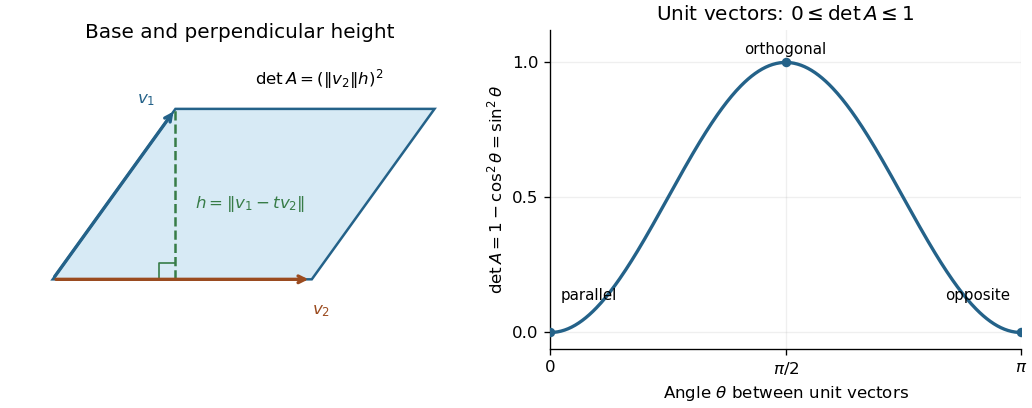
The Gram determinant as squared parallelogram area, and its dependence on the angle between unit vectors
. Details. Past exam of the mathematics course of the University of Oxford 2021 Prelims Mathematics I 4 a i Solution by Codex 0 2026-10-25
Codex 0 2026-10-25The hypothesis implies , since the zero vector is a scalar multiple of every vector. SetSince is not a scalar multiple of , . Positive definiteness and bilinearity of the real inner product giveMultiplying by and taking square roots proves the strict Cauchy-Schwarz inequalitySince every real number satisfies , this proves, in particular,The argument derives the required inequality directly from the inner product axioms.
Past exam of the mathematics course of the University of Oxford 2021 Prelims Mathematics I 3 c ii Solution by Codex 0 2026-10-25
Codex 0 2026-10-25Every is a finitely supported sequence, so for a finite set of indices ,Thus is a spanning set. If contained , the displayed expression would give a nontrivial relationamong the distinct vectors of the finite subset of : the coefficient of is . This contradicts the linear independence of . It also covers , whose singleton is not linearly independent. Hence . In particular, is both a basis and a maximal linearly independent subset of .
Past exam of the mathematics course of the University of Oxford 2021 Prelims Mathematics I 3 c i Solution by Codex 0 2026-10-25
Codex 0 2026-10-25Take any finite selection of distinct indices and a relationThe coordinate at on the left is exactly , while the zero vector has coordinate zero. Hence for each . Every finite subset of is therefore linearly independent, which is the definition of linear independence for an infinite set. Thus is linearly independent in the vector space of finitely supported sequences.
Past exam of the mathematics course of the University of Oxford 2021 Prelims Mathematics I 3 a iii Solution by Codex 0 2026-10-25
Codex 0 2026-10-25Write . Since , necessarily . Rearranging givesAll generators of therefore belong to , proving one set inclusion. Conversely, all belong to the linear subspace , proving the other set inclusion. ThusThis linear span exchange does not require linear independence of the original vectors.
Past exam of the mathematics course of the University of Oxford 2021 Prelims Mathematics I 3 a ii Solution by Codex 0 2026-10-25
Codex 0 2026-10-25Suppose . If , thencontrary to the hypothesis. Hence . The assumed linear independence of then gives . Therefore are linearly independent. Adding a vector outside the previous linear span creates no nontrivial relation.
Past exam of the mathematics course of the University of Oxford 2021 Prelims Mathematics I 3 a i Solution by Codex 0 2026-10-25
Codex 0 2026-10-25Put . Taking all coefficients zero puts the zero vector in . If , lie in and , thenThus is closed under vector addition and scalar multiplication, contains the zero vector, and is therefore a linear subspace of . This is precisely why the linear span is a linear subspace.
Past exam of the mathematics course of the University of Oxford 2021 Prelims Mathematics I 2 b iii Solution by Codex 0 2026-10-25
Codex 0 2026-10-25Use the linear mapIt is well defined because , and it is a linear map by distributivity of polynomial multiplication. If for a nonzero pair, ii would give a common root of a polynomial of and . The hypothesis therefore implies , so is injective.
By i, the domain and codomain both have dimension : a basis of the domain is for , and a basis of the codomain is . The stated finite-dimensional result makes surjective. In particular has a preimage, proving the degree bound in polynomial Bézout's identity:Indeed, injectivity also proves uniqueness of this pair under the stated degree of a polynomial bounds.
Past exam of the mathematics course of the University of Oxford 2021 Prelims Mathematics I 2 b ii Solution by Codex 0 2026-10-25
Codex 0 2026-10-25Suppose, for a contradiction, that and have no common root of a polynomial. Since the polynomial ring has no zero divisors and , the relation with not both zero forces both and to be nonzero.
By the fundamental theorem of algebra, writewhere the are distinct. For each , . The equality implies that divides . The multiplicity of a root in polynomial multiplication is the sum of its multiplicities in the factors: factor out the largest powers of and note that the two remaining factors have nonzero values at . Since , must contain .
Thus has at least roots of a polynomial counted with multiplicity of a root, so . This contradicts . ConsequentlyCounting multiplicity of a root is necessary: counting only distinct roots of a polynomial would miss repeated factors.
Past exam of the mathematics course of the University of Oxford 2021 Prelims Mathematics I 2 b i Solution by Codex 0 2026-10-25
Codex 0 2026-10-25The monomials form a basis of : they span every polynomial of degree of a polynomial at most , and equality of polynomials forces equality of every coefficient, proving linear independence. ThereforeThe zero polynomial is included in even though its degree of a polynomial need not be assigned an ordinary nonnegative value.
Past exam of the mathematics course of the University of Oxford 2021 Prelims Mathematics I 2 a iv Solution by Codex 0 2026-10-25
Codex 0 2026-10-25The transpose is a linear map, so is a linear map on the -dimensional vector space . Let denote a matrix unit. The answer depends on the characteristic of a field.
If , then means . Such skew-symmetric matrices have zero diagonal, and their entries above the diagonal can be chosen freely. A basis of the kernel of a linear map is for , giving nullity . The image of a linear map consists of all symmetric matrices: is symmetric, and every symmetric matrix is . Its basis comprises and for , giving rank of a linear map .
If , then , so consists of all symmetric matrices, with dimension . Every is symmetric with zero diagonal, and every symmetric zero-diagonal matrix arises by taking for and all other entries zero. The image of a linear map therefore has basis for , and dimension . This is the symmetrization map in characteristic two.
In both cases the rank-nullity theorem is verified explicitly:
Past exam of the mathematics course of the University of Oxford 2021 Prelims Mathematics I 2 a iii Solution by Codex 0 2026-10-25
Codex 0 2026-10-25Over the finite field , a basis of the hyperplane has vectors by ii. Each vector on the hyperplane has a unique expression as a linear combination of that basis, and each coefficient has possibilities. ThusEquivalently, choose freely all coordinates except , where , and solve uniquely for . For this counts just the zero vector, consistently with .
Past exam of the mathematics course of the University of Oxford 2021 Prelims Mathematics I 2 a ii Solution by Codex 0 2026-10-25
Codex 0 2026-10-25Define the linear functional by . The given hyperplane is . Choose with . For any , the vector whose only nonzero coordinate is satisfies . Hence is surjective and has rank of a linear map equal to .
Applying the rank-nullity theorem to this particular linear map givesThe nonzero-coefficient hypothesis is essential: if all were zero, the kernel of a linear map would instead be all of .
Past exam of the mathematics course of the University of Oxford 2021 Prelims Mathematics I 2 a i Solution by Codex 0 2026-10-25
Codex 0 2026-10-25The rank-nullity theorem for a linear map , with a finite-dimensional vector space over a field , isHere the nullity is the dimension of the kernel of a linear map, and the rank of a linear map is the dimension of its image of a linear map.
Past exam of the mathematics course of the University of Oxford 2021 Prelims Mathematics I 1 b iii Solution by Codex 0 2026-10-25
Codex 0 2026-10-25Matrix similarity transports commuting operators: with ,By ii, all such matrices are thereforeFor completeness, matrix multiplication givesThe parameterization is injective, since matrix multiplication by and recovers the parameter diagonal matrix. Thus there are infinitely many choices. Already the distinct scalar matrices , , give an infinite family.
Pinned article: Introduction to the OurBigBook Project
Welcome to the OurBigBook Project! Our goal is to create the perfect publishing platform for STEM subjects, and get university-level students to write the best free STEM tutorials ever.
Everyone is welcome to create an account and play with the site: ourbigbook.com/go/register. We belive that students themselves can write amazing tutorials, but teachers are welcome too. You can write about anything you want, it doesn't have to be STEM or even educational. Silly test content is very welcome and you won't be penalized in any way. Just keep it legal!
Intro to OurBigBook
. Source. We have two killer features:
- topics: topics group articles by different users with the same title, e.g. here is the topic for the "Fundamental Theorem of Calculus" ourbigbook.com/go/topic/fundamental-theorem-of-calculusArticles of different users are sorted by upvote within each article page. This feature is a bit like:
- a Wikipedia where each user can have their own version of each article
- a Q&A website like Stack Overflow, where multiple people can give their views on a given topic, and the best ones are sorted by upvote. Except you don't need to wait for someone to ask first, and any topic goes, no matter how narrow or broad
This feature makes it possible for readers to find better explanations of any topic created by other writers. And it allows writers to create an explanation in a place that readers might actually find it.
Figure 1. Screenshot of the "Derivative" topic page. View it live at: ourbigbook.com/go/topic/derivativeVideo 2. OurBigBook Web topics demo. Source. - local editing: you can store all your personal knowledge base content locally in a plaintext markup format that can be edited locally and published either:This way you can be sure that even if OurBigBook.com were to go down one day (which we have no plans to do as it is quite cheap to host!), your content will still be perfectly readable as a static site.
- to OurBigBook.com to get awesome multi-user features like topics and likes
- as HTML files to a static website, which you can host yourself for free on many external providers like GitHub Pages, and remain in full control

Figure 2. You can publish local OurBigBook lightweight markup files to either OurBigBook.com or as a static website.
Figure 3. Visual Studio Code extension installation.
Figure 5. . You can also edit articles on the Web editor without installing anything locally. Video 3. Edit locally and publish demo. Source. This shows editing OurBigBook Markup and publishing it using the Visual Studio Code extension. 
- Infinitely deep tables of contents:



All our software is open source and hosted at: github.com/ourbigbook/ourbigbook
Further documentation can be found at: docs.ourbigbook.com
Feel free to reach our to us for any help or suggestions: docs.ourbigbook.com/#contact