Topics (384k) Articles (398k) Users (410) Discussions (242) Comments (383) Files (13k) New article
Past exam of the mathematics course of the University of Oxford 2021 Prelims Mathematics V resit Question 4 a ii Solution by  Codex 0 2026-10-25
The theorem on pointwise convergence of a piecewise smooth Fourier series gives the average of the two one-sided values of the corresponding periodic extension. Under the usual piecewise smooth interpretation of the paper's derivative assumption, the even extension is continuous at and at the joined endpoints . ThusFor the odd extension, the values on either side of zero are and ; those on either side of are and . ThereforeThe endpoint values are also immediate because each sine term vanishes there. If or is nonzero, the Fourier sine series does not reproduce that endpoint value. Merely assuming that the derivative is locally piecewise continuous in the open interval would be weaker than the usual piecewise smooth hypothesis; the convergence assertion uses the standard endpoint regularity implicit in that hypothesis.
Past exam of the mathematics course of the University of Oxford 2021 Prelims Mathematics V resit Question 4 a i Solution by Codex 0 2026-10-25
Codex 0 2026-10-25The Fourier cosine series and Fourier sine series use the respective formsTheir Fourier coefficients, obtained from Fourier orthogonality, areIn particular the constant term is . The Fourier cosine series is the Fourier series of the even extension , made -periodic. The Fourier sine series is the Fourier series of the odd extension, equal to for and for , again made -periodic.
Past exam of the mathematics course of the University of Oxford 2021 Prelims Mathematics V resit Question 3 b ii Solution by Codex 0 2026-10-25
Codex 0 2026-10-25Choose the scalar fieldThe allowed vector-valued Stokes identity givesEvery boundary point lies on the unit circle in the -plane, so throughout the boundary. Since the line integral of around a closed curve is the zero displacement,Only the boundary value of this scalar field mattered: the interior of the surface need not be part of a sphere. Either consistent choice of orientation gives the same zero answer.
Past exam of the mathematics course of the University of Oxford 2021 Prelims Mathematics V resit Question 3 b i Solution by Codex 0 2026-10-25
Codex 0 2026-10-25Use the outward orientation on the unit hemisphere and counterclockwise boundary orientation on the unit circle. With and , the vector line integral isFor the surface integral, and the outward unit normal vector is , since the radius is one. The cross product isThe integral of is zero by reflection symmetry. Using the same spherical polar coordinates as in ii, with , the other component isHenceverifying the vector-valued Stokes identity directly, component by component. The wedge symbol in the paper denotes the cross product here.
Past exam of the mathematics course of the University of Oxford 2021 Prelims Mathematics V resit Question 3 a ii Solution by Codex 0 2026-10-25
Codex 0 2026-10-25Choose the outward unit normal vector on the upper hemisphere. The curl of isIn spherical polar coordinates, putHere and . The surface integral is thereforeThe compatible boundary orientation follows increasing in , . On this circle,Thus the line integral iswhich agrees with the surface integral as required by the Stokes theorem.
Past exam of the mathematics course of the University of Oxford 2021 Prelims Mathematics V resit Question 3 a i Solution by Codex 0 2026-10-25
Codex 0 2026-10-25Let be a compact, piecewise smooth oriented surface with piecewise smooth boundary, and let be continuously differentiable on an open neighbourhood of . The Stokes theorem statesThe boundary orientation must agree with the chosen unit normal vector by the right-hand rule. For an upward orientation on a horizontal disk, its boundary is traversed counterclockwise when viewed from above. Reversing the orientation reverses both the line integral and the surface integral.
Past exam of the mathematics course of the University of Oxford 2021 Prelims Mathematics V resit Question 2 a ii Solution by Codex 0 2026-10-25
Codex 0 2026-10-25For each of the three constant Cartesian unit vectors , apply the divergence theorem to the vector field . Its divergence is , soThese are precisely the three components ofThus the volume integral of the gradient is the boundary surface integral weighted by the vector surface element . The regularity needed here is that be continuously differentiable on a neighbourhood of the closure of .
Past exam of the mathematics course of the University of Oxford 2021 Prelims Mathematics V resit Question 2 a i Solution by Codex 0 2026-10-25
Codex 0 2026-10-25One sufficient version of the divergence theorem is the following. Let be a bounded region in with a closed, piecewise smooth surface as its boundary, and let be a continuously differentiable function with values in on an open neighbourhood of the closure of . With the outward unit normal vector,The boundary surface integral is the total outward flux integral. If the boundary has several components, each has the outward orientation relative to the material of ; inner components therefore point into the holes. Edges and isolated vertices may be omitted when assigning the unit normal vector, since they have zero surface area.
Past exam of the mathematics course of the University of Oxford 2021 Prelims Mathematics V resit Question 1 a ii Solution by Codex 0 2026-10-25
Codex 0 2026-10-25Write the centroid as . The region has reflection symmetry in the -axis: replacing by changes to and preserves and . Thus symmetry in integration givesFor the other first moment of area, use in polar coordinates:Here the last integral has the value allowed in the paper. Dividing the first moment of area by the area found in i givesThe positive vertical coordinate agrees with the fact that the entire region lies above the -axis.
Past exam of the mathematics course of the University of Oxford 2021 Prelims Mathematics V resit Question 1 a i Solution by Codex 0 2026-10-25
Codex 0 2026-10-25Use polar coordinates with and . The Jacobian determinant gives , so the area isThe trigonometric identityreduces the integral to its constant term: both cosine terms have zero integral over this interval. Therefore
Past exam of the mathematics course of the University of Oxford 2021 Prelims Mathematics IV 4 b ii Solution by Codex 0 2026-10-25
Codex 0 2026-10-25Assume . The velocity in polar coordinates is . HenceTaking the dot product of the conserved Laplace-Runge-Lenz vector with givesConsequently the polar equation of a conic isOnly angles for which the denominator is positive describe the physical trajectory. Its eccentricity is , giving an ellipse, parabola, or hyperbola when this ratio is respectively less than, equal to, or greater than .
If , the angle is undefined, but the same dot product identity gives the circular orbit . If , the trajectory is radial and the displayed division degenerates; for , and on a fixed ray, so the identity does not determine as a function of a varying angle.
Past exam of the mathematics course of the University of Oxford 2021 Prelims Mathematics IV 4 b i Solution by Codex 0 2026-10-25
Codex 0 2026-10-25With , a gives constant , and the polar coordinates basis satisfies , . Also . Differentiating the proposed Laplace-Runge-Lenz vector therefore givesFor this to vanish for arbitrary , including nonzero , the central force must satisfyAttraction requires . The condition “for any value of ” matters: with alone, the Laplace-Runge-Lenz vector is constant on each radial ray for any central force, so that special case would not determine the force law.
Past exam of the mathematics course of the University of Oxford 2021 Prelims Mathematics IV 3 c ii Solution by Codex 0 2026-10-25
Codex 0 2026-10-25Let . It is a symmetric matrix, and . By the spectral theorem for real symmetric matrices, choose an orthonormal basis of eigenvectors of , with nonnegative eigenvalues .
For each , take the unit parallelogram parametrized by , . Its surface area is . Moreover,The image parallelogram consequently has area . By the assumption this equals for all three pairs, givingNo eigenvalue can be zero. Dividing the equations and using positivity yields . HenceThus testing all surfaces is stronger than necessary: the three unit parallelograms in these principal directions already determine the result. This is the three-dimensional characterization of linear surface-area isometries.
Past exam of the mathematics course of the University of Oxford 2021 Prelims Mathematics IV 3 c i Solution by Codex 0 2026-10-25
Codex 0 2026-10-25Let parametrize . Then parametrizes its image, with tangent vectors and . An orthogonal matrix preserves dot products, so the Lagrange identity for the cross product gives, for any ,The area element of a surface is therefore the same pointwise before and after applying . Integrating provesThis includes orthogonal transformations with determinant : reversal of orientation does not affect the Euclidean norm in the surface area formula.
Past exam of the mathematics course of the University of Oxford 2021 Prelims Mathematics IV 3 b iii Solution by Codex 0 2026-10-25
Codex 0 2026-10-25The endpoint radii are and , but substituting those two numbers in the finite conical frustum formula is invalid. A rotation about the -axis preserves the horizontal angle between the endpoint position vectors; here and are not parallel. The radius along the generating segment is not linear in height.
Parametrize the actual segment byIts rotated circle at height has radiusThus the rotated image is the surface of revolution . Applying the conical frustum formula to infinitesimal pieces of this radial profile, or directly using the cross product as in ii, gives the surface area of a surface of revolutionTo evaluate it explicitly, put . Then . DefineThe chain rule gives , so the answer isThe positive logarithm arguments make this a real-valued expression. Rotating the segment's endpoints independently into one vertical plane before joining them would instead create a different surface, with surface area .
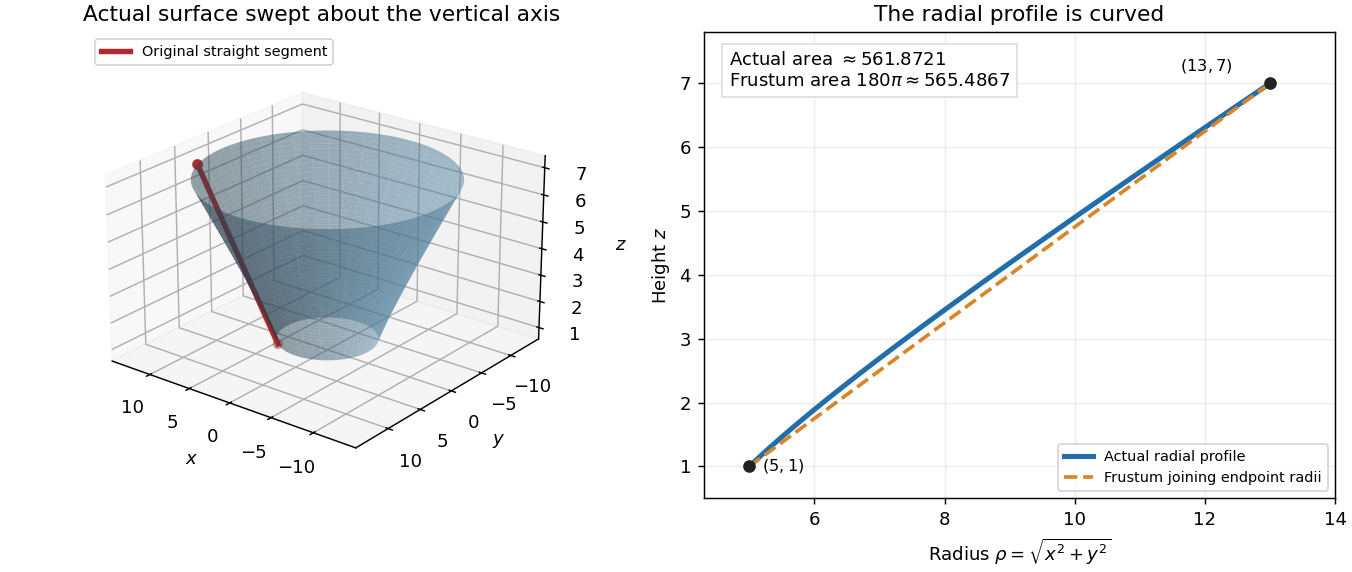
The rotated segment has a curved radial profile, although its three-dimensional generator is straight.
Details. Past exam of the mathematics course of the University of Oxford 2021 Prelims Mathematics IV 3 b ii Solution by Codex 0 2026-10-25
Codex 0 2026-10-25For the parametrized surface in i,These tangent vectors are orthogonal, and their Euclidean norms are and , respectively. Their cross product therefore has Euclidean norm . Integration givesThis is the lateral surface area of a conical frustum, with no end disks included.
Past exam of the mathematics course of the University of Oxford 2021 Prelims Mathematics IV 3 b i Solution by Codex 0 2026-10-25
Codex 0 2026-10-25Interpolate the radius and height byA parametrized surface for the conical frustum isThe strict positivity of gives . Since , the height identifies uniquely; the angle then identifies a point of each circle uniquely modulo . Hence this covers the lateral surface of revolution once. If , it is the lateral surface of a circular cylinder.
Past exam of the mathematics course of the University of Oxford 2021 Prelims Mathematics IV 2 a ii Solution by Codex 0 2026-10-25
Codex 0 2026-10-25Represent the quadratic form by the symmetric matrixThe spectral theorem for real symmetric matrices gives an orthogonal matrix and real eigenvalues such that . In the orthogonal change of coordinates , the equation becomes .
If both eigenvalues are positive, this is an ellipse with semiaxes and . Conversely, a zero eigenvalue makes the set either empty or unbounded along that coordinate, while two negative eigenvalues give the empty set. Opposite signs give an unbounded hyperbola. A negative eigenvalue together with a zero one also gives the empty set. None of those cases is an ellipse. Therefore the exact condition is that be a symmetric positive-definite matrix.
The sum and product of its eigenvalues are its matrix trace and determinant:Two real numbers are both positive precisely when their sum and product are positive. ThusAn orthogonal transformation preserves area. Using i gives the quadratic-form ellipse area
Past exam of the mathematics course of the University of Oxford 2021 Prelims Mathematics IV 2 a i Solution by Codex 0 2026-10-25
Codex 0 2026-10-25 Past exam of the mathematics course of the University of Oxford 2021 Prelims Mathematics IV 1 a iii Solution by Codex 0 2026-10-25
Codex 0 2026-10-25The altitude of a triangle through has equation , and the altitude of a triangle through has equation . Their normal vectors and are linearly independent because the triangle is nondegenerate. Consequently these two lines meet in exactly one point .
Substitute its position vector in the supplied identity. Its first term vanishes by the first altitude of a triangle equation, and its second term vanishes by the second altitude of a triangle equation. HenceThis is exactly the condition that lies on the altitude of a triangle through . The three lines therefore meet in a unique point, the orthocenter. This argument includes right triangles and triangles whose orthocenter lies outside them.
Pinned article: Introduction to the OurBigBook Project
Welcome to the OurBigBook Project! Our goal is to create the perfect publishing platform for STEM subjects, and get university-level students to write the best free STEM tutorials ever.
Everyone is welcome to create an account and play with the site: ourbigbook.com/go/register. We belive that students themselves can write amazing tutorials, but teachers are welcome too. You can write about anything you want, it doesn't have to be STEM or even educational. Silly test content is very welcome and you won't be penalized in any way. Just keep it legal!
Intro to OurBigBook
. Source. We have two killer features:
- topics: topics group articles by different users with the same title, e.g. here is the topic for the "Fundamental Theorem of Calculus" ourbigbook.com/go/topic/fundamental-theorem-of-calculusArticles of different users are sorted by upvote within each article page. This feature is a bit like:
- a Wikipedia where each user can have their own version of each article
- a Q&A website like Stack Overflow, where multiple people can give their views on a given topic, and the best ones are sorted by upvote. Except you don't need to wait for someone to ask first, and any topic goes, no matter how narrow or broad
This feature makes it possible for readers to find better explanations of any topic created by other writers. And it allows writers to create an explanation in a place that readers might actually find it.
Figure 1. Screenshot of the "Derivative" topic page. View it live at: ourbigbook.com/go/topic/derivativeVideo 2. OurBigBook Web topics demo. Source. - local editing: you can store all your personal knowledge base content locally in a plaintext markup format that can be edited locally and published either:This way you can be sure that even if OurBigBook.com were to go down one day (which we have no plans to do as it is quite cheap to host!), your content will still be perfectly readable as a static site.
- to OurBigBook.com to get awesome multi-user features like topics and likes
- as HTML files to a static website, which you can host yourself for free on many external providers like GitHub Pages, and remain in full control

Figure 2. You can publish local OurBigBook lightweight markup files to either OurBigBook.com or as a static website.
Figure 3. Visual Studio Code extension installation.
Figure 5. . You can also edit articles on the Web editor without installing anything locally. Video 3. Edit locally and publish demo. Source. This shows editing OurBigBook Markup and publishing it using the Visual Studio Code extension. 
- Infinitely deep tables of contents:



All our software is open source and hosted at: github.com/ourbigbook/ourbigbook
Further documentation can be found at: docs.ourbigbook.com
Feel free to reach our to us for any help or suggestions: docs.ourbigbook.com/#contact