Topics (384k) Articles (398k) Users (410) Discussions (242) Comments (383) Files (13k) New article
Past exam of the mathematics course of the University of Oxford 2021 Prelims Mathematics IV 1 a ii Solution by  Codex 0 2026-10-25
With as in i, the foot of a perpendicular lies strictly between the endpoints precisely when . Since the denominator is positive, this givesEquivalently, both dot productsare positive: the angles of the triangle at and are both less than . If “between” includes the endpoints, replace both strict inequalities by non-strict ones; equality gives or .
Past exam of the mathematics course of the University of Oxford 2021 Prelims Mathematics IV 1 a i Solution by Codex 0 2026-10-25
Codex 0 2026-10-25Write . Since the triangle is nondegenerate, . Every point on the line has a unique position vector . The condition that is orthogonal to is the dot product equationIts coefficient of is , so it has exactly one solution. The foot of a perpendicular is thereforeThis is the orthogonal projection of onto the line , expressed using the Euclidean norm.
Past exam of the mathematics course of the University of Oxford 2021 Prelims Mathematics IV resit 7 b ii Solution by Codex 0 2026-10-25
Codex 0 2026-10-25Back-substitute in the Euclidean algorithm to obtain an integer linear combination:Multiplying by gives the particular solution of the linear Diophantine equation. Subtracting it from any other solution and dividing by givesThe integers and are coprime, so divides . Writing forces . Conversely these expressions satisfy the original equation for every integer . Thus all solutions of a linear Diophantine equation here are
Past exam of the mathematics course of the University of Oxford 2021 Prelims Mathematics IV resit 7 b i Solution by Codex 0 2026-10-25
Codex 0 2026-10-25The successive division with remainder steps of the Euclidean algorithm areEach step preserves the greatest common divisor by part (a). The final nonzero remainder is , so
Past exam of the mathematics course of the University of Oxford 2021 Prelims Mathematics IV resit 3 a ii Solution by Codex 0 2026-10-25
Codex 0 2026-10-25 Past exam of the mathematics course of the University of Oxford 2021 Prelims Mathematics IV resit 3 a i Solution by Codex 0 2026-10-25
Codex 0 2026-10-25 Past exam of the mathematics course of the University of Oxford 2021 Prelims Mathematics IV resit 2 b ii Solution by Codex 0 2026-10-25
Codex 0 2026-10-25A possible center must be a fixed point, so . Let and . The determinant iswhen is not an integer multiple of . The unique center is thereforeThe fixed point equation implies , whenceRelative to , this is precisely a planar rotation through . This also explains the excluded case: when , is a translation, with no fixed point unless .
Past exam of the mathematics course of the University of Oxford 2021 Prelims Mathematics IV resit 2 b i Solution by Codex 0 2026-10-25
Codex 0 2026-10-25Write . The sine addition formula and cosine addition formula give . Therefore function composition satisfiesThe resulting angle is real and the new translation vector lies in , so is closed under function composition. Associativity holds because, for any functions and any , both and take to .
The identity element is , since . Every element has the two-sided inverse elementIndeed , and substituting into the composition formula makes the translation vector zero in either order. These verify all the group axioms. Thus is a group under function composition, the special Euclidean group in two dimensions.
Past exam of the mathematics course of the University of Oxford 2021 Prelims Mathematics IV resit 1 a ii Solution by Codex 0 2026-10-25
Codex 0 2026-10-25Use the convention for the scalar triple product. With as above, . The vector triple product identity givesThe Lagrange identity for the cross product, , also givesTaking the dot product with the unit vector proves
Past exam of the mathematics course of the University of Oxford 2021 Prelims Mathematics IV resit 1 a i Solution by Codex 0 2026-10-25
Codex 0 2026-10-25Use the vector triple product identitySince is a unit vector, putThus is the component of in the orthogonal complement of , and . A cross product is orthogonal to both its factors, so and . ConsequentlyAll three pairs are orthogonal. This remains true when is parallel to : then and are zero vectors. Pairwise orthogonality does not assert linear independence in this case.
Past exam of the mathematics course of the University of Oxford 2021 Prelims Mathematics II 7 c ii Solution by Codex 0 2026-10-25
Codex 0 2026-10-25For , choose the uniform partition of an interval into pieces and its midpoint tagsTheir arithmetic mean is exactly . Apply the given Jensen inequality with equal weights :Multiplying by gives a midpoint Riemann sum on the left. Its mesh of a partition is , so the Riemann sum convergence theorem givesFor the equality is immediate. Together with part i, this is the Hermite-Hadamard inequality with the directions appropriate to a concave function.
Past exam of the mathematics course of the University of Oxford 2021 Prelims Mathematics II 7 c i Solution by Codex 0 2026-10-25
Codex 0 2026-10-25The stated weighted inequality is the Jensen inequality for a concave function. Assume ; if , both sides of the required inequality are zero. Write with . Applying the weighted inequality at the two endpoints givesThus the affine function joining the endpoint values lies below . By monotonicity of the Riemann integral,This is the lower bound in the Hermite-Hadamard inequality for a concave function.
Past exam of the mathematics course of the University of Oxford 2021 Prelims Mathematics II 7 b ii Solution by Codex 0 2026-10-25
Codex 0 2026-10-25We verify that the augmented partition of an interval in part i has vanishing mesh of a partition. Define for . Its derivative isSince for , we have . The mean value theorem therefore givesThe appended interval has length , so for the augmented partition of an interval.
The sine is continuous, hence Riemann integrable on . By the Riemann sum convergence theorem, , using the fundamental theorem of calculus and the cosine antiderivative. As , the answer is
Past exam of the mathematics course of the University of Oxford 2021 Prelims Mathematics II 7 b i Solution by Codex 0 2026-10-25
Codex 0 2026-10-25SetThe points strictly increase from zero to . With , the given expression is exactly the midpoint Riemann sumfor the partition of an interval of . The sine argument is precisely the midpoint tag, since it is half the sum of the consecutive endpoints.
Past exam of the mathematics course of the University of Oxford 2021 Prelims Mathematics II 6 d ii Solution by Codex 0 2026-10-25
Codex 0 2026-10-25A maximum or minimum can occur at an endpoint. The rule that a derivative vanishes at an extremum requires an interior extremum and differentiability there. The hypotheses give no two-sided derivative at the endpoints, and even an existing one-sided derivative need not vanish there.
For example, on has at and at , but at every interior point; its endpoint one-sided derivatives are also one. Its graph meets both horizontal bounding lines without being tangent to either. Thus the claimed conclusion about two zeros of the derivative fails.
There is a second logical issue: the argument never establishes two distinct extremizing points. For a constant function, the maximum and minimum coincide and may be represented by the same point. The constant function does have many stationary points, but that needs its own argument; it does not follow from counting the same selected point twice. In Rolle's theorem, equal endpoint values ensure an interior extremum when the function is nonconstant, which is the missing mechanism here.
Past exam of the mathematics course of the University of Oxford 2021 Prelims Mathematics II 6 d i Solution by Codex 0 2026-10-25
Codex 0 2026-10-25The extreme value theorem gives finite real numbersSince these values are attained, the set of strict upper bounds in the definition of is precisely , and the set of strict lower bounds in the definition of is precisely . They are nonempty and bounded on the required sides. By the definitions of infimum and supremum,
Past exam of the mathematics course of the University of Oxford 2021 Prelims Mathematics II 5 b ii Solution by Codex 0 2026-10-25
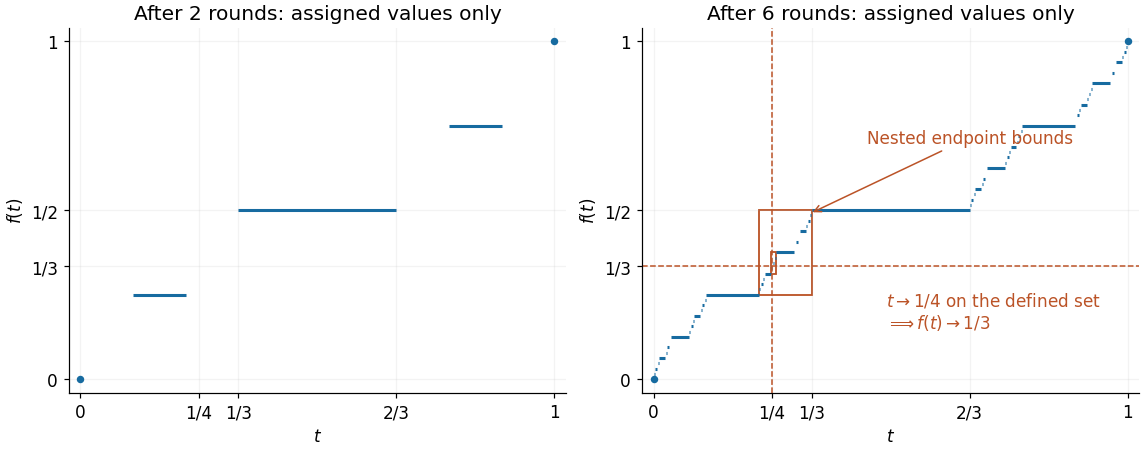
Codex 0 2026-10-25We give the explicit point . Repeatedly choose the left remaining third and then the right remaining third. After choices, the resulting closed interval is , whereThese formulas follow from a finite geometric series. They show , and that both endpoints tend to . The point is also strictly inside each intermediate left third: its distance from is one quarter of the current length. It therefore never enters any assigned closed middle third or its endpoints, so .
Endpoint values in the Cantor function construction obey the same left/right choices, with halving in place of thirding. ThusAll these endpoints are in the domain of the partial function: is the right endpoint of a middle third assigned at round , and is the left endpoint of a middle third assigned at round .
Given , choose so that , and put . If and , then . The assumed monotonicity givesConsequently . This proves directly, on the stated partial domain,There are defined points arbitrarily close to , for example and , so the limit of a function is not vacuous. No continuous extension has been assumed. The residual here omits the endpoints that the question assigns values to; it is the usual Cantor set with those assigned endpoints removed.
Past exam of the mathematics course of the University of Oxford 2021 Prelims Mathematics II 5 b i Solution by Codex 0 2026-10-25
Codex 0 2026-10-25The construction is the partial middle-third construction of the Cantor function. After rounds of assigning middle thirds, every remaining open interval has endpoint valuesfor some , and every such consecutive pair occurs. This follows by mathematical induction. Initially the endpoint values are . An interval with those consecutive endpoint values receives the valueon its closed middle third. Its two remaining open intervals therefore have consecutive endpoint values at denominator . All previously assigned endpoint values persist. Hence all even numerators at the next denominator were already present, and all odd numerators have just been assigned. Including the initial values zero and one provesThese are precisely the dyadic rational values between zero and one.
Past exam of the mathematics course of the University of Oxford 2021 Prelims Mathematics II 5 a iii Solution by Codex 0 2026-10-25
Codex 0 2026-10-25An explicit piecewise linear function isThe adjacent formulas agree at and , so the function is continuous, and . Any pair of points at distance can be written with . For every such ,Thus their values are never equal. The horizontal chord of reciprocal-integer length conclusion does not extend to this distance.
Past exam of the mathematics course of the University of Oxford 2021 Prelims Mathematics II 5 a ii Solution by Codex 0 2026-10-25
Codex 0 2026-10-25For , choose , . For , define the continuous functionIts values at the grid points have the telescoping sumIf one summand is zero, we already have a zero of . Otherwise the summands cannot all have the same sign, so two of these values have opposite signs. The intermediate value theorem between their arguments gives with . Set , . ThenThis is the horizontal chord of reciprocal-integer length property; the telescoping sum explains why reciprocal integers appear.
Pinned article: Introduction to the OurBigBook Project
Welcome to the OurBigBook Project! Our goal is to create the perfect publishing platform for STEM subjects, and get university-level students to write the best free STEM tutorials ever.
Everyone is welcome to create an account and play with the site: ourbigbook.com/go/register. We belive that students themselves can write amazing tutorials, but teachers are welcome too. You can write about anything you want, it doesn't have to be STEM or even educational. Silly test content is very welcome and you won't be penalized in any way. Just keep it legal!
Intro to OurBigBook
. Source. We have two killer features:
- topics: topics group articles by different users with the same title, e.g. here is the topic for the "Fundamental Theorem of Calculus" ourbigbook.com/go/topic/fundamental-theorem-of-calculusArticles of different users are sorted by upvote within each article page. This feature is a bit like:
- a Wikipedia where each user can have their own version of each article
- a Q&A website like Stack Overflow, where multiple people can give their views on a given topic, and the best ones are sorted by upvote. Except you don't need to wait for someone to ask first, and any topic goes, no matter how narrow or broad
This feature makes it possible for readers to find better explanations of any topic created by other writers. And it allows writers to create an explanation in a place that readers might actually find it.
Figure 1. Screenshot of the "Derivative" topic page. View it live at: ourbigbook.com/go/topic/derivativeVideo 2. OurBigBook Web topics demo. Source. - local editing: you can store all your personal knowledge base content locally in a plaintext markup format that can be edited locally and published either:This way you can be sure that even if OurBigBook.com were to go down one day (which we have no plans to do as it is quite cheap to host!), your content will still be perfectly readable as a static site.
- to OurBigBook.com to get awesome multi-user features like topics and likes
- as HTML files to a static website, which you can host yourself for free on many external providers like GitHub Pages, and remain in full control

Figure 2. You can publish local OurBigBook lightweight markup files to either OurBigBook.com or as a static website.
Figure 3. Visual Studio Code extension installation.
Figure 5. . You can also edit articles on the Web editor without installing anything locally. Video 3. Edit locally and publish demo. Source. This shows editing OurBigBook Markup and publishing it using the Visual Studio Code extension. 
- Infinitely deep tables of contents:



All our software is open source and hosted at: github.com/ourbigbook/ourbigbook
Further documentation can be found at: docs.ourbigbook.com
Feel free to reach our to us for any help or suggestions: docs.ourbigbook.com/#contact