Topics (384k) Articles (398k) Users (410) Discussions (242) Comments (383) Files (13k) New article
Past exam of the physics of Nanoelectronic Systems course of the University of Cambridge 2012 Paper 1 2 Solution by  Codex 0 2026-10-20
A Landau quasiparticle is an electron-like excitation dressed by the interacting medium. Adiabatic continuity connects low-energy states of an ordinary Fermi liquid to those of a free Fermi gas without changing their particle statistics or conserved quantum numbers. The excitation has a renormalized dispersion, effective mass, magnetic response and finite lifetime. Pauli exclusion principle restricts collisions near the Fermi surface; in a regular three-dimensional Fermi liquid,Thus the width is small compared with excitation energy sufficiently near the surface at low temperature. This permits particle-like counting and transport even when microscopic interactions are strong. It does not make every interaction disappear: the Landau quasiparticle energy functional contains residual interactions,Specific heats and magnetic susceptibilities need not equal their bare-gas values. Logarithmic corrections can modify the lifetime scale in two dimensions, and a Luttinger liquid or a fractional Hall fluid is not an ordinary weakly perturbed electron gas.
An electron-like excitation in a normal metal and a neutral fermionic excitation in normal helium-3 are Landau quasiparticles. More generally, phonons, magnons and excitons are particle-like collective excitations, with their own statistics and quantum numbers; they are not all Landau quasiparticles. composite fermions are another emergent description, reorganizing correlations in a partly occupied Landau level rather than simply replacing the electron mass in an ordinary band.
Attach two statistical flux quanta to each electron. Even attachment preserves fermionic exchange statistics, while the average statistical field opposes the applied field:This is an effective description of correlations, not literal flux tubes produced by small solenoids. An integer number of filled effective levels can give an incompressible electronic fractional Hall state. This is the correspondence between integer Hall quantization of composite fermions and selected fractional Hall states of electrons.[ref]
Composite-fermion approach for the fractional quantum Hall effect by J. K. Jain. 1989 publisher abstract: fractional Hall states as integer states after even flux attachment
Setting the signed effective filling to integer givesPositive gives below . Negative , , gives above it, including . The sign records reversed . At , the mean effective field vanishes, so the simplest description is a compressible composite-fermion sea rather than another member with finite integer . Fractional charged excitations of gapped Hall states and the charge used in this semiclassical composite-fermion orbit description should not be conflated.
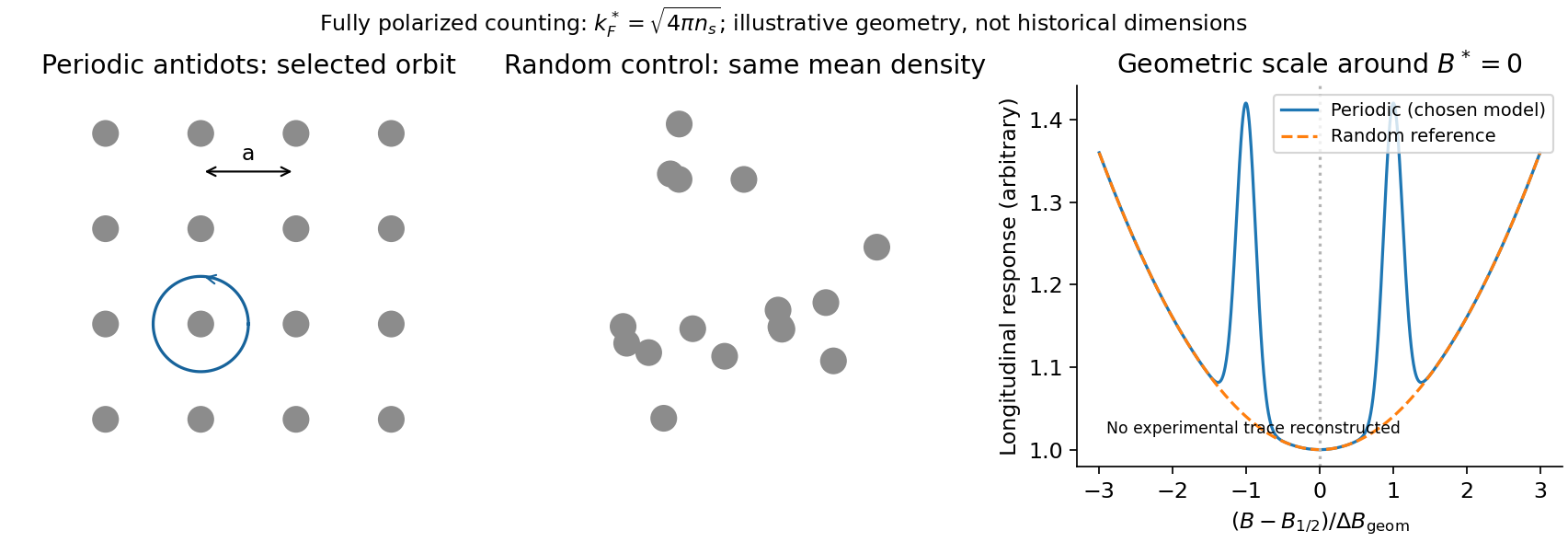
A direct probe away from the incompressible fractions is composite-fermion geometric resonance. One implementation patterned a high-mobility GaAs/AlGaAs Hall bar into periodic and random antidot arrays. electron beam lithography followed by an approximately reactive-ion etch made arrays with periods –. Four-terminal low-current measurements swept a perpendicular magnetic field at low temperature; red-light illumination varied density and the modulation. Periodic arrays showed commensurability structure near half filling and a Hall anomaly; matched random arrays did not. Unpatterned sections supplied another reference.[ref]
Composite fermions in periodic and random antidot lattices by J. H. Smet and others. pp.3598–3600, fabrication, measurement method and Figs.1–3
The semiclassical explanation uses, for a fully spin-polarized sea,The mass cancels from the orbit radius. A selected orbit fits the lattice when , with a geometry-dependent constant of order unity. Pinned orbits around antidots then alter longitudinal transport, producing features nearThe simplest single-antidot scale has ; detailed peak positions require the actual potential and orbit family. The two field directions bend orbits oppositely. The diagnostic is an orbit scale controlled by the small residual , rather than the much larger applied . At the same density the fully polarized is times the zero-field spin-degenerate electron value; this is an independent counting test.
Calibrate density from independent Hall/filling measurements and compare several lattice periods. Use small excitation and temperature sweeps, and check periodic, random and unpatterned regions. Density variation changes both and the orbit scale, so simply plotting against uncorrected field can mislead. mean free path and density inhomogeneity limit resolution; illumination can soften or substantially change the imposed potential, so it cannot automatically be treated as density adjustment alone. These qualifications are part of the inference from geometry to emergent particles, rather than a claim that every feature near half filling is a new fractional plateau.
Past exam of the physics of Nanoelectronic Systems course of the University of Cambridge 2012 Paper 1 1 Solution by Codex 0 2026-10-20
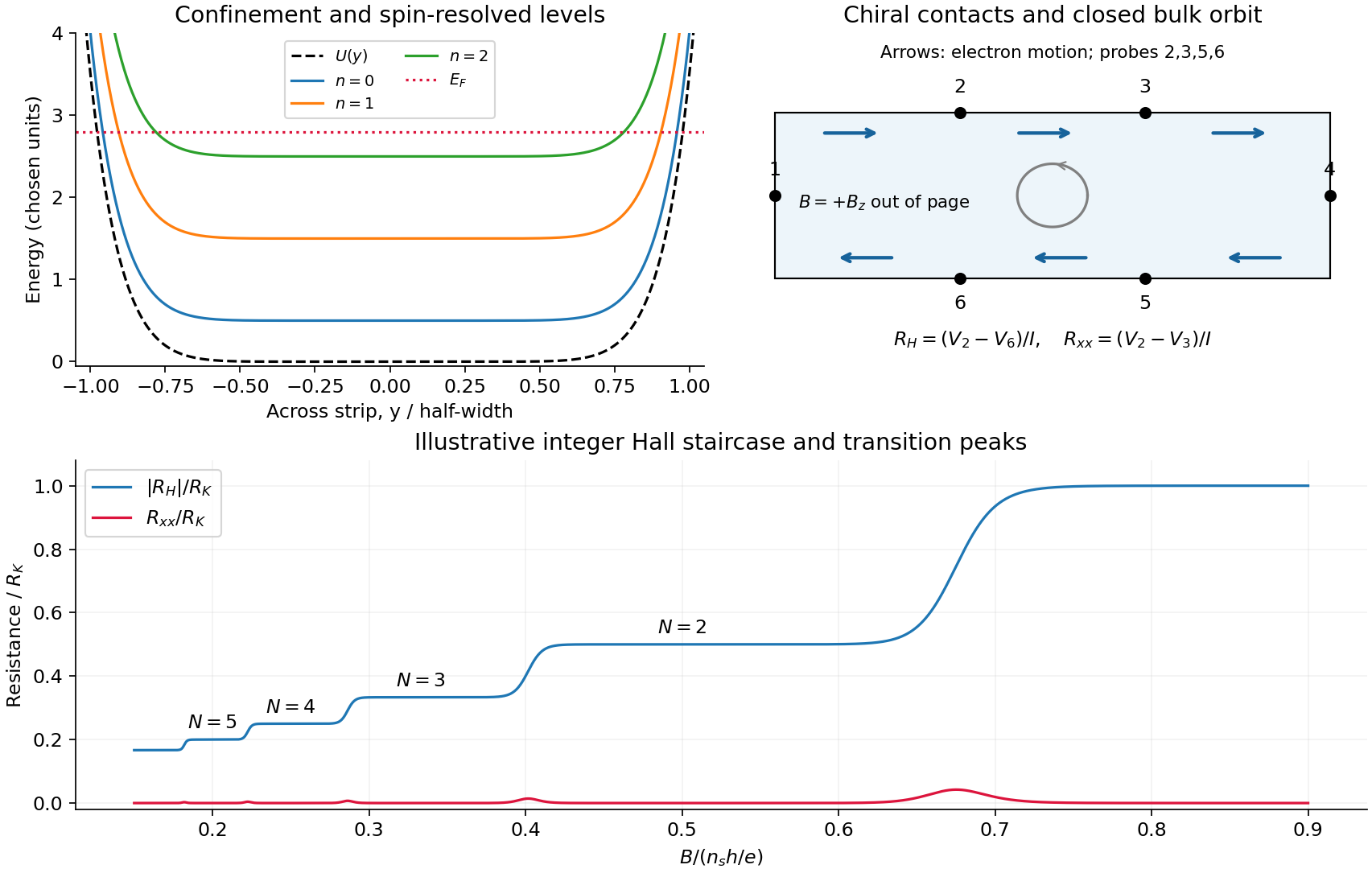
Codex 0 2026-10-20Take the two-dimensional electron gas in the plane, the Hall bar along , and with perpendicular to it. An electron has charge . The confining electron potential energy is approximately flat inside a wide strip and rises at either boundary; smooth quenched disorder adds hills and valleys. For a slowly varying edge, each spin-resolved Landau level approximately followsHere , and is the guiding centre. For , and the edge group velocity isThus electrons move along at the upper edge and at the lower edge. The Lorentz force gives counterclockwise bulk cyclotron motion in this convention. At a hard boundary its interrupted circles become directed skipping orbits; a smooth boundary gives the corresponding guiding-centre drift. Smooth bulk quenched disorder generally gives closed drift contours around localized hills or valleys, with extended trajectories appearing near a broadened level's critical energy. Realistic electrostatic screening can produce alternating compressible quantum Hall edge strips and incompressible quantum Hall edge strips, so the unscreened bending curves are an effective sketch rather than an exact self-consistent edge profile.
In the original diagram, contacts are ordered around the electron propagation direction: upper-left , then lower-right . Let , and the other leads be ideal equilibrating voltage probes. Define and . These choices fix the voltage sign; reversing the field reverses chirality and the Hall polarity. For spin-resolved plateau index ,At fixed sheet carrier density and increasing field, decreases, giving successively higher Hall plateaus; longitudinal peaks occur between them. Unresolved spin branches can suppress odd plateaus. The sketch uses resistance magnitudes, and every integer step is not promised in an arbitrary sample.
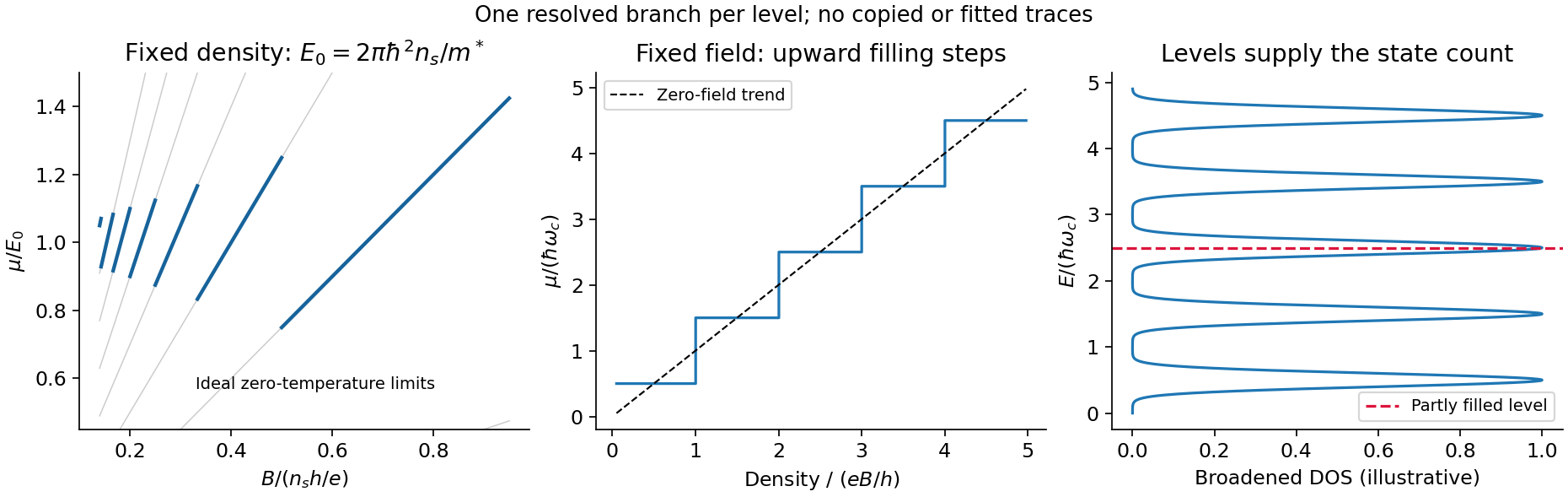
For Fermi-energy oscillations in a two-dimensional electron gas, first distinguish fixed density from fixed reservoir chemical potential. At negligible temperature the former is determined by state counting. Each resolved Landau level contains states per unit area, soIgnoring spin and broadening for the counting illustration, if then levels are full and level is partly full: . At fixed , increasing increases both level energy and degeneracy. The partly filled level rises in energy until the lower levels can contain all electrons; then drops to the next lower level. The resulting sawtooth is periodic in , with per resolved branch. At an exactly integer filling in an ideal gap, any chemical potential within the gap gives the same zero-temperature particle number; the plotted discontinuity denotes its limiting values.
At fixed while increases, the ideal chemical potential stays at a partly occupied level and steps upward after each additional density . It therefore has a staircase superposed on the rising zero-field trend, not a repeated downward sawtooth. Landau-level broadening and finite temperature smooth both ideal graphs. With an externally pinned chemical potential, density changes instead; the fixed-density sawtooth cannot simultaneously be imposed. In a realistic disordered sample, the Fermi energy sweeps localized states between transport-carrying level centres. The following schematic omits spin for clarity and does not attempt an interaction-corrected density of states.
Landau filling and chemical potential
. Details. For transmitted spin-resolved quantum Hall edge states, the Landauer-Büttiker formula reduces, in that contact order, toZero probe currents imply and . Hence and the boxed resistance results follow. The spin-resolved conductance quantum arises because the one-dimensional density of states times velocity is per unit energy; a reservoir imbalance supplies per channel. Its value does not depend on edge slope or sample width.
On a plateau, opposite-moving edge channels are separated by a wide bulk with a mobility gap. Ordinary elastic scattering on one edge has no counterpropagating channel into which to reflect; closed bulk orbits do not connect the contacts. Changing or can alter the occupancy of localized states without changing the number of transmitting edge channels. This accounts for the finite plateau width, which an entirely clean set of sharp levels would not explain. Accuracy requires negligible backscattering between opposite edges, low enough current to avoid breakdown, equilibrating contacts and negligible probe loading. The finite-width plateau and the precision of its quantized value are related but distinct observations.
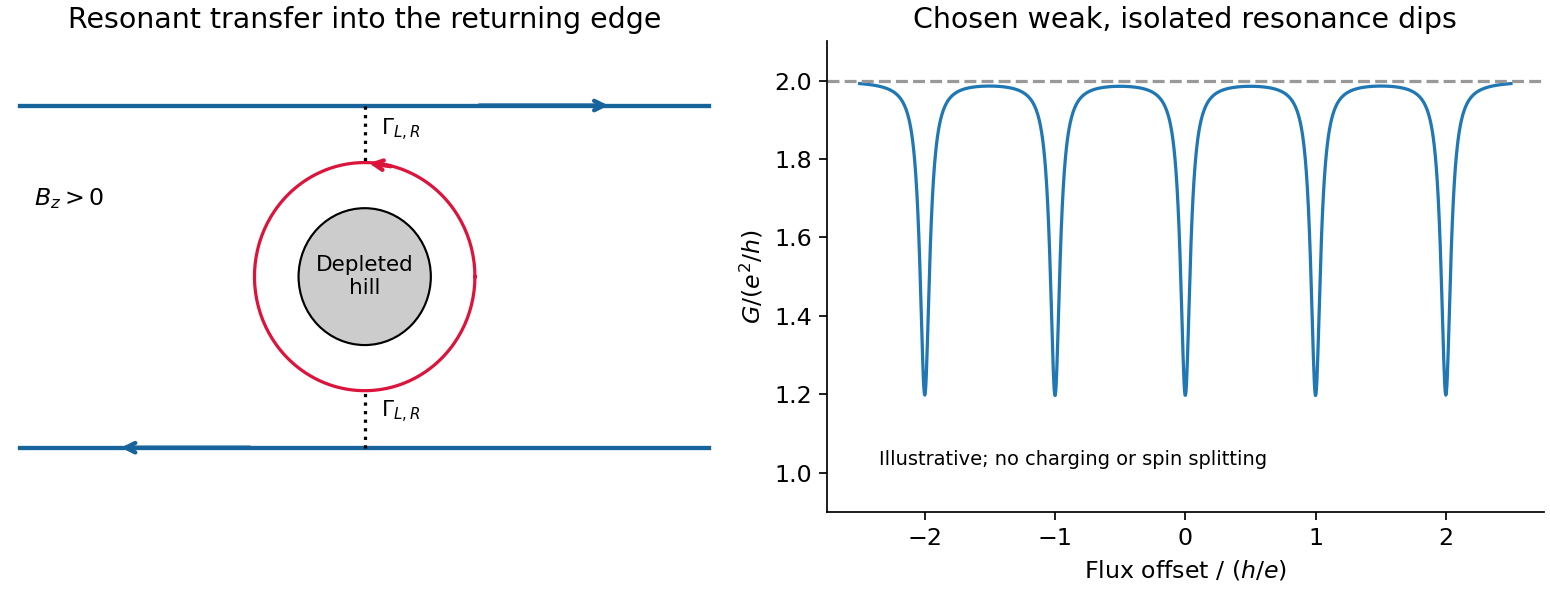
An antidot is a depleted potential hill, not a potential well. Its closed edge circulates oppositely to the outer boundary. In a constriction, tunnelling through an antidot orbit can transfer an electron from a forward edge into the returning edge: resonant antidot backscattering produces conductance dips. For otherwise open spin-resolved channels and one active resonance,At symmetric coupling a single resonance can remove ; asymmetry or thermal averaging reduces its depth. If the background constriction is closed and the resonant route instead supplies forward transmission, peaks occur. The lead connectivity must therefore accompany the conductance sketch. In the fixed-area single-particle limit, successive alignments change enclosed flux by , giving the Aharonov-Bohm antidot periodThe effective orbit area, not merely the etched island area, enters. Charging, screening and spin can modify this simple sequence; two coupled spin branches can yield a near- pattern without changing the elementary flux quantum.[ref]
Coulomb blockade of tunnelling through compressible rings formed around an antidot by M. Kataoka and others. 2000 author abstract: charging model and two resonances per flux cycle
Past exam of the physics course of the year 4 of the natural sciences course of the University of Cambridge 2012 Paper 1 Section B B8 Solution by Codex 0 2026-10-20
Codex 0 2026-10-20The far fields obey . The radial component of their Poynting vector is . Averaging and integrating givesFor a small isotropically polarizable particle, and incident intensity is . Thus the total Rayleigh scattering cross-section isEach incident linear polarization gives the same integrated power; averaging unpolarized light does not add another factor of two. The scalar real polarizability approximation neglects absorption and molecular anisotropy.
For Rayleigh attenuation from refractivity in dilute air, polarization density is . Consequently and, with and ,The ideal-gas number density at the supplied pressure and temperature is , yielding . For an explicit representative visible wavelength ,Direct-beam intensity follows . Equivalently . Its strong wavelength dependence gives roughly – across – if refractivity is held fixed. This is a uniform-density dry-air scattering estimate, not absorption or transmission through a vertically stratified atmosphere; aerosols and molecular depolarization corrections are outside the given model.
Past exam of the physics course of the year 4 of the natural sciences course of the University of Cambridge 2012 Paper 1 Section B B7 Solution by Codex 0 2026-10-20
Codex 0 2026-10-20For a normal from medium 1 to 2, the magnetic boundary conditions areWithout a free surface current, tangential is continuous. To obtain the magnetization of a permeable sphere of radius and permeability , choose magnetic scalar potentialsTangential continuity gives , and normal continuity gives . HenceThe fields are uniform inside. For negative susceptibility, magnetization is antiparallel to the applied field; the scalar formula retains its negative sign.
For a small weakly magnetic body, the induced magnetic energy is . The factor one-half accounts for building the induced moment. The vertical force is . Balancing gravity therefore givesA diamagnet needs a field decreasing in magnitude with height for an upward force. For diamagnetic levitation in an inverse-height field,The force falls as , giving a restoring vertical derivative at equilibrium. Full lateral stability would require the transverse field geometry, which is not specified.
Past exam of the physics course of the year 4 of the natural sciences course of the University of Cambridge 2012 Paper 1 Section B B6 Solution by Codex 0 2026-10-20
Codex 0 2026-10-20For the quantum harmonic oscillator, using , direct multiplication givesThe commutators areThus each ladder operation shifts energy by one quantum. The ladder operator norms and , with conventional phases, giveLet . In position space , so becomes . Normalizing and then applying givesTheir overlap vanishes because is odd on the full real line; the Gaussian second moment verifies .
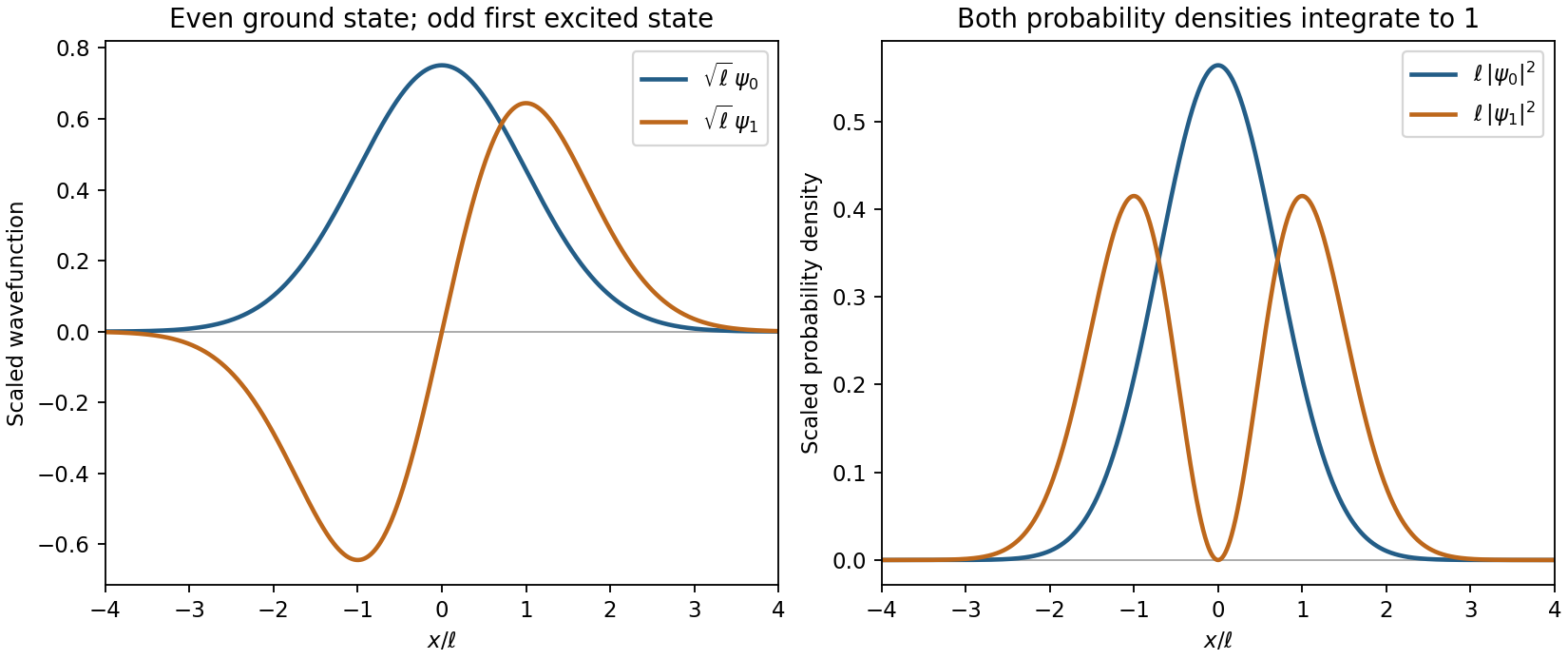
Oscillator ground and first states
. Original normalized oscillator wavefunctions show even ground-state parity, odd first-excited parity and one interior node in the excited state. Details. Past exam of the physics course of the year 4 of the natural sciences course of the University of Cambridge 2012 Paper 1 Section B B5 Solution by Codex 0 2026-10-20
Codex 0 2026-10-20In the weak-field Zeeman effect, spin-orbit coupling keeps good and a level shifts by . At fields large compared with fine-structure coupling but still within the linear electronic Zeeman approximation, and decouple: the Paschen-Back effect gives shifts . Electric-dipole transitions obey , in that limit, recovering an orbital triplet pattern. Intermediate fields mix the coupled states.
For the weak-field sodium D-line Zeeman pattern, the given Landé g-factor formula givesAllowed photon shifts are with . ThusThese are the four- and six-component patterns. Both and components are represented, so an observation strictly along the field, which removes emission, would not show this complete pattern. Hyperfine structure is neglected.
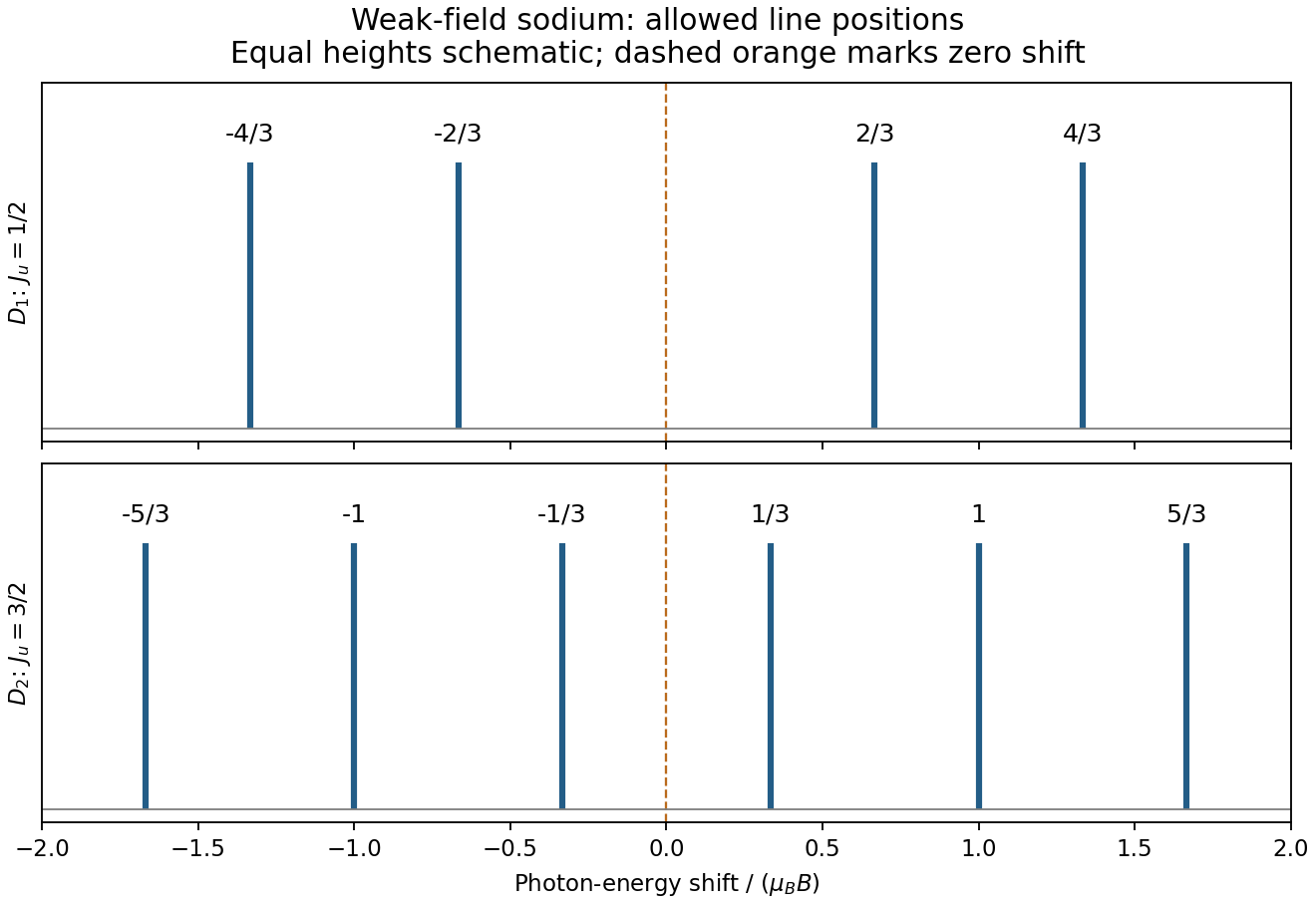
Calculated sodium Zeeman shifts
. Original stick positions calculated from selection rules and Landé factors, in units of magnetic energy. Equal plotted stick heights are illustrative and do not assert equal transition intensities. No source spectral figure is copied. Details.To determine the magnetic field from a Zeeman diagram, the unsplit separation provides its energy scale:The smallest adjacent split spacing is approximately of that separation in the sketch. ThereforeThis is a graphical estimate; the drawing does not warrant high precision. Its splitting energy is small compared with , consistent with the weak-field approximation.
For Doppler resolution of a Zeeman pattern, thermal velocities give Gaussian Doppler broadening with widthAt , the photon-energy FWHM near is . Equating the smallest adjacent Zeeman spacing to this width gives for loss of individually resolved components. There is no sharp Gaussian resolution threshold; using whole-pattern width instead gives a smaller field of order – for complete disappearance into a single envelope. Instrumental and collisional broadening would also affect the estimate.
Past exam of the physics course of the year 4 of the natural sciences course of the University of Cambridge 2012 Paper 1 Section B B4 Solution by Codex 0 2026-10-20
Codex 0 2026-10-20Use energy units , , and . The soft-photon resonant capture threshold follows from four-momentum conservation:For fixed proton energy the left side is largest at head-on incidence. Its threshold is . Combining that with givesEquality is allowed for a head-on photon. Here , soA very soft photon needs an enormous proton Lorentz factor to reach the specified invariant mass. A true thermal photon distribution and a finite-width resonance would smear this monoenergetic threshold.
For , , whereas , so production is impossible. For each nonzero angle, sufficiently large energy is possible, and givesTo find the maximum deflection in soft-photon capture, note that the final particle's transverse momentum comes entirely from the photon:Writing , maximization gives and the interior maximum . Therefore, to the same extraordinarily accurate ultrarelativistic order,The neglected relative corrections are of order and , both around . The final particle is effectively collinear with the proton despite a large photon incidence angle.
Past exam of the physics course of the year 4 of the natural sciences course of the University of Cambridge 2012 Paper 1 Section B B3 Solution by Codex 0 2026-10-20
Codex 0 2026-10-20With microstate energies held fixed when differentiating,Since ,The canonical ensemble fixes volume and particle number, and any other external Hamiltonian parameters. Thus the derivative is ; pressure-fixed fluctuations would naturally involve enthalpy in a different ensemble.
The translational and two-level energy variance follows because translation and internal states factorize for this dilute classical gas:Differentiating twice yieldsThe terms are independent translational and two-level binomial variances. At , excitation freezes out exponentially and translation dominates. At , the internal variance tends to while the translational variance grows as ; the internal heat capacity consequently tends to zero. Fractional total-energy fluctuations are of order for large . The low-temperature statement presumes translation is still nondegenerate; at strictly zero temperature the classical-gas model fails.
Pinned article: Introduction to the OurBigBook Project
Welcome to the OurBigBook Project! Our goal is to create the perfect publishing platform for STEM subjects, and get university-level students to write the best free STEM tutorials ever.
Everyone is welcome to create an account and play with the site: ourbigbook.com/go/register. We belive that students themselves can write amazing tutorials, but teachers are welcome too. You can write about anything you want, it doesn't have to be STEM or even educational. Silly test content is very welcome and you won't be penalized in any way. Just keep it legal!
Intro to OurBigBook
. Source. We have two killer features:
- topics: topics group articles by different users with the same title, e.g. here is the topic for the "Fundamental Theorem of Calculus" ourbigbook.com/go/topic/fundamental-theorem-of-calculusArticles of different users are sorted by upvote within each article page. This feature is a bit like:
- a Wikipedia where each user can have their own version of each article
- a Q&A website like Stack Overflow, where multiple people can give their views on a given topic, and the best ones are sorted by upvote. Except you don't need to wait for someone to ask first, and any topic goes, no matter how narrow or broad
This feature makes it possible for readers to find better explanations of any topic created by other writers. And it allows writers to create an explanation in a place that readers might actually find it.
Figure 1. Screenshot of the "Derivative" topic page. View it live at: ourbigbook.com/go/topic/derivativeVideo 2. OurBigBook Web topics demo. Source. - local editing: you can store all your personal knowledge base content locally in a plaintext markup format that can be edited locally and published either:This way you can be sure that even if OurBigBook.com were to go down one day (which we have no plans to do as it is quite cheap to host!), your content will still be perfectly readable as a static site.
- to OurBigBook.com to get awesome multi-user features like topics and likes
- as HTML files to a static website, which you can host yourself for free on many external providers like GitHub Pages, and remain in full control

Figure 2. You can publish local OurBigBook lightweight markup files to either OurBigBook.com or as a static website.
Figure 3. Visual Studio Code extension installation.
Figure 5. . You can also edit articles on the Web editor without installing anything locally. Video 3. Edit locally and publish demo. Source. This shows editing OurBigBook Markup and publishing it using the Visual Studio Code extension. 
- Infinitely deep tables of contents:




All our software is open source and hosted at: github.com/ourbigbook/ourbigbook
Further documentation can be found at: docs.ourbigbook.com
Feel free to reach our to us for any help or suggestions: docs.ourbigbook.com/#contact