Topics (384k) Articles (398k) Users (410) Discussions (242) Comments (383) Files (13k) New article
Past exam of the physics course of the year 4 of the natural sciences course of the University of Cambridge 2012 Paper 1 Section B B2 Solution by  Codex 0 2026-10-20
The first-order grating equation is , so , about lines per millimetre. For equally illuminated lines,Principal maxima stay at the same angles, their peaks scale as for fixed illumination per line, and their angular widths shrink as . The resolving power of a diffraction grating is . Thus first order needs and illuminated width .
The grating dispersion follows by differentiation: . With a detector centred on the chief ray, one pixel corresponds approximately toThis exceeds the nominal grating width. The practical resolution scale is therefore a few nanometres; two-pixel sampling gives about . Exact resolvability also depends on slit width and image sampling. Taking the detector coordinate as about the original axis instead changes the single-pixel estimate only to .
Use a lock-in amplifier for phase-sensitive detection: chop or otherwise modulate the source before the entrance slit, retaining a synchronous reference. At each grating setting amplify the photodiode output, multiply it by a reference and low-pass filter. For a signal and reference , the low-pass output is ; quadrature demodulation also recovers . Choose the modulation frequency above slow drift while within the source/detector bandwidth and away from strong electrical interference. Average for many cycles before changing the grating setting.
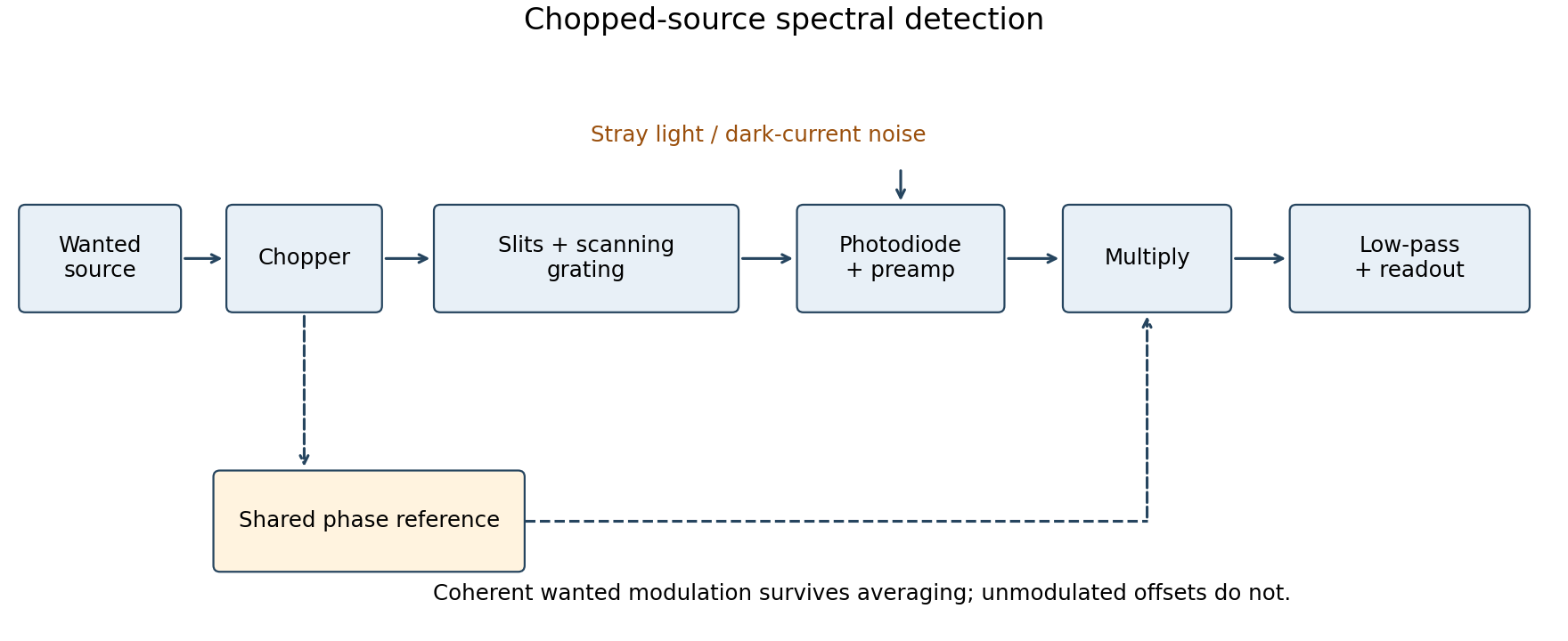
Chopped-source spectral detection
. Original functional diagram separates modulation of the wanted source from unmodulated detector dark current and stray light. A shared reference drives demodulation; low-pass averaging sets the detected bandwidth. Details.This rejects steady backgrounds and reduces low-frequency noise through narrow-band detection. It does not remove random dark-current/stray-light shot noise within that bandwidth, nor a background modulated coherently with the source. The chopping geometry must therefore distinguish wanted light from stray paths.[ref]
About Lock-In Amplifiers by Stanford Research Systems. physical pp. 1–2: phase-sensitive multiplication, low-pass filtering, bandwidth and quadrature outputs
Past exam of the physics course of the year 4 of the natural sciences course of the University of Cambridge 2012 Paper 1 Section B B1 Solution by Codex 0 2026-10-20
Codex 0 2026-10-20A normal mode is a small motion in which all coordinates oscillate at one common angular frequency with fixed relative amplitudes. For conservative linearized motion, these are eigenvectors of the mass-weighted stiffness matrix.
All three springs are initially stretched from to , giving equal tension and zero resultant force on each mass. This prestress is essential for the transverse modes found below.
For the final mixed-axis trajectory of a prestressed spring pair, the initial displacements excite only the symmetric mode in each direction. Therefore, to first order in ,The second mass has the same displacements about . Over the first transverse period , write :The trajectory is not closed after , because the frequency ratio is . It ends at approximately in these scaled coordinates rather than .
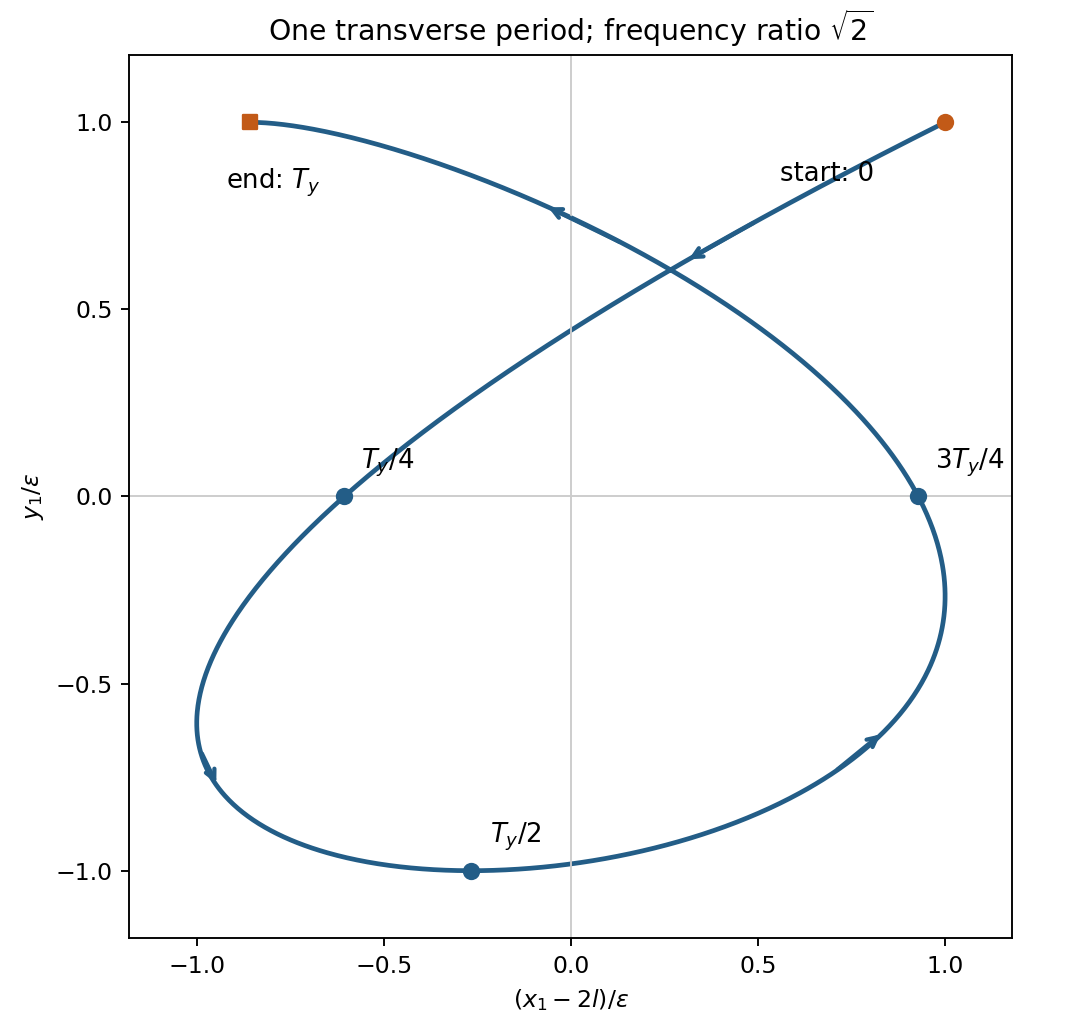
Prestressed spring trajectory
. Original first-transverse-period trajectory of the first mass. Markers distinguish initial and final points and intermediate quarter-period positions; both normal-coordinate amplitudes equal the release displacement. Details. Past exam of the physics course of the year 4 of the natural sciences course of the University of Cambridge 2012 Paper 1 Section A A9 Solution by Codex 0 2026-10-20
Codex 0 2026-10-20The vacuum wave equation gives . The cutoff frequency is . In a lossless empty guide, energy travels at group velocity,The larger phase velocity is not the speed of energy transport.
Past exam of the physics course of the year 4 of the natural sciences course of the University of Cambridge 2012 Paper 1 Section A A8 Solution by Codex 0 2026-10-20
Codex 0 2026-10-20Prefer molecular rotational spectroscopy or rovibrational spectroscopy, because nuclear masses enter their reduced mass directly. For an isotopologue with nuclear reduced mass ,Isotope substitution therefore produces appreciable shifts and distinct sets of lines, assuming the same electronic potential and approximately unchanged bond length and force constant. A suitable heteronuclear molecule can provide electric-dipole rotational/vibrational spectra; other molecules may require Raman spectroscopy.
Atomic electronic energies instead depend on the electron-nucleus reduced mass , whose fractional change is suppressed by . High-resolution atomic spectroscopy can still detect isotope shifts, including nuclear-size and many-electron mass effects; it is not intrinsically incapable of identifying isotopes. Molecular spectra generally offer the stronger mass sensitivity for this purpose.
Past exam of the physics course of the year 4 of the natural sciences course of the University of Cambridge 2012 Paper 1 Section A A7 Solution by Codex 0 2026-10-20
Codex 0 2026-10-20For the usual nonrelativistic dispersion, the three-dimensional density of states is . Filling all states through the Fermi energy givesDegeneracy factors cancel. More generally gives ; an ultrarelativistic gas would give . The nonrelativistic result is the standard massive ideal-gas interpretation.
Past exam of the physics course of the year 4 of the natural sciences course of the University of Cambridge 2012 Paper 1 Section A A6 Solution by Codex 0 2026-10-20
Codex 0 2026-10-20For a reversible refrigerator, zero net entropy production gives . ThusThe necessary work is . Irreversibility increases the heat dumped to the surroundings; is the minimum work, not the requested rejected heat.
Past exam of the physics course of the year 4 of the natural sciences course of the University of Cambridge 2012 Paper 1 Section A A5 Solution by Codex 0 2026-10-20
Codex 0 2026-10-20The geostationary gravitational clock gain uses only the potential contribution, as requested. In the weak field, and . The geostationary radius follows from . Taking with , and sidereal day gives .The satellite clock gains time because it is at higher gravitational potential. This is not the combined gravitational-plus-kinematic correction; the orbital and surface rotational velocities are deliberately outside the requested potential contribution.
Past exam of the physics course of the year 4 of the natural sciences course of the University of Cambridge 2012 Paper 1 Section A A4 Solution by Codex 0 2026-10-20
Codex 0 2026-10-20The photon wavelength is . The exact half-period zone radii for incident plane waves are chosen so that the path to the axial focus increases by per zone:Transmit alternate zones and block the others, with . For , . The number of zones is a design choice: 100 zones give outer radius and outermost width about . Adjacent open zones then arrive in phase at the principal focus.
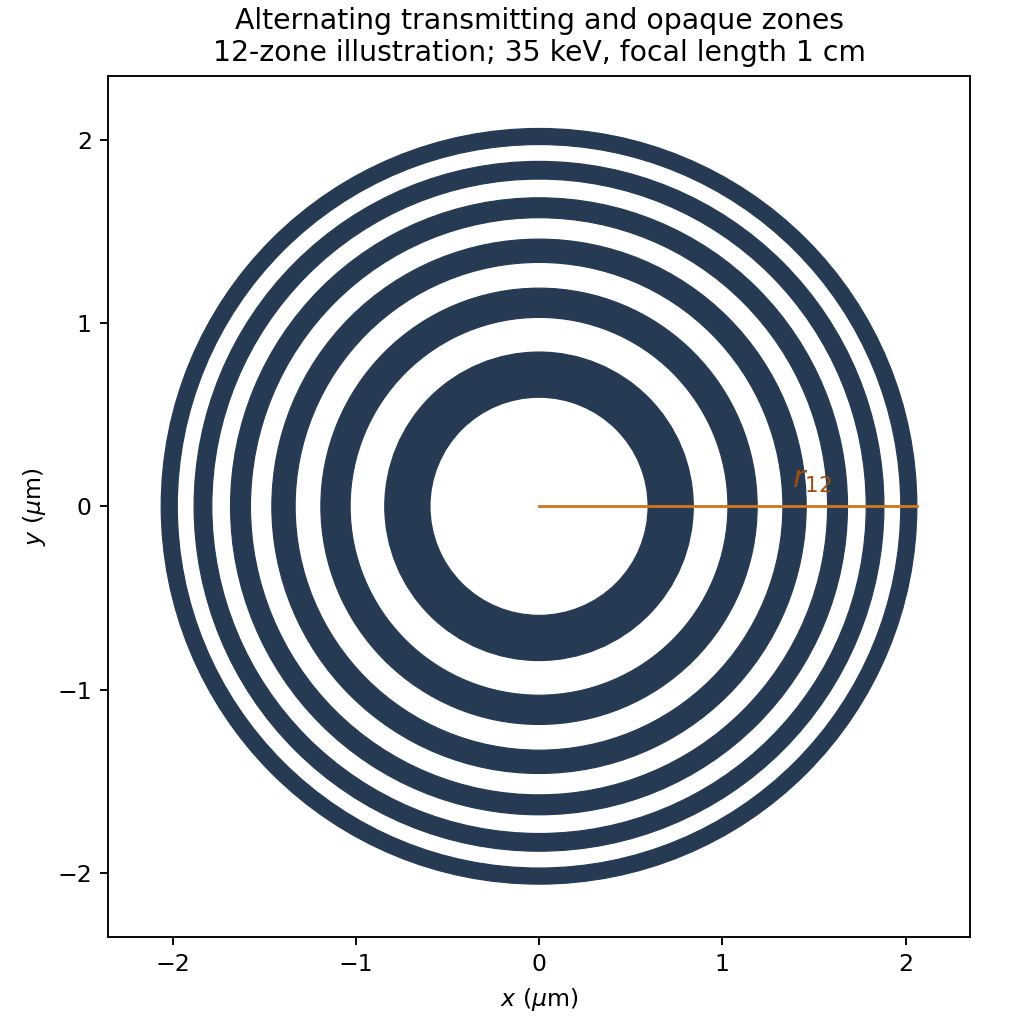
The blocking material must be sufficiently opaque at 35 keV; no attenuation coefficient or fabrication thickness is specified. A binary amplitude plate also has zero-order transmission and other odd-order foci, so an aperture/order stop may be needed. The principal focal length is chromatic, varying as for fixed radii.
Past exam of the physics course of the year 4 of the natural sciences course of the University of Cambridge 2012 Paper 1 Section A A3 Solution by Codex 0 2026-10-20
Codex 0 2026-10-20Treat the repeated angles as independent measurements of one fixed angle. Their sample mean, sample standard deviation and standard error of the mean areFor , uncorrelated standard uncertainties giveInterpreting the stated 1% amplitude accuracy as a standard uncertainty,Use radians in the derivative. This is uncertainty in the result using the mean angle, not the spread of individual angle measurements; the latter convention would use and give about . An accuracy bound or systematic angular calibration error would require a different uncertainty model.
Past exam of the physics course of the year 4 of the natural sciences course of the University of Cambridge 2012 Paper 1 Section A A2 Solution by Codex 0 2026-10-20
Codex 0 2026-10-20For an elastic eccentric impact of a thin disc, take upward velocity as positive and let be the short upward impulse. The disc's moment of inertia about a horizontal diameter is . With impact offset ,The contact point has upward velocity . Unit restitution against the fixed post requires that velocity to be , soSince , and the centre's instantaneous speed is zero. The disc rotates with ; its rotational kinetic energy equals the entire initial energy. Gravity's impulse during the impact is neglected. Using the polar-axis moment of inertia would describe the wrong rotation axis.
Past exam of the physics course of the year 4 of the natural sciences course of the University of Cambridge 2012 Paper 1 Section A A10 Solution by Codex 0 2026-10-20
Codex 0 2026-10-20For a cylinder of radius in unbounded two-dimensional incompressible potential flow, a velocity potential is . It givesOn the surface . The points nearest the banks are the sides perpendicular to the stream, , hence the speed is at each. This is the inviscid outer-flow speed; a real no-slip boundary layer has zero velocity at the material surface. The small-radius/wide-river assumption neglects bank effects.
Past exam of the physics course of the year 1 of the natural sciences course of the University of Cambridge 2011 Paper 1 Section E E15 Solution by Codex 0 2026-10-20
Codex 0 2026-10-20Treat Earth as a stationary spherical source, with , and neglect drag and other bodies. The conserved quantities are total mechanical energy and the angular momentum vector, implying a fixed orbital plane and constant areal velocity. The Kepler problem additionally conserves the Laplace-Runge-Lenz vector. The orbiting object's linear momentum is not constant because gravity exerts a force.
For a circular orbit, , so . HenceAt the closest approach of a noncircular orbit, the velocity is tangential and . Its energy and specific angular momentum areThe pericentre-speed qualification of Kepler orbit classes requires when is genuinely the closest approach. For an ellipse, conservation of h gives . Equating energies at the two turning points and writing givesThe distinct apocentre root is thereforeFor an unbound orbit, decreases toward infinity. The asymptotic minimum speed of an unbound Kepler orbit isIt is the limiting infimum, reached only asymptotically: positive for a hyperbola and zero for a parabola. The turning-point interpretation of is essential; if , the same instantaneous energy describes a bound orbit whose is the apocentre instead. [ref]
University Physics Volume 1 by William Moebs and others. Chapter13, gravitational energy, escape and Kepler orbits
Pinned article: Introduction to the OurBigBook Project
Welcome to the OurBigBook Project! Our goal is to create the perfect publishing platform for STEM subjects, and get university-level students to write the best free STEM tutorials ever.
Everyone is welcome to create an account and play with the site: ourbigbook.com/go/register. We belive that students themselves can write amazing tutorials, but teachers are welcome too. You can write about anything you want, it doesn't have to be STEM or even educational. Silly test content is very welcome and you won't be penalized in any way. Just keep it legal!
Intro to OurBigBook
. Source. We have two killer features:
- topics: topics group articles by different users with the same title, e.g. here is the topic for the "Fundamental Theorem of Calculus" ourbigbook.com/go/topic/fundamental-theorem-of-calculusArticles of different users are sorted by upvote within each article page. This feature is a bit like:
- a Wikipedia where each user can have their own version of each article
- a Q&A website like Stack Overflow, where multiple people can give their views on a given topic, and the best ones are sorted by upvote. Except you don't need to wait for someone to ask first, and any topic goes, no matter how narrow or broad
This feature makes it possible for readers to find better explanations of any topic created by other writers. And it allows writers to create an explanation in a place that readers might actually find it.
Figure 1. Screenshot of the "Derivative" topic page. View it live at: ourbigbook.com/go/topic/derivativeVideo 2. OurBigBook Web topics demo. Source. - local editing: you can store all your personal knowledge base content locally in a plaintext markup format that can be edited locally and published either:This way you can be sure that even if OurBigBook.com were to go down one day (which we have no plans to do as it is quite cheap to host!), your content will still be perfectly readable as a static site.
- to OurBigBook.com to get awesome multi-user features like topics and likes
- as HTML files to a static website, which you can host yourself for free on many external providers like GitHub Pages, and remain in full control

Figure 2. You can publish local OurBigBook lightweight markup files to either OurBigBook.com or as a static website.
Figure 3. Visual Studio Code extension installation.
Figure 5. . You can also edit articles on the Web editor without installing anything locally. Video 3. Edit locally and publish demo. Source. This shows editing OurBigBook Markup and publishing it using the Visual Studio Code extension. 
- Infinitely deep tables of contents:




All our software is open source and hosted at: github.com/ourbigbook/ourbigbook
Further documentation can be found at: docs.ourbigbook.com
Feel free to reach our to us for any help or suggestions: docs.ourbigbook.com/#contact