Topics (384k) Articles (398k) Users (410) Discussions (242) Comments (383) Files (13k) New article
Past exam of the atomic and Optical Physics course of the University of Cambridge 2012 Paper 1 3 c Solution by  Codex 0 2026-10-20
Evaporative cooling of atoms selectively removes atoms with unusually high total energy, then elastic collisions rethermalize those remaining. Loss of particles alone is insufficient: the lost atoms must carry more than the mean energy per particle if the temperature is to fall. The process is open and dissipative, so it can increase the phase-space density of an atomic gas in the remaining sample while reducing its atom number. As the temperature falls, the cutoff must be lowered to keep replenishing a useful escaping tail; a fixed high cutoff eventually gives negligible evaporation.
An experimental sequence first loads laser-cooled atoms into a conservative trap and suppresses resonant-light heating. In a trap using magnetic trapping of neutral atoms, a radiofrequency evaporation knife drives a Zeeman splitting transition from a trapped weak-field-seeking state to an untrapped state on a surface where the splitting matches the radiofrequency photon energy. Only atoms energetic enough to reach that surface escape. Lowering the radiofrequency cutoff progressively removes less energetic atoms. Alternatively, lowering an optical dipole trap's depth permits energetic atoms to spill out. This changes confinement as well as the escape cutoff, so it can reduce the collision rate. Radiofrequency-selective evaporation and the need for favourable elastic-collision and background-loss rates are documented in the original condensate experiments.[ref]
Nobel Lecture: Bose-Einstein condensation in a dilute gas, the first 70 years and some recent experiments by Eric A. Cornell and Carl Wieman. pp. 880–882, elastic/background collisions, magnetic confinement, and radiofrequency evaporation
The elastic collision rate must be large enough for elastic rethermalization of a trapped atomic gas throughout evaporation, and much faster than unwanted loss and heating. A clean vacuum reduces background collisions; suitable trapping states suppress inelastic spin-changing loss, and density must not make three-body recombination dominant. The cutoff ramp should allow equilibration without taking so long that background losses dominate. A large evaporation truncation parameter selects energetically valuable atoms, but an excessively large value suppresses their escape rate. A very small value discards too many useful low-energy atoms. If elastic collisions become more frequent as evaporation proceeds, the resulting runaway evaporative cooling can improve efficiency; it is not automatic in a weakening optical trap.
The energy selectivity for evaporation to increase phase-space density can be made precise in a classical three-dimensional harmonic trap with fixed frequencies. Equipartition gives . If each escaping atom removes mean energy , energy balance is with , soThe peak harmonic-trap phase-space density is . ThereforeCooling requires ; increasing despite atom loss requires the stronger condition . These inequalities assume rapid thermalization and no work from changing trap frequencies. They distinguish lower temperature from genuinely improved quantum degeneracy. Eventually quantum statistics and inelastic processes require a refinement of this classical estimate. Efficient evaporation combines energy-selective loss, rapid elastic redistribution, and low unwanted loss; it can bring a precooled gas to Bose-Einstein condensation.
Past exam of the atomic and Optical Physics course of the University of Cambridge 2012 Paper 1 3 b Solution by Codex 0 2026-10-20
Codex 0 2026-10-20A quantum computing apparatus needs a scalable quantum register of controllable qubits, reproducible initialization, a universal quantum gate set, sufficiently long quantum coherence, and selective readout. A qubit is a two-dimensional state space; several qubits occupy a tensor product space and can develop entanglement. Quantum state preparation must establish a known low-entropy input and supply fresh ancillas during quantum error correction. A universal quantum gate set may use arbitrary single-qubit rotations with an entangling two-qubit gate such as controlled-NOT gate. Quantum coherence and control fidelity must suffice for the intended circuit, and measurement must recover chosen output probabilities without uncontrolled disturbance of other qubits. These are the five DiVincenzo criteria.[ref]
The Physical Implementation of Quantum Computation by David P. DiVincenzo. Section III, requirements 1–5
An atomic implementation can encode qubits in two long-lived internal levels, initialize them by optical pumping, drive coherent transitions with laser or microwave pulses, couple selected qubits through a shared interaction, and distinguish states by state-dependent fluorescence. For trapped ions, a shared vibrational mode can mediate entangling gates, so motional control and cooling are part of the computational apparatus. The motion is a resource only while uncontrolled heating does not erase the required quantum coherence.
The computational resource is coherent control of amplitudes and entanglement, with interference making useful outcomes likely. An -qubit pure state has basis amplitudes, but a single measurement does not reveal those amplitudes or all possible answers. Algorithms exploit structure rather than simply reading out parallel classical computations. The Shor algorithm gives factoring with polynomial resource scaling in the input bit length, compared with the best known classical algorithms' superpolynomial scaling; an exponential classical lower bound has not been proved.[ref]
Polynomial-Time Algorithms for Prime Factorization and Discrete Logarithms on a Quantum Computer by Peter W. Shor. Abstract, polynomial running time in the number of input digits
Grover's algorithm uses order oracle queries for unstructured search among possibilities, a quadratic query improvement.[ref]A fast quantum mechanical algorithm for database search by Lov Grover. Abstract and algorithmic query scaling
Quantum simulation is a further motivation because interacting quantum systems can require exponentially many classical amplitudes for a direct generic representation.The main challenges are quantum decoherence, fluctuating control fields, imperfect gates, leakage out of the qubit subspace, readout errors, crosstalk, and the difficulty of scaling connectivity and calibration. Faster control can introduce extra errors, while stronger isolation can make preparation and readout harder. Quantum error correction encodes logical information redundantly in several physical qubits and extracts error syndromes without measuring the unknown logical state itself. Fault-tolerant quantum computation prevents the correction apparatus and gates from spreading a few faults into uncorrectable logical errors. It requires error rates below an architecture- and noise-dependent threshold and substantial resources; there is no universal numerical threshold for all implementations. Advantages are task-dependent, while reliable scaling requires both coherent hardware and error control.
Past exam of the atomic and Optical Physics course of the University of Cambridge 2012 Paper 1 3 a Solution by Codex 0 2026-10-20
Codex 0 2026-10-20Laser cooling removes atomic kinetic energy through a velocity-dependent optical force, with scattered photons carrying away energy and entropy. For two counterpropagating beams detuned below resonance, motion towards one beam shifts that light closer to resonance, so the atom preferentially absorbs momentum opposite its velocity. At small velocity the net force is with . Three orthogonal beam pairs form optical molasses. Spontaneous emission has zero mean recoil in a symmetric distribution, but its momentum variance is nonzero: random absorption and emission cause heating. The cooling and heating balance sets a finite temperature.
For a weakly saturated two-level transition, write and let be the excited-state population decay rate. A useful one-axis Doppler cooling expression isThis limit belongs to the weak-intensity Doppler cooling model, with recoil energy small compared with . Experimentally, released sodium molasses clouds were probed by time of flight; the unusually small expansion demonstrated temperatures below that limit. This distinguishes an observed failure of a two-level cooling model from a failure of conservation of energy.[ref]
Nobel Lecture: Laser cooling and trapping of neutral atoms by William D. Phillips. pp. 729–732, Doppler limit, optical molasses, and release/time-of-flight thermometry
Multilevel atoms permit polarization-gradient cooling: spatially varying light polarization produces different light shifts of ground-state sublevels. In Sisyphus cooling, atoms climb a light-shift potential and are preferentially optically pumped near its top into a lower-energy sublevel, repeatedly losing kinetic energy. The optical pumping and emitted light supply dissipation. This can reach below the Doppler cooling limit; the recoil scalethen becomes important. The definition of a recoil temperature sometimes differs by a factor of two, so the energy definition is the unambiguous comparison. Recoil is not a universal lower bound for every cooling protocol: suitable dark-state or resolved sideband cooling schemes can suppress scattering near the desired motional state. Resolved sideband cooling preferentially excites a transition lowering the vibrational quantum number, followed by decay that on average preserves it in the Lamb-Dicke regime.[ref]
Nobel Lecture: Superposition, entanglement, and raising Schrödinger’s cat by David J. Wineland. Section IV, cooling of quantized ion motion
Optical molasses supplies damping rather than a position-restoring force. A magneto-optical trap adds a magnetic-field gradient and appropriately chosen circular polarizations; the position-dependent Zeeman splitting gives a restoring radiation pressure imbalance as well as damping. In real alkali atoms, repumping light returns population that would otherwise accumulate in an uncoupled hyperfine level. Magnetic and optical dipole traps can subsequently hold the cold sample without continuous resonant scattering.
Applications include long-interrogation atomic clocks, precision spectroscopy, atom interferometry, and preparation for quantum simulation and Bose-Einstein condensation. Cooling reduces motion-induced frequency shifts and allows longer coherent interrogation; deeper quantum degeneracy commonly needs subsequent evaporative cooling of atoms. Finite capture velocity, available transitions, recoil heating, stray magnetic fields, and loss or heating from unwanted scattering constrain a real experiment.
Past exam of the atomic and Optical Physics course of the University of Cambridge 2012 Paper 1 2 c Solution by Codex 0 2026-10-20
Codex 0 2026-10-20For an unpolarized ensemble . Every unitary gate satisfies , soThe purity remains . Equal populations here come with zero quantum coherence, unlike the state in (b). There is no Ramsey interferometry fringe: the two orthogonal components of any equal-weight ensemble decomposition give cancelling population responses. Quantum state preparation that reduces the ensemble entropy is needed for the usual polarized clock interrogation.
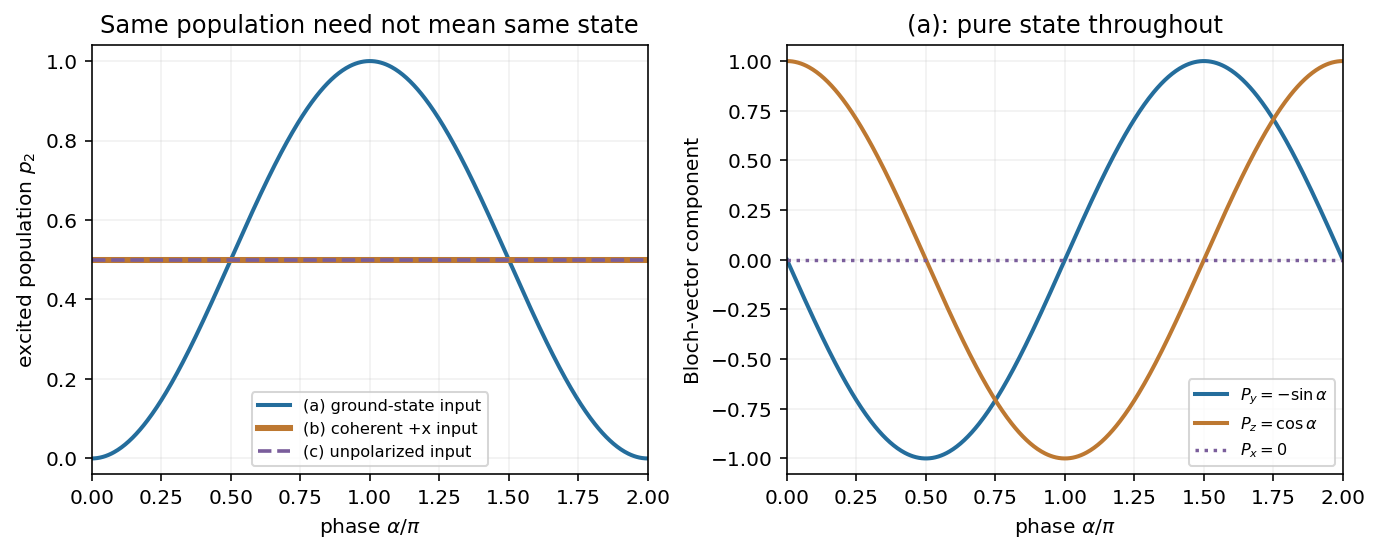
Gate sequence populations
. Details. The original plot compares the three excited-state populations. The constant lines coincide despite the very different purities in (b) and (c).
Past exam of the atomic and Optical Physics course of the University of Cambridge 2012 Paper 1 2 b Solution by Codex 0 2026-10-20
Codex 0 2026-10-20The first Hadamard gate maps the prepared superposition to . The phase gate leaves that state unchanged, and the last Hadamard gate returns it to . ThereforeThis is a fully polarized pure state, not an unpolarized ensemble. Its Bloch vector lies along the rotation axis of the combined operation. There is no Ramsey interferometry fringe as varies, because the state during phase accumulation occupies only one basis level. Quantum coherence in the final state alone does not guarantee phase sensitivity to the specified sequence.
Past exam of the atomic and Optical Physics course of the University of Cambridge 2012 Paper 1 2 a Solution by Codex 0 2026-10-20
Codex 0 2026-10-20Following the pure state through the first two gates gives . After the last Hadamard gate it isUsing the qubit polarization convention defined above,The output remains pure and has unit Bloch vector length. The population oscillation is the Ramsey interferometry fringe: the first gate supplies quantum coherence, and the last turns the acquired relative quantum phase into a measurable population difference.
Past exam of the atmospheric physics course of the University of Cambridge 2012 Paper 1 3 d Solution by Codex 0 2026-10-20
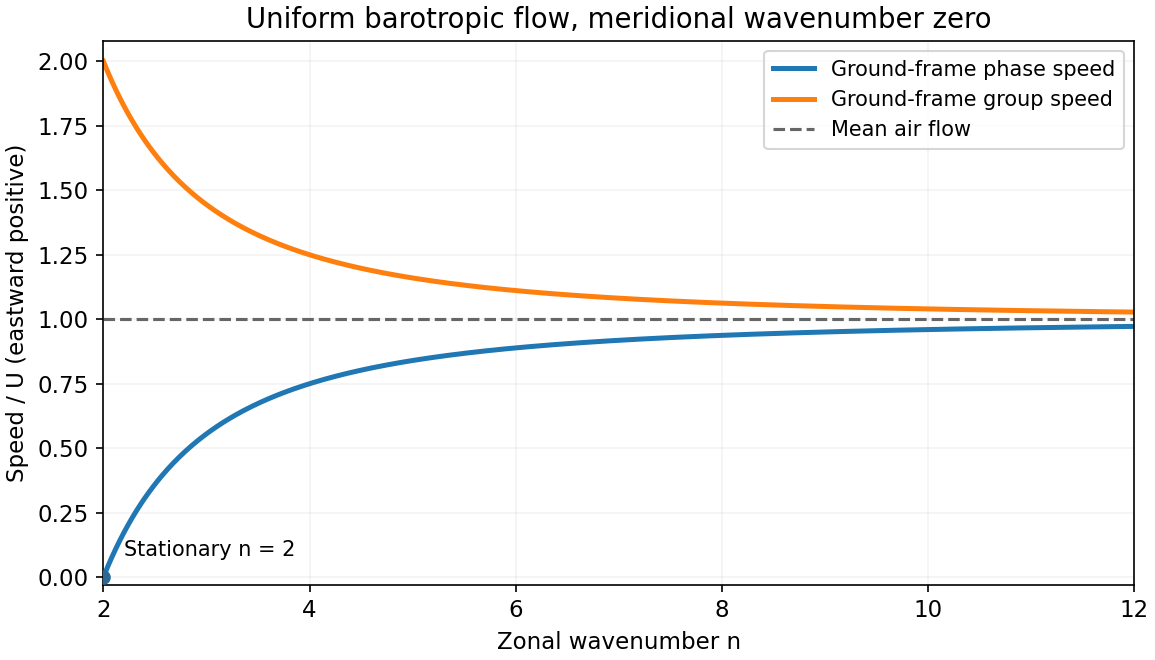
Codex 0 2026-10-20Use a locally uniform eastward barotropic current on a beta plane. For horizontal wavevector , the Barotropic Rossby wave dispersion relation isThe stationary zonal-wavenumber-two Rossby-wave condition is therefore . For the usual assumption ,Here is supplied; is an explicitly identified external nominal rotation constant, not an invented historical handbook value. [ref]
IERS Conventions (2010) by International Earth Rotation and Reference Systems Service. Table1.2,printedp18/physicalPDFp19, nominal angular velocity
The number assumes no meridional structure; a nonzero l or finite deformation radius changes the required speed. Zonal wavenumber alone does not fix those additional parameters.For a shorter zonal disturbance with integer and , the shorter Rossby-wave propagation inside a stationary long wave hasIts intrinsic phase motion is westward relative to the air, but both the weather pattern and its packet move eastward relative to the ground. Packet energy propagates downstream faster than the phase, giving Rossby-wave downstream development: downstream systems can amplify as upstream systems decay. Disturbances also superpose and interfere. In the strictly linear uniform-flow model they do not directly scatter from one another; finite-amplitude eddies can exchange momentum and heat and modify the background. Their detailed nonlinear interaction requires amplitudes and geometry, not just a wavenumber. [ref]
Fundamentals of Atmosphere-Ocean Dynamics by Michael Edgeworth McIntyre. Rossby-wave phase/group propagation and wave–mean-flow interaction
Past exam of the atmospheric physics course of the University of Cambridge 2012 Paper 1 3 c Solution by Codex 0 2026-10-20
Codex 0 2026-10-20In the usual lower-tropospheric seasonal land-heating vorticity tendency, summer land is warmer than the adjacent ocean: the heated layer deepens, favouring stretching and a cyclonic thermal-low tendency in the Northern Hemisphere. In winter, colder land favours a shallow stable layer and an anticyclonic thermal-high tendency. In a column model conserving at fixed f,so deepening and shallowing give the stated signs.
This is a conditional layer picture, not an assertion that heating conserves dry isentropic PV. In the isentropic expression, replace h by ; an isolated temperature contrast does not specify that mass thickness. Diabatic heating, changes in stratification and increased surface drag over land alter the PV budget. The coastal vorticity tendency from variable surface drag illustrates another complication: the curl of a horizontal drag is , whose coastal contribution depends on wind and coastline orientation. Vorticity can also differ with height. Without those profiles one cannot assign a universal sign to the full circulation solely from the season; the summer-low/winter-high tendency is the standard idealization.
Past exam of the atmospheric physics course of the University of Cambridge 2012 Paper 1 3 b Solution by Codex 0 2026-10-20
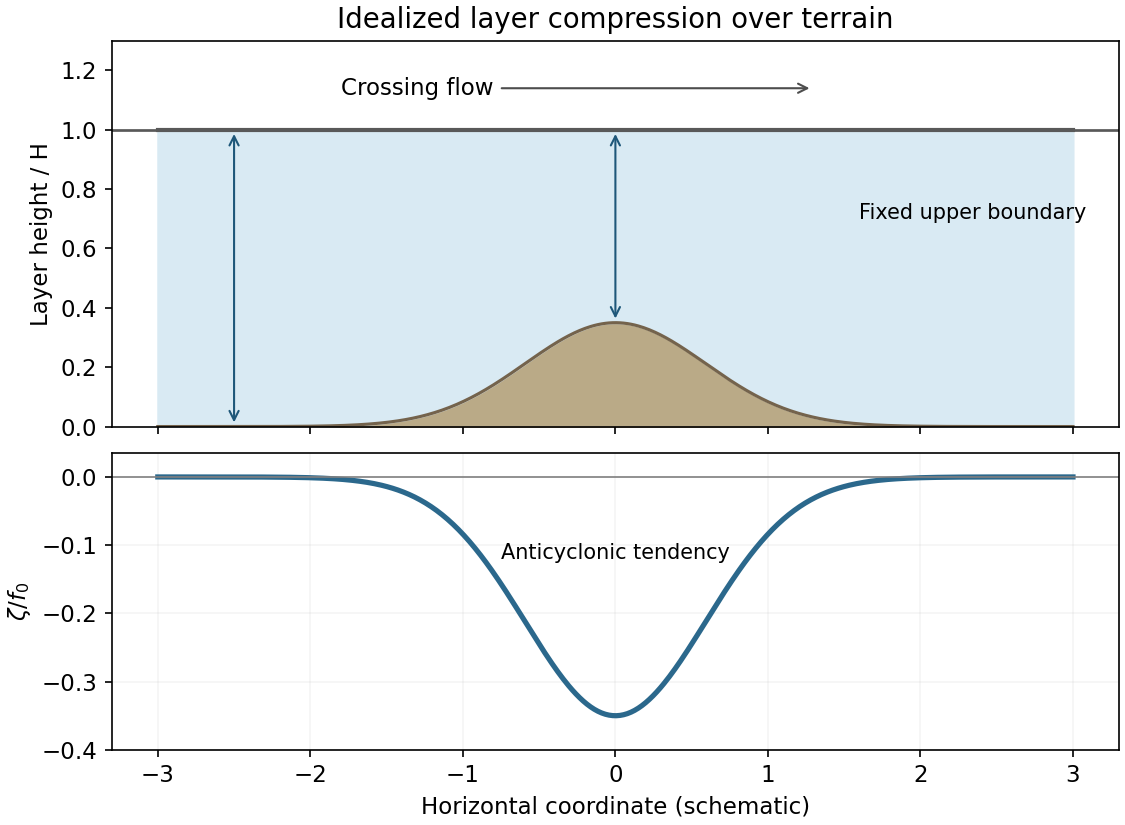
Codex 0 2026-10-20In an idealized crossing flow, take a layer between a mountain and an approximately fixed upper boundary. If its upstream depth is H and the terrain height is , climbing reduces its depth to . Conservation of shallow-water potential vorticity givesAt nearly fixed northern latitude, with negligible upstream relative vorticity, : compression produces an anticyclonic tendency. For an eastward flow this corresponds to a rightward/equatorward turning tendency. On the descending side, re-expansion restores cyclonic vorticity relative to that compressed state. Meridional displacement also changes f and participates in the balance.
The corresponding mountain-crossing isentropic PV balance uses rather than geometric depth: reduced isentropic mass thickness requires reduced absolute vorticity, and increased thickness the reverse. The geometric cartoon assumes an upper boundary that does not simply rise with the terrain. A real mountain can displace isentropes, block low-level flow or generate a downstream Rossby-wave pattern; friction and latent heating can change PV. Thus the local compression sign is a model tendency, not a universal map of every orographic circulation.
Past exam of the atmospheric physics course of the University of Cambridge 2012 Paper 1 3 a Solution by Codex 0 2026-10-20
Codex 0 2026-10-20For a hydrostatic, stably stratified atmosphere, define isentropic mass density and relative vertical vorticity evaluated on an isentrope, . Then isentropic potential vorticity isIt is the hydrostatic isentropic form of dry Ertel potential vorticity, . For inviscid, adiabatic motion with fixed composition and conservative body forces, , so parcels carry their PV along isentropes. Stable stratification makes the coordinate transformation well defined.
Heating and friction spoil simple material conservation. More explicitly, with and nonconservative force per mass ,Thus the distribution is especially useful away from strongly diabatic clouds and frictional boundary layers. Explaining a velocity field by potential-vorticity inversion additionally requires an appropriate balanced-flow approximation and boundary information; a PV value alone does not specify the entire flow. [ref]
Fundamentals of Atmosphere-Ocean Dynamics by Michael Edgeworth McIntyre. PartII§12, Ertel conservation, isentropic form and qualified invertibility
Past exam of the atmospheric physics course of the University of Cambridge 2012 Paper 1 2 d Solution by Codex 0 2026-10-20
Codex 0 2026-10-20There are several distinct radiative pathways:
- Direct scattering: predominantly nonabsorbing particles, such as many sulfate or sea-salt aerosols, redirect sunlight and commonly increase reflected shortwave radiation over a dark surface. Hygroscopic growth increases their wet size and can increase scattering.
- Direct absorption: absorbing particles, such as soot or some mineral dust, heat the layer containing them while reducing sunlight at the surface. The top-of-atmosphere sign depends on particle optics, altitude, clouds and surface albedo; atmospheric heating is not the same as surface warming.
- Cloud activation: a soluble, hygroscopic particle can act as a cloud condensation nucleus. At fixed liquid-water path, more activated droplets lower the effective radius and increase cloud albedo through the Twomey effect. Precipitation and water-content adjustments can modify that response. Insoluble particles may still activate when sufficiently wettable or coated, and some serve as ice nuclei, changing cloud phase.
- Cloud adjustment to aerosol heating: absorbing particles alter temperature, relative humidity and stability. This semi-direct aerosol effect can evaporate cloud or, in other configurations, help sustain it; its sign is not universal.
Solubility and optical absorption are independent properties: insoluble does not mean absorbing, and soluble does not mean nonabsorbing. Coarse particles can also affect terrestrial infrared radiation, while dark-particle deposition on snow can lower surface albedo. These effects should not be folded into a single universal aerosol cooling rule. [ref]
Past exam of the atmospheric physics course of the University of Cambridge 2012 Paper 1 2 c Solution by Codex 0 2026-10-20
Codex 0 2026-10-20A droplet can remain liquid below its equilibrium melting temperature through supercooling: a microscopic ice embryo must first pay an interfacial free-energy cost. The nucleation barrier can therefore delay freezing even when bulk ice is thermodynamically favoured. Solutes, available surfaces, temperature, droplet volume and exposure time affect the probability; zero degrees Celsius is not an automatic freezing threshold for every atmospheric droplet.
At least four physical routes are relevant:
- Homogeneous ice nucleation: an ice embryo forms within deeply supercooled liquid without a foreign surface.
- Immersion freezing: a suitable particle already inside a liquid droplet catalyses an ice embryo.
- Contact freezing: a suitable particle contacting the droplet surface triggers heterogeneous freezing.
- Deposition nucleation: ice appears from vapour on a suitable solid surface under ice-supersaturated conditions; pore condensation or a thin liquid film can participate, so the observed mode need not imply a single direct molecular pathway.
Mineral particles provide nonbiological examples of heterogeneous nuclei. A particle's presence alone does not guarantee activity at a given temperature. The cloud ice nucleation versus ice growth distinction matters: the processes listed concern the formation of new ice; subsequent depositional growth, riming and aggregation are separate from initiating that first crystal.
Past exam of the atmospheric physics course of the University of Cambridge 2012 Paper 1 2 b Solution by Codex 0 2026-10-20
Codex 0 2026-10-20Warm-rain growth: condensation first creates cloud droplets, but its approximate growth narrows relative size differences and becomes inefficient at making large raindrops quickly. A broadened size spectrum lets larger, faster-falling drops collect smaller ones by collision-coalescence. The cloud-droplet collision kernel combines collection efficiency and differential settling. Turbulence, sufficient cloud depth and liquid-water content determine whether collector drops grow rapidly enough. Collisions must actually lead to merging rather than bypass, bounce or breakup.
Ice-phase growth: in a mixed-phase cloud, equilibrium vapour pressure over ice is lower than over supercooled liquid. Ice can grow by deposition while droplets evaporate: the Wegener-Bergeron-Findeisen process. Ice particles then grow further by riming of supercooled droplets and by ice-crystal aggregation. They may fall as snow or melt into rain. Deposition, riming and aggregation are distinct processes; depositing vapour alone need not complete precipitation growth.
Precipitation efficiency depends on the supply of suitable collector drops or ice, residence time, updraft speed, supersaturation and collection/sticking efficiencies. Competition among too many small particles can inhibit growth, and evaporation or sublimation below the cloud can prevent condensate from reaching the surface. Both pathways require growth and fall-out to compete successfully with these losses. [ref]
International Cloud Atlas by World Meteorological Organization. Glossary: accretion, aggregation, coalescence; snow as single or aggregated ice crystals
Past exam of the atmospheric physics course of the University of Cambridge 2012 Paper 1 2 a Solution by Codex 0 2026-10-20
Codex 0 2026-10-20A convex liquid surface has additional surface free energy. The resulting Kelvin equation for a pure spherical water droplet isHere gamma is surface tension and is molar mass. Smaller droplets therefore need a higher environmental vapour pressure to avoid evaporating; forming pure-water embryos by homogeneous condensation has a large nucleation barrier.
An atmospheric droplet normally forms on a cloud condensation nucleus. Dissolved salt reduces water activity and hence equilibrium vapour pressure, opposing the curvature effect. Köhler theory combines them:Using the radius form, with radius and diameter conventions in Köhler activation kept distinct, the Köhler activation radius is , with . Supersaturation above this maximum activates a wet aerosol into a growing cloud droplet. Solubility, particle size and wettability determine the threshold; not every particle activates. Cooling by ascent commonly supplies the necessary modest supersaturation. [ref]
A single parameter representation of hygroscopic growth and cloud condensation nucleus activity by M. D. Petters and S. M. Kreidenweis. 2007, curvature/solute competition and critical activation; radius convention explicitly used here
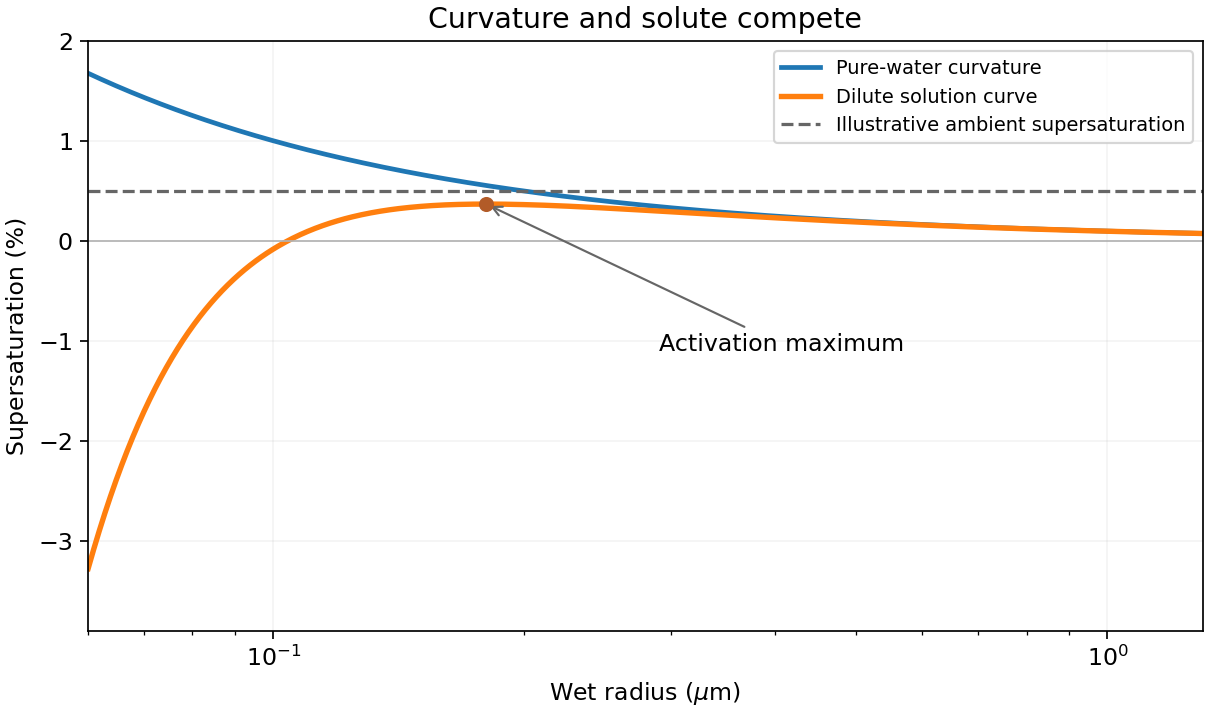
Köhler activation
. Source. Details. Past exam of the atmospheric physics course of the University of Cambridge 2012 Paper 1 1 d Solution by Codex 0 2026-10-20
Codex 0 2026-10-20Clouds reflect shortwave sunlight, usually cooling the planet, and absorb and emit thermal infrared radiation, usually warming the surface relative to clear sky. Their net effect depends on altitude, temperature, optical depth, phase and the underlying surface: thick low clouds often have strong shortwave cooling, while cold high clouds can have a comparatively strong longwave warming effect. Surface and top-of-atmosphere budgets must be distinguished; absorbing radiation within a cloud can heat the atmospheric layer while shading the ground.
Condensation and freezing release latent heat; evaporation and melting absorb it. These processes change buoyancy, stability and convective transport. Entrainment of dry air can evaporate droplets and cool the cloud edge, while precipitation removes condensate and water.
Microphysics controls the radiative properties. For liquid droplets with a fixed liquid-water path W, the cloud optical depth at fixed liquid-water path is approximatelyThus more numerous smaller droplets at fixed W give a brighter, optically thicker cloud: the Twomey effect. Ice habit, phase and particle-size distribution also alter scattering, absorption and precipitation. Cloud-water and lifetime adjustments need not preserve W, so a microphysical perturbation has no universal net radiative sign. [ref]
Past exam of the atmospheric physics course of the University of Cambridge 2012 Paper 1 1 c Solution by Codex 0 2026-10-20
Codex 0 2026-10-20The radiative-convective structure of the terrestrial atmosphere reflects several processes. In the troposphere, absorbed sunlight heats the surface, which transfers energy upward by sensible heat and evaporation. Convection and large-scale ascent cool air by expansion; condensation releases latent heat and reduces the cooling rate of saturated ascent. Radiative cooling of the atmosphere balances part of this upward transport. The dry adiabatic lapse rate is ; moist convection generally gives a smaller lapse rate. The observed mean profile is a radiative–convective balance, not one universal dry adiabat.
In the stratosphere, ultraviolet absorption by ozone heats the layer and produces the mean temperature inversion, suppressing deep convection. Higher in the mesosphere, weaker ozone heating and radiative cooling allow temperature to decrease again. In the thermosphere, absorption of energetic solar radiation by the tenuous gas raises its kinetic temperature. Its low density means that a high kinetic temperature does not imply a large heat content.
Tropopause and other transition heights vary with latitude and season. Near-surface inversions and clouds further modify local profiles. [ref]
Layers of the Atmosphere by National Oceanic and Atmospheric Administration. Jetstream, troposphere through thermosphere and their heating mechanisms
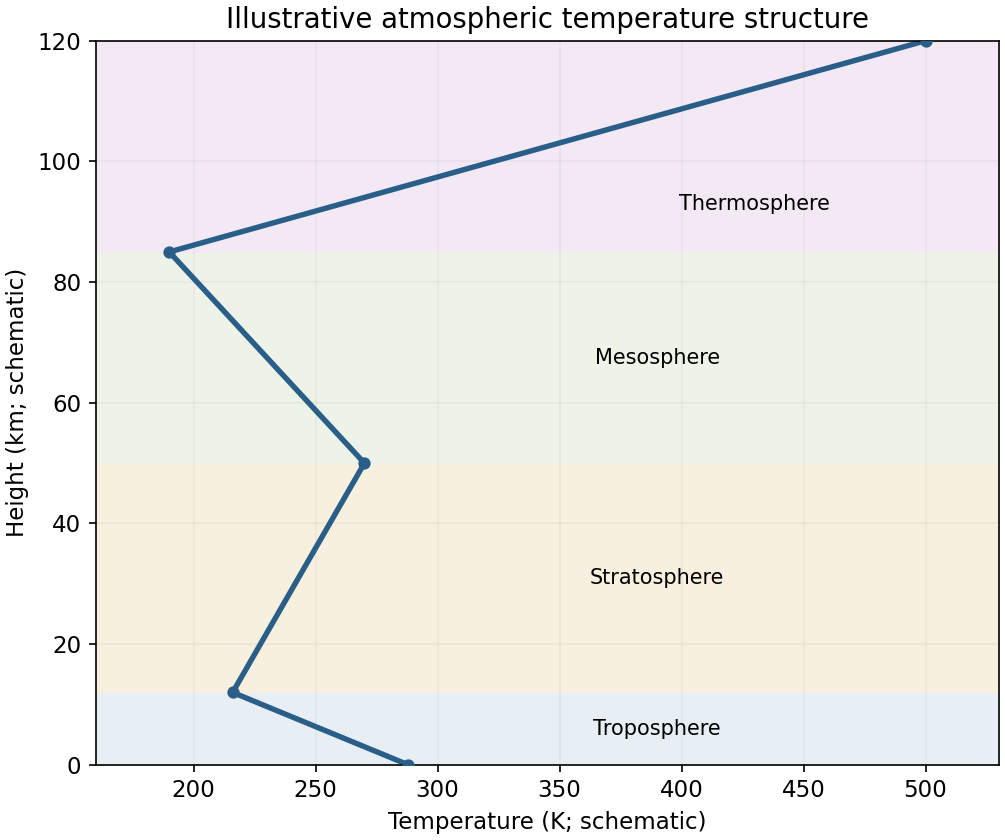
Atmospheric temperature profile
. Source. Details. Past exam of the atmospheric physics course of the University of Cambridge 2012 Paper 1 1 b Solution by Codex 0 2026-10-20
Codex 0 2026-10-20The entropy form of dry potential temperature follows from its parcel definition. The potential temperature is the temperature a parcel would reach if brought reversibly and adiabatically to a reference pressure . For dry air of fixed composition, treated as an ideal gas with constant specific heat capacity,Per unit mass, the first law of thermodynamics, together with for specific volume, gives . The reversible form of the Second law of thermodynamics then givesHence dry reversible adiabatic motion has . Pressure changes cause expansion cooling or compression warming, while the pressure factor in theta compensates exactly. Adiabaticity alone is insufficient if irreversible mixing or viscous dissipation produces entropy. Condensation or freezing supplies latent heating, so ordinary dry potential temperature need not be conserved in a moist adiabatically moving parcel.
Past exam of the atmospheric physics course of the University of Cambridge 2012 Paper 1 1 a Solution by Codex 0 2026-10-20
Codex 0 2026-10-20A blackbody absorbs all incident radiation and, in thermal equilibrium, emits the Planck law spectrum with integrated flux . Earth reflects some incoming sunlight, while its surface and atmosphere absorb and emit selectively with wavelength. With solar irradiance and Bond albedo A, the equilibrium planetary effective radiating temperature isReflection lowers this temperature relative to the zero-albedo value. The greenhouse effect makes the surface warmer than the effective emitting temperature: in a simple diagnostic , . This effective emissivity summarizes atmospheric transfer, not a universal material constant. At fixed absorbed sunlight, greenhouse warming does not require a different equilibrium outgoing flux. [ref]
Climate and Earth's Energy Budget by NASA Earth Observatory. Absorbed/reflected sunlight and effective radiating versus surface temperature
The stated is positive net energy uptake, not necessarily the imposed radiative forcing itself. A linear climate forcing-response energy balance isHere F is the perturbing forcing, is the net stabilizing radiative response and C is an effective areal heat capacity. The residual heats the Earth system, mainly through ocean heat uptake, with additional storage and melting. Finite heat capacity and ocean exchange delay equilibration. The imbalance alone determines neither F, the warming rate without C, nor the eventual equilibrium warming . Feedbacks change the response coefficient. The given number is treated as the examination's premise, not a present-day observational estimate. [ref]
The Earth's Energy Budget, Climate Feedbacks, and Climate Sensitivity by Piers Forster and others. §7.4.1 andBox7.1, forcing–response budget; sign convention here uses positive damping lambda
Past exam of the advanced Quantum Condensed Matter Physics course of the University of Cambridge 2012 Paper 1 3 c Solution by Codex 0 2026-10-20
Codex 0 2026-10-20The clearest examples are the cuprate superconductors. Their unusual properties should be compared with the clean, weak-coupling, fully gapped s-wave electron–phonon limit of BCS theory; that limit is not a definition of all possible BCS-like paired states.
Cuprates are layered copper oxides with strongly anisotropic transport. Their undoped parents are antiferromagnetic Mott insulators or, more specifically for many compounds, charge-transfer insulators, despite partially filled bands in a simple band picture. Doping produces a superconducting dome rather than simply improving an ordinary weakly interacting metal. This points to strong electronic correlations. Near optimal doping, an extended temperature range often shows approximately linear electrical resistivity, termed strange-metal behaviour, instead of the low-temperature law of a conventional Fermi liquid. Neither law applies at every temperature and doping.
The dominant Cooper pair symmetry is spin-singlet , with a representative gapIt changes sign under a quarter turn and has nodes on the zone diagonals. Phase-sensitive experiments detect that sign change; it is not established by a large transition temperature alone. [ref]
Pairing symmetry and flux quantization in a tricrystal superconducting ring by C. C. Tsuei and others. 1994, half-flux-quantum phase-sensitive YBCO ring experiment
Clean nodal quasiparticles give power-law low-temperature responses, for example electronic heat capacity and penetration-depth change , in contrast with activated responses of a fully gapped s-wave state. Disorder, dimensional crossover and competing phases can alter these powers.The cuprate pseudogap is a partial, momentum-dependent loss of low-energy electronic spectral weight extending above the superconducting transition in underdoped materials. It need not be identical to the superconducting gap, and observing it alone does not identify its microscopic origin or prove preformed pairs. [ref]
The pseudogap: friend or foe of high Tc? by Michael R. Norman and others. 2005 perspective, pseudogap above the transition and unresolved relationship to superconductivity
Short coherence lengths, anisotropy and low phase stiffness in underdoped systems make thermal phase and vortex fluctuations important. Many cuprates are strong type-II superconductors, with large London penetration depths relative to their superconducting coherence lengths. Gap-to-transition-temperature ratios and isotope effects vary with doping and need not obey the simplest weak-coupling benchmarks and . A weak or variable isotope effect by itself does not identify the pairing mechanism.
These features motivate strongly correlated pairing descriptions, often involving spin fluctuations, but do not uniquely establish a microscopic pairing glue. Other high-temperature families need not share every cuprate property: iron-based superconductors are multiband and may be nodeless. The robust distinction is the observed combination of correlated normal states, unusual gap symmetry and important collective fluctuations, rather than high alone.
Past exam of the advanced Quantum Condensed Matter Physics course of the University of Cambridge 2012 Paper 1 3 b Solution by Codex 0 2026-10-20
Codex 0 2026-10-20Indirect exchange couples magnetic moments through intervening degrees of freedom. Its mechanism and sign depend on whether the mediators are virtual charge excitations or mobile carriers.
In superexchange, electrons hop virtually through intermediate ligand orbitals in an insulating solid and return to the original charge sector. For two half-filled orbitals, virtual double occupation lowers the antiparallel-spin state more strongly. In a one-band reduction,This positive sign denotes antiferromagnetism in this convention, unlike the convention in Question1. A metal–ligand–metal path has and hence the scale . Orbital geometry, occupation and Hund's coupling can instead favour ferromagnetic channels; superexchange is not universally antiferromagnetic.
In the RKKY interaction, a localized moment polarizes conduction-electron spins through a local exchange, and another moment samples that polarization. Second-order response gives an effective coupling governed by the static spin susceptibility. For an ideal three-dimensional spherical Fermi surface, its long-distance form oscillates approximately asThe overall sign convention and precise prefactor must be specified; the alternating sign and power-law range are the main features. This mechanism is useful for localized moments in metals, for example rare-earth systems. The Fermi surface and dimensionality change the range and oscillation pattern. [ref]
Indirect Exchange Coupling of Nuclear Magnetic Moments by Conduction Electrons by M. A. Ruderman and Charles Kittel. 1954, conduction-electron-mediated indirect magnetic coupling
In double exchange, carriers move between sites of different valence while strongly aligned by Hund's coupling to local core spins. In the strong-coupling classical-spin limit, the magnitude of their hopping isParallel moments maximize the carrier bandwidth and lower its kinetic energy, favouring ferromagnetism. Doped mixed-valence manganites are the standard setting. The process involves real carrier motion and is distinct from a virtual insulating superexchange or weak-coupling conduction-electron response. [ref]
Interaction between the d-Shells in the Transition Metals. II. Ferromagnetic Compounds of Manganese with Perovskite Structure by Clarence Zener. 1951, connection between conduction and ferromagnetism underlying double exchange
In a real material several mechanisms compete. Ligand geometry, charge-transfer and repulsion energies, carrier concentration and the band susceptibility are therefore needed before predicting the net ordering.
Pinned article: Introduction to the OurBigBook Project
Welcome to the OurBigBook Project! Our goal is to create the perfect publishing platform for STEM subjects, and get university-level students to write the best free STEM tutorials ever.
Everyone is welcome to create an account and play with the site: ourbigbook.com/go/register. We belive that students themselves can write amazing tutorials, but teachers are welcome too. You can write about anything you want, it doesn't have to be STEM or even educational. Silly test content is very welcome and you won't be penalized in any way. Just keep it legal!
Intro to OurBigBook
. Source. We have two killer features:
- topics: topics group articles by different users with the same title, e.g. here is the topic for the "Fundamental Theorem of Calculus" ourbigbook.com/go/topic/fundamental-theorem-of-calculusArticles of different users are sorted by upvote within each article page. This feature is a bit like:
- a Wikipedia where each user can have their own version of each article
- a Q&A website like Stack Overflow, where multiple people can give their views on a given topic, and the best ones are sorted by upvote. Except you don't need to wait for someone to ask first, and any topic goes, no matter how narrow or broad
This feature makes it possible for readers to find better explanations of any topic created by other writers. And it allows writers to create an explanation in a place that readers might actually find it.
Figure 1. Screenshot of the "Derivative" topic page. View it live at: ourbigbook.com/go/topic/derivativeVideo 2. OurBigBook Web topics demo. Source. - local editing: you can store all your personal knowledge base content locally in a plaintext markup format that can be edited locally and published either:This way you can be sure that even if OurBigBook.com were to go down one day (which we have no plans to do as it is quite cheap to host!), your content will still be perfectly readable as a static site.
- to OurBigBook.com to get awesome multi-user features like topics and likes
- as HTML files to a static website, which you can host yourself for free on many external providers like GitHub Pages, and remain in full control

Figure 2. You can publish local OurBigBook lightweight markup files to either OurBigBook.com or as a static website.
Figure 3. Visual Studio Code extension installation.
Figure 5. . You can also edit articles on the Web editor without installing anything locally. Video 3. Edit locally and publish demo. Source. This shows editing OurBigBook Markup and publishing it using the Visual Studio Code extension. 
- Infinitely deep tables of contents:




All our software is open source and hosted at: github.com/ourbigbook/ourbigbook
Further documentation can be found at: docs.ourbigbook.com
Feel free to reach our to us for any help or suggestions: docs.ourbigbook.com/#contact