Topics (384k) Articles (398k) Users (410) Discussions (242) Comments (383) Files (13k) New article

A determiner is a grammatical category whose members help specify the reference of a noun phrase in context. They can signal distinctions such as definite versus indefinite reference, proximity or quantity. Their contribution differs from the descriptive property supplied by a typical adjective.[ref]
Compare
a red box, the red box and this red box. The descriptive words can remain fixed while the expressions impose different expectations about identifying the referent. In a display with several red boxes, pointing can help interpret this, while an earlier mention can help establish the intended referent of the.Classification also requires a stated scheme. Universal Dependencies includes articles such as
a and the under DET, but uses a separate numerical label for cardinal numbers. A familiar broad description like “a word before a noun” is therefore too weak to reproduce the intended linguistic annotation.Grammatical voice concerns how a construction relates an event's participants to grammatical positions such as subject and object. Active voice and passive voice provide a familiar contrast, but the categories recognized across languages are not limited to that pair.[ref]
Universal Dependencies annotation guidelines. Voice, overview and Act/Pass values
In
The mechanic repairs the pump, the mechanic is the subject. In The pump is repaired by the mechanic, the pump occupies that relation while the mechanic is expressed differently. Both can describe the same repair. Changing is repaired to was repaired instead changes grammatical tense while retaining passive voice.A structural account can therefore hold the participants and event approximately fixed while varying their expression. Separating grammatical voice, grammatical tense and thematic roles prevents a parser or an experiment from treating those dimensions as interchangeable. It also makes the claimed invariants and changes in a comparison explicit.
A pronoun is a member of a grammatical category whose uses commonly occupy nominal positions while their interpretation is recovered from context. A previous noun phrase can supply that context, but is not required:
I can identify the current speaker without repeating an earlier name.[ref]Universal Dependencies annotation guidelines. PRON, Definition and personal-pronoun examples
Consider
The robot moved beside the box. It stopped. Under a stipulated reading where both objects are possible referents, the spelling it alone does not select one. Grammatical number and syntax can constrain the possibilities while leaving a contextual decision unresolved. The category of the expression and the identity of its referent are distinct annotation questions.The border with determiners also depends on the adopted scheme. Universal Dependencies documents
PRON and DET using characteristic distribution and language-specific conventions. An explicit inventory helps compare text corpus annotations without assuming that a familiar label always covers exactly the same words in every language.A gold nanoring is a ring-shaped gold nanostructure whose central opening and wall dimensions alter its response to light. Charge oscillations associated with its inner and outer surfaces couple, changing its localized surface plasmon resonance relative to that of a compact particle.[ref]
Optical Properties of Gold Nanorings by Javier Aizpurua and others. Abstract, measured resonance shifts and coupled surface modes
The 2003 experiments and modelling showed that varying the ring geometry shifts the optical resonance. Comparing rings with different wall-thickness-to-radius ratios thus tests a geometric mechanism while retaining the same elemental material. A measured colour or spectral peak must be interpreted together with geometry and the surrounding dielectric, not as a unique measure of overall particle diameter.[ref]
Optical Properties of Gold Nanorings by Javier Aizpurua and others. Geometry-dependent optical response
Kerning adjusts spacing for particular combinations of glyphs. For example, the open region beneath an overhanging “T” can allow a following round glyph to be placed closer than a uniform spacing rule would suggest. The OpenType
kern feature provides context-dependent adjustments for horizontal layout; the separate vkrn feature addresses vertical layout.[ref]Kerning in the OpenType Registered Features by Microsoft. Feature kern: function, To example and relation to vkrn
In a simplified horizontal pair model with default glyph advances and adjustment , the total advance is . A negative reduces the gap for that pair, while a positive increases it. The numerical value depends on the computer font, its scale and the applicable layout rules; a particular letter pair does not have one universal adjustment.
Kerning is one application of glyph positioning. It can preserve the same glyph indices while changing their arrangement. A typographic ligature instead selects a combined form through glyph substitution. Selecting an appropriate form and placing it well are complementary parts of text shaping.
A glyph advance is the displacement of the logical pen position after a glyph is processed. In horizontal layout its main component is often called the advance width. The OpenType horizontal-metrics table records an
advanceWidth in font units, together with a left side bearing.[ref]Horizontal Metrics Table by Microsoft. Horizontal metrics, hMetrics records and advanceWidth
The advance need not equal the width of the visible glyph's bounding box. A spacing text character can select a glyph with a positive advance and no visible outline. Conversely, a drawn shape can extend beyond its nominal advance, or a positioned accent can have a zero advance. The geometry of the ink and the progression of the logical pen therefore require separate data. In a simple horizontal metric, the advance is the left side bearing plus the ink width plus the right side bearing; overhangs can make a bearing negative.
For a hypothetical pair with advances 600 and 600 font units, a pair adjustment of minus 80 gives a total advance of 1120 font units. The second origin moves 80 font units left of its unadjusted position. No glyph outline needs to change for this kerning operation. The final layout can therefore have different advances from the default values stored for isolated glyphs.
In glyph positioning, the pen position is the logical point from which the next glyph is placed. The word pen describes a layout convention: the renderer can draw an outline or a collection of pixels rather than trace a physical pen stroke. Simple horizontal layout places this reference point on the text baseline.[ref]
Glyph Metrics in the FreeType documentation. Section 1: the baseline and logical origin; section 3: advances
Let be the current pen position, a placement offset and the resolved glyph advance. The current glyph's drawing origin and the next logical point are, respectively,For example, in one horizontal coordinate system, , and draw at but leave the next logical point at . Moving the current shape and changing the progression of the run are separate operations.
A glyph's bounding box is therefore not a substitute for its pen position. A left side bearing can leave space between the logical origin and the ink, and a right side bearing records how the ink ends relative to the default advance. Kerning or attachment of a combining character can modify the placement or progression without changing the stored outline.
A text baseline is the reference line used to align glyphs in a run of text. It supplies a placement reference rather than the edge of every visible shape. In a horizontal coordinate system with the baseline at , a descender can extend below the line, while an ascender extends above the main body of a lowercase letter. Aligning ink bounding boxes at their bottom edges would therefore fail to align the writing.[ref]
Glyph Metrics in the FreeType documentation. Section 1: baseline, pens and layouts
The reference depends on the writing system and layout. OpenType distinguishes an alphabetic baseline (
romn), a hanging baseline (hang) and a mathematical baseline (math), among others. The last is the reference about which mathematical forms are centred; it need not coincide with the alphabetic baseline. Vertical layout also requires an appropriate baseline convention.[ref]Baseline Tags by Microsoft. Registered baseline tags and their meanings in horizontal and vertical axes
For a simple horizontal run, start the logical pen position at on the chosen text baseline. A glyph advance moves the next pen position to . A vertical placement adjustment can move an accent glyph while leaving that baseline and the subsequent logical positions intact. This distinction lets glyph positioning align the run while placing individual forms precisely.
Hyaluronan synthase builds hyaluronic acid by alternately transferring glucuronate and N-acetylglucosamine residues from activated sugar donors. The donors are UDP-glucuronic acid and UDP-N-acetylglucosamine; alternating transfers create the polymer's two-sugar repeat rather than a random mixture of the two sugars.[ref]
For an idealized chain extension of complete repeats, the enzyme incorporates residues from each donor. Supplying only one donor cannot indefinitely produce the normal alternating chain. This makes donor omission a useful control in an enzyme assay.
In 1996, P. L. DeAngelis measured synthesis by cell-free membrane preparations from Pasteurella multocida. Activity required the sugar donors and suitable divalent ions. At the reported concentrations, manganese produced approximately twice the incorporation observed with magnesium. An analogous streptococcal enzyme favored magnesium instead.[ref]
Enzymological characterization of the Pasteurella multocida hyaluronic acid synthase by P. L. DeAngelis. Abstract, ion concentrations and comparative incorporation
Heparosan synthase is an enzyme activity that assembles the alternating glucuronic acid and N-acetylglucosamine backbone of heparosan. Its activated donors include UDP-glucuronic acid and UDP-N-acetylglucosamine. Backbone synthesis is distinct from subsequent modification such as N-sulfation of glucosamine or epimerization.[ref]
Identification and molecular cloning of a heparosan synthase from Pasteurella multocida type D by P. L. DeAngelis and Carissa L. White. Abstract, donor pair and nonsulfated, unepimerized polymer product
The 2002 study of Pasteurella multocida type D cloned a 617-residue protein and tested a recombinant preparation produced in Escherichia coli. Incorporation from activated sugars labeled with radioisotopes supplied evidence for polymer formation; detecting the recombinant protein alone would establish expression, rather than the claimed chain-building reaction.[ref]
Identification and molecular cloning of a heparosan synthase from Pasteurella multocida type D by P. L. DeAngelis and Carissa L. White. Abstract and Activity Assays, recombinant preparation and radiolabeled donor incorporation
A constructed donor-limitation model illustrates the balance. Assume a supplied acceptor population, no chain initiation or donor side reactions, and equal numbers of additions of the two sugars. Starting with 30 nanomoles of UDP-glucuronic acid and 20 nanomoles of UDP-N-acetylglucosamine permits at most nanomoles of complete two-sugar repeat equivalents. That corresponds to 40 nanomoles of incorporated residues and leaves 10 nanomoles of the first donor when only these balanced additions are counted.
This ceiling concerns total incorporation, not the number of polymer molecules or their individual lengths. Terminal residues can also make real chains depart from exact whole-repeat accounting. Measuring product size and chemical identity alongside incorporation therefore distinguishes more possibilities than a single bulk signal. The characterized bacterial enzyme supplies a concrete implementation; it does not establish that every organism builds or modifies related polysaccharides with the same protein architecture.
Chondroitin synthase is an enzyme activity that builds the alternating glucuronic acid and N-acetylgalactosamine backbone of chondroitin using activated sugar donors. Making that backbone is distinct from adding the sulfate substitutions found in chondroitin sulfate.[ref]
Identification and molecular cloning of a chondroitin synthase from Pasteurella multocida type F by P. L. DeAngelis and A. J. Padgett-McCue. Abstract, product composition and donor-dependent chain extension
A particularly informative bacterial example was characterized from Pasteurella multocida type F. The tested soluble recombinant preparation contained residues 1–704 of a 965-residue protein. It extended chondroitin oligosaccharide acceptors using UDP-N-acetylgalactosamine and UDP-glucuronic acid, with both required transfer activities attributed to one polypeptide in this example.[ref]
Identification and molecular cloning of a chondroitin synthase from Pasteurella multocida type F by P. L. DeAngelis and A. J. Padgett-McCue. Abstract, truncated soluble construct and repetitive transfer from the two donors
Product characterization went beyond observing expression of the cloned gene. Size-exclusion chromatography examined product size, while susceptibility to chondroitin AC lyase and resistance to hyaluronan lyase supplied complementary evidence about product identity. Related nucleotide-sugar donors did not simply substitute in the reported elongation assay.[ref]
Identification and molecular cloning of a chondroitin synthase from Pasteurella multocida type F by P. L. DeAngelis and A. J. Padgett-McCue. Abstract, donor specificity, size analysis and contrasting lyase susceptibility
An invented counting example shows why incorporation and size are different measurements. Twenty chains each receiving fifty complete two-sugar repeats incorporate sugar residues. Ten chains each receiving one hundred repeats also incorporate residues. A bulk incorporation signal alone cannot distinguish those populations. Characterizing the size distribution answers an additional question about how the same total material is organized.
Ceramide glucosyltransferase, EC2.4.1.80, is a glycosyltransferase that transfers a glucose-derived group from UDP-glucose to a ceramide acceptor, producing glucosylceramide and uridine diphosphate. The accepted reference reaction specifically names an N-acylsphingosine acceptor and a D-glucosyl-N-acylsphingosine product.[ref]
The transfer changes the lipid headgroup while retaining the ceramide portion. The reaction therefore differs from simply mixing free glucose with a lipid, and from transferring an intact nucleotide onto the lipid. The uridine diphosphate moiety leaves while the glucose-derived residue remains attached through a glycosidic bond.
For a stoichiometric example, suppose a defined mixture begins with12nanomoles of UDP-glucose and5nanomoles of the accepted ceramide, with no replenishment or side reactions. One glucose-transfer event consumes one donor and one acceptor, so product formation is bounded above by5nanomoles, even though donor remains. This upper bound does not assert complete conversion or determine a reaction rate.
A conceptual activity assay must identify the glucosylated lipid and compare an appropriate enzyme-free control: disappearance of donor alone could reflect another reaction. The IUBMB record also lists other possible acceptors and donors, reminding us that an accepted reference reaction is not a claim of absolute specificity for every preparation.[ref]
Enzyme Nomenclature by the IUBMB. EC2.4.1.80, Comments: sphingosine/dihydrosphingosine acceptors and CDP-glucose donor
Alpha-globin is a globin chain used in several human hemoglobin assemblies. Two alpha chains pair with two beta-globin chains in hemoglobin A, or with two gamma-globin chains in fetal hemoglobin. Human alpha-chain production is associated with the HBA1 and HBA2 genes.[ref]
Human globin gene records in NCBI Gene. HBA1/HBA2 nomenclature and Summary, adult/fetal chain composition
A gene count, a chain count and a tetramer count describe different biological levels.Primary diffraction structures make the assembly distinction concrete. Adult deoxyhemoglobin record 4HHB contains alpha and beta chains, while fetal record 1FDH contains alpha and gamma chains.[ref]
The crystal structure of human deoxyhaemoglobin at 1.74 A resolution by G. Fermi and others. RCSB 4HHB, Macromolecules and Biological Assembly
[ref]Structure of human foetal deoxyhaemoglobin by J. A. Frier and M. F. Perutz. RCSB 1FDH, Macromolecules and Biological Assembly
A free alpha chain is not the complete oxygen-carrying tetramer.An original stoichiometry model asks what can be assembled from fixed chain pools. Let and be amounts of adult and fetal tetramers, and available chain amounts be for alpha, beta and gamma. Ignoring losses, other assemblies and kinetic restrictions,For 100 pmol alpha, 80 pmol beta and 60 pmol gamma, this gives , and . Forty pmol adult plus ten pmol fetal tetramers uses all alpha chains; twenty plus thirty does too. Increasing one product can consume the shared resource needed by the other.
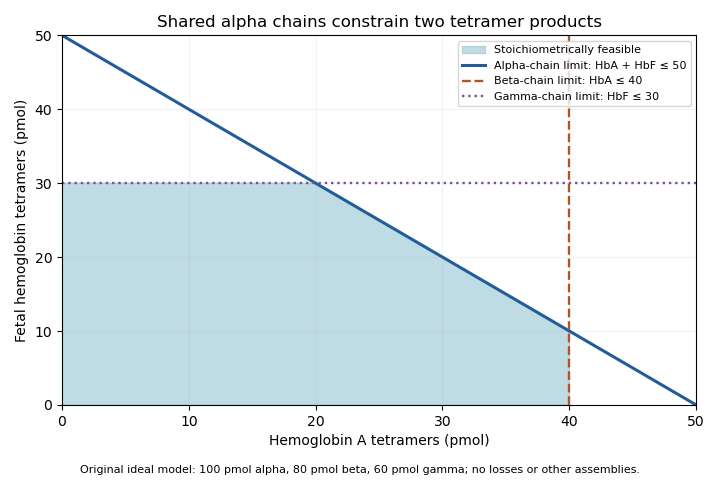
Original stoichiometric constraints on two tetramer products sharing an alpha-chain pool; no intracellular assembly rates are implied
. Details. The shaded region describes permitted amounts, not the product mixture a cell must actually make. Gene expression, chain stability and assembly pathways determine how much of each chain becomes available and incorporated. The calculation explains why measuring alpha-chain supply alone cannot identify the full hemoglobin composition.
Beta-globin is the human HBB gene product that combines with alpha-globin in hemoglobin A. The standard adult assembly contains two alpha and two beta chains, .[ref] Beta-globin is one component of that assembly, not another name for the entire hemoglobin molecule.
Primary structural evidence comes from human deoxyhemoglobin record 4HHB, which identifies the alpha and beta chains within its tetramer.[ref]
The crystal structure of human deoxyhaemoglobin at 1.74 A resolution by G. Fermi and others. RCSB 4HHB, Macromolecules and Biological Assembly
Oxygen binding changes the state of a hemoglobin assembly without changing a beta chain into a gamma chain. Subunit identity and oxygen occupancy are separate descriptions.An original assembly model illustrates why a protein-mixture measurement need not equal a gene-allele count. Suppose a pool contains two distinguishable beta-chain forms in proportions and . If two beta positions were filled independently from this pool, the predicted tetramer fractions would beThese are conditional predictions of random pairing, not an assertion that real hemoglobin assembly is always independent or that every heterozygote makes this mixture. Differential gene expression, chain recovery and assembly preferences can change the measured proportions.
The example separates the fraction of a chain form from the fraction of tetramers containing it. In the model, 30 percent of beta chains are form 2, while 51 percent of tetramers contain at least one form-2 chain. A molecular assay should therefore specify whether it reports a sequence, chain abundance, assembled-protein composition or a functional oxygen-binding quantity. Those observations can support one another without being interchangeable.
Gamma-globin is the globin-chain class that pairs with alpha-globin in fetal hemoglobin, whose standard composition is . In humans, the HBG1 and HBG2 genes encode closely related gamma-chain products.[ref] The NCBI annotations distinguish A-gamma from G-gamma by alanine versus glycine at residue 136; gamma is therefore not necessarily a single sequence label.
The human fetal deoxyhemoglobin structure 1FDH provides a molecular example, identifying alpha and gamma entities within the tetramer.[ref]
Structure of human foetal deoxyhaemoglobin by J. A. Frier and M. F. Perutz. RCSB 1FDH, Macromolecules and Biological Assembly
The gamma chain occupies a protein-subunit role; it is not a gamma photon or a description of the molecule's oxygenation state.An original amount calculation makes the subunit distinction useful. Suppose an assay quantifies 120 pmol total gamma chains, with 90 pmol of one sequence form and 30 pmol of the other. Their chain fractions are 0.75 and 0.25. If every measured gamma chain belongs to fetal tetramers containing exactly two gamma chains, total fetal hemoglobin isIf 12 pmol of that measured gamma pool is instead free or belongs to other material, the same tetramer interpretation gives pmol. A total chain assay does not by itself prove where every chain was assembled.
A separate sequence-selective assay can establish which gamma forms are present, while a composition or functional measurement tests the assembled hemoglobin. Changes in HBG1 or HBG2 expression are questions about the producing system; changes in oxyhemoglobin versus deoxyhemoglobin are questions about oxygen binding. Keeping those levels separate prevents a molecular identity result from being mistaken for a complete physiological measurement.
An oligodendrocyte is a glial cell that forms myelin around axons in the central nervous system. Different processes from one oligodendrocyte can wrap separate segments of several axons. The insulated segments alternate with nodes of Ranvier, allowing saltatory conduction.[ref]
Anatomy and Physiology 2e by J. Gordon Betts and others. Section 12.2, Glial Cells of the CNS and Myelin
This branching arrangement differs from the one myelinated segment made by a peripheral Schwann cell. Insulation is part of circuit function: changes to the number or geometry of sheaths can alter when signals arrive. Experiments manipulating visual experience in mice linked altered oligodendrocyte-generated sheath geometry to changes in optic nerve conduction.[ref]
A Schwann cell is a glial cell of the peripheral nervous system that ensheaths axons. A myelinating Schwann cell wraps its cell membrane repeatedly around one segment of one axon, producing myelin. Adjacent Schwann cells leave a node of Ranvier between their sheaths, supporting saltatory conduction.[ref]
Anatomy and Physiology 2e by J. Gordon Betts and others. Section 12.2, Glial Cells of the PNS and Myelin
Other Schwann cells support small axons without building thick myelin sheaths. Thus being associated with a Schwann cell does not imply that a peripheral fibre is myelinated. The one-segment arrangement also differs from an oligodendrocyte, whose processes can myelinate parts of several central axons.
A tanycyte is a specialized ependymal cell and glial cell of the hypothalamus. Its body can line the third ventricle, while a long process extends toward underlying tissue. In the median eminence, tanycytic endings surround neurosecretory terminals near blood vessels.[ref]
Vascular endothelial cells promote acute plasticity in ependymoglial cells of the neuroendocrine brain by Sandrine De Seranno and others. Introduction and Figure 1; ventricular cell bodies, long processes and vascular end-feet
In cultured rat tanycytes, signals from endothelial cells altered actin organization through nitric oxide.[ref]
An endocrine gland releases hormones into the surrounding internal fluid for delivery to target tissues, commonly through the blood. Unlike an exocrine gland, it does not use a duct to discharge its hormonal secretion onto an epithelial surface or into an anatomical lumen.[ref]
Anatomy and Physiology 2e by J. Gordon Betts and others. Section 17.1, Structures of the Endocrine System
The thyroid and pituitary are examples. The pancreas shows why classification can be functional: its endocrine cells release hormones such as insulin, while other pancreatic cells send digestive secretion through ducts. Hormone delivery alone does not specify the response. A target cell's receptors and intracellular signaling determine whether and how it reacts, and feedback can regulate further secretion.
Pinned article: Introduction to the OurBigBook Project
Welcome to the OurBigBook Project! Our goal is to create the perfect publishing platform for STEM subjects, and get university-level students to write the best free STEM tutorials ever.
Everyone is welcome to create an account and play with the site: ourbigbook.com/go/register. We belive that students themselves can write amazing tutorials, but teachers are welcome too. You can write about anything you want, it doesn't have to be STEM or even educational. Silly test content is very welcome and you won't be penalized in any way. Just keep it legal!
Intro to OurBigBook
. Source. We have two killer features:
- topics: topics group articles by different users with the same title, e.g. here is the topic for the "Fundamental Theorem of Calculus" ourbigbook.com/go/topic/fundamental-theorem-of-calculusArticles of different users are sorted by upvote within each article page. This feature is a bit like:
- a Wikipedia where each user can have their own version of each article
- a Q&A website like Stack Overflow, where multiple people can give their views on a given topic, and the best ones are sorted by upvote. Except you don't need to wait for someone to ask first, and any topic goes, no matter how narrow or broad
This feature makes it possible for readers to find better explanations of any topic created by other writers. And it allows writers to create an explanation in a place that readers might actually find it.
Figure 1. Screenshot of the "Derivative" topic page. View it live at: ourbigbook.com/go/topic/derivativeVideo 2. OurBigBook Web topics demo. Source. - local editing: you can store all your personal knowledge base content locally in a plaintext markup format that can be edited locally and published either:This way you can be sure that even if OurBigBook.com were to go down one day (which we have no plans to do as it is quite cheap to host!), your content will still be perfectly readable as a static site.
- to OurBigBook.com to get awesome multi-user features like topics and likes
- as HTML files to a static website, which you can host yourself for free on many external providers like GitHub Pages, and remain in full control

Figure 2. You can publish local OurBigBook lightweight markup files to either OurBigBook.com or as a static website.
Figure 3. Visual Studio Code extension installation.
Figure 5. . You can also edit articles on the Web editor without installing anything locally. Video 3. Edit locally and publish demo. Source. This shows editing OurBigBook Markup and publishing it using the Visual Studio Code extension. 
- Infinitely deep tables of contents:



All our software is open source and hosted at: github.com/ourbigbook/ourbigbook
Further documentation can be found at: docs.ourbigbook.com
Feel free to reach our to us for any help or suggestions: docs.ourbigbook.com/#contact