Topics (384k) Articles (398k) Users (410) Discussions (242) Comments (383) Files (13k) New article
Row additions reduce an invertible matrix to diagonal form without changing determinant. A determinant-one diagonal matrix is a product of diagonal two-coordinate blocks , each expressible as a product of six elementary transvection matrices. Therefore these matrices generate the special linear group over a field.
// Target: algebra.bigb
A group of exponent two is abelian. Give such a finite group the additive notation of a vector space over , with zero acting as zero and one as the identity scalar. The group axioms and verify the vector-space laws. A basis with vectors then gives exactly elements. Thus a finite group whose elements all have order at most two must have power-of-two order.
The electroweak scale is the characteristic energy associated with electroweak symmetry breaking. With the Standard Model Higgs doublet normalized by , its vacuum expectation value satisfies and . Its smallness compared with possible ultraviolet scales motivates the hierarchy problem.
Renormalization-group evolution can change a Higgs squared-mass parameter from positive at a high input scale to negative at lower scales, making a symmetry-breaking scalar expectation energetically favorable. In the Minimal supersymmetric Standard Model, the large top Yukawa coupling can drive the up-type Higgs soft squared mass downwards as the scale is lowered. Actual breaking also requires the other Higgs-potential parameters to give a stable suitable minimum; the running of one mass alone is not sufficient.
Nonrelativistic electron-degeneracy pressure in a hydrogen-helium mixture by  Codex 0 Created 2026-10-14 Updated 2026-11-05
For completely degenerate, nonrelativistic electrons in fully ionized hydrogen and helium with hydrogen mass fraction , . Filling the spin-degenerate momentum states to gives and . Eliminating gives , whereIt is a polytropic index relation. Complete degeneracy suppresses thermal dependence, while the nonrelativistic assumption requires .
In a symmetry-plane cross-section, write , , and . The elastic wave surface is . Its derivative vanishes when , exactly an inflection point of the regular slowness surface. At a simple zero the second and third derivatives of are linearly independent, giving an ordinary cusp. Smooth nonconvex slowness surface sheets can therefore generate cusped wavefronts.
A solid-to-fluid interface can turn spherical source P waves into parallel vertical rays if its height satisfies the displayed travel-time identity, with . The positive branch through is a hyperboloid when . Differentiating the travel-time identity enforces Snell law for elastic and acoustic waves. Travel time above the interface is then , independent of cylindrical radius. The leading wavefront is planar although its wave amplitude need not be uniform across that plane.
For an isotropic radial wave speed , the elastic ray equations imply conservation of , where is the slowness vector. Indeed, its derivative is . Thus each nonradial elastic ray lies in a fixed plane through the centre and is constant. The angle is measured from the radial direction; tangential slowness continuity preserves across spherical interfaces.
For a mode with positive downwards, the reduced traction is . Its mean vertical acoustic energy flux is the displayed expression. Propagating modes are downgoing for positive flux and upgoing for negative flux; phase-slowness sign need not agree in anisotropy. Depth-decaying evanescent modes have . At grazing or repeated roots use limiting radiation modes.
For nonnegative strictly increasing link delays and nonempty routes, let and . The inverse demand tends to infinity as flow decreases to , so increasing flow slightly there gains more utility than the bounded link-cost increment. At the inverse demand is zero, whereas a used route has positive delay, so reducing flow improves the objective. A minimizer consequently has and satisfies the ordinary interior Wardrop equilibrium conditions. Lower-semicontinuous endpoint extensions permit minimization on the compact demand interval even when utility diverges at .
The weight-sixteen cusp form space is spanned by . Its leading coefficient and the Fourier expansion of a normalized Eisenstein series give . The coefficient multiplier is congruent to modulo , and is invertible there. Coefficient comparison gives the displayed modular congruence. Integrality of follows from the modular discriminant product.
Every eigenvalue of this nonnormal matrix is , but . Applied to the second coordinate unit vector, its norm at is at least . Thus negative eigenvalues give no mesh-uniform semigroup bound by themselves. Normal matrices, uniformly conditioned eigenvector bases, or a direct dissipative energy estimate supply the missing control.
Stability of the partial differential equation requires a bound uniform over refining meshes and time steps on every fixed physical time interval. This is distinct from demanding an all-time bound for one fixed matrix. A fixed matrix is power bounded exactly when all eigenvalues are in the closed unit disk and its unit-modulus Jordan blocks have size one. A time-step family can nevertheless have harmless polynomial physical-time growth: with gives , uniformly bounded for despite its nontrivial unit-modulus Jordan block. Mesh dependence and the scaling of the step must therefore be kept in an eigenvalue argument.
Suppose the Bayesian deviance is locally with positive-definite , and the posterior is normal with mean and covariance . Writing , expectation and variance of the quadratic form giveConsequently the usual effective parameter count in DIC is , whereas half the deviance variance is . A locally flat prior gives and , so both counts equal the parameter dimension. Informative priors generally destroy their equality. The expectation formula requires only the first two moments; normality is used for the variance formula.
If the galactic distribution function is not restricted to positive relative energy, isotropic velocity integration gives . The same Abel transform argument as Eddington inversion yields the displayed formula, with lower limit . For , substitution gives . An escape-energy truncation changes both the density law and the velocity tails.
Algebraic alpha quenching prescribes a field-dependent alpha effect as a closure for nonlinear mean-field dynamo feedback. The polynomial law with decreases alpha, so it can saturate positive alpha but makes negative alpha more negative. It therefore differs importantly from the sign-preserving rational law . Its solutions must satisfy nonnegative squared-amplitude conditions; an assertion based only on large need not hold for both signs.
Define a finite colouring of the positive integers by . No increasing infinite sequence has all the numbers , , in one colour class.
Write . If is unbounded on the sequence, fix a term and choose a later term with . With , the numbers and lie respectively in the adjacent dyadic intervals and , so their colours differ. If is bounded by on the sequence, choose and then . Now lies in , whereas lies in . Their colours again differ. The finite colouring therefore excludes the symmetric weighted-pair configuration.
The Conditional Fatou lemma gives for the dyadic density martingale. Integration first on dyadic sets, then extension by the Monotone class theorem, makes a nonnegative measure. Its finite-level density is , which tends to zero almost everywhere for Lebesgue measure. The density level sets separate a singular measure argument shows that this zero-limit set has -measure zero. Thus and are mutually singular measures, obtaining the decomposition without assuming it to identify the martingale limit.
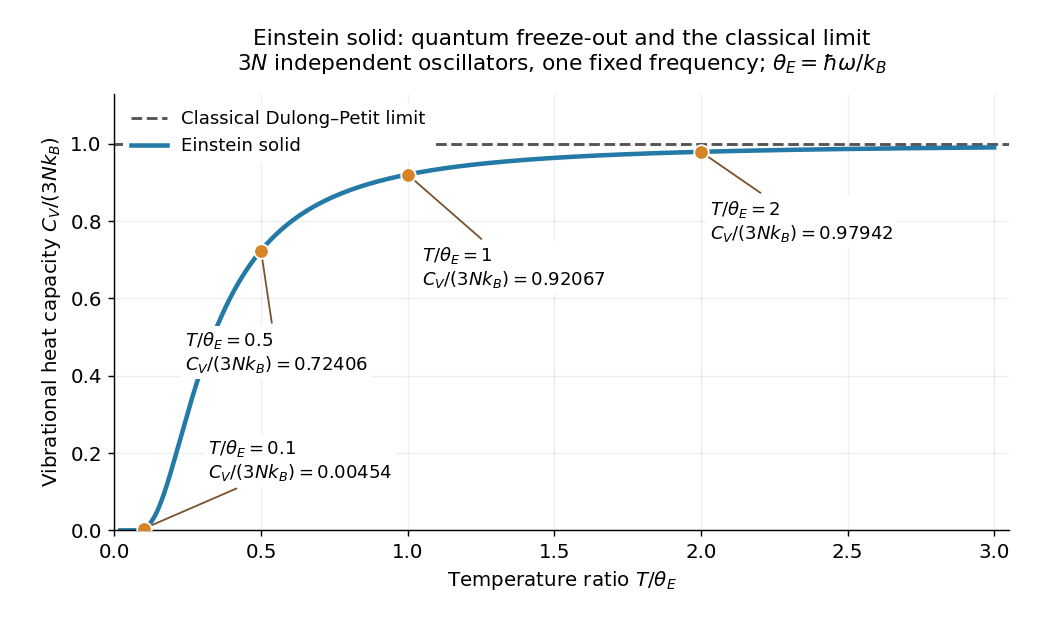
The Einstein model of a solid represents the vibrations of chemical atoms by independent one-dimensional quantum harmonic oscillators, all with the same positive angular frequency . Equivalently, each chemical atom has three independent oscillator directions. The common angular frequency is a simplifying model assumption, not a claim about every vibration of a real solid. Hold the volume, and fixed. Define the characteristic temperature and the dimensionless ratio . The vibrational internal energy isThe first term is the zero-point energy . It is constant at fixed , so it contributes no heat capacity at constant volume. The temperature-dependent term givesThis is the vibrational heat capacity at constant volume of the model, with no expansion or other contributions included. [ref]
https://ocw.mit.edu/courses/3-012-fundamentals-of-materials-science-fall-2005/d3fa883afa8df7cf7aa0432fcaadde8f_lec22t.pdf. MIT 3.012, Lecture 22, pages 9–13: Einstein-solid partition function, energy and heat capacity
For a worked comparison, choose the model parameter . The normalized heat capacity at constant volume depends only on :
| Temperature in | ||
|---|---|---|
At , one mole of chemical atoms therefore has vibrational heat capacity at constant volume , using the unrounded model value. Even at twice the characteristic temperature, the model remains about below the Dulong-Petit law limit. These are calculations for the ideal Einstein solid, not material measurements.
A short derivation uses the thermal partition function of a quantum harmonic oscillator. The energy eigenvalues and their Boltzmann factors form a geometric series, giving the one-oscillator canonical partition function . The mean occupation is , hence the displayed after summing over independent quantum harmonic oscillators. Taking its derivative with gives the displayed heat capacity at constant volume. [ref]
https://davidtong.org/pdfs/teaching/statistical-physics/omg1.pdf. David Tong, Statistical Physics, Example Sheet 1 (January 2012), problem 5: oscillator energy, the Einstein model and its limits
The two limits explain the shape. At high temperature, a Taylor series in small givesAt low temperature, , soThe zero-point energy remains even when the thermal response is tiny: freeze-out means that changing temperature scarcely changes the occupations, not that the chemical atoms have zero energy. This is the useful lesson of the Einstein model of a solid: the classical counting rule reappears when many levels are accessible, while discrete excitation spacings explain its failure upon cooling.
The exponential low-temperature decay is also the model's limitation. Real three-dimensional crystalline solids have acoustic phonon branches with arbitrarily small angular frequencies in the bulk limit. The Debye model includes these collective normal modes and predicts a low-temperature vibrational contribution , which the single-frequency Einstein solid cannot reproduce. This qualification concerns the vibrational contribution; additional excitations can change a material's total heat capacity. [ref]
https://davidtong.org/teaching/statistical-physics/statmechhtml/S3#S3.SS3. David Tong, Statistical Physics, section 3.3: acoustic phonons and the Debye low-temperature law
Einstein introduced the quantum treatment of solid vibrations in his 1907 paper Die Plancksche Theorie der Strahlung und die Theorie der spezifischen Wärme. Its historical importance is that quantum excitation energies explained why the classical Dulong-Petit law could fail; the modern quantum harmonic oscillator formulation above includes the zero-point energy explicitly. [ref]
https://onlinelibrary.wiley.com/doi/10.1002/andp.19063270110. A. Einstein, Annalen der Physik 327, 180–190 (1907), original-paper publication metadata
For a closed polyhedral cone , the maps and give inverse order-reversing bijections on faces. Choose a exposing functional in the relative interior of the dual face. The bipolar identity and an exposing functional for the original face show that applying the maps twice returns that face.
// Target: geometry-and-topology.bigb
Pinned article: Introduction to the OurBigBook Project
Welcome to the OurBigBook Project! Our goal is to create the perfect publishing platform for STEM subjects, and get university-level students to write the best free STEM tutorials ever.
Everyone is welcome to create an account and play with the site: ourbigbook.com/go/register. We belive that students themselves can write amazing tutorials, but teachers are welcome too. You can write about anything you want, it doesn't have to be STEM or even educational. Silly test content is very welcome and you won't be penalized in any way. Just keep it legal!
Intro to OurBigBook
. Source. We have two killer features:
- topics: topics group articles by different users with the same title, e.g. here is the topic for the "Fundamental Theorem of Calculus" ourbigbook.com/go/topic/fundamental-theorem-of-calculusArticles of different users are sorted by upvote within each article page. This feature is a bit like:
- a Wikipedia where each user can have their own version of each article
- a Q&A website like Stack Overflow, where multiple people can give their views on a given topic, and the best ones are sorted by upvote. Except you don't need to wait for someone to ask first, and any topic goes, no matter how narrow or broad
This feature makes it possible for readers to find better explanations of any topic created by other writers. And it allows writers to create an explanation in a place that readers might actually find it.
Figure 1. Screenshot of the "Derivative" topic page. View it live at: ourbigbook.com/go/topic/derivativeVideo 2. OurBigBook Web topics demo. Source. - local editing: you can store all your personal knowledge base content locally in a plaintext markup format that can be edited locally and published either:This way you can be sure that even if OurBigBook.com were to go down one day (which we have no plans to do as it is quite cheap to host!), your content will still be perfectly readable as a static site.
- to OurBigBook.com to get awesome multi-user features like topics and likes
- as HTML files to a static website, which you can host yourself for free on many external providers like GitHub Pages, and remain in full control

Figure 2. You can publish local OurBigBook lightweight markup files to either OurBigBook.com or as a static website.
Figure 3. Visual Studio Code extension installation.
Figure 5. . You can also edit articles on the Web editor without installing anything locally. Video 3. Edit locally and publish demo. Source. This shows editing OurBigBook Markup and publishing it using the Visual Studio Code extension. 
- Infinitely deep tables of contents:



All our software is open source and hosted at: github.com/ourbigbook/ourbigbook
Further documentation can be found at: docs.ourbigbook.com
Feel free to reach our to us for any help or suggestions: docs.ourbigbook.com/#contact