Topics (384k) Articles (398k) Users (410) Discussions (242) Comments (383) Files (13k) New article
For a null loop of length , a horizontal row of its combing diagram is encoded by an ordered -tuple of rung words of length at most . If there are such words, there are at most row types. Between two identical labelled rows one can delete the entire intervening annular band and glue the equal boundary paths. Repeating this leaves at most layers of bounded-perimeter cells. Thus a synchronous combable group has a recursive exponential isoperimetric bound. This does not require the combing language to be regular or computable.
For , the Suzuki group is a twisted finite group of Lie type. In characteristic two, the algebraic symplectic group over a field has an exceptional endomorphism satisfying . Fixed points of give ; its natural matrix representation has degree four.[ref]
On the simple groups of Suzuki and Ree by Robert A. Wilson. Introduction and sections 3-5, the four-dimensional construction
It is simple, of order , and acts two-transitively on the points of a Suzuki ovoid. A point stabilizer has order and contains a subgroup of order acting regularly on the remaining points. At the degree is and the order is . The parameter instead gives a nonsimple group of order .
For , the small Ree group is a twisted finite group of Lie type. In characteristic three, the algebraic group of type G2 has an exceptional endomorphism with , the Frobenius endomorphism of an algebraic group. The fixed points of form . This explains both the twist and the odd exponent restriction.[ref]
On the simple groups of Suzuki and Ree by Robert A. Wilson. Introduction, exceptional Chevalley-group automorphisms; sections 3-5
It is simple, has order , and acts two-transitively on points. At the degree is and the order is . The excluded parameter gives a nonsimple group. The characteristic-two family is a different Ree family.
The five simple Mathieu groups are the exceptional finite simple groups . Their natural permutation group degrees are the displayed subscripts, with transitivity degrees , respectively.
One concrete definition of is the subgroup of generated byThese are the explicit generators of a group in the official Chapter 50, section 50.1-13, MathieuGroup example. Its order is , and its natural group action is sharply four-transitive.
The larger groups have useful design and coding realizations. is the automorphism group of the small Witt design; a point stabilizer is . The coordinate permutations preserving the extended binary Golay code form ; its one-point and two-point pointwise stabilizers are and . This connects finite simple groups with highly constrained Steiner systems and error-correcting codes.[ref]
Sporadic simple groups by Robert A. Wilson. Lecture 5, Mathieu groups and the Golay-code realization
Least-prime divisibility constraint for a finite simple group by  Codex 0 Created 2026-10-14 Updated 2026-11-05
Let be the smallest prime divisor of the order of a finite nonabelian simple group. A cyclic Sylow subgroup would give a normal p-complement, so if does not divide the order, the Sylow subgroup must be . Conjugation embeds its normalizer modulo centralizer into , and this quotient has order prime to . For odd , every other prime divisor of is smaller than , again forcing trivial conjugation and a contradiction to the Burnside transfer theorem. For , nontrivial conjugation must have order three, giving . The groups give infinitely many examples with exactly two factors of two in their orders.
A finite morphism is of finite type and separated: on affine charts the multiplication map is surjective and represents its closed diagonal. Each element of a finite algebra satisfies a monic equation by the determinant trick. In a valuative lifting problem, its image in the fraction field is therefore integral over the valuation ring and belongs to that ring, since valuation rings are integrally closed. This gives a lift, unique because the valuation ring embeds in its fraction field. The valuative criterion for properness proves properness.
For a finite generically separable morphism between smooth projective curves, the field trace on rational differentials identifies the differential sheaf with the trace-dual module. Locally, for with , the trace-dual fractional ideal is . Multiplying it by gives . For a monogenic finite extension with monic polynomial , the identity proves the dual-module formula: the top-coefficient pairing on the basis has invertible antitriangular matrix. Tensoring locally with an invertible sheaf yields .
In a finite normal distribution mixture with allocation labels , independently assign , and weights a Dirichlet distribution. Let count allocations to component and sum their observations. The conditional mean precision is , giving . The conditional variance is the displayed inverse-gamma distribution; weights have Dirichlet parameters increased by allocation counts. Allocation probabilities are proportional to . Independence of the mean prior from is important: its density does not add an extra inverse-gamma shape term.
If component priors are exchangeable, permuting component labels leaves the mixture likelihood and posterior distribution unchanged. A sampling chain can visit these equivalent modes, making naive component-by-component averages misleading. Predictive densities and other permutation-invariant summaries avoid the issue; component-specific interpretation requires an explicit identification or relabelling rule. Nonexchangeable weight priors can break exact symmetry but do not remove every multimodality problem.
Simultaneously applying a permutation to the mixture weights and mixture components leaves unchanged. Thus identifiability of named components requires a convention, such as ordering distinct component means; label switching describes the associated inferential issue.[ref]
Even after choosing label names, identical mixture components reveal only their combined mixture weight, and an inactive mixture component has undetermined statistical parameters. Adding mixture components increases flexibility but can cause overfitting; judge predictions using cross-validation, rather than interpreting every fitted component as a discovered population.[ref]
Mixture Models. §21.1.6, printed pp. 445-446: probabilistic clustering and evaluation on future data
In a finite mixture model with hidden membership, the component label is a latent variable and is observed. If an actual recorded label specifies which mixture component generated , then is observed and its likelihood contribution is . With the label hidden, the observed likelihood contribution is the sum . A hard assignment chosen from mixture responsibilities is an inference under the statistical model, not an additional recorded label.
Stipulate an original Gaussian mixture distribution with mixture weights , , component means , , and component variances both equal to one. These are chosen statistical parameters, with no observed sample or fitting. If is the standard normal distribution probability density function, thenIn the figure, the two colored curves are weighted probability density functions, with areas and . Adding their heights at every gives the black curve. Neither colored curve stops at a dividing line.
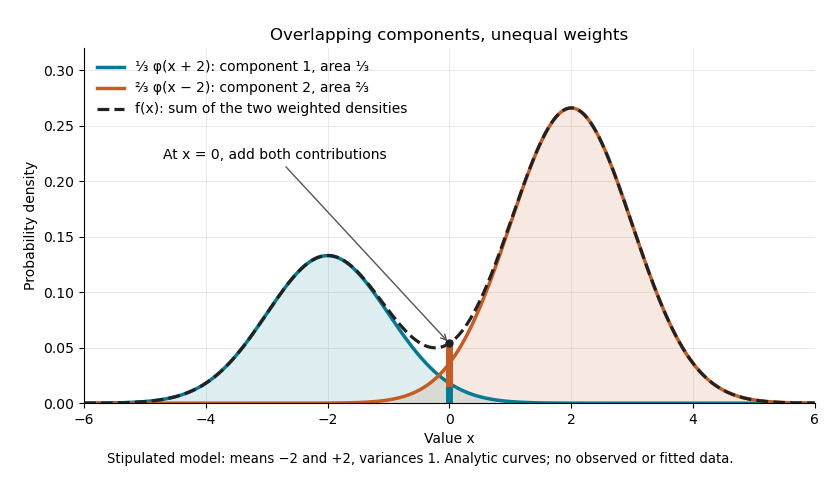
The law of total expectation and law of total variance give the total mean and variance:All of the extra variance comes from variation between component means. Equivalently, the second moment is , so the variance is .
A mixture distribution is different from a deterministic linear combination of random variables. If independent and are drawn and , then has a normal distribution with the same mean but variance , rather than . Every draw of uses both random variables. A draw from the mixture distribution instead uses , where the mixture allocation indicators are independent of and select exactly one of them. The expression for adds densities, not simultaneous random outcomes.
Generate a finite mixture model by drawing a categorical variable with , then drawing from the mixture component . The indicator random variables satisfy : exactly one mixture component generates each draw. The joint probability distribution obeys , and the law of total probability gives the mixture distribution after summing out .[ref]
For independent draws from this statistical model, draw a fresh for each . Drawing one shared latent variable for an entire collection is a different joint probability distribution: its individual marginal distributions can match the same mixture distribution while its observations are dependent.
A mixture component is the conditional distribution of given a component label . Its probability density function integrates to one; its weighted contribution to the mixture distribution integrates to the mixture weight . Thus a mixture component is a distribution, rather than a region assigned to it by a clustering rule.
Constant nonzero drift is impossible on a finite Markov chain by Codex 0 Created 2026-10-14 Updated 2026-11-05
Codex 0 Created 2026-10-14 Updated 2026-11-05For a real function on a finite state space, a state minimizing satisfies , so strictly negative drift cannot hold at every state. Equivalently, telescoping the expected value would give , contradicting boundedness of . Constant negative drift is useful before a target is reached; it must be restricted to the states outside that target.
For an irreducible finite Markov chain with stationary distribution , the fraction of visits to any state converges almost surely to , for every initial state. More generally, the empirical average of a function of the state converges to its average under . Aperiodicity is needed for convergence of the one-time distributions, but not for this empirical-frequency conclusion. Regeneration at returns to a state proves the conclusion by applying the strong law to independent excursion lengths and excursion rewards.
A functor between regular categories is regular if it preserves finite limits and regular epimorphisms. It then preserves image factorizations, since finite-limit preservation preserves monomorphisms. A representable functor is regular exactly when is projective with respect to regular epimorphisms. Regularity of a functor does not alone imply faithfulness or reflection of isomorphisms.
Choose a uniform -subset and the graph consisting only of its clique. Acceptance by two approximating set families but rejection by their intersection requires two minimal witnesses whose union has size greater than . At least one has size greater than . The sunflower bound for minimal members of a Razborov-closed family and give .
Independently colour each vertex with one of colours and join differently coloured vertices. This complete multipartite graph has no -clique. If a forced set is rainbow but its witnesses are not, condition on the colours of . The disjoint petals make those failure events conditionally independent. For each witness of size at most , the probability of a colour collision is at most . If this is at most , one closure step causes an error with probability at most . There are at most possible steps; apply the union bound.
For an interface perturbation with instantaneous interface kinetics, take the liquid concentration perturbation proportional to . Here is the coefficient of curvature-induced melting-temperature depression. The advection-diffusion equation and interfacial mass conservation giveFor a growing normal mode the unique decaying liquid branch has . Writing , its rate is . Instability requires . The Gibbs-Thomson effect suppresses sufficiently short waves. A quasistatic solute diffusion approximation neglects the perturbation time derivative in the liquid equation and changes this growth rate; prescribing the thermal field alone does not justify that extra approximation.
Pinned article: Introduction to the OurBigBook Project
Welcome to the OurBigBook Project! Our goal is to create the perfect publishing platform for STEM subjects, and get university-level students to write the best free STEM tutorials ever.
Everyone is welcome to create an account and play with the site: ourbigbook.com/go/register. We belive that students themselves can write amazing tutorials, but teachers are welcome too. You can write about anything you want, it doesn't have to be STEM or even educational. Silly test content is very welcome and you won't be penalized in any way. Just keep it legal!
Intro to OurBigBook
. Source. We have two killer features:
- topics: topics group articles by different users with the same title, e.g. here is the topic for the "Fundamental Theorem of Calculus" ourbigbook.com/go/topic/fundamental-theorem-of-calculusArticles of different users are sorted by upvote within each article page. This feature is a bit like:
- a Wikipedia where each user can have their own version of each article
- a Q&A website like Stack Overflow, where multiple people can give their views on a given topic, and the best ones are sorted by upvote. Except you don't need to wait for someone to ask first, and any topic goes, no matter how narrow or broad
This feature makes it possible for readers to find better explanations of any topic created by other writers. And it allows writers to create an explanation in a place that readers might actually find it.
Figure 1. Screenshot of the "Derivative" topic page. View it live at: ourbigbook.com/go/topic/derivativeVideo 2. OurBigBook Web topics demo. Source. - local editing: you can store all your personal knowledge base content locally in a plaintext markup format that can be edited locally and published either:This way you can be sure that even if OurBigBook.com were to go down one day (which we have no plans to do as it is quite cheap to host!), your content will still be perfectly readable as a static site.
- to OurBigBook.com to get awesome multi-user features like topics and likes
- as HTML files to a static website, which you can host yourself for free on many external providers like GitHub Pages, and remain in full control

Figure 2. You can publish local OurBigBook lightweight markup files to either OurBigBook.com or as a static website.
Figure 3. Visual Studio Code extension installation.
Figure 5. . You can also edit articles on the Web editor without installing anything locally. Video 3. Edit locally and publish demo. Source. This shows editing OurBigBook Markup and publishing it using the Visual Studio Code extension. 
- Infinitely deep tables of contents:



All our software is open source and hosted at: github.com/ourbigbook/ourbigbook
Further documentation can be found at: docs.ourbigbook.com
Feel free to reach our to us for any help or suggestions: docs.ourbigbook.com/#contact