Topics (384k) Articles (398k) Users (410) Discussions (242) Comments (383) Files (13k) New article
The Lorentzian real form of the Klein quadric is the projectivized real null cone of signature . Scaling a nonzero null vector makes its positive two-dimensional and negative four-dimensional parts both unit vectors. Real projectivization then identifies with , yielding the displayed quotient. Its universal cover is , and its fundamental group is infinite cyclic. An affine Minkowski chart omits a null cone at infinity. This projective compact space is distinct from an unwrapped causal cover used for a Penrose diagram.
A complete inertial timelike geodesic in Minkowski spacetime has with . Under , , both tend to the same endpoint, giving past timelike infinity and future timelike infinity. A complete null geodesic has one finite limiting null coordinate at each end and reaches past null infinity and future null infinity. Complete spacelike geodesics have asymptotically and both ends approach spacelike infinity. The endpoints have finite compactified coordinates but occur at infinite physical affine parameter. A conformal transformation preserves null paths as unparametrized geodesics; it does not generally preserve timelike or spacelike geodesic paths.
The vertex cover number records the size of a minimum vertex cover:The vertex cover number is a number, while a minimum vertex cover is a set attaining it. For the cycle graph , the independence number is , so the complement correspondence gives . The vertex cover above attains this size.
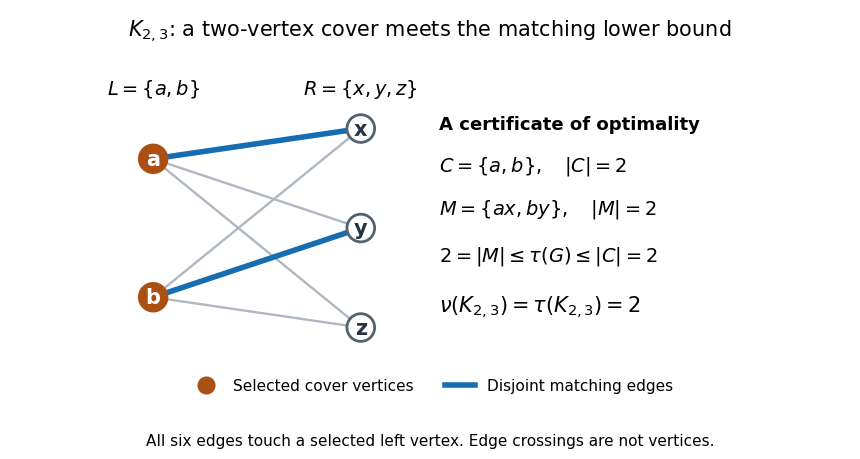
Every matching in a graph gives a lower bound on the vertex cover number. Its edges have no shared endpoints, so covering each selected edge requires a different vertex. Thus, for any matching in a graph and any vertex cover ,where is the matching number. Exhibiting a matching in a graph and a vertex cover of the same size certifies that both are optimum. Kőnig's theorem for bipartite matching says that every finite bipartite graph admits this equality: .[ref]
Graph Theory by Reinhard Diestel. Diestel, Graph Theory, Section 2.1, Theorem 2.1.1 and its lower-bound argument
For the complete bipartite graph , let the left vertices be and the right vertices be . All six edges join to . Selecting covers every edge; selecting gives a matching in a graph of size two. The lower bound and this vertex cover give , so . The remaining vertices form a largest independent set of size three. Crossings of drawn edges are not extra vertices.
The bipartite graph hypothesis matters. In a triangle in a graph, any two vertices form a minimum vertex cover, while any two edges share an endpoint. Hence and . Similarly, the cycle graph has and . The inequality for the matching number remains valid, but equality can fail.
The unique lightest edge across a cut of a graph belongs to every minimum spanning tree. If a spanning tree omits it, inserting it creates a graph cycle with another edge across that cut of a graph. Removing that heavier edge gives a lighter spanning tree, a contradiction. This proves the correctness of Prim algorithm and Kruskal algorithm for distinct weights.
The unique heaviest edge on a graph cycle belongs to no minimum spanning tree. If a spanning tree contains it, deleting it gives two components; the rest of the graph cycle has a lighter edge across that cut of a graph. Insert that edge to reduce the weight. This is the deletion certificate used by the reverse-delete algorithm.
Start from one graph vertex. Repeatedly add the least-weight edge joining the reached graph vertices to an unreached graph vertex. Each step grows a tree and obeys the minimum spanning tree cut property. On a finite connected graph, the result is a minimum spanning tree.
Kruskal's algorithm constructs a minimum spanning tree of a finite connected graph with undirected edges and real edge weights. Start with all vertices and no edges, a forest of isolated vertices. Sort the edges by nondecreasing weight, then accept an edge exactly when its endpoints belong to different current connected components of a graph. Otherwise reject it: the existing graph path between its endpoints would close a graph cycle. Each acceptance merges two connected components of a graph. Stop after acceptances, when the forest has become one spanning tree.
This is a greedy algorithm for economical network connection: only the next affordable connection and the current connected components of a graph matter. Unlike Prim's algorithm, which grows one reached tree, Kruskal's algorithm can grow several separate trees before joining them. The essential safeguard is avoiding a graph cycle, rather than simply buying the cheapest fixed number of edges.
Joseph Bernard Kruskal described this rule as Construction A on page 49 of his February 1956 paper, On the shortest spanning subtree of a graph and the traveling salesman problem; page 50 gives an exchange argument for distinct weights.[ref]
https://langevin.univ-tln.fr/cours/graphe/bonus/Krukskal.pdf. Joseph B. Kruskal, Jr., Proceedings of the American Mathematical Society 7(1), February 1956, pp. 48–50; inspected scan, Construction A and final exchange argument
The reverse-delete algorithm processes edges of a finite connected undirected weighted graph in nonincreasing weight order, deleting an edge whenever the graph stays connected.
Maintain the invariant that the surviving graph contains some minimum spanning tree. A deletable edge lies on a cycle. Previously retained heavier edges are bridges and remain bridges after further deletions, so every other edge on that cycle has weight at most . If a current optimum contains , removing it creates a cut. Another cycle edge crosses that cut; replacing by gives a surviving tree of no greater weight. Thus an optimum remains after deleting .
At termination the graph is connected and acyclic, hence is itself a minimum spanning tree. With tied weights, need not be excluded from every optimum. On a triangle with all weights one, every edge belongs to some optimum, yet deleting any one edge is safe. The minimum spanning tree cycle property excludes an edge from every optimum only when it is uniquely heaviest on a cycle.
A prime ideal is minimal over an ideal if and no smaller prime ideal contains . The definition also applies to two-sided prime ideals of a noncommutative ring.
Integer powers for an annihilating polynomial with roots one and minus one by  Codex 0 Created 2026-10-14 Updated 2026-11-05
Over a field of characteristic different from two, if a square matrix satisfies , then , and every integer matrix power lies in the span of . Writing , the universal formula is , where , and . The polynomial on the right satisfies , and . These value and derivative conditions implement interpolation at a repeated root. For negative integers the inverse formula first puts in the same polynomial algebra; the nilpotent block identity for proves the derivative rule for every integer.
The minimal polynomial of a real matrix, initially computed over the complex numbers, has real coefficients. Its coefficientwise complex conjugate is also a monic polynomial of the same degree annihilating the matrix. Uniqueness of the minimal polynomial forces the two polynomials to agree.
Characteristic and minimal polynomials of right multiplication by Codex 0 Created 2026-10-14 Updated 2026-11-05
Codex 0 Created 2026-10-14 Updated 2026-11-05On two-by-two complex matrices let . In row-entry coordinates, its matrix is , so its characteristic polynomial is the square of that of . For every polynomial , . Thus implies , and the reverse implication follows by taking . The operators have exactly the same annihilating polynomials and hence the same minimal polynomial. In general, right multiplication on -by- matrices has characteristic polynomial and the same minimal polynomial.
The socle is generated by all minimal nontrivial normal subgroups. Distinct minimal normal subgroups commute and meet trivially, although in the abelian case not every collection of them is an independent direct-product decomposition. It is a direct product of simple groups. In a faithful primitive permutation group each nontrivial normal subgroup is transitive; its minimal normal subgroups are either elementary abelian and regular, or direct powers of a nonabelian simple group. This is the starting point of the O'Nan–Scott theorem.
Choose a minimal nontrivial normal subgroup of . Its conjugates under the ambient group are minimal normal subgroups of ; distinct ones intersect trivially and commute. Choose a maximal family whose product is direct. Any omitted conjugate either lies in that product or meets it trivially and could be adjoined, so all conjugates lie in it. Their product is ambient-normal and therefore is . A normal subgroup of one factor is then normal in , since the other factors commute with it; minimality makes each factor simple. All factors are isomorphic because they are conjugates of . In the abelian case they are cyclic of one common prime order.
A nontrivial minimal normal subgroup of a finite solvable group is abelian: its commutator subgroup is characteristic, and minimality plus solvability excludes . A nontrivial Sylow subgroup of this abelian group is characteristic, so minimality makes a p-group. The characteristic subgroup of pth powers is proper, hence trivial by minimality. Therefore is an elementary abelian group.
The substrate concentration giving half the limiting reaction rate in the Michaelis-Menten equation. In the elementary mechanism , it is under the quasi-steady-state approximation, whereas the binding dissociation constant is .
If the relative weak topology on the unit ball of a normed vector space is first countable at zero, choose a countable collection of finite families of continuous linear functionals defining a local base. For any and , one family has common kernel on which . Extend that restriction to with using the Hahn-Banach theorem. Then vanishes on , so it belongs to by finite-dimensional factorization. Consequently the countable union of these families has norm-dense linear span in . The converse is the metrization of the weak topology on a bounded set construction from a norm-dense sequence in . In particular, separability of alone does not suffice: has nonseparable dual .
For a subset of a metric space, its metric entropy at resolution is the logarithm of the least number of radius- balls covering , with value infinity when no finite cover exists. It quantifies how many choices are needed to approximate an element at that resolution. If points are pairwise more than apart, each covering ball contains at most one, giving a lower bound by their logarithmic cardinality. The logarithm base changes only a constant factor. This approximation entropy differs from Kolmogorov-Sinai entropy of a dynamical system.
The metric induced by the maximum norm measures the largest difference in Cartesian coordinates. Simultaneous changes of Cartesian coordinates cost only as much as the slowest coordinate requires.
The metric induced by the L1 norm gives taxicab geometry. Each difference in Cartesian coordinates contributes its absolute value independently, so an axis-aligned route with no backtracking realizes the endpoint distance.
Pinned article: Introduction to the OurBigBook Project
Welcome to the OurBigBook Project! Our goal is to create the perfect publishing platform for STEM subjects, and get university-level students to write the best free STEM tutorials ever.
Everyone is welcome to create an account and play with the site: ourbigbook.com/go/register. We belive that students themselves can write amazing tutorials, but teachers are welcome too. You can write about anything you want, it doesn't have to be STEM or even educational. Silly test content is very welcome and you won't be penalized in any way. Just keep it legal!
Intro to OurBigBook
. Source. We have two killer features:
- topics: topics group articles by different users with the same title, e.g. here is the topic for the "Fundamental Theorem of Calculus" ourbigbook.com/go/topic/fundamental-theorem-of-calculusArticles of different users are sorted by upvote within each article page. This feature is a bit like:
- a Wikipedia where each user can have their own version of each article
- a Q&A website like Stack Overflow, where multiple people can give their views on a given topic, and the best ones are sorted by upvote. Except you don't need to wait for someone to ask first, and any topic goes, no matter how narrow or broad
This feature makes it possible for readers to find better explanations of any topic created by other writers. And it allows writers to create an explanation in a place that readers might actually find it.
Figure 1. Screenshot of the "Derivative" topic page. View it live at: ourbigbook.com/go/topic/derivativeVideo 2. OurBigBook Web topics demo. Source. - local editing: you can store all your personal knowledge base content locally in a plaintext markup format that can be edited locally and published either:This way you can be sure that even if OurBigBook.com were to go down one day (which we have no plans to do as it is quite cheap to host!), your content will still be perfectly readable as a static site.
- to OurBigBook.com to get awesome multi-user features like topics and likes
- as HTML files to a static website, which you can host yourself for free on many external providers like GitHub Pages, and remain in full control

Figure 2. You can publish local OurBigBook lightweight markup files to either OurBigBook.com or as a static website.
Figure 3. Visual Studio Code extension installation.
Figure 5. . You can also edit articles on the Web editor without installing anything locally. Video 3. Edit locally and publish demo. Source. This shows editing OurBigBook Markup and publishing it using the Visual Studio Code extension. 
- Infinitely deep tables of contents:



All our software is open source and hosted at: github.com/ourbigbook/ourbigbook
Further documentation can be found at: docs.ourbigbook.com
Feel free to reach our to us for any help or suggestions: docs.ourbigbook.com/#contact