Topics (384k) Articles (398k) Users (410) Discussions (242) Comments (383) Files (13k) New article

A cell line comprises descendants after a primary cell culture's first subculture. Further division can be finite or continuous; one founder biological cell is not required.[ref]
The useful continuity is ancestry across successive subcultures: descendants supply the next experiment. Individual biological cells can divide or die while their cell line persists. A common origin helps compare experiments, but does not imply that every descendant has identical DNA, gene expression or cell state.
A biochemist investigates the molecular chemistry of living systems, including the structure, reactions, and regulation of proteins, nucleic acids, lipids, and metabolites. The subject links chemistry with biology through experimentally testable mechanisms.
For example, measuring how an enzyme's reaction rate changes after a targeted amino-acid substitution can test a proposed catalytic role. Structural, kinetic, and cellular measurements answer complementary questions; a molecular interaction observed in isolation need not establish its importance in a living organism.
Energy metabolism comprises reactions that capture, transfer, and use energy to support cellular processes. Oxidation of nutrients can reduce electron carriers and support synthesis of ATP, which then couples favorable chemical change to otherwise unfavorable work.
ATP is a transferable chemical intermediate, not a substance that creates energy. In oxidative phosphorylation, electron transfer helps establish an electrochemical gradient across a membrane, and ATP synthase uses that gradient. Conservation of energy and the direction of free-energy changes constrain the whole process.
A metabolic pathway is a connected sequence of enzyme-catalyzed chemical reactions in metabolism, with a reaction product of one step serving as a substrate for another. A pathway boundary is a choice about which transformations to count: glycolysis ends at pyruvate, whereas subsequent fermentation or cellular respiration changes the final material balance. Adding the individual chemical equations cancels internal intermediates and exposes the net stoichiometry; it does not determine the reaction rate.
A cell-free extract is material obtained from disrupted biological cells after removing intact biological cells. Its biochemical activity can be tested separately from the whole organism. It can contain many enzymes and substrates, together with cofactor components; cell removal is different from purification of one component.
Hexokinase provides a concrete connection between sugar chemistry and energy coupling: it transfers a terminal phosphate group from ATP to glucose, forming a phosphorylated sugar and adenosine diphosphate. The enzyme accelerates the transfer, while consuming ATP changes the net chemical reaction being carried out. The donated group reaches the substrate through the catalytic route.[ref]
Biology 2e by Mary Ann Clark and others. §7.2, First Half of Glycolysis, step 1: hexokinase and ATP-dependent glucose phosphorylation
For a symbolic teaching model, write for an unphosphorylated sugar, for its phosphorylated form, and for inorganic phosphate. These are labels for chemical states, not complete elemental formulas. Using one consistent reference convention at fixed pH and temperature, stipulate the following molar changes in Gibbs free energy:All three numbers are chosen illustrative values, not measured properties of glucose or a particular enzyme. The prime marks a biochemical reference convention with pH held fixed; explicit proton and metal-binding bookkeeping is suppressed consistently. The first two lines are a thermodynamic decomposition: cancelling water and inorganic phosphate gives the net transfer. They do not assert that the reaction mechanism first releases free inorganic phosphate and then recaptures it.
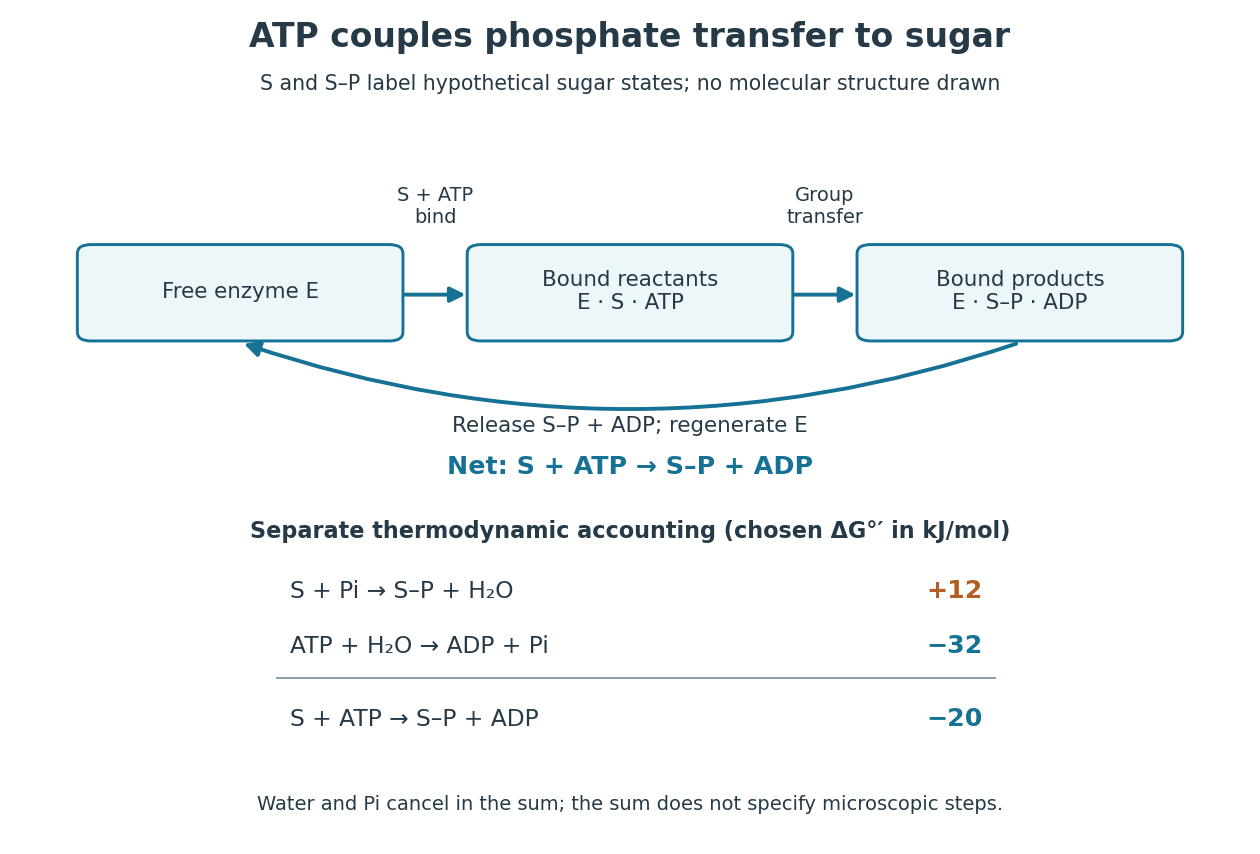
Because Gibbs free energy is a state function, consistently defined reaction changes add. A working reaction mechanism must also connect the desired conversion to ATP consumption; independently allowing ATP hydrolysis beside the sugar does not establish energy coupling. The general distinction is developed under energy coupling. ATP-dependent phosphorylation of a membrane protein can likewise connect a chemical change to active transport.[ref]
Biology 2e by Mary Ann Clark and others. §6.4, Energy Coupling, Figure 6.14: transfer to the sodium-potassium pump and its conformational cycle
Actual Gibbs free energy changes depend on thermodynamic activities. Even a favourable reference sum can be overcome by accumulation of reaction products or depletion of ATP; it supplies no prediction of the reaction rate. A living biological cell also regenerates ATP. Sustained operation therefore requires a connected metabolism, not an inexhaustible stock of a special molecule.
An enzyme accelerates particular chemical reactions, with catalytic selectivity arising from recognition and from the relative ease of the subsequent chemistry. Strong binding alone does not guarantee fast conversion. Nor does catalysis change the chemical equilibrium for an unchanged net chemical reaction. These distinctions explain how enzymes can direct the flow of material without creating an extra source of free energy.[ref]
Chemistry 2e by Paul Flowers and others. §12.7, opening paragraphs and Enzyme Structure and Function: alternative mechanisms, regeneration and specificity
For an original model of competing routes, let a substrate become either a desired reaction product or another reaction product :The labels represent hypothetical chemical species with the same elemental composition, not molecular structures. Assume fixed volume, irreversible first-order reactions, constant effective rate constants, and initially of with neither reaction product present. The model approximates a limited operating regime; real enzyme kinetics can include saturation and reverse reactions.
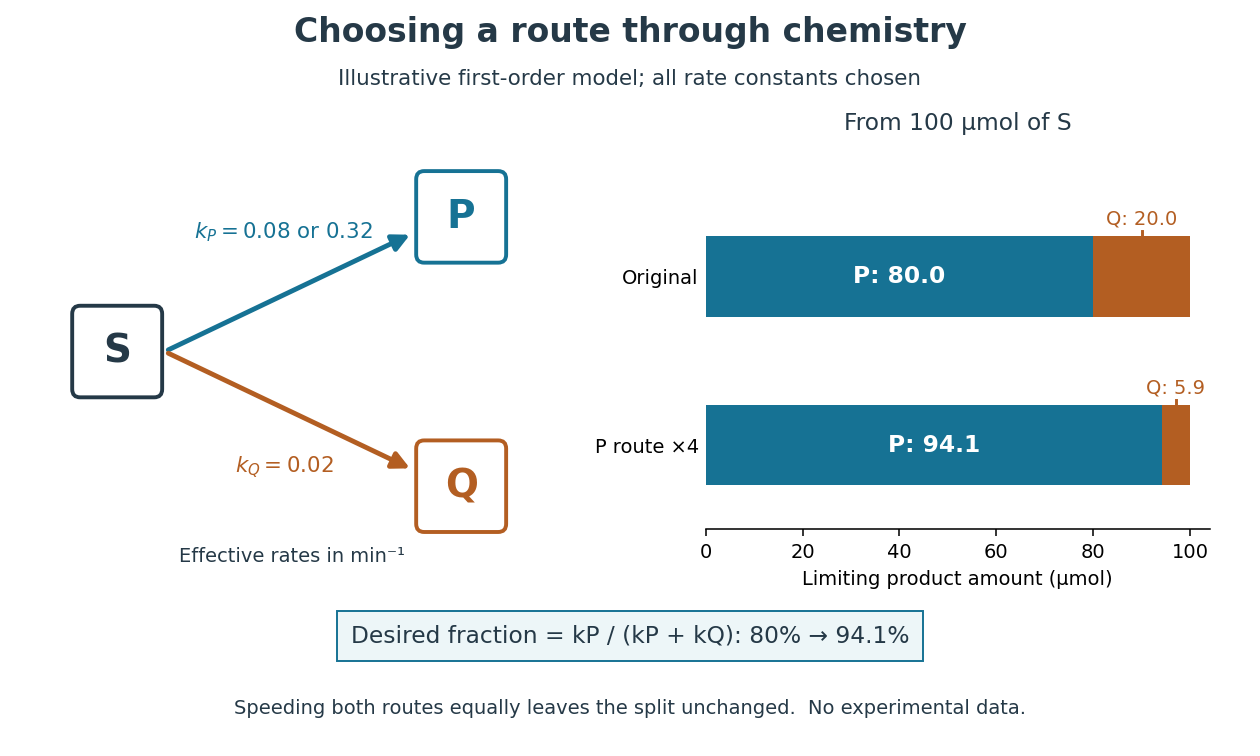
Selective acceleration changes the split between competing biochemical reaction products
. Original illustrative chemical reaction network and limiting product amounts from of hypothetical . Chosen effective rate constants are or and . The boxes label chemical species; they are not molecular structures. The bars are model limits, not experimental data. Details.The reaction-rate equations give , and , where denotes amount of substance. Consequently,With and , the eventual split is of and of . At ten minutes, the calculated amounts are approximately , and for , and . Selectively increasing fourfold changes the eventual desired fraction to . Increasing both rate constants fourfold instead preserves the split and only shortens the conversion time. Speed and selectivity answer different questions.
The bookkeeping matters independently of that model. In ideal alcoholic fermentation, complete conversion of of glucose yields each of ethanol and carbon dioxide. Of the initial of carbon chemical atoms, remain in ethanol and enter carbon dioxide. This is a chosen material-balance example using the net stoichiometry explained under Saccharomyces cerevisiae; it gives neither an observed yield nor the mechanism of the individual steps. Equal amounts of the two reaction products also do not mean equal masses.
Dialysis exchanges small solutes between a sample and an external bath through a semipermeable membrane, while retaining suitably large macromolecules, such as proteins. The transport is passive diffusion: random motion carries permeant molecules both ways, with net transport down their concentration gradient. The bath is the dialysate. At equal permeant solute concentrations, microscopic exchange continues but net exchange stops.[ref]
Dialysis: an overview, Pierce Biotechnology technical note. Dialysis: an overview, Tech Tip 20, p. 1, Dialysis is Diffusion Through a Semi-Permeable Membrane
For example, a protein sample containing excess sodium chloride can lose the small ions to a low-salt dialysate without deliberately transferring the protein. Conversely, components of a new buffer solution can enter from the bath. This is useful before studying enzyme kinetics: changing the surrounding chemical solution can remove an interfering small solute while keeping the enzyme available for the next experiment.
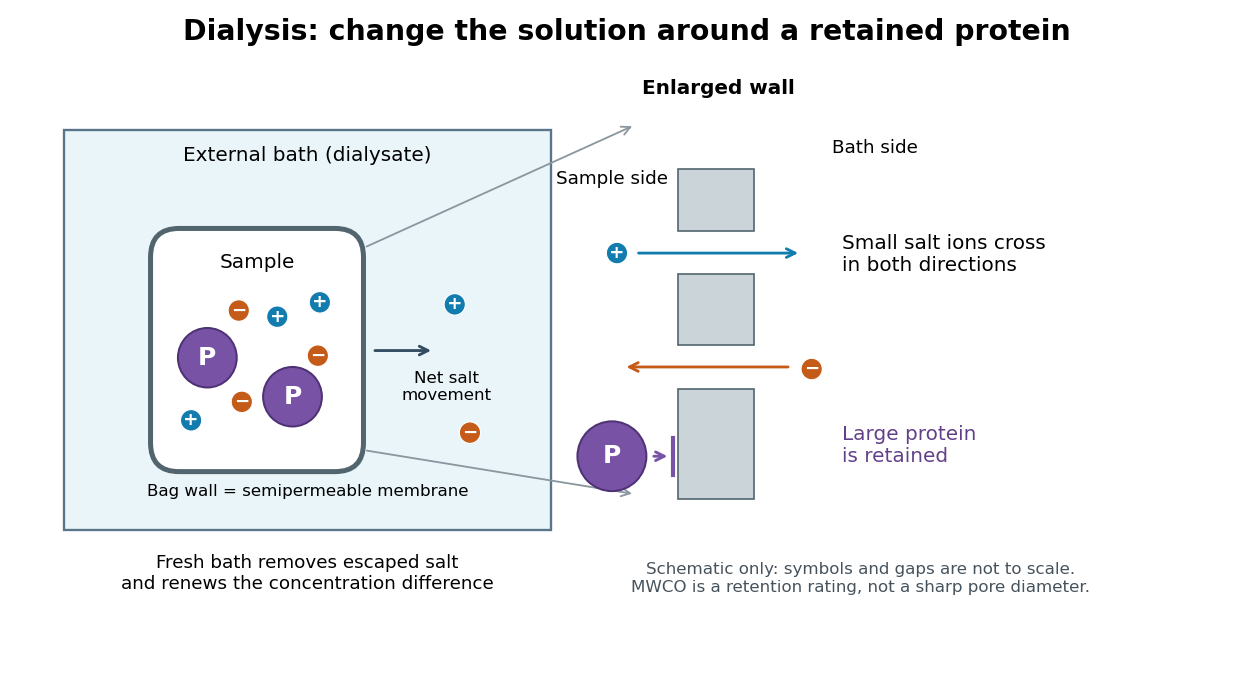
The striking feature is that the retained protein does not have to be captured and released again to change its surroundings. However, retention is conditional on the semipermeable membrane and the particular macromolecule, and dialysis is poorly suited to separating proteins of nearly the same size. The molecular weight cut-off is a nominal retention rating, not a sharp geometrical boundary.
Methods for preparing and probing chemical atoms in atomic physics.
An assay that estimates protein concentration from a colour-producing chemical reaction, measured by absorbance and compared with known protein reference samples. Bovine serum albumin is commonly used as the reference protein. The readout estimates protein content rather than identifying each protein in a mixture.
In suppressed-carrier amplitude modulation, a message multiplies a carrier without adding a large standalone carrier term. The double-sideband form is , with spectrum . Multiplying by a phase-aligned local oscillator and low-pass filtering recovers under appropriate bandwidth separation. A phase error instead scales the recovered message by . Thus ordinary envelope detection is not generally enough; coherent carrier phase information matters. Suppressing the carrier changes power allocation without removing both sidebands.
Pinned article: Introduction to the OurBigBook Project
Welcome to the OurBigBook Project! Our goal is to create the perfect publishing platform for STEM subjects, and get university-level students to write the best free STEM tutorials ever.
Everyone is welcome to create an account and play with the site: ourbigbook.com/go/register. We belive that students themselves can write amazing tutorials, but teachers are welcome too. You can write about anything you want, it doesn't have to be STEM or even educational. Silly test content is very welcome and you won't be penalized in any way. Just keep it legal!
Intro to OurBigBook
. Source. We have two killer features:
- topics: topics group articles by different users with the same title, e.g. here is the topic for the "Fundamental Theorem of Calculus" ourbigbook.com/go/topic/fundamental-theorem-of-calculusArticles of different users are sorted by upvote within each article page. This feature is a bit like:
- a Wikipedia where each user can have their own version of each article
- a Q&A website like Stack Overflow, where multiple people can give their views on a given topic, and the best ones are sorted by upvote. Except you don't need to wait for someone to ask first, and any topic goes, no matter how narrow or broad
This feature makes it possible for readers to find better explanations of any topic created by other writers. And it allows writers to create an explanation in a place that readers might actually find it.
Figure 1. Screenshot of the "Derivative" topic page. View it live at: ourbigbook.com/go/topic/derivativeVideo 2. OurBigBook Web topics demo. Source. - local editing: you can store all your personal knowledge base content locally in a plaintext markup format that can be edited locally and published either:This way you can be sure that even if OurBigBook.com were to go down one day (which we have no plans to do as it is quite cheap to host!), your content will still be perfectly readable as a static site.
- to OurBigBook.com to get awesome multi-user features like topics and likes
- as HTML files to a static website, which you can host yourself for free on many external providers like GitHub Pages, and remain in full control

Figure 2. You can publish local OurBigBook lightweight markup files to either OurBigBook.com or as a static website.
Figure 3. Visual Studio Code extension installation.
Figure 5. . You can also edit articles on the Web editor without installing anything locally. Video 3. Edit locally and publish demo. Source. This shows editing OurBigBook Markup and publishing it using the Visual Studio Code extension. 
- Infinitely deep tables of contents:




All our software is open source and hosted at: github.com/ourbigbook/ourbigbook
Further documentation can be found at: docs.ourbigbook.com
Feel free to reach our to us for any help or suggestions: docs.ourbigbook.com/#contact