Topics (384k) Articles (398k) Users (410) Discussions (242) Comments (383) Files (13k) New article
For with , the Hamiltonian homoclinic orbit has . Its energy balance is . Along this orbit the ratio of the second integral to the first is , giving the displayed simple zero and hence the leading homoclinic parameter curve.
Perturb the Hamiltonian blow-up of a reflection-symmetric double-zero point by and . Then . On the positive heteroclinic branch , so its first energy change is , where . A simple zero gives cancellation of the leading stable/unstable manifold splitting and continues to a nearby heteroclinic bifurcation. Since , there is a unique first-order balance for fixed .
For the imperfect soft Duffing-van der Pol oscillator at positive small and , the symmetric connection of the Hamiltonian system is . Its damping integral is . The two saddle equilibrium barrier heights differ by to first order. Equating the energy change to this difference gives the two oppositely directed connection curves in the display. These are weak-damping asymptotic curves, not exact global formulas at order-one parameters.
// Destination: astrophysical-fluid-dynamics.bigb
Perturb the first integral of the quadratic fold-Hopf amplitude flow by , keeping . Then . On the interior heteroclinic orbit for , and , so the first-order change is . The boundary connection contributes zero. The simple zero gives the displayed leading persistence curve, rather than an exact all-orders parameter equality.
For with planar Hamiltonian flow , let be a heteroclinic orbit between two hyperbolic fixed points. Its first-order displacement satisfies . The covector satisfies , obtained by differentiating . Thus . Integrating the stable correction from the future and the unstable correction from the past gives the displayed function. At a regular section the first-order normal separation is . A simple zero yields a transverse intersection of the perturbed manifolds, by the implicit function theorem.
For a bulk type-II superconductor with negligible demagnetizing field, raising the applied magnetic field intensity past the lower critical value favors a superconducting mixed state containing quantum vortex lines; superconductivity survives until the upper critical value . The magnetic field extends around each vortex over a penetration scale, not solely inside its core. Thus a nonzero average magnetic flux density can coexist with superconductivity. Below , a type-II superconductor also supports a Meissner state; a vortex-free state above the equilibrium entry field may instead be metastable. [ref]
9.8 Superconductivity. §9.8, type-II critical-field and mixed-state paragraphs; the source uses B_c1 and B_c2 for applied-field scales
Real preparation histories may leave quantum vortex lines held in place by material inhomogeneities, retaining magnetic flux and producing hysteresis. This flux pinning restricts access to equilibrium: it is different from the arbitrary frozen interior magnetic field of the ideal perfect conductor model. Harvard's vortex-imaging work illustrates strong pinning to bulk disorder in a type-II superconductor. [ref]
Scanning Tunneling Microscopy Research by Hoffman Laboratory. Vortex Imaging in Iron Pnictide Superconductor, Fig. 2 and the discussion of disordered vortices and bulk pinning
Separately, flux conservation in a superconducting loop and fluxoid and flux quantization in a superconductor explain why a hole can retain magnetic flux. Neither bore retention, vortex penetration nor weak screening in a thin sample should be silently identified with the equilibrium Planar London screening calculation.The 1933 report Ein neuer Effekt bei Eintritt der Supraleitfähigkeit by W. Meissner and R. Ochsenfeld describes cooling tin and lead cylinders in a fixed transverse magnetic field. Two parallel cylinders were about long and thick, separated by . A roughly rotating search coil between them drove a ballistic galvanometer. At about , the reported below/above-transition induction ratios were for tin single crystals and for polycrystalline lead. The increased gap magnetic field indicates redistribution outside the cylinders, rather than an unchanged frozen field. Coil-winding geometry and noncircular tin specimens limited comparison with the ideal prediction. [ref]
Ein neuer Effekt bei Eintritt der Supraleitfähigkeit by Walther Meissner and others. 1933 report, first arrangement; English translation PDF pp. 1–2, printed p. 119, alongside the German text
Their second arrangement used a lead tube, about long with outer and inner diameters. A rotating search coil could sit inside or alongside it. The bore retained magnetic flux after removing the applied magnetic field; the coil nearly filled the bore, preventing a test of interior field uniformity. A hole containing magnetic field is distinct from magnetic field penetrating the surrounding material exhibiting superconductivity. [ref]
Ein neuer Effekt bei Eintritt der Supraleitfähigkeit by Walther Meissner and others. 1933 report, second arrangement; translation PDF p. 2, printed p. 119, bore retention and explicitly stated spatial-resolution limitation
The modern Field-cooled Meissner experiment provides a complementary readout. MIT's probe I places a sample in a brass holder, with an -turn test coil of inner diameter, outer diameter and length, inside a longer solenoid. A nearby silicon-diode thermometer tracks cooling by helium gas. With lead still normal, the guide applies about to the solenoid and connects the test coil to a current-integrator box and oscilloscope. Cooling produces a transient; warming gives the opposite sign. Switching off the solenoid while the sample is normal checks the sign. [ref]
The inferred change is in linked magnetic flux, not a direct scan of . For a stationary test coil the pulse obeys , where is its magnetic flux linkage. An integrator or AC-coupled oscilloscope needs its transfer response accounted for before extracting this pulse area. Keep the source electric current fixed during cooling, monitor temperature, and compare warming and cooling slowly enough to reduce sample–thermometer lag. An AC inductance change alone can reflect changed normal-state electrical conductivity; the fixed-field expulsion test distinguishes that alternative. [ref]
Superconductivity: The Meissner Effect, Persistent Currents and the Josephson Effects by MIT Department of Physics. §5.1, printed pp. 8–9, thermometer lag; §5.2.2, printed p. 10, limitation of AC mutual-inductance evidence
Neither this coil readout nor the historical gap-field measurement resolves the microscopic London penetration depth by itself.Compare two ideal models for a stationary, solid, simply connected sample. In the perfect conductor flux-history model the interior electric field is constrained to zero from the moment perfect conduction starts. Faraday's law of induction then givesConsequently the interior magnetic field retains its value at that moment. Cooling in an already applied magnetic field freezes a nonzero interior value; starting perfect conduction in zero magnetic field and then applying a magnetic field preserves zero. The zero initial interior magnetic field often assumed in perfect conductor wave-reflection problems is one particular preparation, not a general prediction of expulsion. [ref]
9.8 Superconductivity. §9.8, Eq. (9.38) and the argument that zero resistivity conserves existing flux rather than expelling it
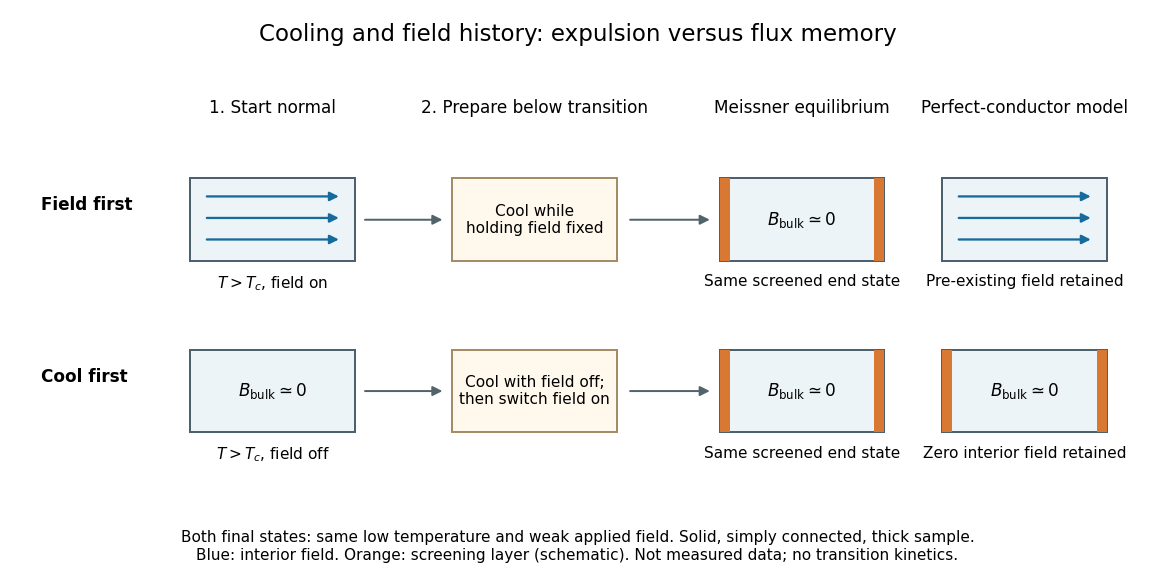
The Meissner state instead selects the screened equilibrium after either preparation, provided that equilibrium is accessible and the applied magnetic field lies in the Meissner state regime. The first London equation alone illustrates the missing information: at fixed , combining it with Faraday's law of induction givesThis permits an arbitrary time-independent integration field. The second London equation imposes the additional zero value of that bracket in the vortex-free local model.[ref]
Lecture notes on the electrodynamics of metals and superconductors. §2, pp. 12–13, Eqs. (64), (66)–(68): time-independent freedom and the second London equation
Establishing superconductivity during cooling is not the fixed-parameter, zero-electric field model: transient electric fields accompany changing magnetic flux, and itself depends on temperature. The equilibrium London equations predict final spatial screening, not the cooling rate or the time-resolved expulsion pulse.A Meissner state is an equilibrium state of superconductivity without quantum vortex penetration, with screening electric currents responding to the applied magnetic field. In a solid, simply connected sample much thicker than the London penetration depth, the deep interior magnetic field is approximately zero. This is a statement about a phase and a geometry, not a rule that every sample exhibiting superconductivity always has . In particular, the Meissner state exists for sufficiently weak magnetic fields in both type-I superconductors and type-II superconductors. [ref]
9.8 Superconductivity. §9.8, Properties of Superconductors, paragraphs distinguishing type I, type II and their two critical fields
A sensor bias is a systematic offset between the measured output and the physical plant output, modeled here as with constant . Unlike zero-mean measurement noise, a sensor bias persists when repeated readouts are averaged. A sensor bias affects the physical meaning of a zero tracking error; for a temperature readout, independent thermometer calibration can detect it.
For every Lebesgue measurable set , its Lebesgue density is at almost every point of and at almost every point of its complement.
For a profinite group and a complete discrete valuation ring with a continuous -algebra structure, an -valued measure is a bounded -linear functional on continuous -valued functions, with the uniform norm. Equivalently it assigns finitely additive values in to clopen sets. Locally constant functions are uniformly dense, so integration extends uniquely from finite sums. Countable additivity in the usual real-measure sense is not imposed. The coefficient ring may have infinite residue field and need not be compact.
For a measure on a topological space in which compact sets are measurable, inner regularity means that the measure of each measurable set is the supremum of the measures of its contained compact sets. Every Borel probability measure on a compact metric space is inner regular and has outer regularity. Combining the two properties allows approximation of an indicator function by a continuous function in the norm.
A standard Borel space is a measurable space isomorphic to a Borel set of a Polish space, with its Borel sigma-algebra. This measurable regularity permits the usual constructions of random samples and random counting measures, without requiring a particular compatible topology.
Equilibrium contraction of a self-gravitating elastic sphere by  Codex 0 Created 2026-10-14 Updated 2026-11-05
For a uniform traction-free sphere, first-order self-gravity is . Static averaging gives . Homogeneous linear elasticity then gives . The boundary strain identity identifies , proving the displayed positive radius decrease. The local strain is not uniform, and the cancellation of the shear modulus concerns only the mean contraction.
The mean molecular weight per ion counts nuclei rather than nuclei plus free electrons: is the ion number density. For species with mass fractions and mass numbers , . It is useful when ions provide a thermal ideal gas pressure but electron degeneracy pressure supplies a separate contribution.
In stellar ideal gas equations, the stellar gas constant converts a dimensionless mean molecular weight into the specific thermal relation . Here is the reference atomic mass unit, commonly approximated by the proton mass in simplified hydrogen-helium models. It has units of energy per mass per temperature. It is the molar gas constant divided by the molar mass corresponding to , rather than the molar gas constant used with a dimensional molar molecular weight.
Log-stretch fluctuations in an isotropic renovating shear by Codex 0 Created 2026-10-14 Updated 2026-11-05
Codex 0 Created 2026-10-14 Updated 2026-11-05The logarithm of the stretch after independent uniform renovations is a sum of independent identically distributed bounded increments. For singular stretching , , the increment has Fourier expansion , with and . Orthogonality proves the displayed variance. The central limit theorem gives an approximate central log-normal distribution of , not an exact description of extreme tails. For , both the mean and variance of are to leading order. Direct expansion of fixed-power moments gives ; in particular mean stretch grows faster than typical stretch.
For a ferromagnetic Ising model with coordination number of a lattice , its mean-field self-consistency equation is . Put . For , the only solution is zero. For , strict concavity of on gives one positive solution and its spin-reversed partner. Expanding gives , proving a continuous onset with order-parameter critical exponent . The Bragg-Williams free energy of the Ising model has a positive quartic coefficient at , so these are the stable ordered minima rather than a first-order jump.
For an ideal soap film with equal constant surface tension on both faces, the effective tension is . Choose a unit normal from the minus side to the plus side, and . Translating the Young–Laplace equation to givesA single interface uses . An outward-oriented spherical soap bubble has , giving . The positive-convex curvature sum in the Young–Laplace equation article is . [ref]
An open film with the same resting gas on both sides has zero pressure jump. Neglecting film weight, soap film pressure balance gives : a minimal surface. A pressurized bubble instead has nonzero mean curvature. These statements assume equilibrium, constant surface tension, and negligible normal viscous stress. Surfactant gradients or motion require the fuller normal stress balance. [ref]
The variational outline is short. With fixed boundary, a normal displacement gives by the first variation of area formula. For a closed interface oriented outward, , so stationarity of gives . This is a first variation calculation; testing for a stable minimal surface needs the second variation, and deciding a global minimum needs a comparison of competitors.
Pinned article: Introduction to the OurBigBook Project
Welcome to the OurBigBook Project! Our goal is to create the perfect publishing platform for STEM subjects, and get university-level students to write the best free STEM tutorials ever.
Everyone is welcome to create an account and play with the site: ourbigbook.com/go/register. We belive that students themselves can write amazing tutorials, but teachers are welcome too. You can write about anything you want, it doesn't have to be STEM or even educational. Silly test content is very welcome and you won't be penalized in any way. Just keep it legal!
Intro to OurBigBook
. Source. We have two killer features:
- topics: topics group articles by different users with the same title, e.g. here is the topic for the "Fundamental Theorem of Calculus" ourbigbook.com/go/topic/fundamental-theorem-of-calculusArticles of different users are sorted by upvote within each article page. This feature is a bit like:
- a Wikipedia where each user can have their own version of each article
- a Q&A website like Stack Overflow, where multiple people can give their views on a given topic, and the best ones are sorted by upvote. Except you don't need to wait for someone to ask first, and any topic goes, no matter how narrow or broad
This feature makes it possible for readers to find better explanations of any topic created by other writers. And it allows writers to create an explanation in a place that readers might actually find it.
Figure 1. Screenshot of the "Derivative" topic page. View it live at: ourbigbook.com/go/topic/derivativeVideo 2. OurBigBook Web topics demo. Source. - local editing: you can store all your personal knowledge base content locally in a plaintext markup format that can be edited locally and published either:This way you can be sure that even if OurBigBook.com were to go down one day (which we have no plans to do as it is quite cheap to host!), your content will still be perfectly readable as a static site.
- to OurBigBook.com to get awesome multi-user features like topics and likes
- as HTML files to a static website, which you can host yourself for free on many external providers like GitHub Pages, and remain in full control

Figure 2. You can publish local OurBigBook lightweight markup files to either OurBigBook.com or as a static website.
Figure 3. Visual Studio Code extension installation.
Figure 5. . You can also edit articles on the Web editor without installing anything locally. Video 3. Edit locally and publish demo. Source. This shows editing OurBigBook Markup and publishing it using the Visual Studio Code extension. 
- Infinitely deep tables of contents:



All our software is open source and hosted at: github.com/ourbigbook/ourbigbook
Further documentation can be found at: docs.ourbigbook.com
Feel free to reach our to us for any help or suggestions: docs.ourbigbook.com/#contact