Topics (384k) Articles (398k) Users (410) Discussions (242) Comments (383) Files (13k) New article

Rice University's ELEC 332: In the Lab makes the model experimentally testable. Preparation resets the spectrum analyzer and observes an unmodulated generator output on it and an oscilloscope. A Wavetek function generator supplies external modulation. The specified carrier and message separate three peaks. Marker readouts give frequency and level; narrowing resolution bandwidth shows how the instrument broadens a line.[ref]
ELEC 332: In the Lab, Rice University. ELEC 332: In the Lab, Part 1, “Initial Configuration”, “Initializing”, “Observing a signal”, “Changing the bandwidth”, “Using the marker” and “Resolving signals”
Part 3 uses an SA602 analog multiplier module. The message generator also triggers the oscilloscope; multiplier output feeds both displays. A no-offset module supplies a suppressed-carrier control. Replacing it with the offset-adding module restores the carrier; varying levels tests signal distortion. Finally a radio receives the conventional AM transmission, and varying message frequency checks that the heard tone belongs to this source. These are prescribed observations, not reported measurements.[ref]
ELEC 332: In the Lab, Rice University. ELEC 332: In the Lab, Part 3, module descriptions and “Connect the components” through “AM transmitter”: input/output connections, offset control, level sweep and receiver check
Calibration matters: verify generator voltage at the connected input, distinguish peak from peak-to-peak amplitude and root mean square, and check analyser units and loading before comparing heights with or power with . The unmodulated carrier is a reference control. Limited resolution can merge sidebands; generator harmonics can add peaks. Rice explicitly demonstrates both limitations in Part 1.[ref]
ELEC 332: In the Lab, Rice University. ELEC 332: In the Lab, Part 1, “Resolving signals”: message-generator harmonic distortion and unresolved sidebands when the message frequency is reduced
A complementary University of Kansas procedure, A.2 - Amplitude Modulation, calibrates the added carrier and the suppressed-carrier product separately to peak-to-peak before recombining them. It holds the carrier fixed, varies modulation depth, reads envelope extrema and carrier-to-sideband power differences, then connects the demodulator and adjusts its tunable low-pass filter for recovery, comparing the output with the message. These are setup targets and comparison instructions, not measured results.[ref]
The inference combines time and frequency spectrum readouts: correct sideband spacing tests frequency translation, relative heights test modulation depth, and the recovered message tests the detector. Hardware clipping, receiver filtering and noise can spoil recovery even at . Conversely failure of an envelope detector at does not demonstrate failure of a synchronized multiplier receiver. The two diagrams above illustrate the stipulated linear model only.
Coherent demodulation recovers a message by multiplying the received signal by a reference carrier wave of the same frequency and known relative wave phase, then passing the result through a low-pass filter. For the ideal AM model and reference ,A unity-gain ideal low-pass filter passing and but rejecting and leaves . Such a separating cutoff exists because . At , subtraction of recovers exactly for any finite , including overmodulation, provided the transmitter and channel preserve this linear waveform. This is the signed factor, not its absolute value.
A constant phase error scales the recovered message by : a radian error halves it, and a error removes it. A known error with nonzero cosine can be compensated in gain; a frequency mismatch makes the relative wave phase drift and no longer gives constant attenuation. The lecture illustrates synchronous multiplication, filtering and phase error.[ref]
Continuous-Time Modulation by Alan V. Oppenheim. Signals and Systems, Lecture 13: Continuous-Time Modulation, transparencies 13.10–13.11 on pp. 13-7–13-8 and 13.16 on p. 13-10: multiplier, low-pass separation and phase-error cosine factor
An envelope detector extracts the slowly varying nonnegative wave envelope of a rapid carrier wave. In a simple electrical version a diode charges a capacitor near positive carrier peaks and an attached resistor discharges it between peaks. When , ideal envelope extraction gives ; removing the constant leaves . This permits recovery without a synchronized carrier reference. Carrier injection thus trades transmitted power for simplicity.[ref]
Continuous-Time Modulation by Alan V. Oppenheim. Signals and Systems, Lecture 13: Continuous-Time Modulation, printed p. 13-2 and transparencies 13.17–13.19 on pp. 13-11–13-12: asynchronous recovery and injected carrier
A working peak detector needs margins as well as : should comfortably exceed the diode's forward-voltage scale and noise, and the time constant must suppress carrier ripple while following a falling wave envelope. The coarse scale window isA time constant that is too short leaves carrier ripple; one that is too long makes the discharging capacitor fall more slowly than the envelope. In the ideal zero-drop, continuous-tracking approximation, following a falling requires . For ,Differentiating the ratio locates its maximum at . This original slope check explains why operation near is demanding even before overmodulation: the upper bound tends to zero while the need to smooth carrier cycles persists. It is an approximate circuit criterion, not a guarantee in the presence of diode drops, loading or noise. At there is no varying message to track; at ideal envelope extraction remains algebraically possible, but the simple detector has no positive trough margin.
For , even an ideal noiseless envelope detector returns . Removing its mean or its original offset cannot restore the discarded sign. A more elaborate receiver can use the retained wave phase through coherent demodulation.
For this single-tone AM model, overmodulation means . The signed factor becomes negative whenever . On such intervals,The sign reversal is a radian shift of the carrier's wave phase. At each zero of , the wave envelope vanishes and that phase is undefined. The waveform itself is continuous: the formula has not clipped it or created extra spectral lines.
At , sign changes occur at message phases and within each cycle. At the trough , the desired signed factor is , whereas its nonnegative wave envelope is . Ideal envelope recovery followed by subtraction of would give there, rather than the desired message voltage . This is loss of polarity in the detector, not loss of the message from the full modulated signal. Actual transmitter clipping is a separate signal distortion that can generate additional spectral components.
Apply the product-to-sum formula to the voltage model:The carrier wave component has peak voltage amplitude ; each AM sideband has peak voltage amplitude . These are temporal frequency spectrum components, unlike the spatial sidebands used in pattern stability. The separation makes the three positive angular frequencies distinct, and keeps the lower one positive. The span between sidebands is , or in hertz when ; this is the single-tone span, not a universal signal bandwidth for arbitrary messages.
A one-sided cosine-amplitude display assigns to the carrier line. A two-sided complex-exponential expansion instead assigns at each of , and at each of the four sideband locations. The signal is identical; confusing the conventions creates a factor-of-two error. An ideal infinite-duration sinusoid gives a spectral line. A finite recording and finite analyser resolution broaden the displayed peak.
For a voltage applied across an ideal resistor of electrical resistance , a component of peak voltage has root mean square voltage and mean power by Ohm's law. ThusThe proof of additivity is to average over a long time: cross-products of distinct frequencies have zero mean. Consequently the whole signal's root mean square voltage is , not simply its maximum wave envelope divided by . The carrier-component remains unchanged as varies.
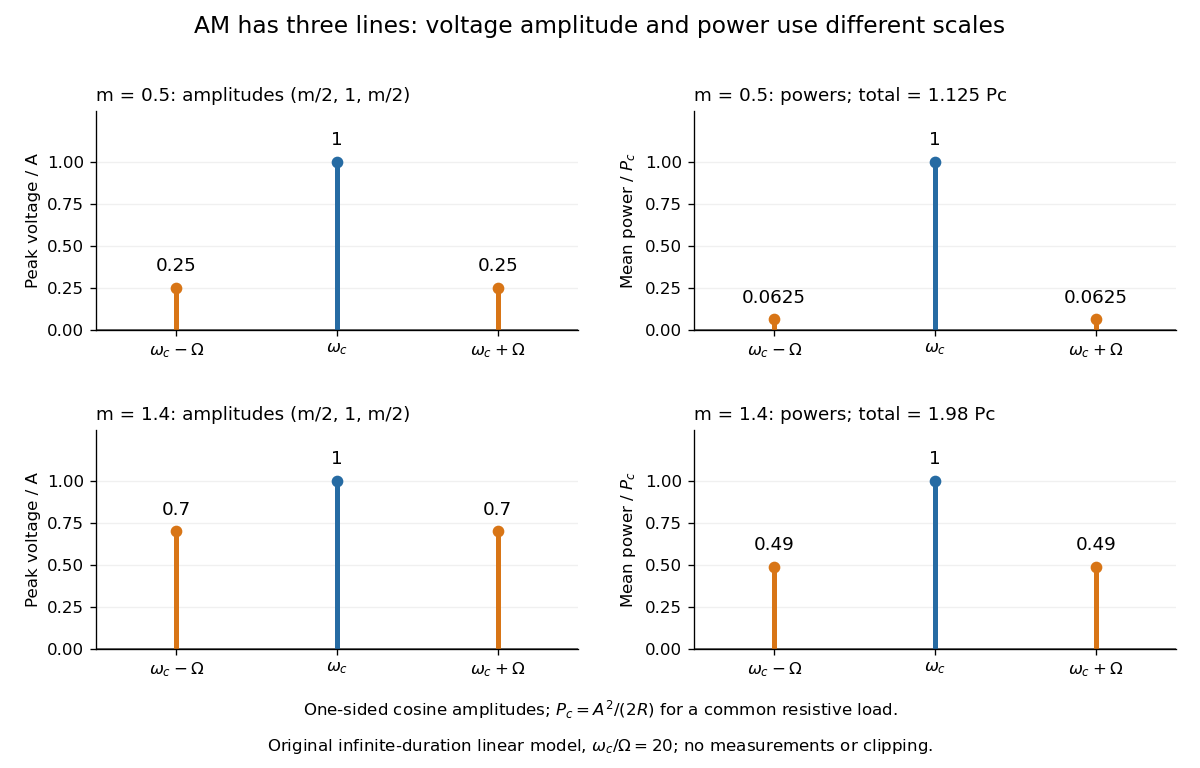
With , and , the carrier supplies and each peak sideband supplies , giving total. At each sideband is peak and supplies , giving total. Neither case changes the carrier-component power.
The fraction of mean power in the message-bearing sidebands is . It is at and at . Conventional AM spends the remaining power on a carrier that enables an inexpensive envelope detector. Increasing beyond increases this fraction in the linear model but breaks ordinary envelope recovery. Removing the carrier gives suppressed-carrier amplitude modulation and changes the receiver requirement.
In the single-sinusoid AM voltage model, is the peak fractional excursion of the signed multiplying factor from its mean value . At there is only the carrier wave; at its multiplying factor ranges from to ; at it just touches zero. For , the wave envelope extrema areThe last equality follows by adding and subtracting the first two. An oscilloscope estimate uses local carrier peaks near the message extrema and needs enough carrier cycles to approximate those bounds. Consistent local peak-to-peak amplitude readings give the same ratio because their common factor of two cancels. Mixing a peak reading with a peak-to-peak reading does not.
For and , the wave envelope ranges from to , giving . These are model values. At , the signed factor has minimum , but the nonnegative wave envelope reaches zero at its sign changes; the extrema formula would misleadingly report . It cannot measure the true depth of overmodulation from the folded envelope alone.
A terminating check returning whether two values match under a specified relation. Mathematical equality is one such relation; a chosen equivalence relation can instead express matching keys. Linear search only needs this check, whereas binary search also uses relative order. The cost of an equality test depends on the representation and implementation of its operands.
Given a fixed sequence of compatible matrices , choose a binary parenthesization of that minimizes the number of scalar multiplications in ordinary matrix multiplication. The order of the matrices is fixed: parenthesization changes the grouping, not the operand order. Associativity preserves the product while intermediate matrix dimensions change the cost. The possible binary groupings are counted by the Catalan number for .
Spectroscopy investigates how a system emits, absorbs or scatters signals as a function of frequency, wavelength or energy. A spectrum can identify transition energies, response strengths and line shapes. In atomic spectroscopy, a photon connects two energy levels through ; in inelastic scattering, both energy and momentum transfers can matter.
A simple optical experiment passes source light through a sample, disperses the transmitted light and compares it with a reference. An absorption line identifies reduced transmission over a spectral interval, but its depth also depends on the sample amount and instrumental response. Wavelength calibration and energy resolution distinguish an intrinsic feature from a shifted or broadened recording. The inference therefore uses a response model as well as a list of line positions.
Metrology asks what a measurement means and how closely it can be reproduced. An instrument reading becomes useful when it is related to a reference through measurement calibration, with a stated measurement uncertainty. Measuring a changing object against a changing ruler makes the problem especially clear: an observed difference contains the responses of both.
The history of mathematics studies how mathematical problems, methods, notation and standards of explanation developed. A modern theorem statement can hide the concrete problem that first motivated it and the assumptions introduced only later.
The development of calculus illustrates the difference: effective rules for tangents and quadratures preceded modern definitions of limits and continuity. Historical claims about priority should therefore identify the actual statement, proof and publication being compared. Original papers and contemporary editions also reveal when familiar notation or a general theorem was absent from an earlier discovery.
Chemical engineering designs processes that transform, separate and transport materials. It combines mass balance, energy balance, thermodynamics, reaction kinetics and transport phenomena. A reactor's desired chemical conversion is only one part of a process: mixing, heat removal, separation and recycling determine whether that conversion can be maintained at useful scale. Scaling a small vessel up changes surface-to-volume ratios and transport distances, so multiplying every dimension does not preserve all operating behaviour.
A resistor with a movable contact that selects a point along its resistive path. In the Thévenin measurement experiment, a contact and one end provide an adjustable resistive electrical load.
A negative ratio of terminal voltage to entering electric current, or a negative differential slope in a more general terminal relation. A linear dependent electrical source can produce a negative Thévenin resistance without any of the network's ordinary resistors having a negative value.
An ideal source whose electric potential difference or electric current is controlled by a specified voltage or electric current in the electrical circuit. Thévenin source suppression retains its linear control relation.
An ideal current source prescribes an electric current; its electric potential difference is determined by the connected electrical circuit. A dependent electrical source can prescribe a current controlled by another circuit variable instead.
An ideal voltage source prescribes an electric potential difference; its electric current is determined by the connected electrical circuit. A dependent electrical source can prescribe a voltage controlled by another circuit variable instead.
An ideal voltage source or current source whose prescribed value is not controlled by a variable in the connected electrical circuit.
The external electrical circuit attached to the specified output terminals. In a Thévenin terminal response, its entering electric current is the network's delivered electric current.
Pinned article: Introduction to the OurBigBook Project
Welcome to the OurBigBook Project! Our goal is to create the perfect publishing platform for STEM subjects, and get university-level students to write the best free STEM tutorials ever.
Everyone is welcome to create an account and play with the site: ourbigbook.com/go/register. We belive that students themselves can write amazing tutorials, but teachers are welcome too. You can write about anything you want, it doesn't have to be STEM or even educational. Silly test content is very welcome and you won't be penalized in any way. Just keep it legal!
Intro to OurBigBook
. Source. We have two killer features:
- topics: topics group articles by different users with the same title, e.g. here is the topic for the "Fundamental Theorem of Calculus" ourbigbook.com/go/topic/fundamental-theorem-of-calculusArticles of different users are sorted by upvote within each article page. This feature is a bit like:
- a Wikipedia where each user can have their own version of each article
- a Q&A website like Stack Overflow, where multiple people can give their views on a given topic, and the best ones are sorted by upvote. Except you don't need to wait for someone to ask first, and any topic goes, no matter how narrow or broad
This feature makes it possible for readers to find better explanations of any topic created by other writers. And it allows writers to create an explanation in a place that readers might actually find it.
Figure 1. Screenshot of the "Derivative" topic page. View it live at: ourbigbook.com/go/topic/derivativeVideo 2. OurBigBook Web topics demo. Source. - local editing: you can store all your personal knowledge base content locally in a plaintext markup format that can be edited locally and published either:This way you can be sure that even if OurBigBook.com were to go down one day (which we have no plans to do as it is quite cheap to host!), your content will still be perfectly readable as a static site.
- to OurBigBook.com to get awesome multi-user features like topics and likes
- as HTML files to a static website, which you can host yourself for free on many external providers like GitHub Pages, and remain in full control

Figure 2. You can publish local OurBigBook lightweight markup files to either OurBigBook.com or as a static website.
Figure 3. Visual Studio Code extension installation.
Figure 5. . You can also edit articles on the Web editor without installing anything locally. Video 3. Edit locally and publish demo. Source. This shows editing OurBigBook Markup and publishing it using the Visual Studio Code extension. 
- Infinitely deep tables of contents:



All our software is open source and hosted at: github.com/ourbigbook/ourbigbook
Further documentation can be found at: docs.ourbigbook.com
Feel free to reach our to us for any help or suggestions: docs.ourbigbook.com/#contact